
Rounding on a Number Line: Which Method Should You Use? 🎯
Why Rounding Trips Students Up More Than It Should
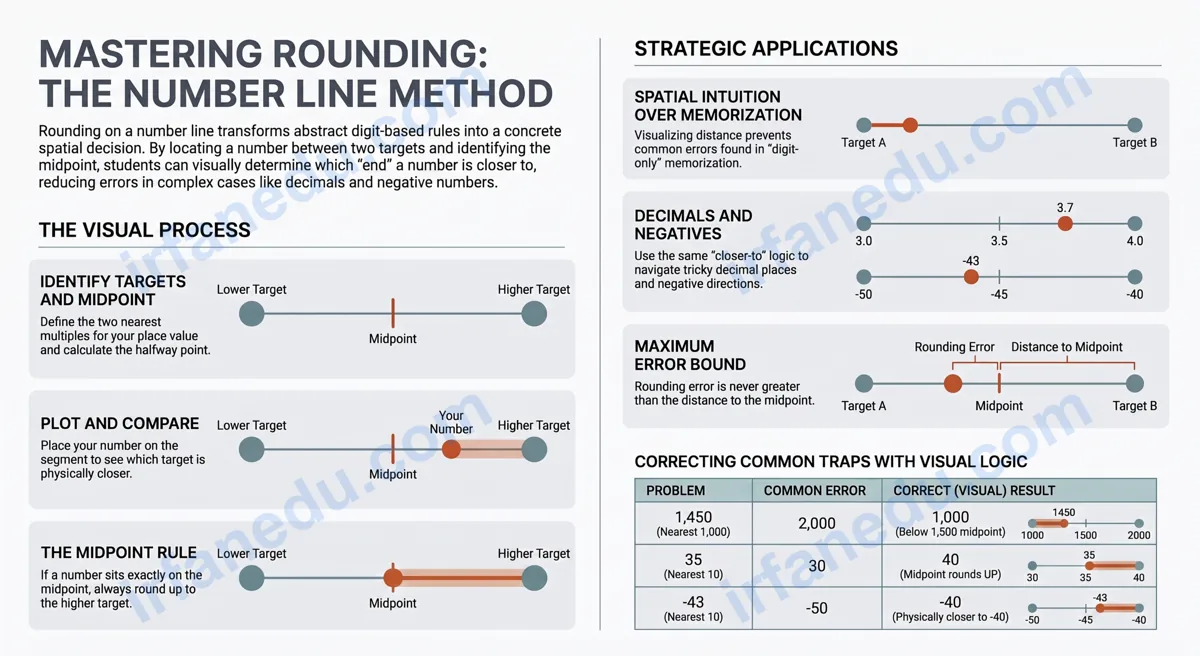
Rounding on a number line means locating a number between two rounding targets, finding the midpoint, and choosing the closer target. If the number is at or above the midpoint, round up. If it is below, round down. The number line turns an abstract rule into a visible, spatial decision.
Most students learn rounding as a digit rule: “look at the next digit — if it’s 5 or more, round up.” That rule works, but it gives students no intuition for why it works. I have watched students apply the digit rule correctly on easy problems and then completely freeze when the number is something like 3.47 rounded to the nearest tenth, because they have no mental picture to fall back on.
The number line fixes that. It makes rounding a spatial judgment — “which end is this number closer to?” — and spatial thinking is something every student already has. In my experience teaching this concept across multiple grade levels, students who learn rounding visually first make far fewer errors on standardized tests than those who only memorize the digit rule.
In this guide you will learn:
- Exactly how to use a number line to round whole numbers and decimals
- A decision guide for choosing the right rounding method for each problem type
- The midpoint rule and why 5 always rounds up
- Common mistakes (with wrong-vs-right corrections)
- Real worked examples you can follow step by step
⚡ TL;DR – Quick Summary
- 🎯 Place your number between two rounding targets on a number line.
- 📍 The midpoint is always halfway — for tens, it ends in 5.
- ⬆️ At or above the midpoint = round up to the higher target.
- ⬇️ Below the midpoint = round down to the lower target.
- 🔢 Works for whole numbers, decimals, and negative numbers.
- ✅ The number line explains the digit rule — it does not replace it.
| Fact | Detail |
|---|---|
| What you need | Two rounding targets + a midpoint |
| Midpoint rule | Exactly at midpoint = always round UP |
| Works for | Whole numbers, decimals, negatives |
| Grade level | Grades 3–7 (and beyond for decimals) |
| Key digit to check | The digit immediately to the right of the rounding place |
| Common error | Rounding to the wrong place value |
What Is Rounding on a Number Line?
Rounding on a number line is a visual method for approximating a number to a specified place value. You draw a short segment of a number line, mark the two nearest multiples of your target place value at each end, find the midpoint, and then decide which end your number is closer to.
The formal definition: rounding is the process of replacing an exact number with a nearby value that is simpler or more convenient, based on a defined place value. The number line makes this definition concrete by showing distance as a literal physical gap.
For example, to round 47 to the nearest ten:
- The two nearest tens are 40 and 50.
- The midpoint is 45.
- 47 is above 45, so it is closer to 50.
- Answer: 50.
This is not a different answer from the digit rule — it is the same answer arrived at with genuine understanding.
🗺️ Decision Guide: Which Rounding Method Should You Use?
Not every rounding problem calls for the same approach. Here is a practical decision table I use when teaching students how to choose their method based on what the problem gives them.
| Situation | Best Method | Use Number Line? | Why |
|---|---|---|---|
| Learning rounding for the first time | Number line (visual) | YES — always | Builds spatial intuition before digit rules |
| Rounding a whole number to nearest 10 or 100 | Either method | YES — great here | Easy to draw; midpoint is obvious (ends in 5 or 50) |
| Rounding a decimal to nearest whole number | Number line (visual) | YES — highly recommended | Students confuse decimal place values; the line clarifies |
| Rounding to 2+ decimal places quickly | Digit rule | Optional | Drawing a line to hundredths is slow; digit rule is faster once understood |
| Rounding a negative number | Number line (visual) | YES — essential | Direction confusion is common; the line shows which end is “closer” |
| Checking your digit-rule answer | Number line (verify) | YES — as a check | Catches errors caused by misidentifying the rounding digit |
| Timed test with many rounding problems | Digit rule (fast) | Skip drawing | Speed matters; use mental number line only |
In my experience, the biggest mistake teachers make is introducing the digit rule first and the number line second — as if the line is a “baby” method you graduate from. I do it the opposite way. I start every rounding unit with a number line, spend two full lessons on it, and only then introduce the digit rule as a shortcut. Students who follow this sequence almost never confuse rounding direction, even on decimals. The decision table above is exactly what I hand out to students on day one so they know both tools and when to reach for each.
How Do You Round Any Number on a Number Line? (Step-by-Step)
Rounding on a number line follows the same five steps regardless of the number type. Master this sequence and you can handle whole numbers, decimals, and negatives with the same process.
- Identify the place value — Read the problem. Are you rounding to the nearest ten? Nearest whole number? Nearest tenth? This tells you the scale of your number line.
- Find your two rounding targets — These are the two nearest multiples of that place value on either side of your number. For 47 rounded to the nearest ten: targets are 40 and 50.
- Draw the number line segment — Mark the two targets at each end. Add tick marks if helpful, but you only strictly need the two endpoints and the midpoint.
- Mark the midpoint — The midpoint is always (lower target + upper target) ÷ 2. For 40 and 50: midpoint = 45. For 300 and 400: midpoint = 350.
- Plot your number and decide — Place your number on the line. At or above the midpoint = round up. Below the midpoint = round down.
📊 Visual Number Line Diagrams
🔶 Diagram 1 — Rounding 47 to the Nearest Ten
  40          45          50
  |-----+-----+-----+--●--|
  ↑              ↑        ↑
 Lower        Midpoint  Upper
 target         (45)    target

  47 is to the RIGHT of 45  →  Round UP  →  50
🔶 Diagram 2 — Rounding 3.6 to the Nearest Whole Number
  3.0         3.5         4.0
  |-----+-----+-----+--●--|
  ↑              ↑        ↑
 Lower        Midpoint  Upper
 target        (3.5)    target

  3.6 is to the RIGHT of 3.5  →  Round UP  →  4
🔶 Diagram 3 — The Midpoint Case: Rounding 35 to the Nearest Ten
  30          35          40
  |-----+-----●-----+-----|
  ↑              ↑        ↑
 Lower       MIDPOINT   Upper
 target     (exactly!)  target

  35 is EXACTLY at the midpoint  →  Convention: Round UP  →  40
🔶 Diagram 4 — Rounding a Negative: -43 to the Nearest Ten
  -50         -45         -40
  |-----+-----+--●--+-----|
  ↑              ↑        ↑
 Lower        Midpoint  Upper
 target        (-45)    target

  -43 is to the RIGHT of -45  →  Closer to -40  →  Round to -40
Worked Examples: Whole Numbers and Decimals
Let me walk through six fully solved examples. Each one shows the number line thinking, not just the answer.
Targets: 60 and 70. Midpoint: 65.
62 < 65, so 62 is below the midpoint.
Answer: 60 (round down — 62 is closer to 60).
Targets: 300 and 400. Midpoint: 350.
385 > 350, so 385 is above the midpoint.
Answer: 400 (round up — 385 is closer to 400).
Targets: 2 and 3. Midpoint: 2.5.
2.3 < 2.5, so 2.3 is below the midpoint.
Answer: 2 (round down — 2.3 is closer to 2).
Targets: 7.8 and 7.9. Midpoint: 7.85.
7.85 is exactly at the midpoint.
Answer: 7.9 (midpoint rule — always round up).
Targets: 1,000 and 2,000. Midpoint: 1,500.
1,450 < 1,500, so 1,450 is below the midpoint.
Answer: 1,000 (round down — many students wrongly round this up!).
Targets: 0.07 and 0.08. Midpoint: 0.075.
0.076 > 0.075, so 0.076 is above the midpoint.
Answer: 0.08 (round up).
❌ Common Rounding Mistakes — Wrong vs. Right
These are the five errors I see most often, along with exactly why each one happens and how to correct it.
| Mistake | Wrong Answer | Correct Answer | Why It Happens |
|---|---|---|---|
| Rounding 1,450 to nearest thousand as 2,000 | 2,000 | 1,000 | Student sees “5” in hundreds place and applies digit rule to the wrong digit |
| Rounding 35 to nearest ten as 30 | 30 | 40 | Student rounds down at midpoint instead of following the round-up convention |
| Rounding -43 to nearest ten as -50 | -50 | -40 | Student confuses “larger digit” with “closer to” for negative numbers |
| Rounding 2.95 to nearest tenth as 2.9 | 2.9 | 3.0 | Student rounds the tenths digit without noticing it carries over to whole number |
| Rounding 99 to nearest ten as 90 | 90 | 100 | Student does not consider that rounding up can cross a place-value boundary |
The negative-number rounding mistake is the one that surprises students the most. In my experience, drawing the number line is the only reliable fix. When a student can see that -43 sits between -40 and -50 on a line, and can physically see that -43 is only 3 units from -40 but 7 units from -50, the “closer to” answer becomes obvious. No amount of verbal explanation achieves the same result as that single visual.
🌍 Real-World Applications of Rounding
Rounding is not just a school exercise. It appears in everyday life constantly, and understanding the number line model helps students recognize it.
- Shopping: A price of $4.87 rounds to $5.00 for a quick mental budget check.
- Science measurements: A lab reading of 98.6°F is already a rounded value (body temperature varies slightly).
- Population statistics: News reports say “about 8 billion people” — that is 8,000,000,000 rounded to the nearest billion.
- Engineering tolerances: A bolt specified as 12mm might be manufactured to 11.97mm — engineers round to assess whether it is within tolerance.
- Digital displays: A phone battery showing “73%” is a rounded percentage of a continuous voltage measurement.
- Sports statistics: A batting average of .3333… is displayed as .333 — rounded to three decimal places.
💡 Unique Insight — What Most Rounding Guides Get Wrong
Almost every guide — including popular classroom resources — teaches the number line as a tool for checking the digit rule. That framing is backwards, and it has a measurable cost. The digit rule is a shortcut derived from the number line, not the other way around. When students learn the shortcut first, they treat the “5 rounds up” convention as an arbitrary rule to memorize, which is why they misapply it on edge cases like 1,450 or negative numbers. The number line makes the convention self-evident: 5 rounds up because it is the midpoint, and the midpoint has to go somewhere. Teach the line first. The digit rule then becomes a speed optimization, not a mystery.
A second insight most guides miss: the number line also reveals that rounding is a lossy operation with a predictable error bound. When you round to the nearest ten, your maximum error is always 5 (the distance to the midpoint). When you round to the nearest hundred, your maximum error is 50. This error-bound concept is foundational for understanding significant figures, measurement precision, and estimation — topics that appear in every science class from grade 6 onward.
🧠 Quick Quiz: Test Your Rounding Skills
Rounding Number Line Quiz
Q1. Round 73 to the nearest ten using a number line. The midpoint between 70 and 80 is 75. Where does 73 fall?
Q2. Round 4.5 to the nearest whole number. The midpoint between 4 and 5 is 4.5. What is the answer?
Q3. Round 2,340 to the nearest thousand. The targets are 2,000 and 3,000. The midpoint is 2,500. Where does 2,340 fall?
✏️ Practice Problems (Click to Reveal)
Problem 1: Round 156 to the nearest ten.
156 > 155, so 156 is above the midpoint.
Answer: 160
Problem 2: Round 8.2 to the nearest whole number.
8.2 < 8.5, so 8.2 is below the midpoint.
Answer: 8
Problem 3: Round 750 to the nearest hundred.
750 is exactly at the midpoint — apply the midpoint rule.
Answer: 800 (round up at midpoint)
Problem 4: Round -67 to the nearest ten.
-67 < -65 (more negative, so further left on the line).
-67 is closer to -70.
Answer: -70
Problem 5: Round 0.045 to the nearest hundredth.
0.045 is exactly at the midpoint — apply the midpoint rule.
Answer: 0.05 (round up at midpoint)
❓ Frequently Asked Questions
What is the midpoint rule for rounding on a number line?
How do you round to the nearest ten using a number line?
Can you use a number line to round decimals?
Why does 5 always round up?
What is the difference between rounding to the nearest ten and nearest hundred?
Sources & References
Reviewed by Dr. Irfan Mansuri. External links open in a new tab and are provided for further reading and verification.