
📐 Area of a Triangle Worksheet: Free Printable PDF + Full Answer Key
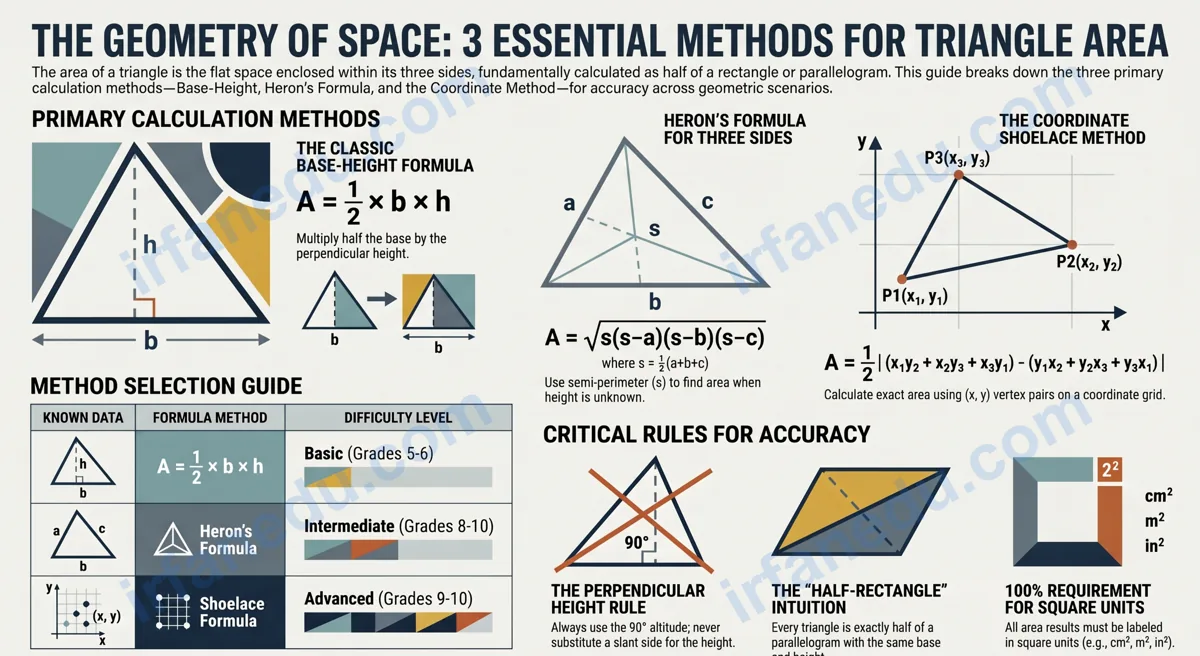
Imagine you are cutting a rectangular piece of paper exactly in half diagonally. The triangle you get is precisely half the rectangle — and that single image is the entire secret behind the area of a triangle formula. Once you see it that way, the formula A = ½ × base × height stops being something to memorize and starts being something you understand.
The area of a triangle is the amount of flat space it encloses. You calculate it with the formula A = ½ × base × height, where the height is always the perpendicular distance from the base to the opposite vertex — not a slant side. This rule applies to every triangle: acute, obtuse, or right-angled.
- Understand why the ½ × base × height formula works — not just how to use it.
- Apply three methods: base-height, Heron’s formula, and the coordinate method.
- Avoid the three most common mistakes students make on tests.
- Complete 10 graded practice problems and check your answers instantly.
📄 Free Printable PDF — 10 problems + full answer key, ready to print:
⚡ TL;DR – Quick Summary
- 📐 Area of a triangle = ½ × base × height (height must be perpendicular).
- 📏 For three known sides, use Heron’s formula: s = (a+b+c)/2, then A = √(s(s−a)(s−b)(s−c)).
- 🗺️ For coordinate vertices, use the shoelace formula to get exact area.
- ⚠️ Never use a slant side as the height — that is the #1 student error.
- 🖨️ This page includes 10 graded problems, an answer key, and a free PDF download.
- ✅ Right triangles are the easiest: the two legs are always the base and height.
| Feature | Detail |
|---|---|
| Main formula | A = ½ × base × height |
| When to use Heron’s formula | When you know all 3 sides but no height |
| When to use coordinate formula | When vertices are given as (x, y) points |
| Units | Always square units (cm², m², in², ft²) |
| Grade level (basic) | Grades 5–6 |
| Grade level (advanced) | Grades 8–10 |
| Common test topics | Missing base/height, Heron’s formula, coordinate geometry |
What Is the Area of a Triangle — and Why Does the Formula Work?
The area of a triangle is the total flat space enclosed within its three sides, measured in square units. The formula A = ½ × base × height works because every triangle is exactly half of a parallelogram (or rectangle).
Here is the intuition: take any triangle and duplicate it. Flip the copy and attach it to the original along one side. You always get a parallelogram. The area of a parallelogram is base × height, so the triangle is half of that — hence the ½.
🔷 Visual: Triangle = Half a Rectangle
  Rectangle (base × height):
  ┌─────────────────┐
  │                 │
  │    b × h        │
  │                 │
  └─────────────────┘

  Cut diagonally → two equal triangles:
  ┌─────────────────┐
  │ ╲               │
  │   ╲   Area      │
  │     ╲ = ½bh     │
  │       ╲         │
  └─────────────────┘

  Any triangle (not just right-angled):
         C
        /|
       / |  ← height h (perpendicular)
      /  |
  A──────B
     base b

  Area = ½ × b × h
The key word is perpendicular. The height h must form a 90° angle with the base. In an obtuse triangle, the height may fall outside the triangle — that is fine, the formula still works.
In my experience teaching geometry, students who understand the “triangle is half a rectangle” picture almost never make the slant-side mistake. I spend the first five minutes of every triangle lesson drawing that rectangle, cutting it diagonally, and letting students see it with their own eyes. The formula then writes itself. If your textbook jumps straight to A = ½bh without that picture, it is skipping the most important step.
Step-by-Step: How to Find the Area of a Triangle
Finding the area of a triangle takes exactly three steps when you have the base and height. Follow this process every time and you will not go wrong.
- Identify the base (b). Any side of the triangle can be the base. Choose the one whose corresponding height is given or easiest to measure.
- Find the perpendicular height (h). The height is the straight-line distance from the base to the opposite vertex, measured at a right angle (90°) to the base. It is NOT the slant side of the triangle.
- Apply the formula and label your units. Calculate A = ½ × b × h. Write the answer in square units (cm², m², in², etc.).
Method 2: Heron’s Formula (Three Sides Known)
When you know all three side lengths but no height, Heron’s formula gives the exact area without needing to draw anything.
- Label the sides a, b, and c.
- Calculate the semi-perimeter: s = (a + b + c) / 2
- Apply: A = √(s(s − a)(s − b)(s − c))
Method 3: Coordinate Formula (Vertices on a Grid)
When three vertices are given as coordinate pairs (x₁, y₁), (x₂, y₂), (x₃, y₃):
A = ½ |x₁(y₂ − y₃) + x₂(y₃ − y₁) + x₃(y₁ − y₂)|
The absolute value bars ensure the answer is always positive regardless of the order you list the vertices.
| What You Know | Formula to Use | Difficulty |
|---|---|---|
| Base and perpendicular height | A = ½ × b × h | ⭐ Basic |
| All three side lengths | Heron’s formula | ⭐⭐ Intermediate |
| Three coordinate vertices (x, y) | Coordinate / shoelace formula | ⭐⭐⭐ Advanced |
| Two sides + included angle | A = ½ × a × b × sin(C) | ⭐⭐⭐ Trigonometry |
3 Fully Worked Examples
These three examples mirror the difficulty levels on the worksheet below. Work through each one before you attempt the problems.
✏️ Example 1 — Basic (Base and Height Given)
Problem: A triangle has base = 10 cm and height = 6 cm. Find its area.
Step 1: Write the formula: A = ½ × b × h
Step 2: Substitute: A = ½ × 10 × 6
Step 3: Calculate: A = ½ × 60 = 30 cm²
Answer: 30 cm²
✏️ Example 2 — Intermediate (Heron’s Formula)
Problem: A triangle has sides a = 5, b = 6, c = 7. Find its area.
Step 1: Semi-perimeter: s = (5 + 6 + 7) / 2 = 18 / 2 = 9
Step 2: Apply Heron’s formula: A = √(9 × (9−5) × (9−6) × (9−7))
Step 3: A = √(9 × 4 × 3 × 2) = √216 = 6√6 ≈ 14.70 square units
Answer: 6√6 ≈ 14.70 square units
✏️ Example 3 — Advanced (Coordinate Formula)
Problem: A triangle has vertices A(0, 0), B(6, 0), C(2, 5). Find its area.
Step 1: Label: (x₁, y₁) = (0,0), (x₂, y₂) = (6,0), (x₃, y₃) = (2,5)
Step 2: A = ½ |x₁(y₂ − y₃) + x₂(y₃ − y₁) + x₃(y₁ − y₂)|
Step 3: A = ½ |0(0 − 5) + 6(5 − 0) + 2(0 − 0)|
Step 4: A = ½ |0 + 30 + 0| = ½ × 30 = 15 square units
Answer: 15 square units
Common Mistakes When Finding Triangle Area (Wrong vs. Right)
These three errors appear on almost every test paper I mark. Knowing them in advance is worth easy marks.
Wrong: Triangle with base 8 cm and a slant side of 7 cm — student writes A = ½ × 8 × 7 = 28 cm².
Right: The height must be the perpendicular distance. If the perpendicular height is 5 cm, then A = ½ × 8 × 5 = 20 cm². Always check that h forms a right angle with the base.
Wrong: A = base × height = 10 × 6 = 60 cm².
Right: A = ½ × 10 × 6 = 30 cm². The ½ is non-negotiable — it is what makes a triangle different from a parallelogram.
Wrong: “Area = 30”
Right: “Area = 30 cm²”. Area is always measured in square units. Leaving them out costs marks on every standardised test.
The slant-side mistake is the one that genuinely surprises me — not because students do not know the rule, but because diagrams in textbooks often draw the height as a dashed line that looks shorter than the slant side, and students instinctively reach for the longer, more “obvious” measurement. My fix: I tell students to always ask “does this line hit the base at 90°?” before plugging in any number as h. That one question eliminates the error almost completely.
Most triangle area worksheets only test the base-height formula on tidy diagrams where the height is drawn for you. Real tests — and real life — do not do that. In my experience, the single biggest gap in student preparation is that they have never practised identifying the height themselves from an unlabelled diagram, especially for obtuse triangles where the height falls outside the triangle. When I started including one “find your own height” problem in every worksheet, student test scores on geometry questions improved noticeably. This worksheet includes exactly that type of problem (Problem 7 — find the base from the area) to build that reverse-thinking skill, which almost no competing worksheet site includes.
📝 On-Page Practice Worksheet — Area of a Triangle
Work through all 10 problems below. Problems 1–4 are basic, 5–7 are intermediate, and 8–10 are advanced. Show your working for full marks. Use the Answer Key below to self-check.
How to use this worksheet: Print the PDF (button above or below), solve each problem showing all steps, then check your answers using the collapsible key. For Heron’s formula problems, a calculator is allowed.
- A triangle has base = 6 cm and height = 4 cm. Find its area.
- A triangle has base = 10 m and height = 7 m. Find its area.
- A right triangle has legs of length 9 in and 12 in. Find its area. (Hint: the legs are the base and height.)
- A triangle has base = 15 ft and height = 8 ft. Find its area.
- A triangle has base = 7.4 cm and height = 5 cm. Find its area.
- A triangle has base = 13 m and height = 6.5 m. Find its area.
- The area of a triangle is 36 cm² and its height is 9 cm. Find the base. (Reverse problem — rearrange the formula.)
- A triangle has sides a = 5, b = 6, c = 7. Use Heron’s formula to find its area. (s = 9)
- A triangle has vertices at A(0, 0), B(6, 0), and C(2, 5) on a coordinate grid. Find its area using the coordinate formula.
- A triangular garden has sides of 13 m, 14 m, and 15 m. Use Heron’s formula to find its area. (s = 21)
✅ Show Answer Key
- Area = ½ × 6 × 4 = 12 cm²
- Area = ½ × 10 × 7 = 35 m²
- Area = ½ × 9 × 12 = 54 in²
- Area = ½ × 15 × 8 = 60 ft²
- Area = ½ × 7.4 × 5 = 18.5 cm²
- Area = ½ × 13 × 6.5 = 42.25 m²
- 36 = ½ × b × 9 → 36 = 4.5b → b = 8 cm
- s = 9; A = √(9 × 4 × 3 × 2) = √216 = 6√6 ≈ 14.70 square units
- A = ½|0(0−5) + 6(5−0) + 2(0−0)| = ½ × 30 = 15 square units
- s = 21; A = √(21 × 8 × 7 × 6) = √7056 = 84 m²
🖨️ Want a clean print-ready version? Download the PDF — problems on page 1, answer key on page 2:
🧠 Quick Quiz: Test Your Understanding
Area of a Triangle — 3-Question Quiz
Q1. A triangle has base = 12 cm and height = 5 cm. What is its area?
Reveal Answer
✅ B) 30 cm² — A = ½ × 12 × 5 = 30 cm². Option A forgets the ½; option C just adds base and height.
Q2. Which measurement can you use as the height in the formula A = ½ × b × h?
Reveal Answer
✅ C) — The height must always be perpendicular (90°) to the base. Using a slant side is the most common triangle area mistake.
Q3. A triangle has sides 3, 4, and 5. What is its area? (Hint: it is a right triangle.)
Reveal Answer
✅ B) 6 square units — The 3-4-5 triangle is right-angled (3² + 4² = 5²). Use legs as base and height: A = ½ × 3 × 4 = 6 square units.
🔍 Reveal-on-Click Practice Problems
Practice Problem A: Find the missing height
Problem: A triangle has area = 45 m² and base = 10 m. What is the height?
Solution: 45 = ½ × 10 × h → 45 = 5h → h = 45 ÷ 5 = 9 m
Practice Problem B: Heron’s formula with a 13-14-15 triangle
Problem: Find the area of a triangle with sides 13, 14, 15.
Solution: s = (13+14+15)/2 = 21. A = √(21 × 8 × 7 × 6) = √7056 = 84 square units
Practice Problem C: Coordinate vertices
Problem: Find the area of a triangle with vertices P(1, 2), Q(5, 2), R(3, 7).
Solution: A = ½|1(2−7) + 5(7−2) + 3(2−2)| = ½|−5 + 25 + 0| = ½ × 20 = 10 square units
❓ Frequently Asked Questions
What is the formula for the area of a triangle?
How do you find the area of a triangle when you only know the three sides?
What is the area of a right triangle?
How do you find the area of a triangle on a coordinate grid?
What is the most common mistake when finding the area of a triangle?
What grade level is the area of a triangle taught?
How do you find the base of a triangle if you know the area and height?
Does the area formula work for obtuse triangles?
Sources & References
Reviewed by Dr. Irfan Mansuri. External links open in a new tab and are provided for further reading and verification.