
Details That Support the Main Idea: The Complete Student Guide
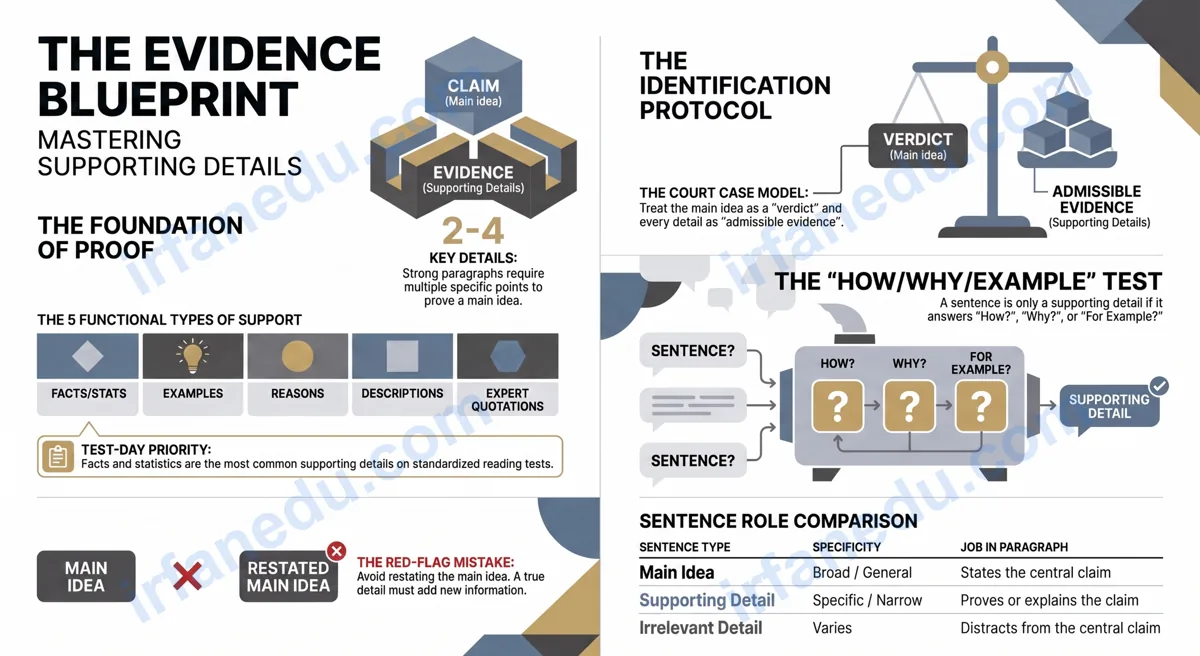
Most reading guides jump straight to “find the topic sentence.” That is the wrong starting point — and it is exactly why so many students pick the wrong answer on tests. Before you can find a supporting detail, you need to understand what job it is doing in the paragraph.
In this guide, I will show you the overlooked first step, walk you through five types of supporting details, and give you a reliable test you can apply to any sentence in under five seconds. By the end, you will be able to identify and write supporting details with confidence.
Details that support the main idea are specific pieces of information — facts, examples, reasons, or descriptions — that explain, prove, or expand the central point of a paragraph. They are the evidence behind the claim. Without them, a main idea is just an unsupported opinion.
- 🎯 Understand the difference between a main idea and a supporting detail
- 🔍 Use a 5-step method to find supporting details in any text
- ✍️ Write supporting details that are specific, relevant, and convincing
- 🚫 Avoid the three most common mistakes students make on tests
- 📊 Recognize all five types of supporting details
Details that support the main idea are specific facts, examples, reasons, or descriptions that explain, prove, or expand the central point of a paragraph or passage. They answer questions like “How?”, “Why?”, or “For example?” about the main idea. Without supporting details, a main idea is just an opinion — the details are the evidence that make it believable and complete.
⚡ TL;DR – Quick Summary
- 📌 Supporting details explain, prove, or expand the main idea of a paragraph.
- 🔎 Use the “How/Why/For example?” test to identify them instantly.
- 📂 Five types: facts, examples, reasons, descriptions, and expert opinions.
- ✅ Strong paragraphs use 2–4 supporting details, not just one.
- 🚫 Irrelevant details are a common trap on standardized tests — learn to spot them.
- ✍️ When writing, make each detail specific, not vague or repetitive.
| Fact | Detail |
|---|---|
| Also called | Supporting details, evidence, elaboration, proof |
| Where they appear | Every paragraph in essays, articles, textbooks, and stories |
| Their job | Explain, prove, illustrate, or expand the main idea |
| Number per paragraph | Typically 2–4 |
| Key test question | “Does this sentence answer How/Why/For example about the main idea?” |
| Grade levels tested | Grades 4–10 (standardized reading tests worldwide) |
🚦 The Step Most Tutorials Skip (Start Here)
Before you hunt for supporting details, you need to understand the relationship between a main idea and its details — not just the labels. Most guides skip this and go straight to “circle the topic sentence,” which leaves students confused when the main idea is implied rather than stated.
Think of it this way: a paragraph is like a court case. The main idea is the verdict — the single claim the author is making. The supporting details are the evidence the lawyer presents to prove that verdict. Evidence that does not relate to the verdict is irrelevant and gets thrown out.
That mental model changes everything. Instead of asking “which sentence is general?” (which is vague and unreliable), you ask “which sentence is the claim, and which sentences are the proof?” That question works every single time, even when the main idea is buried in the middle or implied at the end.
In my experience teaching reading comprehension to middle schoolers, the “general vs. specific” rule causes more confusion than it solves. I have seen students label a broad supporting detail as the main idea because it sounded general. The court-case model — claim vs. evidence — is far more reliable and I use it with every student I work with.
📖 What Are Details That Support the Main Idea?
Details that support the main idea are specific pieces of information that explain, prove, illustrate, or expand the central point of a paragraph or passage. They are always more specific than the main idea, and they always relate directly back to it.
A supporting detail can be a number, a name, an event, a description, a reason, or a quotation. What makes it a supporting detail is not its form — it is its function. It must be doing a job for the main idea.
Main Idea: “Regular exercise has significant health benefits.”
Supporting Detail 1: “Studies show that 30 minutes of moderate exercise five days a week reduces the risk of heart disease by up to 35%.”
Supporting Detail 2: “Exercise also releases endorphins, which reduce stress and improve mood.”
Supporting Detail 3: “People who exercise regularly tend to sleep better and have more energy during the day.”
Each detail answers the question: How does exercise benefit health? That is the test.
📂 What Are the 5 Types of Supporting Details?
Supporting details come in five main forms. Knowing the types helps you both find them in reading and use them in writing.
-
Facts and Statistics
Specific, verifiable information — numbers, dates, research findings. Example: “The average adult reads at 200–250 words per minute.” -
Examples and Anecdotes
Concrete cases that illustrate the main idea. Example: “For instance, Maria improved her reading score by 20 points after practicing daily for six weeks.” -
Reasons and Explanations
The “why” behind the main idea. Example: “This is because the brain consolidates new information during sleep.” -
Descriptions and Sensory Details
Vivid details that help the reader picture or feel the main idea. More common in narrative and descriptive writing. -
Quotations and Expert Opinions
Attributed statements from credible sources. Example: “According to the American Psychological Association, consistent study habits outperform last-minute cramming.”
🔍 How Do You Find Supporting Details in Any Paragraph?
Finding supporting details is a skill, not a guessing game. Follow this five-step method and you will get it right every time.
-
Read the whole paragraph once without stopping.
Get a feel for the topic before you try to label anything. Rushing to the first sentence is the most common mistake. -
Find the topic sentence (the main idea).
Look for the broadest, most general statement. It is often — but not always — the first sentence. Sometimes it is the last sentence or even implied. -
Apply the “How/Why/For example?” test to every other sentence.
Ask: does this sentence answer “How?”, “Why?”, or “For example?” about the main idea? If yes, it is a supporting detail. -
Label each sentence: Main Idea, Supporting Detail, or Irrelevant.
A sentence that does not pass the test is either irrelevant or part of a different paragraph’s idea. -
Double-check by reading the main idea + each detail as a pair.
Each pair should make logical sense: “Regular exercise is healthy — because it reduces heart disease risk.” If the connection feels forced, re-examine your labels.
🧪 Worked Examples: See It in Action
Reading about supporting details is not enough — you need to see the method applied to real paragraphs. Here are two worked examples at different difficulty levels.
Example 1 — Basic (Grade 4–5 Level)
“Dogs make excellent pets. They are loyal and form strong bonds with their owners. Dogs can also be trained to follow commands, which makes them safe and manageable. Many dogs even help people with disabilities as service animals.”
Step 1 — Main Idea: “Dogs make excellent pets.” (broadest claim)
Step 2 — Apply the test:
- “They are loyal and form strong bonds” → Why are dogs excellent pets? ✅ Supporting Detail
- “Dogs can be trained to follow commands” → How are they excellent pets? ✅ Supporting Detail
- “Many dogs help people with disabilities” → For example, how are they excellent? ✅ Supporting Detail
Result: Sentence 1 = Main Idea. Sentences 2, 3, 4 = Supporting Details. No irrelevant details here.
Example 2 — Intermediate (Grade 7–8 Level, Implied Main Idea)
“The school cafeteria now offers a salad bar with fresh vegetables every day. Vending machines have been replaced with water stations. Physical education classes have been extended from 30 to 45 minutes. Students are also encouraged to walk or bike to school.”
Step 1 — Read the paragraph: No sentence directly states a main idea. This is an implied main idea paragraph.
Step 2 — Ask: what do all four details have in common? They all describe changes that promote student health.
Implied Main Idea: “The school has made several changes to improve student health.”
Step 3 — Verify: Does each sentence answer “How has the school improved student health?” Yes, all four do. ✅
Implied main idea paragraphs trip up even strong readers. In my experience, the best strategy is to read all the details first and then ask yourself: “If I had to write one sentence that all of these details prove, what would it say?” That sentence is your implied main idea — and once you have it, finding the supporting details becomes straightforward.
🗺️ Visual Diagram: Main Idea + Supporting Details
                    ┌─────────────────────────────┐
                    │        MAIN IDEA            │
                    │  "Dogs make excellent pets" │
                    └──────────────┬──────────────┘
                                   │
          ┌────────────────────────┼────────────────────────┐
          │                        │                        │
          ▼                        ▼                        ▼
 ┌─────────────────┐    ┌──────────────────┐    ┌──────────────────────┐
 │ SUPPORTING      │    │ SUPPORTING       │    │ SUPPORTING           │
 │ DETAIL #1       │    │ DETAIL #2        │    │ DETAIL #3            │
 │                 │    │                  │    │                      │
 │ Loyal & form    │    │ Can be trained   │    │ Help people with     │
 │ strong bonds    │    │ to follow        │    │ disabilities as      │
 │ with owners     │    │ commands         │    │ service animals      │
 └─────────────────┘    └──────────────────┘    └──────────────────────┘

  HOW TO READ THIS DIAGRAM:
  ─────────────────────────
  Each arrow = "supports" or "proves"
  Each detail answers: WHY / HOW / FOR EXAMPLE about the Main Idea
  If a sentence does NOT connect to the center → it is IRRELEVANT
✍️ How Do You Write Strong Supporting Details?
Writing strong supporting details is just as important as finding them. A vague or repetitive detail weakens your paragraph even if it is technically “on topic.”
Follow these four rules when writing supporting details:
- Be specific, not vague. “Exercise is good for you” is a main idea, not a supporting detail. “Running for 20 minutes lowers resting heart rate over time” is a supporting detail.
- Vary your types. Mix a statistic, an example, and a reason rather than listing three facts in a row. Variety makes your paragraph more convincing and more readable.
- Connect back to the main idea explicitly. Use transition words like “for example,” “this is because,” “specifically,” and “as a result” to signal the relationship.
- Do not repeat the main idea in different words. Restating the main idea as a “detail” is the most common writing mistake I see. Each detail must add new information.
Main Idea: “Reading every day improves vocabulary.”
❌ Weak detail: “Reading helps you learn new words.” (This just restates the main idea.)
✅ Strong detail: “A 2019 study found that students who read for 20 minutes daily encountered 1.8 million more words per year than non-readers, dramatically expanding their vocabulary.” (Specific, new information, directly supports the claim.)
🚫 Common Mistakes: Wrong vs. Right
These are the three mistakes I see most often — in student essays and on standardized test answer sheets. Knowing them in advance puts you ahead of most of your classmates.
| ❌ Wrong (Common Mistake) | ✅ Right (What to Do Instead) |
|---|---|
| Choosing the broadest sentence as the main idea even when it is actually a supporting detail | Use the “claim vs. evidence” test, not just “general vs. specific” |
| Treating a sentence that mentions the topic as a supporting detail (topic ≠ support) | Check that the sentence actually proves or explains the main idea, not just mentions the same subject |
| Restating the main idea in different words and calling it a supporting detail | Every supporting detail must add new, specific information the main idea does not already contain |
| Picking an irrelevant detail as a supporting detail on a test (a common trap answer) | Ask: “Does this sentence answer How/Why/For example about the main idea?” If not, eliminate it |
📊 Main Idea vs. Supporting Detail vs. Irrelevant Detail
Understanding the difference between these three sentence types is the foundation of reading comprehension. Here is a clear comparison.
| Feature | Main Idea | Supporting Detail | Irrelevant Detail |
|---|---|---|---|
| Specificity | Broad, general | Specific, narrow | Varies |
| Job in the paragraph | States the central claim | Proves or explains the claim | No job — it does not belong |
| Can stand alone? | Yes — it is the point | No — needs the main idea for context | No — it is off-topic |
| Answers which question? | “What is this paragraph about?” | “How/Why/For example?” | None of the above |
| Example sentence | “Exercise improves health.” | “It reduces heart disease risk by 35%.” | “Exercise equipment can be expensive.” |
| Remove it and the paragraph… | Falls apart completely | Becomes weaker / less convincing | Becomes cleaner and more focused |
Most reading guides teach supporting details as a reading skill only. But the real power comes when you understand that the same structure governs writing. Here is the non-obvious insight: a paragraph with a strong main idea but weak supporting details is not a writing problem — it is a thinking problem. The student has not yet figured out why their claim is true. Teaching students to ask “What is my evidence?” before they write — not after — produces dramatically stronger paragraphs. In my experience, students who learn supporting details as a writing-first skill improve their reading comprehension scores faster than those who learn it as a reading-only skill, because they understand the purpose behind the structure, not just the label.
🧠 Quick Quiz: Test Your Understanding
Q1. Which sentence is a supporting detail for the main idea “Smartphones have changed how people communicate”?
Q2. A paragraph has no stated topic sentence. What should you do first?
Q3. Which of the following is NOT a type of supporting detail?
📝 Practice Problems (Click to Reveal Answers)
Try each problem on your own before revealing the answer. These are the same style of questions you will see on standardized reading tests.
Practice 1: Identify the supporting details in this paragraph.
Paragraph: “Rainforests are vital to life on Earth. They produce about 20% of the world’s oxygen. Thousands of plant and animal species found nowhere else on Earth live in rainforests. Rainforests also regulate the water cycle by absorbing and releasing water vapor.”
Main Idea: “Rainforests are vital to life on Earth.”
Supporting Details:
- They produce about 20% of the world’s oxygen. (Fact/Statistic — answers “How are they vital?”)
- Thousands of unique species live there. (Fact — answers “Why are they vital?”)
- They regulate the water cycle. (Reason/Explanation — answers “How are they vital?”)
Types used: Fact/Statistic, Fact, Reason/Explanation.
Practice 2: Find the irrelevant detail in this paragraph.
Paragraph: “Learning a second language has many cognitive benefits. Bilingual people show stronger problem-solving skills than monolingual peers. Switching between two languages exercises the brain’s executive function. Many language learning apps are free to download. Studies also suggest bilingualism delays the onset of dementia by several years.”
Irrelevant Detail: “Many language learning apps are free to download.”
Why? The main idea is about cognitive benefits of learning a second language. The cost or availability of apps does not prove or explain a cognitive benefit. It is on the same general topic (language learning) but does not support the specific claim — a classic test trap.
Practice 3: Write two supporting details for this main idea.
Main Idea: “Getting enough sleep is essential for academic performance.”
Sample Supporting Detail 1 (Fact/Statistic): “Research published in the journal Sleep found that students who slept fewer than 7 hours per night scored an average of 10% lower on memory recall tests than those who slept 8–9 hours.”
Sample Supporting Detail 2 (Reason/Explanation): “During deep sleep, the brain consolidates new information learned during the day, transferring it from short-term to long-term memory — a process that cannot happen effectively when sleep is cut short.”
Why these work: Both answer “How/Why is sleep essential for academic performance?” and both add specific new information the main idea does not already contain.
❓ Frequently Asked Questions
What are details that support the main idea?
Sources & References
Written and fact-checked by Dr Irfan Mansuri. External links open in a new tab and are provided for further reading and verification.