
Fluid Reasoning: What It Is, Why It Matters, and How to Strengthen It
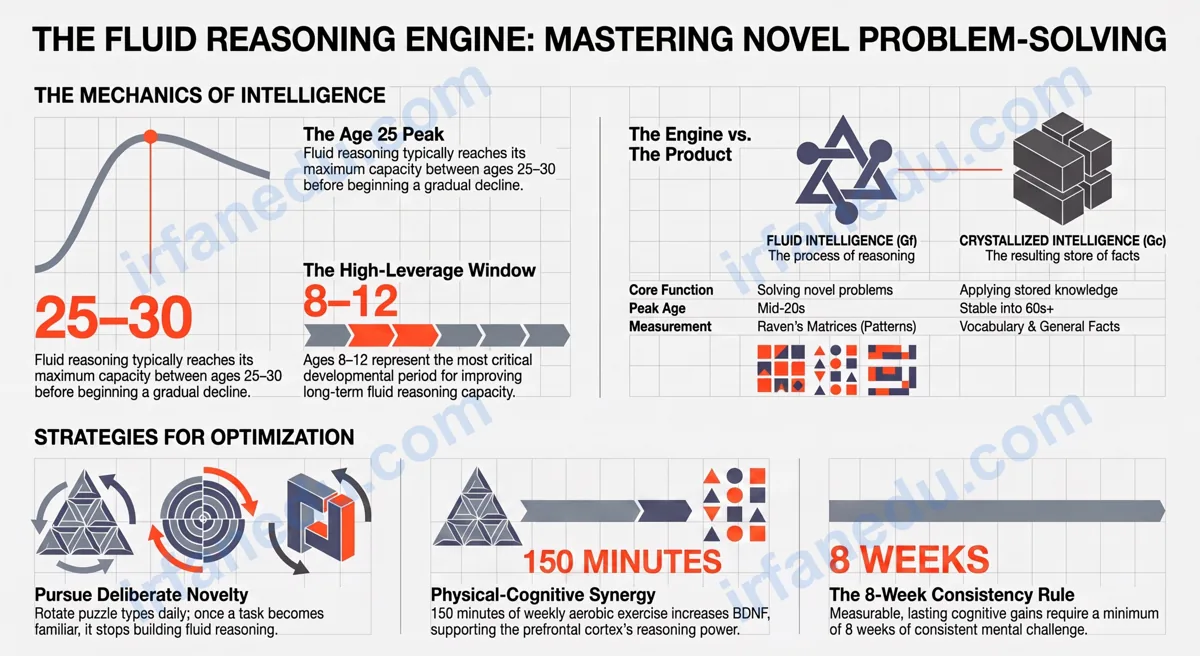
Fluid reasoning is the cognitive ability to identify patterns, think logically, and solve problems you have never encountered before — all without drawing on memorized facts or previously learned procedures. It is one of the most reliable predictors of academic achievement and long-term learning capacity.
Here is the bold claim I want to prove in this article: fluid reasoning is more important to your child’s long-term academic success than any single subject they study in school — and most parents have never heard of it. By the time you finish reading, you will know exactly what it is, how it is measured, and what you can do to strengthen it.
TL;DR – Quick Summary
- Fluid reasoning = solving new problems using logic, not memory.
- It differs from crystallized intelligence, which is accumulated knowledge.
- It peaks around age 25 and gradually declines after that.
- Raven’s Progressive Matrices is the gold-standard measurement tool.
- Exercise, sleep, music training, and novel puzzles all strengthen it.
- Transfer learning — applying skills across contexts — is the most underused strategy.
| Feature | Detail |
|---|---|
| Formal name | Fluid Intelligence (Gf) — part of Cattell-Horn-Carroll (CHC) theory |
| Proposed by | Raymond Cattell (1963), extended by John Horn and John Carroll |
| Peak age | Mid-20s (approximately 25–30) |
| Key brain regions | Prefrontal cortex, parietal cortex, anterior cingulate cortex |
| Gold-standard test | Raven’s Progressive Matrices |
| Other tests | WISC-V Matrix Reasoning, WAIS-IV, CogAT, Woodcock-Johnson |
| Can it be improved? | Yes — modestly but meaningfully, especially in children |
| Related to IQ? | Strongly — fluid reasoning is the heaviest contributor to general intelligence (g) |
Fluid Reasoning Is Your Brain’s Raw Problem-Solving Engine
Fluid reasoning is the ability to think flexibly, recognize patterns, and solve problems that have no ready-made answer in your memory. The word “fluid” is deliberate: this type of thinking flows and adapts to whatever new situation you face, rather than relying on a fixed store of facts.
The concept originates from psychologist Raymond Cattell’s 1963 theory of intelligence, which split general intelligence into two broad factors. Fluid intelligence (Gf) handles novel, on-the-spot reasoning. Crystallized intelligence (Gc) handles knowledge you have already acquired. Both matter, but they work very differently.
A concrete example makes this clear. Suppose you see this number sequence for the first time:
Visual: Pattern Recognition in Action
  Number Series:   2 — 6 — 18 — 54 — ?

  Step 1: Look at the relationship between terms.
          2 × 3 = 6
          6 × 3 = 18
         18 × 3 = 54

  Step 2: Apply the rule to find the next term.
         54 × 3 = 162

  Answer: 162

  This is fluid reasoning — you identified the rule
  from scratch and applied it to an unseen problem.
  No memorization required.
You did not need to have seen that exact sequence before. You spotted the rule (multiply by 3), held it in working memory, and applied it forward. That process — inductive reasoning from a novel pattern — is the heart of fluid reasoning.
In my experience teaching students across age groups, the ones who struggle most are rarely the ones who lack knowledge. They are the ones who cannot transfer a rule they learned in one context to a slightly different problem. That gap is almost always a fluid reasoning gap — and it is fixable.
Fluid vs. Crystallized Intelligence: The Distinction That Changes Everything
Fluid and crystallized intelligence are complementary, not competing — but confusing them leads to serious mistakes in how students study and how parents interpret test scores.
Crystallized intelligence is everything you have learned and stored: vocabulary, historical facts, mathematical formulas, grammar rules. It grows throughout your life and does not decline much with age. Fluid intelligence, by contrast, is the engine that acquires new crystallized knowledge. It is the process; crystallized intelligence is the product.
| Dimension | Fluid Intelligence (Gf) | Crystallized Intelligence (Gc) |
|---|---|---|
| Definition | Reasoning with novel problems | Applying stored knowledge |
| Depends on memory? | No — works without prior knowledge | Yes — draws on what you have learned |
| Age trajectory | Peaks ~25, declines gradually | Grows throughout life, stable into 60s+ |
| Example task | Completing a pattern matrix | Defining a vocabulary word |
| Measured by | Raven’s Matrices, matrix reasoning | Vocabulary tests, general knowledge tests |
| Improved by | Novel challenges, exercise, sleep | Reading, study, experience |
Fluid Reasoning Develops in Predictable Stages — and Peaks Earlier Than You Think
Fluid reasoning follows a clear developmental arc, and knowing this arc helps parents and teachers set realistic expectations and intervene at the right time.
- Early childhood (ages 3–7): Basic pattern recognition emerges. Children begin to sort objects by shape, color, and size — the earliest form of inductive reasoning.
- Middle childhood (ages 8–12): Abstract reasoning accelerates. Children can handle multi-step logical problems and begin to generalize rules across contexts. This is the highest-impact window for targeted training.
- Adolescence (ages 13–17): Fluid reasoning approaches adult levels. Abstract thinking, hypothesis testing, and systematic problem-solving become possible. Formal education should be leveraging this capacity far more than it does.
- Early adulthood (ages 18–25): Peak performance. Working memory capacity and processing speed are at their highest, which directly supports fluid reasoning.
- Mid-adulthood onward (25+): Gradual decline begins, though the rate varies widely by individual. Lifestyle factors — exercise, sleep, continued cognitive challenge — significantly slow the decline.
Standardized Tests Measure Fluid Reasoning Without Requiring Any Prior Knowledge
The defining feature of a fluid reasoning test is that it requires no prior knowledge to complete — only the ability to reason in the moment. This makes fluid reasoning tests uniquely “culture-fair” compared to most academic assessments.
The gold standard is Raven’s Progressive Matrices, developed by John C. Raven in 1936 and still widely used today. Each item presents a 3×3 grid of geometric patterns with one cell missing. The test-taker must identify the rule governing the patterns and select the correct missing piece from eight options.
How Raven’s Progressive Matrices Work (Simplified)
  ┌─────┬─────┬─────┐
  │  ○  │  ○○ │ ○○○ │   ← Row 1: circles increase by 1
  ├─────┼─────┼─────┤
  │  □  │  □□ │ □□□ │   ← Row 2: squares increase by 1
  ├─────┼─────┼─────┤
  │  △  │  △△ │  ?  │   ← Row 3: triangles should increase by 1
  └─────┴─────┴─────┘

  Rule 1 (rows): shapes increase left to right
  Rule 2 (cols): shape type changes top to bottom

  Answer: △△△  (three triangles)

  You reasoned this out from scratch — no prior
  knowledge of triangles or matrices required.
Other commonly used tests include:
- WISC-V Matrix Reasoning — used in school-based psychoeducational evaluations for children aged 6–16.
- WAIS-IV Matrix Reasoning — the adult version, used from age 16 upward.
- CogAT (Cognitive Abilities Test) — widely used in gifted education screening in US schools.
- Woodcock-Johnson Tests of Cognitive Abilities — includes fluid reasoning subtests used in learning disability assessments.
Fluid Reasoning Predicts Academic Success Across Every Subject
Fluid reasoning is not just a math skill — it predicts performance across reading comprehension, science, writing, and standardized tests. This claim is well-supported by decades of cognitive research.
A student with strong fluid reasoning can:
- Understand a new grammar rule and immediately apply it to unfamiliar sentences.
- Read a passage about an unfamiliar topic and draw accurate inferences.
- Encounter a physics problem with a new setup and work out the solution from first principles.
- Adapt to a new teacher’s explanation style without losing comprehension.
I have seen students with average crystallized knowledge consistently outperform “better-prepared” peers on standardized tests — purely because their fluid reasoning was stronger. They could work out answers from context and logic when others were stuck waiting for a memorized fact to surface. This is the skill schools underinvest in, and it is the one that pays the highest return.
Most Parents and Teachers Confuse Fluid Reasoning With General Smartness
This is the most damaging misconception I encounter, and it deserves a direct correction. Fluid reasoning is a specific, measurable cognitive ability — not a fixed trait you are born with and cannot change.
| Common Misconception | What the Evidence Actually Shows |
|---|---|
| “My child is just not a logical thinker.” | Fluid reasoning is trainable, especially in children aged 8–12. It responds to targeted practice. |
| “If they study harder, their reasoning will improve.” | Studying content builds crystallized knowledge, not fluid reasoning. You need different activities to build Gf. |
| “High grades mean strong fluid reasoning.” | Grades reflect a mix of crystallized knowledge, effort, and test-taking skill. A student can earn high grades with weak fluid reasoning — until they hit a ceiling. |
| “Fluid reasoning declines, so there is no point training it in adults.” | Training slows the decline and maintains functional capacity. Even modest improvements in adults have real-world cognitive benefits. |
| “Brain training apps significantly boost fluid reasoning.” | Most commercial brain training apps show narrow, task-specific gains that do not transfer. The activities that transfer are exercise, music, sleep, and genuinely novel problem-solving. |
Seven Proven Strategies to Strengthen Fluid Reasoning
The following strategies are supported by peer-reviewed research. Each one works by forcing the brain to process novel information, hold multiple rules in working memory simultaneously, or adapt existing knowledge to a new context — the three core demands of fluid reasoning.
- Train working memory deliberately. Working memory is the cognitive workspace where fluid reasoning happens. Tasks that require you to hold and manipulate information simultaneously — such as mental arithmetic, dual n-back exercises, or remembering a sequence while performing another task — directly strengthen this workspace. Even 15–20 minutes of deliberate working memory practice per day produces measurable gains over 4–8 weeks.
- Solve genuinely novel puzzles daily. The key word is “novel.” Once a puzzle type becomes familiar, it stops building fluid reasoning and starts building crystallized knowledge. Rotate between logic puzzles, number series, spatial reasoning tasks, and Raven’s-style matrix problems. The discomfort of unfamiliarity is the signal that fluid reasoning is being engaged.
- Learn a musical instrument. Multiple studies have found that instrumental music training — particularly in children aged 6–12 — produces measurable gains in fluid reasoning, working memory, and processing speed. The mechanism is the simultaneous demand on pattern recognition, motor coordination, auditory processing, and attention. Even one year of lessons produces detectable effects.
- Do regular aerobic exercise. Aerobic exercise increases brain-derived neurotrophic factor (BDNF), a protein that supports the growth of new neurons and the strengthening of synaptic connections. The prefrontal cortex — the brain region most critical for fluid reasoning — is particularly responsive to exercise-induced BDNF. Aim for at least 150 minutes of moderate aerobic activity per week.
- Protect and prioritize sleep. Sleep is when the brain consolidates the neural connections formed during learning and problem-solving. Chronic sleep deprivation specifically impairs working memory and fluid reasoning more than it impairs crystallized knowledge retrieval. School-age children need 9–11 hours; teenagers need 8–10 hours; adults need 7–9 hours.
- Practice transfer learning deliberately. Take a concept you have mastered in one subject and force yourself to apply it in a completely different context. For example: after learning about exponential growth in math, apply the same reasoning to population biology, compound interest, and viral spread. This deliberate cross-domain application is the most direct way to build the flexible, transferable reasoning that defines fluid intelligence.
- Play strategy-based games. Chess, Go, and complex strategy video games (such as real-time strategy games) require sustained planning, pattern recognition, hypothesis testing, and adaptive decision-making under uncertainty. These are fluid reasoning sub-skills. Chess instruction in particular has been linked to measurable gains in fluid reasoning in school-age children.
Unique Insight: The Transfer Problem Nobody Talks About
Here is something almost no guide on fluid reasoning addresses: the biggest barrier to improving fluid reasoning is not lack of practice — it is practicing the same type of problem repeatedly until it becomes automatic. Once a problem type is automatic, it is no longer a fluid reasoning task; it has become a crystallized one. This is why students who drill hundreds of SAT math problems often plateau: they have converted fluid reasoning challenges into crystallized pattern-matching. The fix is deliberate variety — constantly introducing problem types you have never seen before, across different domains. In my experience, the students who improve most are the ones who actively seek out unfamiliar problem formats, not the ones who perfect familiar ones.
Quick Knowledge Check
Test Your Understanding — 3 Questions
1. Which of the following is the best example of fluid reasoning?
2. At approximately what age does fluid reasoning typically peak?
3. Which activity is most likely to produce genuine fluid reasoning gains?
Practice Problems
Problem 1: What comes next in this series? 3, 9, 27, 81, ___
Answer: 243
Each term is multiplied by 3. This is a geometric sequence with a common ratio of 3. Applying the rule: 81 × 3 = 243. This is a classic fluid reasoning task — you identify the rule from the pattern and apply it to an unseen term.
Problem 2: Which shape completes the pattern? Circle, Square, Triangle, Circle, Square, ___
Answer: Triangle
The sequence repeats in a cycle of three: Circle, Square, Triangle. After two complete cycles, the next shape in the third cycle is Triangle. Recognizing repeating cycles is a core fluid reasoning sub-skill tested in cognitive assessments for children.
Problem 3: If all Bloops are Razzles, and all Razzles are Lazzles, are all Bloops definitely Lazzles?
Answer: Yes
This is a deductive reasoning problem using fictional categories — so prior knowledge is irrelevant. The logic is: Bloops ⊂ Razzles ⊂ Lazzles. Therefore, all Bloops are Lazzles. This type of syllogism appears on fluid reasoning assessments because it tests pure logical structure, stripped of content knowledge.
Frequently Asked Questions
What is fluid reasoning in simple terms?
What is the difference between fluid and crystallized intelligence?
Can fluid reasoning be improved?
At what age does fluid reasoning peak?
How is fluid reasoning measured?
Why does fluid reasoning matter for students?
Is fluid reasoning the same as IQ?
Key Takeaways
- Fluid reasoning is the ability to solve novel problems using logic — not memory.
- It is distinct from crystallized intelligence, which is accumulated knowledge.
- It peaks around age 25 and declines gradually — but lifestyle choices slow the decline.
- Raven’s Progressive Matrices is the gold-standard test for measuring it.
- Ages 8–12 are the highest-leverage window for building fluid reasoning in children.
- The most effective improvement strategies are: novel problem-solving, aerobic exercise, music training, sleep, and deliberate transfer learning.
- Most brain training apps do not transfer — genuine novelty and cognitive challenge do.