
Biochemistry Practice Exam: The Complete 2026 Study Guide (Which Resources Actually Work?)
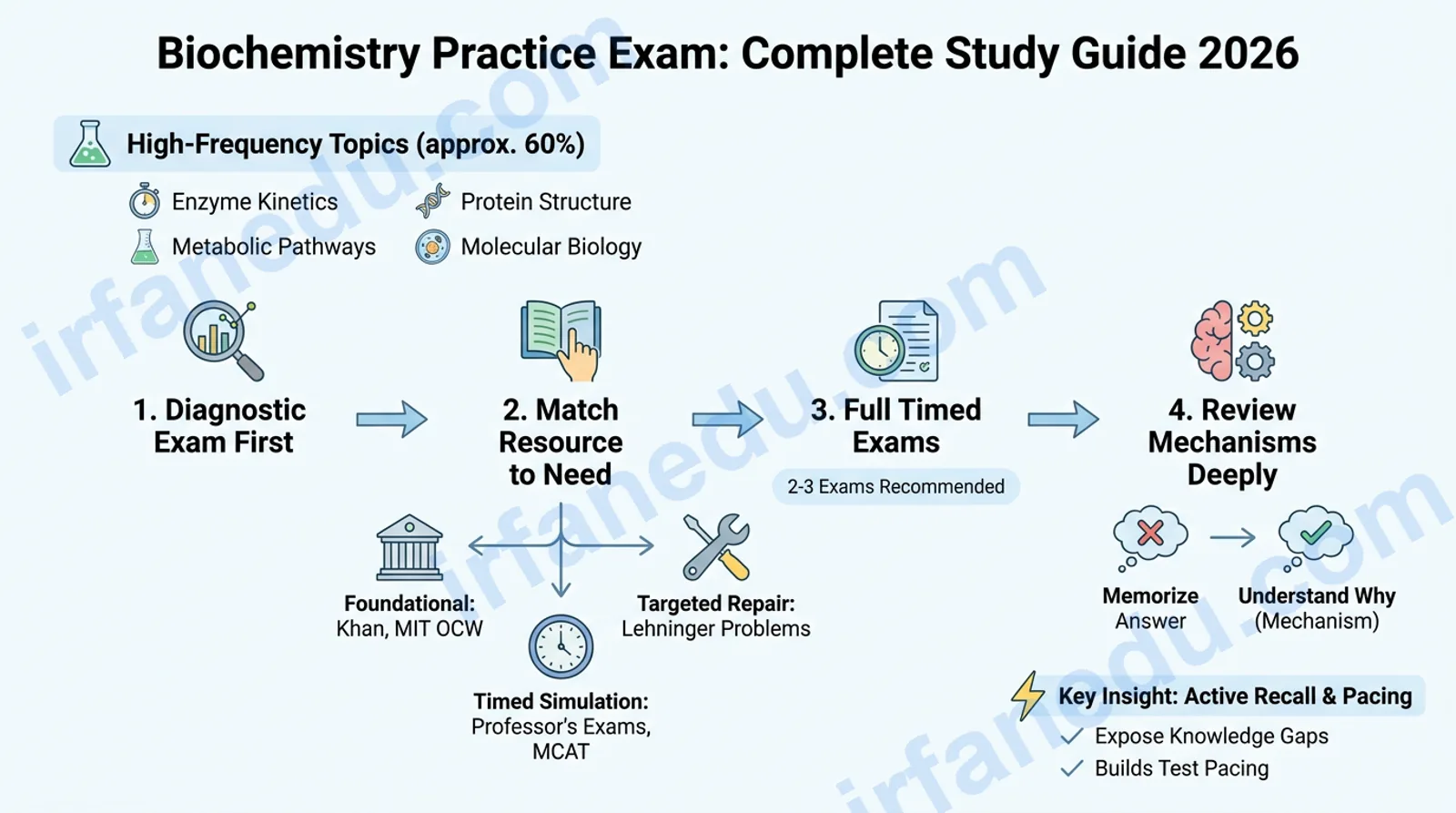
A biochemistry practice exam is a timed simulation of your real test, covering enzyme kinetics, metabolic pathways, protein structure, and molecular biology. Used correctly, practice exams are the single highest-return study activity in biochemistry because they force active recall, expose hidden knowledge gaps, and build the pacing skills that separate a B from an A.
- How to choose the right biochemistry practice exam resource for your course level
- The five highest-frequency topics you must master before exam day
- A step-by-step prep system that takes you from diagnostic to exam-ready
- The most common mistakes students make on biochemistry exams — and how to avoid them
- A worked enzyme kinetics example with a visual solution
A biochemistry practice exam is a timed set of questions covering enzyme kinetics, metabolic pathways, protein structure, and cell signaling, used to simulate real test conditions. To prepare effectively: identify weak topics first with a diagnostic exam, work through at least two full-length timed practice exams, review every wrong answer mechanistically (not just by memorizing the correct answer), and focus on understanding why a pathway works, not just what it produces.
- 🧪 Enzyme kinetics, glycolysis, and protein structure cover ~60% of most biochemistry exams.
- 📋 Take a diagnostic exam first — it reveals gaps faster than re-reading notes.
- ⏱️ Always practice under timed conditions; pacing is a learnable skill.
- 🔍 Review wrong answers by tracing the mechanism, not just noting the right answer.
- 📚 No single free resource replaces a full timed practice exam from your course materials.
- 🎯 Two to three full practice exams is the evidence-supported sweet spot for most students.
Which Biochemistry Practice Exam Resource Should You Use? 🔍
The honest answer is: it depends on your course level and what you’re trying to fix. Not all practice exam resources are built the same, and picking the wrong one wastes hours you don’t have.
Here is a decision guide I use when advising students. Match your situation to the right tool, then use the comparison table below to confirm your choice.
If you need to build foundational understanding first: Start with Khan Academy’s MCAT biochemistry section or MIT OpenCourseWare 7.01 lecture notes. These are concept-first, not exam-first.
If you need timed exam simulation: Use your professor’s released past exams (always the best source), or MCAT-style biochemistry question banks (Kaplan, Princeton Review, or free AAMC materials).
If you need to fix a specific weak topic: Use Lehninger’s Principles of Biochemistry end-of-chapter problems, then return to a full practice exam to confirm the fix.
| Resource | Best For | Timed Practice? | Depth Level | Cost |
|---|---|---|---|---|
| Your Professor’s Past Exams | Exact course alignment | ✅ Yes (self-timed) | Course-specific | Free |
| Khan Academy (MCAT Biochem) | Concept building, foundational review | ⚠️ Limited | Introductory–Intermediate | Free |
| MIT OCW 7.01 / 7.05 | Deep mechanistic understanding | ✅ Problem sets | Advanced | Free |
| AAMC MCAT Practice | Pre-med students, MCAT prep | ✅ Full timed exams | Intermediate–Advanced | Paid (some free) |
| Lehninger End-of-Chapter Problems | Targeted topic repair | ❌ No | Intermediate–Advanced | Textbook required |
| Quizlet / Anki Decks | Vocabulary and definitions | ❌ No | Introductory | Free/Freemium |
In my experience working with undergraduate biochemistry students, the single most common mistake I see is using Quizlet as a primary study tool. Flashcards build recognition, not reasoning. Biochemistry exams test whether you can apply a concept in a novel context, not whether you can match a term to a definition. I’ve watched students who scored 95% on their Anki decks fail the actual exam because they’d never practiced working through a multi-step enzyme kinetics problem under time pressure. Use flashcards for vocabulary only — never as your main prep strategy.
What Topics Appear Most on Biochemistry Practice Exams? 🧬
The five highest-frequency topics on undergraduate biochemistry practice exams account for roughly 60-70% of all questions. Master these first before spending time on lower-yield areas.
-
Enzyme Kinetics (Michaelis-Menten & Inhibition)
Expect questions on Km, Vmax, kcat, and the three inhibition types (competitive, uncompetitive, mixed/non-competitive). You must be able to read and interpret Lineweaver-Burk plots. This topic alone appears in 20-25% of questions on most exams. -
Glycolysis, TCA Cycle & Oxidative Phosphorylation
Know the key regulatory enzymes (phosphofructokinase-1, pyruvate kinase, isocitrate dehydrogenase), the ATP yield per glucose, and where each process occurs in the cell. Regulation questions are especially common. -
Protein Structure (Primary Through Quaternary)
Understand the forces stabilizing each structural level, the difference between alpha-helices and beta-sheets, and how denaturation affects function. Hemoglobin cooperativity is a perennial exam favorite. -
DNA Replication, Transcription & Translation
Know the key enzymes (DNA polymerase, RNA polymerase, ribosomes), directionality (5′ to 3′), and the differences between prokaryotic and eukaryotic processes. Post-translational modifications are increasingly tested. -
Lipid Metabolism (Fatty Acid Synthesis & Beta-Oxidation)
Know where each occurs (cytoplasm vs. mitochondria), the role of acetyl-CoA, and the net ATP yield from a specific fatty acid. Regulation by malonyl-CoA is a high-yield detail.
After you identify your weak topics from a diagnostic exam, spend 80% of your remaining study time on the top three weakest areas. Students who spread effort evenly across all topics consistently underperform compared to those who triage strategically. Biochemistry rewards depth over breadth in the final week before an exam.
How to Prepare for a Biochemistry Practice Exam: Step-by-Step 📋
Preparation for a biochemistry exam is most effective when it follows a specific sequence. Here is the system I recommend, refined over years of working with students at multiple course levels.
-
Take a Diagnostic Exam First (No Studying)
Before opening a single textbook, take one full practice exam cold. This is uncomfortable but essential. It tells you exactly where your knowledge gaps are, so you study what you don’t know rather than what you already know. -
Categorize Your Errors by Topic and Error Type
Sort wrong answers into three buckets: (a) content gap — you never learned this; (b) conceptual confusion — you learned it wrong; (c) careless error — you knew it but misread the question. Each bucket needs a different fix. -
Study Mechanistically for Each Gap
For content gaps, read the relevant textbook section and draw the pathway or mechanism by hand. For conceptual confusion, find a worked example and trace the logic step by step. Do not re-read passively. -
Do a Full Timed Practice Exam Under Real Conditions
No notes. Strict time limit. No phone. Simulate the actual exam environment as closely as possible. Pacing is a skill that only develops under real time pressure. -
Review Every Wrong Answer Mechanistically
For each wrong answer, write one sentence explaining exactly which concept you misapplied. This forces you to articulate the gap, which is far more effective than just reading the correct answer.
[IMAGE: Step-by-step biochemistry exam prep flowchart showing diagnostic → categorize → study → timed exam → review cycle | ALT: biochemistry practice exam preparation flowchart for students]
Worked Example: Enzyme Kinetics Problem 🔬
Enzyme kinetics questions are the most feared part of biochemistry exams. Here is a complete worked example of the type that appears on most undergraduate and MCAT-level practice exams.
Question: An enzyme has a Km of 2 mM and a Vmax of 100 µmol/min. A competitive inhibitor is added at a concentration that doubles the apparent Km. At a substrate concentration of 2 mM, what is the new reaction rate?
Step 1 — Identify what changed. Competitive inhibition increases apparent Km but does NOT change Vmax. New apparent Km = 4 mM.
Step 2 — Apply the Michaelis-Menten equation:
v = (Vmax × [S]) / (Km_apparent + [S])
v = (100 × 2) / (4 + 2) = 200 / 6 ≈ 33.3 µmol/min
Step 3 — Interpret the result. Without the inhibitor, the rate at [S] = 2 mM (which equals Km) would be exactly Vmax/2 = 50 µmol/min. The competitive inhibitor reduced the rate from 50 to 33.3 µmol/min — a 33% reduction. This is the kind of two-step reasoning biochemistry exams reward.
  Lineweaver-Burk Plot: No Inhibitor vs. Competitive Inhibitor
  (1/v on Y-axis, 1/[S] on X-axis)

  1/v |
      |              / ← Competitive Inhibitor
      |            /     (steeper slope, same Y-intercept)
      |          /
      |        / ← No Inhibitor
      |      /
      |    /
      |  /
      |/_____________________________________ 1/[S]
      |
      ← Same Y-intercept (1/Vmax unchanged)
      ← Different X-intercept (-1/Km shifts left for inhibitor)

  KEY:
  • Y-intercept = 1/Vmax  → SAME for competitive inhibitor
  • X-intercept = -1/Km   → SHIFTS (apparent Km increases)
  • Slope = Km/Vmax        → INCREASES with competitive inhibitor
In my experience, students who draw Lineweaver-Burk plots by hand during their study sessions score significantly better on enzyme kinetics questions than those who only read about them. The act of drawing forces you to think about what each axis represents and what each line change means mechanistically. I tell every student I work with: if you can draw all three inhibition types from memory and explain what changes and what stays the same, you’ve mastered the hardest part of most biochemistry practice exams.
Common Mistakes on Biochemistry Practice Exams (Wrong vs. Right) ⚠️
Most biochemistry exam errors fall into predictable patterns. Knowing them in advance lets you avoid them before they cost you points.
Memorizing that “competitive inhibitors increase Km” without understanding why.
Understanding that competitive inhibitors compete with substrate for the active site, so you need more substrate to achieve half-maximal rate — that’s why Km increases.
Confusing the location of fatty acid synthesis (cytoplasm) with beta-oxidation (mitochondria).
Linking location to logic: synthesis needs NADPH from the cytoplasm; oxidation feeds directly into the TCA cycle in the mitochondria.
Skipping the units in ATP yield calculations and guessing “38 ATP” for every glucose oxidation question.
Using the modern accepted net yield of ~30-32 ATP per glucose (accounting for the mitochondrial proton gradient efficiency), and showing your calculation steps.
Treating all four levels of protein structure as equally important for every question.
Recognizing that most exam questions about protein function focus on tertiary and quaternary structure, where active sites and allosteric regulation live.
One of the most test-damaging misconceptions I see: students assume that a higher Km always means a “worse” enzyme. In reality, a high Km means the enzyme has a low affinity for its substrate — but whether that is “good” or “bad” depends entirely on the physiological context. Glucokinase (hexokinase IV) has a high Km for glucose precisely so it only activates when blood glucose is high. Exam writers love this nuance.
What most biochemistry study guides get wrong: they treat practice exams as a measurement tool, not a learning tool.
The standard advice is “take a practice exam, see your score, study more.” But the research on retrieval practice — including work published by cognitive scientists at Washington University in St. Louis — shows that the act of attempting a question, even incorrectly, primes the brain to encode the correct information more deeply when you review it afterward. This is called the “hypercorrection effect.”
The practical implication: do not wait until you feel ready to take a practice exam. Take it early, get it wrong, and use the errors as the primary driver of your study plan. A student who takes a practice exam on Day 1 and reviews it carefully will outperform a student who spends Day 1-5 re-reading notes and only takes the practice exam on Day 6 — even if the second student “knows more” going in.
In my experience teaching biochemistry, the students who improve the most between their first and second practice exam are almost always the ones who treated their wrong answers as a curriculum, not a failure.
Reveal-and-Check Practice Problems 🧩
Try each question on your own first, then click to reveal the full worked answer.
Problem 1: An enzyme has Km = 5 mM. At [S] = 5 mM, what fraction of Vmax is the reaction rate?
Using Michaelis-Menten: v = (Vmax × [S]) / (Km + [S]) = (Vmax × 5) / (5 + 5) = Vmax/2.
This is the definition of Km: the substrate concentration at which the reaction rate is exactly half of Vmax. If you remember nothing else about Km, remember this — it appears on virtually every biochemistry practice exam.
Problem 2: Glycolysis produces a net gain of how many ATP per glucose molecule, and where does it occur?
Glycolysis invests 2 ATP in the preparatory phase (steps 1 and 3) and generates 4 ATP in the payoff phase (steps 7 and 10), for a net gain of 2 ATP. It also produces 2 NADH and 2 pyruvate. Critically, glycolysis requires no oxygen — it is anaerobic. The cytoplasmic location is a frequent exam trap; students often confuse it with the TCA cycle, which occurs in the mitochondrial matrix.
Problem 3: What is the difference between uncompetitive and non-competitive (mixed) inhibition on a Lineweaver-Burk plot?
Uncompetitive inhibitor: binds only the enzyme-substrate (ES) complex. Both Km and Vmax decrease by the same factor, so the slope (Km/Vmax) stays constant — the Lineweaver-Burk lines are parallel.
Pure non-competitive inhibitor: binds E and ES equally. Vmax decreases; Km is unchanged. Lines intersect on the Y-axis (same X-intercept, different Y-intercepts).
Mixed inhibitor: binds E and ES with different affinities. Both Km and Vmax change, and lines intersect to the left of the Y-axis. This distinction is a classic exam question.
Problem 4: Why does malonyl-CoA inhibit fatty acid beta-oxidation?
Malonyl-CoA is the first committed intermediate in fatty acid synthesis (made by ACC in the cytoplasm). When the cell is in a biosynthetic state (fed, high insulin), malonyl-CoA levels rise. High malonyl-CoA inhibits CPT-I, the enzyme that transfers long-chain fatty acids onto carnitine for transport into the mitochondria. This prevents a futile cycle of simultaneously synthesizing and degrading fatty acids. This regulatory logic — one pathway’s intermediate inhibiting the opposing pathway — is a high-yield concept that appears across multiple biochemistry exam topics.
Frequently Asked Questions 💬
How many practice exams should I do before a biochemistry test?
What topics appear most often on biochemistry practice exams?
Is Khan Academy enough to prepare for a biochemistry exam?
What is the best way to review wrong answers on a biochemistry practice exam?
- Enzyme kinetics, glycolysis/TCA, protein structure, DNA processes, and lipid metabolism cover ~60-70% of most biochemistry exams.
- Take a diagnostic practice exam before studying — it reveals gaps faster than any other method.
- Always practice under timed, exam-like conditions; pacing is a skill that only develops under pressure.
- Review wrong answers mechanistically: write down the exact concept you misapplied, not just the right answer.
- Two to three full practice exams is the evidence-supported sweet spot for most students.
- The “hypercorrection effect” means attempting questions early — even incorrectly — leads to deeper learning than passive review.
- No free resource replaces a full timed practice exam from your actual course materials.
Sources & References
-
Khan Academy — Enzymes and the Active Site (AP