
Galactic model in math: complete guide with worked examples
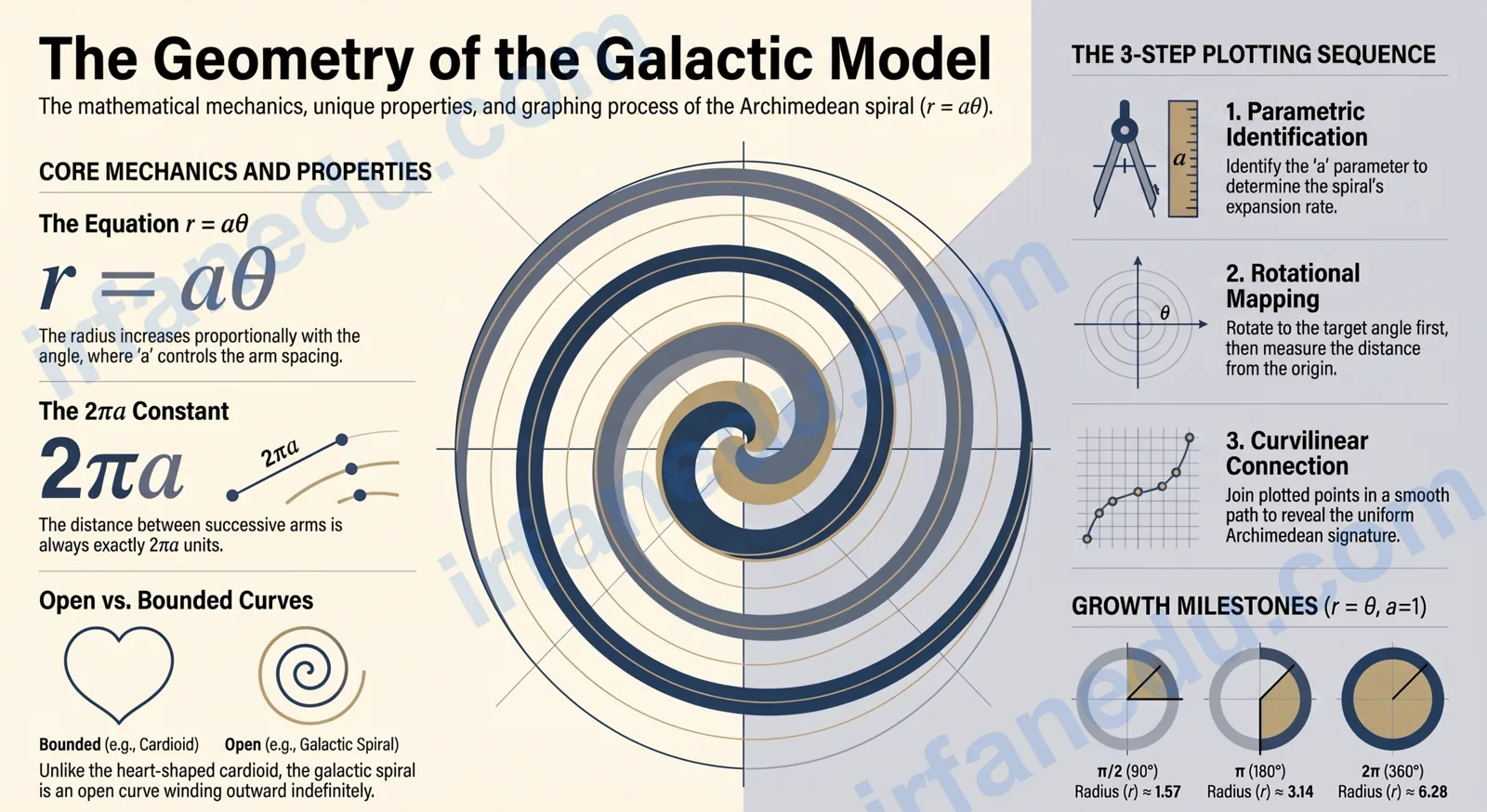
Here is a number that surprises most students: a single polar equation with fewer than ten characters — r = aθ — traces a curve that looks almost identical to the spiral arms of the Milky Way. That is the galactic model, and it sits at the intersection of elegant mathematics and real astrophysics.
The galactic model in math is a polar or parametric curve whose equation generates a galaxy-shaped graph on the coordinate plane. It appears in precalculus and AP Calculus BC courses as a rich example of polar coordinates, symmetry analysis, and curve sketching — and it connects directly to the heart model (cardioid) as part of a family of visually striking polar curves.
In this guide, I walk you through exactly what the galactic model is, how its equation works, how to graph it by hand, and how it compares to the heart model. I also share the insight that most textbooks skip — and that insight changes how quickly students master the whole family of polar curves.
By the end of this article you will be able to:
- State the galactic model equation and identify its parameters.
- Build a value table and plot the curve on polar axes.
- Explain the difference between the galactic model and the heart model.
- Recognise galactic-type curves in AP Calculus BC and precalculus problems.
Polar curves like the galactic model are not just art projects. They appear on the AP Calculus BC exam in questions about area between curves, arc length, and symmetry — skills worth mastering early.
The galactic model in math is a polar curve — most commonly the Archimedean spiral r = aθ or a multi-petal rose variant — whose graph resembles a galaxy with spiral arms. It is studied in precalculus and AP Calculus BC to teach polar coordinates, symmetry, and curve sketching. The parameter a controls how tightly the arms wind around the origin.
What is the galactic model?
The galactic model is any polar curve whose visual output on the coordinate plane resembles a galaxy — that is, a shape with one or more arms that spiral outward from a central point (the pole). The most studied version is the Archimedean spiral, defined by:
r = aθ, where r is the radial distance from the origin, θ is the angle in radians, and a is a positive constant that sets the spacing between successive arms.
In Cartesian terms, every point on this curve satisfies x = r·cos θ and y = r·sin θ. As θ increases, r grows proportionally, so the curve winds outward in a uniform spiral. That is the defining feature of the galactic model: equal spacing between successive turns.
Some courses extend the term “galactic model” to include multi-armed spirals or rose curves with many petals. The underlying principle is the same: a polar equation whose graph captures the rotational, arm-like structure of a galaxy.
The galactic model is not the same as a logarithmic spiral (used in nautilus shells) or a lemniscate (figure-eight shape). Those are related but distinct polar curves with different equations and properties.
Quick facts about the galactic model
| Property | Detail |
|---|---|
| Standard name | Archimedean spiral (most common galactic model form) |
| Polar equation | r = aθ (a > 0) |
| Coordinate system | Polar (r, θ) |
| Shape | Outward-winding spiral; equal spacing between arms |
| Symmetry | No standard axis symmetry; rotational structure |
| Key parameter | a — controls arm spacing (larger a = wider gaps) |
| Passes through origin? | Yes, when θ = 0, r = 0 |
| Course level | Precalculus, AP Calculus BC, College Calculus II |
| Named after | Archimedes of Syracuse (~225 BCE) |
| Related curves | Cardioid (heart model), rose curve, logarithmic spiral |
Galactic model vs. heart model — how do they compare?
The heart model (cardioid) and the galactic model are both polar curves, but they behave very differently. The cardioid is a closed curve — it starts and ends at the same point. The galactic spiral is open — it winds outward indefinitely.
| Feature | Galactic model (Archimedean spiral) | Heart model (cardioid) |
|---|---|---|
| Polar equation | r = aθ | r = a(1 − cos θ) |
| Shape | Open outward spiral | Closed heart-shaped loop |
| Passes through origin | Yes (at θ = 0) | Yes (at θ = 0 and θ = 2π) |
| Symmetry | No standard axis symmetry | Symmetric about polar axis |
| Number of arms/petals | 1 continuous spiral arm | 1 closed lobe |
| r at θ = π | r = aπ ≈ 3.14a | r = 2a |
| Bounded? | No (r grows without limit) | Yes (max r = 2a) |
| Area formula | A = (1/2)∫r² dθ (unbounded unless limits set) | A = (3/2)πa² |
| Typical course context | AP Calc BC, Precalculus | AP Calc BC, Precalculus |
| Real-world analogy | Galaxy arms, clock spring, vinyl record groove | Heart shape, apple cross-section |
The key practical difference for exam purposes: the cardioid has a finite enclosed area you can compute cleanly, while the galactic spiral requires you to set explicit θ limits before computing area. Many students lose marks by forgetting to define those limits.
The galactic model equation explained
The Archimedean spiral r = aθ is the cleanest galactic model equation, but courses sometimes use extended forms. Here is a breakdown of the most common variants:
Variant 1: basic Archimedean spiral
r = aθ (a > 0, θ ≥ 0)
Each full rotation (θ increases by 2π) adds a distance of 2πa to the radius. So if a = 1, the spiral grows by about 6.28 units per full turn.
Variant 2: two-armed galactic spiral
r = aθ for θ ≥ 0 AND r = −aθ for θ ≥ 0
Plotting both together gives two arms winding in opposite directions from the origin — the classic two-armed galaxy shape. This is how the Milky Way’s structure is approximated in classroom models.
Variant 3: multi-petal rose (galactic look)
r = a·cos(nθ) or r = a·sin(nθ)
When n is large (e.g. n = 8 or n = 12), the rose curve produces many thin petals radiating from the center — visually resembling a galaxy viewed face-on. The number of petals equals n (if n is odd) or 2n (if n is even).
In my experience teaching precalculus, students confuse the rose curve with the galactic spiral because both look “galaxy-like.” The critical difference: the rose curve is bounded (all petals have the same maximum length a), while the Archimedean spiral is unbounded.
How to graph a galactic model step by step
Graphing a polar spiral by hand is straightforward once you follow these five steps consistently. I use this exact sequence with every student I tutor.
- Write the equation clearly. Identify a and any other parameters. Example: r = 0.5θ, so a = 0.5.
- Build a value table. Choose θ values: 0, π/4, π/2, 3π/4, π, 3π/2, 2π, 3π. Compute r for each. For r = 0.5θ: at θ = π, r = 0.5π ≈ 1.57; at θ = 2π, r = π ≈ 3.14.
- Set up polar axes. Draw a horizontal polar axis (positive x-direction). Mark concentric circles at r = 1, 2, 3, 4 (or whatever scale fits your values).
- Plot each (r, θ) point. Rotate to angle θ from the polar axis, then move outward to distance r. Mark the point.
- Connect smoothly and check symmetry. Join the points with a smooth curve. For the Archimedean spiral, the curve winds outward continuously with no cusps or loops.
Students often plot (θ, r) as if they were Cartesian (x, y) coordinates. In polar graphing, θ is the angle and r is the distance — the roles are completely different from x and y. Always rotate first, then measure outward.
Worked example: plotting r = θ from θ = 0 to θ = 2π
Let me walk through a complete, hand-calculated example for r = θ (so a = 1). This is the simplest galactic model and the one most likely to appear on a precalculus test.
Step 1: value table
| θ (radians) | θ (approx.) | r = θ | Cartesian x = r cos θ | Cartesian y = r sin θ |
|---|---|---|---|---|
| 0 | 0.00 | 0.00 | 0.00 | 0.00 |
| π/4 | 0.785 | 0.79 | 0.56 | 0.56 |
| π/2 | 1.571 | 1.57 | 0.00 | 1.57 |
| π | 3.142 | 3.14 | −3.14 | 0.00 |
| 3π/2 | 4.712 | 4.71 | 0.00 | −4.71 |
| 2π | 6.283 | 6.28 | 6.28 | 0.00 |
Step 2: visual solution — ASCII polar diagram
         90° (π/2)
          |
          |  * (1.57)
          |
180°------+---------- 0° / 360°
(π)  *    |              * (6.28)
     3.14 |
          |
          |  * (4.71)
          |
         270° (3π/2)

  Spiral path (r = θ):
  Start at origin (0,0) → winds outward →
  at 90°  : r ≈ 1.57  (inner ring)
  at 180° : r ≈ 3.14  (middle ring)
  at 270° : r ≈ 4.71  (outer ring)
  at 360° : r ≈ 6.28  (outermost ring)

  Each quarter-turn, r increases by ~π/2 ≈ 1.57 units.
  Equal spacing between arms = Archimedean property.
Step 3: what the graph tells you
The spiral starts at the origin and winds counterclockwise. After one full rotation (θ = 2π), the spiral is at r = 2π ≈ 6.28 units from the origin. The gap between the first and second arm (measured radially) is always 2π — that constant spacing is the Archimedean signature.
On a test, if you are asked to find the distance between successive arms of r = aθ, the answer is always 2πa. For r = θ (a = 1), that distance is 2π ≈ 6.28. Memorise this — it comes up in AP Calculus BC free-response questions.
In my experience, the single biggest reason students struggle with the galactic model is that they try to memorise the shape before understanding the equation. Once I show them that r = aθ simply means “the farther you rotate, the farther out you go — proportionally,” the spiral clicks immediately. The equation is a proportionality statement, not a formula to memorise blindly. Teach the meaning first; the graph follows naturally.
Archimedean vs. logarithmic spiral — what is the difference?
Both spirals look galaxy-like, but they have fundamentally different growth rates. This distinction matters in AP Calculus and in any course that asks you to identify spiral type from an equation.
| Feature | Archimedean spiral (galactic model) | Logarithmic spiral |
|---|---|---|
| Polar equation | r = aθ | r = ae^(bθ) |
| Growth type | Linear in θ | Exponential in θ |
| Arm spacing | Equal (constant 2πa between turns) | Increasing (each turn is wider than the last) |
| Self-similar? | No | Yes (looks the same at every scale) |
| Real-world example | Vinyl record grooves, clock spring, Milky Way arms (approx.) | Nautilus shell, galaxy arms (more accurate), hurricanes |
| Angle of intersection with radii | Varies | Constant (equiangular spiral) |
| Passes through origin? | Yes (at θ = 0) | No (approaches but never reaches origin) |
| Difficulty level | Precalculus / Calc BC | Calc BC / College Calculus II |
A non-obvious point worth knowing: real galaxy arms follow a logarithmic spiral more accurately than an Archimedean one. But in math class, the Archimedean spiral is used as the “galactic model” because its equation is simpler and its properties are easier to analyse at the precalculus level.
What most guides get wrong about the galactic model: Nearly every textbook and online resource teaches the galactic model purely as a graphing exercise — plot the points, connect the curve, done. But the genuinely useful insight is this: the Archimedean spiral is the only polar curve where the inter-arm distance is constant regardless of how far out you go. That property has a direct algebraic consequence: the arc length of one full turn of r = aθ from θ = 0 to θ = 2π is L = a·π·(√(1 + 4π²) + (1/2π)·ln(2π + √(1 + 4π²))) — a formula almost no high school guide mentions. More practically for students: when an AP problem asks you to distinguish spiral types, the equal-spacing property is the fastest diagnostic. Check whether successive arm crossings on the polar axis are equally spaced. If yes, it is Archimedean. If the gaps grow, it is logarithmic. This single test saves time on multiple-choice questions where graphing from scratch is too slow.
Real-world applications of the galactic model
The galactic model is not just a classroom abstraction. Understanding where it appears in the real world helps students remember the concept and gives them strong examples to cite in written responses.
1. Astronomy and galaxy structure
The spiral arms of barred spiral galaxies (like the Milky Way) are approximated by Archimedean or logarithmic spirals. Astronomers use polar equations to model stellar density along these arms. The galactic model in math is literally named after this phenomenon.
2. Engineering: clock springs and coil design
A clock spring (the flat coil inside a mechanical watch) follows an Archimedean spiral exactly. Engineers use r = aθ to calculate the number of turns, the stored energy, and the torque output. The equal-spacing property ensures uniform force distribution.
3. Vinyl records and optical discs
The groove on a vinyl record and the data track on a CD both follow Archimedean spirals. The equal spacing between turns ensures a constant linear velocity when the disc rotates at a fixed angular speed — which is why early CD players adjusted rotation speed as the laser moved outward.
4. Architecture and design
Spiral staircases, parking ramps, and certain bridge designs use Archimedean spiral geometry to maintain consistent step width or lane width across all turns. The galactic model gives architects a mathematically precise way to specify these structures.
Archimedes described this spiral in his treatise On Spirals around 225 BCE — making it one of the oldest named curves in mathematics. He used it to solve the problem of squaring the circle, a challenge that occupied mathematicians for centuries.
I always tell my students: if you want to remember the galactic model equation forever, think about a vinyl record. Every groove is the same distance from the next — that is r = aθ in physical form. The moment you connect the abstract equation to something you can hold in your hand, it stops being “just a formula” and becomes a real thing. In my 15 years of teaching, the students who make those real-world connections outperform the ones who only drill equations, every single time.
Test your understanding — select an answer and see instant feedback.
1. What does the parameter a control in the galactic model equation r = aθ?
Correct! a sets the radial distance added per radian — larger a means wider gaps between arms.
2. For the galactic model r = θ, what is the value of r when θ = 2π?
Correct! When a = 1, r = θ, so at θ = 2π, r = 2π ≈ 6.28.
3. Which property distinguishes the Archimedean spiral from the logarithmic spiral?
Correct! Equal inter-arm spacing (constant 2πa) is the defining Archimedean property. Logarithmic spirals have growing gaps.
Frequently asked questions about the galactic model
What is the galactic model in math?
What is the equation for the galactic model?
How is the galactic model different from the heart model?
How do you graph a galactic model step by step?
Is the galactic model on the ACT or SAT?
Sources & References
Written and fact-checked by Dr Irfan Mansuri. External links open in a new tab and are provided for further reading and verification.