
Simplifying polynomials: the complete guide + free worksheet 📐
✍ Written & fact-checked by Dr. Irfan Mansuri | Last Updated: July 2026
📋 In this guide
Imagine you are tidying a messy desk. 📚 You have sticky notes scattered everywhere — some are math notes, some are history notes, some are reminders. Tidying the desk does not mean throwing anything away. It means grouping the same type of thing together so the desk is easier to work with.
Simplifying a polynomial is exactly that. You have a messy algebraic expression with terms scattered in no particular order. Your job is to group the matching pieces, combine them, and write a clean result. That is the entire skill — no new math, just organized arithmetic.
A polynomial is simplified when all like terms — terms sharing the same variable(s) and exponent(s) — have been combined into single terms and the result is written in descending degree order. The process requires no multiplication or division of variables; only the coefficients change.
- Understand what “like terms” really means (and the one exception most students miss)
- Follow a reliable 4-step method for any polynomial
- Avoid the four most common simplification errors
- Practice with 10 graded problems and check your answers instantly
Simplifying a polynomial means combining all like terms — terms that share the same variable(s) and exponent(s) — into a single expression. Add or subtract their coefficients, leave the variable parts unchanged, and write the result in descending degree order. For example, 3x² + 5x − 2x² + 7 − 3x simplifies to x² + 2x + 7.
Download free PDF ↓
🎯 The Short Version
- Like terms share the same variable AND same exponent — both must match.
- Only coefficients change when combining; variables and exponents stay identical.
- Always distribute negative signs before combining (the #1 error source).
- Standard form = highest degree term first, constant last.
- Simplifying does NOT change the value of the expression — only its appearance.
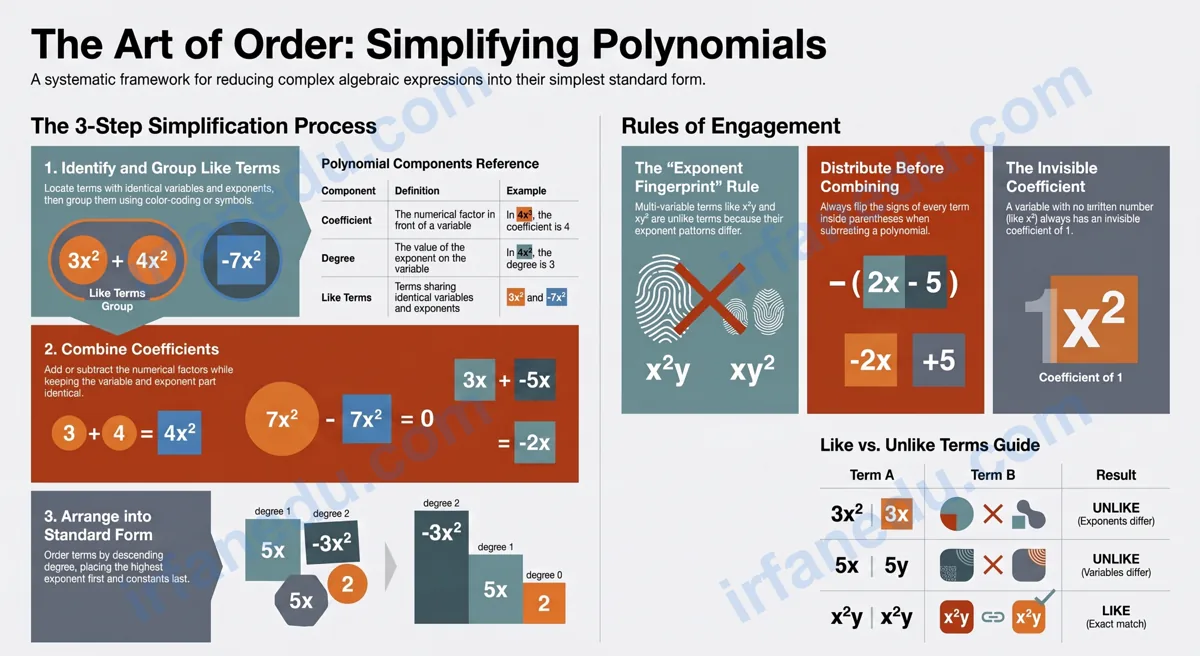
- Multi-variable terms like x²y and xy² are unlike terms — exponent patterns differ.
What is a polynomial?
Think of a polynomial as a sorted storage shelf. Each shelf slot holds one type of item — one type of term. A polynomial is a mathematical expression made of one or more terms, where each term is a number, a variable, or a product of a number and variable(s) raised to a whole-number exponent.
| Term | Definition | Example |
|---|---|---|
| Polynomial | An expression with one or more terms; whole-number exponents only | 4x³ − 2x + 7 |
| Term | A single number, variable, or product separated by + or − | 4x³ is one term |
| Coefficient | The numerical factor in front of the variable | In 4x³, the coefficient is 4 |
| Degree of a term | The exponent on the variable (or sum of exponents for multi-variable terms) | Degree of 4x³ is 3 |
| Degree of a polynomial | The highest degree among all terms | Degree of 4x³ − 2x + 7 is 3 |
| Standard form | Terms written in descending order of degree | 4x³ − 2x + 7 (not 7 − 2x + 4x³) |
| Like terms | Terms with identical variable(s) AND identical exponent(s) | 3x² and −7x² are like; 3x² and 3x are NOT |
A monomial has one term (e.g., 6x²), a binomial has two (e.g., 3x + 5), and a trinomial has three (e.g., x² − 2x + 1). These names describe the simplified form — so you cannot name the type until you have simplified.
Why simplifying polynomials matters
Simplified polynomials are the foundation of almost every algebra skill that follows. You cannot factor, graph, or solve a polynomial equation efficiently if the expression is still cluttered with unsimplified terms.
In my experience teaching algebra, students who struggle with factoring or quadratic equations almost always have the same root problem: they never built a solid habit of simplifying first. I have seen students try to factor 3x² + 5x − 2x² + 7 − 3x directly — an impossible task — when a 30-second simplification step would turn it into the clean x² + 2x + 7 they could actually work with. Simplifying is not a minor housekeeping step. It is the prerequisite for everything else.
Beyond algebra class, simplified expressions are easier to evaluate, easier to graph, and far less prone to arithmetic errors. Every extra unsimplified term is a trap waiting to catch you on a timed test.
How do you simplify a polynomial? (4-step method)
The 4-step method below works for every polynomial you will encounter in middle school and high school algebra. Think of it as the four actions of tidying that messy desk: identify, group, combine, arrange.
- Identify like terms. Scan every term. Two terms are “like” only if they share the exact same variable(s) raised to the exact same exponent(s). Circle or underline matching groups with the same color or symbol.
- Group like terms together. Rewrite the expression with like terms adjacent. Carry the sign (+ or −) that sits in front of each term as you move it — the sign belongs to the term, not to the space between terms.
- Combine coefficients. Add or subtract the coefficients of each group. The variable part does not change — only the number in front changes. If the coefficient becomes 0, the term disappears entirely.
- Write in standard form. Arrange the surviving terms in descending order of degree. The highest-degree term leads; the constant (degree 0) comes last.
That is the complete method. The only complication is when parentheses are involved — in that case, add a zero-th step: distribute any coefficient or negative sign outside the parentheses before you begin step 1.
Expression:  3x²  +  5x  −  2x²  +  7  −  3x

Step 1 — Identify like terms:
  ┌─────────────┐   ┌──────────────┐   ┌─────┐
  │ 3x²  − 2x² │   │  5x  −  3x  │   │  7  │
  │  (x² group)│   │  (x group)  │   │(const)│
  └─────────────┘   └──────────────┘   └─────┘

Step 2 — Group:
  (3x² − 2x²)  +  (5x − 3x)  +  7

Step 3 — Combine coefficients:
  (3−2)x²  +  (5−3)x  +  7
   = 1x²   +   2x    +  7

Step 4 — Standard form (already in order):
  x² + 2x + 7  ✓
Worked examples: simplifying polynomials step by step
Three examples below, progressing from straightforward to a case with parentheses and a negative sign — the type that trips students up most often.
Simplify: 6a² + 4a − a² + 2a − 9
Step 1 — Like terms: a² terms: 6a² and −a². a terms: 4a and 2a. Constant: −9.
Step 2 — Group: (6a² − a²) + (4a + 2a) − 9
Step 3 — Combine: 5a² + 6a − 9
Step 4 — Standard form: Already in order. Answer: 5a² + 6a − 9
Simplify: (7n² + 2n − 9) − (3n² − 4n + 2)
Zero-th step — Distribute the minus sign:
7n² + 2n − 9 − 3n² + 4n − 2
Note: −(−4n) becomes +4n, and −(+2) becomes −2. This is where most errors happen.
Step 1–3 — Group and combine: (7n² − 3n²) + (2n + 4n) + (−9 − 2) = 4n² + 6n − 11
Answer: 4n² + 6n − 11
Simplify: 3(2x² − x + 4) − 2(x² + 3x − 1)
Zero-th step — Distribute:
6x² − 3x + 12 − 2x² − 6x + 2
Step 1–3 — Combine: (6x² − 2x²) + (−3x − 6x) + (12 + 2) = 4x² − 9x + 14
Answer: 4x² − 9x + 14
Like terms vs unlike terms: side-by-side comparison
The single most important judgment call in simplifying polynomials is deciding whether two terms are “like.” Here is a reference table that covers the cases students most often get wrong.
| Term A | Term B | Like terms? | Reason |
|---|---|---|---|
| 3x² | −7x² | YES | Same variable (x), same exponent (2) |
| 3x² | 3x | NO | Same variable, but exponents differ (2 vs 1) |
| 5x | 5y | NO | Different variables |
| 4 | −9 | YES | Both are constants (degree 0) |
| x²y | xy² | NO | Exponent pattern differs (x²y¹ vs x¹y²) |
| 2x²y | −5x²y | YES | Same variables, same exponents on each |
| 6m³ | 6m³n | NO | Second term has an extra variable factor |
| −x | x | YES | Both are degree-1 x terms; coefficients are −1 and 1 |
The x²y vs xy² case is the one I have to re-teach most often at the high school level. Students see “x, y, and a 2 somewhere” and assume the terms are alike. I always tell them: read the exponent pattern like a fingerprint — x²y¹ and x¹y² are different fingerprints, so they cannot be combined. No shortcut replaces reading each exponent carefully.
Common mistakes when simplifying polynomials
These four errors account for the vast majority of wrong answers I see on algebra tests. Recognizing them in advance is half the battle.
| ❌ Wrong | ✅ Right |
|---|---|
| Combining unlike terms: 3x² + 2x = 5x³ | 3x² + 2x stays as 3x² + 2x — exponents differ, cannot combine |
| Changing the exponent: 3x² + 4x² = 7x⁴ | 3x² + 4x² = 7x² — only coefficients add; exponent stays 2 |
| Missing the sign flip: (5x − 3) − (2x − 7) = 3x − 10 | Distribute the minus: 5x − 3 − 2x + 7 = 3x + 4 |
| Dropping a term: 4x² + 0x − 5 written as 4x² − 5 with the middle term forgotten | If a coefficient becomes 0, the term vanishes cleanly: 4x² − 5 is correct, but confirm it was truly 0 first |
The sign-flip error (mistake #3) is the single most common source of lost points on algebra tests. When you subtract a polynomial in parentheses, every term inside flips sign — not just the first one. Write out the distribution step explicitly every time; do not try to do it in your head.
Most simplifying-polynomials guides focus entirely on combining like terms — and stop there. What they rarely mention is the coefficient-of-1 invisibility trap.
When a term like x² appears without a written coefficient, students routinely treat it as having no coefficient at all. So when they compute 3x² − x², they
Sources & References
Written and fact-checked by Dr Irfan Mansuri. External links open in a new tab and are provided for further reading and verification.