
Thomas Paine’s Common Sense: A Complete Summary and Analysis
✍ Written & fact-checked by Dr. Irfan Mansuri
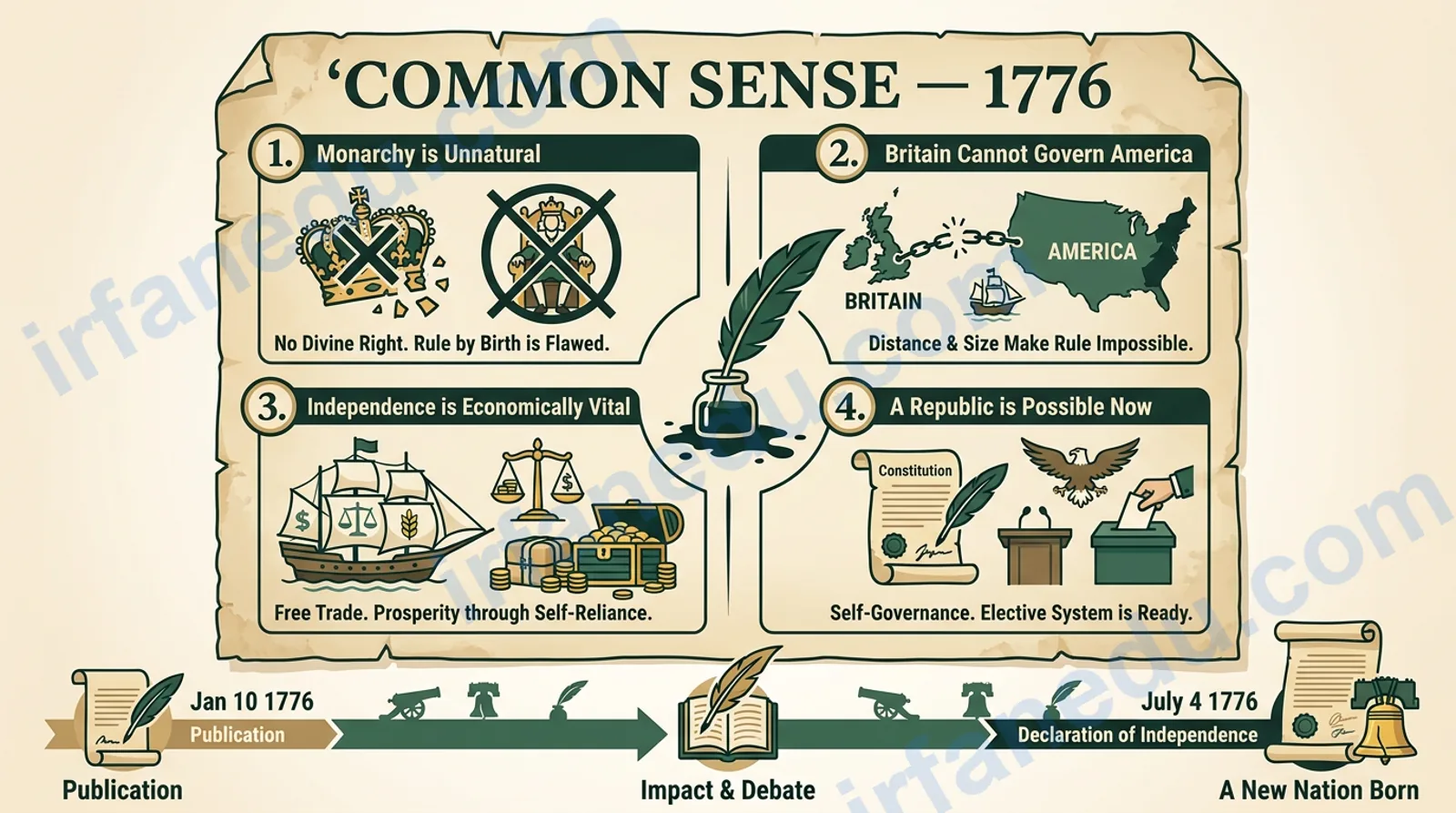
Thomas Paine’s Common Sense, published on January 10, 1776, is a 47-page pamphlet that made one audacious argument in plain English: the American colonies should not seek reform within the British Empire — they should break from it entirely and build a democratic republic from scratch. No political document of its era reached as many ordinary readers, and none shifted public opinion faster.
In my experience teaching this text, students often underestimate how radical that argument was in early 1776. At that point, most colonists still considered themselves British subjects seeking fairer treatment, not revolutionaries. Paine changed that framing in a matter of weeks. By the time the Continental Congress voted on independence in July 1776, the intellectual groundwork had been laid by this one pamphlet.
This guide gives you a section-by-section summary, analysis of Paine’s key arguments, the historical context you need, and a free printable worksheet so you can test your understanding.
After reading this guide, you will be able to:
- Summarize each of the four parts of Common Sense accurately.
- Explain Paine’s three core arguments in your own words.
- Identify the rhetorical techniques Paine used to persuade ordinary readers.
- Connect Common Sense to the Declaration of Independence and beyond.
10 comprehension and analysis questions — print and practise.
⚡ TL;DR
- Published January 10, 1776 by Thomas Paine (an English immigrant).
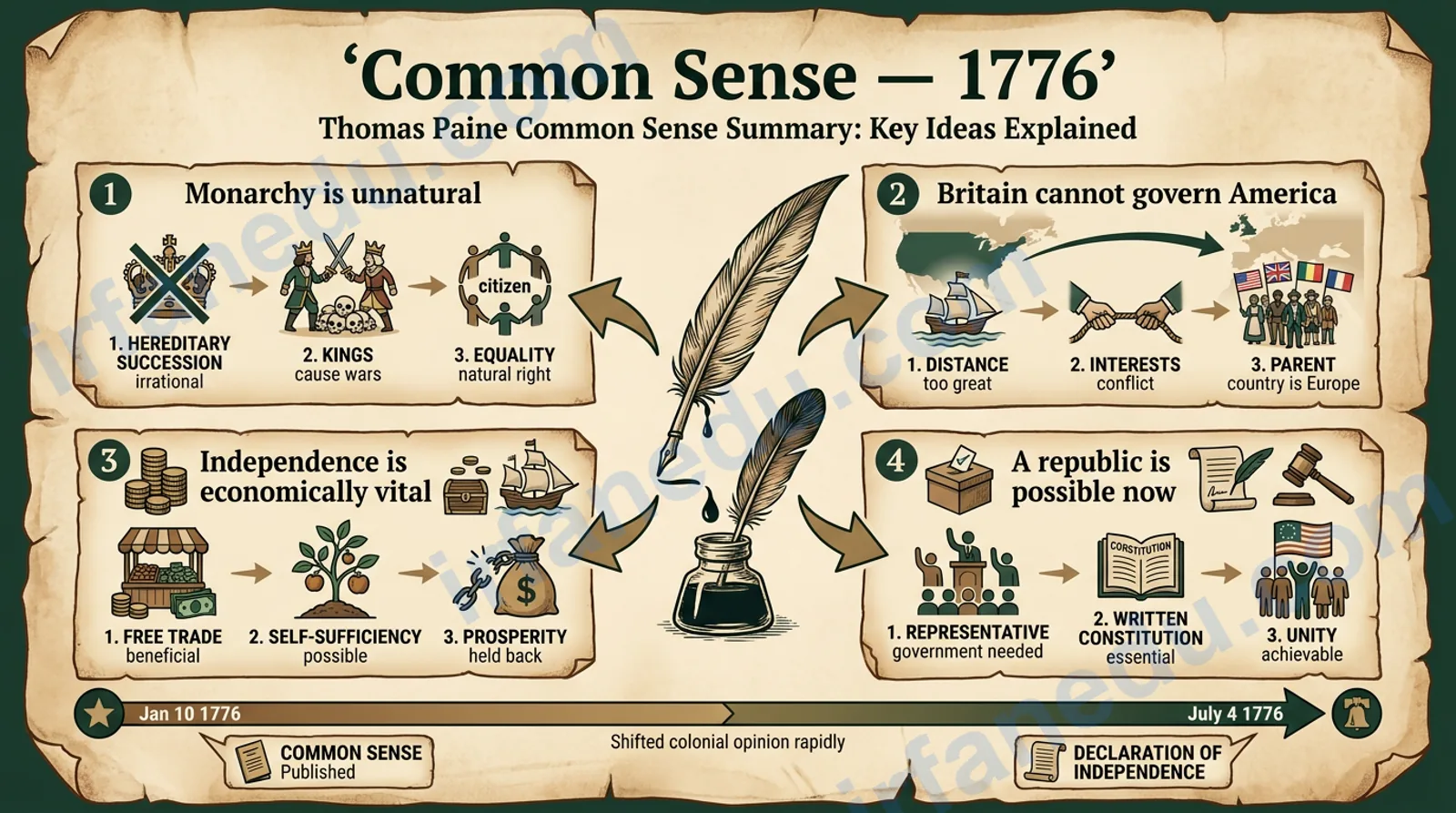
- Core claim: monarchy is unnatural; Britain has no right to rule the colonies.
- Paine proposed a democratic republic with a written constitution.
- Sold ~500,000 copies — extraordinary for a population of ~2.5 million.
- Shifted colonial opinion from reform to full independence within months.
- Influenced the Declaration of Independence (July 4, 1776).
Historical context: why 1776 mattered
By January 1776, the American colonies had been in open conflict with Britain for nearly a year — the battles of Lexington, Concord, and Bunker Hill had already been fought. Yet the dominant colonial position was still reconciliation, not independence. Most colonial leaders, including many in the Continental Congress, wanted a return to the relationship that existed before the Stamp Act of 1765.
Thomas Paine arrived in this atmosphere as a recent immigrant. Born in Thetford, Norfolk, England in 1737, he had failed at multiple careers — corset-maker, tax collector, schoolteacher — before Benjamin Franklin encouraged him to emigrate to Philadelphia in 1774. He had been in America for just over a year when he wrote Common Sense.
That outsider status matters. Paine had no land, no family connections, and no political career to protect. He could say what established colonial leaders could not afford to say publicly: that the entire British system was rotten, that the king was a tyrant, and that independence was not just desirable but inevitable.
The four parts of Common Sense — section summaries
The pamphlet is divided into four sections. Each builds on the previous one, moving from abstract political philosophy to a concrete call to action.
Part 1: On the origin and design of government in general
Paine opens by distinguishing between society and government. Society, he argues, is produced by human needs and is a positive force. Government, by contrast, is produced by human wickedness — it is a “necessary evil” whose only purpose is to protect life, liberty, and property. The simpler the government, the better.
Paine’s thought experiment
Paine asks readers to imagine a small group of people starting fresh on an island. They would naturally cooperate (society). Only when some members broke the rules would they need laws and enforcers (government). This thought experiment strips government of any divine or hereditary legitimacy — it is purely functional.
Part 2: On monarchy and hereditary succession
This is the most philosophically radical section. Paine argues that monarchy is not just bad government — it is unnatural and anti-Biblical. He cites the Old Testament story of Samuel (1 Samuel 8), in which the Israelites demand a king and God warns them this is a mistake. Paine uses this to argue that kingship is a sin against God’s design.
He then attacks hereditary succession directly: “For all men being originally equals, no one by birth could have a right to set up his own family in perpetual preference to all others.” The idea that a nation should be governed by whoever happens to be born to the current king is, Paine says, absurd on its face.
Part 3: Thoughts on the present state of American affairs
This is the practical heart of the pamphlet. Paine makes three arguments for immediate independence:
- Economic: Being tied to Britain forces the colonies into European wars they have no interest in, damaging trade with nations that would otherwise be neutral partners.
- Military: The colonies are large enough and resource-rich enough to build a navy and defend themselves.
- Diplomatic: No foreign nation will formally ally with the colonies as long as they claim to be part of Britain. Independence is a prerequisite for international support.
Part 4: On the present ability of America
Paine closes by arguing that the colonies are right now in the best possible position to declare independence. They are young, growing, and not yet burdened by the debts and entrenched aristocracies of European nations. Waiting, he argues, will only make independence harder — not easier.
Paine’s three core arguments explained
Across all four parts, three arguments do the heaviest lifting. Understanding these three will get you through any essay or exam question on this text.
Argument 1: Monarchy is irrational and immoral
Paine does not just say the current king is bad — he says the institution of monarchy is indefensible. His logic: if all men are created equal (a premise his readers largely accepted), then no man has a natural right to rule over others by birth. Hereditary monarchy is therefore a logical contradiction.
Argument 2: Britain has no legitimate authority over the colonies
Paine attacks the idea that Britain “discovered” and therefore owns the colonies. He points out that the colonies were populated largely by people fleeing British persecution — religious minorities, economic refugees. Britain did not create colonial prosperity; colonists did. The “mother country” metaphor, he argues, is propaganda.
Argument 3: Immediate independence is the only rational choice
Paine reframes the debate entirely. The question is not “should we seek independence?” but “why are we waiting?” He lists the practical advantages the colonies have right now — natural resources, a large population, geographic distance from Britain — and argues that delay only benefits Britain, not the colonists.
How did Paine persuade ordinary readers?
The rhetorical achievement of Common Sense is as important as its arguments. Paine deliberately wrote for an audience that had never read a political pamphlet.
Plain language over legal jargon
Earlier colonial political writing — John Dickinson’s Letters from a Farmer in Pennsylvania, for instance — was written for educated gentlemen and filled with Latin phrases and legal citations. Paine stripped all of that out. His sentences are short. His metaphors are domestic. He compares monarchy to a bad parent, government to a necessary lock on a door.
Biblical authority
Paine knew his audience was deeply religious. By grounding his argument against monarchy in the Old Testament, he made independence feel not just politically correct but spiritually correct. This was a masterstroke of audience awareness.
Emotional directness
Paine calls King George III “the Royal Brute of Britain” and “the hardened, sullen-tempered Pharaoh of England.” This kind of language was shocking in 1776 — no published colonial writer had spoken about the king this way. It gave readers permission to feel anger they had been suppressing.
Paine’s rhetorical strategy — at a glance
AUDIENCE: Ordinary colonists (farmers, tradespeople, artisans)
         |
         v
STRATEGY 1: Plain English (no Latin, no legal jargon)
         |
STRATEGY 2: Biblical framing (monarchy = sin against God)
         |
STRATEGY 3: Emotional language ("Royal Brute", "Pharaoh")
         |
STRATEGY 4: Practical economics (independence = better trade)
         |
         v
RESULT: Shifted opinion from "reform" to "independence"
        in under 6 months (Jan 1776 -> Jul 1776)
Common Sense vs. the Declaration of Independence
Students often confuse these two documents or assume one caused the other in a simple chain. The relationship is more nuanced. Common Sense created the popular will; the Declaration gave it legal and diplomatic form.
| Feature | Common Sense (Jan 1776) | Declaration of Independence (Jul 1776) |
|---|---|---|
| Author | Thomas Paine (English immigrant, no political office) | Thomas Jefferson (with Franklin, Adams, Sherman, Livingston) |
| Audience | Ordinary colonists — farmers, tradespeople | Colonial leaders, foreign governments, posterity |
| Tone | Passionate, populist, emotionally direct | Formal, legalistic, philosophically measured |
| Core claim | Independence is necessary and achievable now | Independence is legally and morally justified |
| Language level | Plain English, accessible to non-readers | Elevated prose, assumes educated reader |
| Legal status | None — a pamphlet, not an official document | Official act of the Continental Congress |
| Lasting influence | Model for popular political writing; influenced French Revolution | Foundation of US law; cited globally in independence movements |
Common student mistakes when analyzing this text
These are the errors I see most often in student essays and exam answers. Fixing them will immediately improve your grade.
This misses the point. Paine’s argument is structural, not personal — he argues the institution of monarchy is flawed, regardless of who sits on the throne.
The Revolution was already underway — battles had been fought for nine months. Paine changed the goal of the conflict, not its existence.
Paine was born in England and had lived in America for only about 14 months when he wrote Common Sense. His outsider perspective was part of what made his argument so direct.
💡 Unique Insight: the economic argument is stronger than the moral one
Most textbooks and online summaries lead with Paine’s moral argument against monarchy — and that is the part students remember. But in my reading of the pamphlet, Paine’s economic argument in Part 3 is what actually moved fence-sitters.
Here is the non-obvious point: by 1776, many colonists had already accepted that the king was behaving unjustly. What they feared was the cost of independence — war, economic disruption, loss of British trade protection. Paine’s genius was to flip this: he argued that staying in the Empire was the economically dangerous choice, because it dragged the colonies into European wars that had nothing to do with them and blocked trade with France, Spain, and the Netherlands.
This reframe — from “independence is a moral duty” to “independence is an economic necessity” — is what separated Common Sense from every earlier colonial pamphlet. It gave merchants and farmers a self-interested reason to support independence, not just a principled one. Most guides get this wrong by treating the pamphlet as purely ideological.
On-page practice worksheet: Common Sense comprehension
Use these questions to test your understanding before downloading the full PDF. Try to answer each one without looking at your notes first, then check the answer key below.
How to use this worksheet: Work through all ten questions in order. For short-answer questions, write two to three sentences. When you are done, open the Answer Key to self-check. For any question you got wrong, re-read the relevant section above before moving on.
- On what date was Common Sense first published, and who wrote it?
- Name the THREE main arguments Paine makes in Common Sense.
- Paine uses the Bible to argue against monarchy. Which Old Testament story does he cite to show that kingship is against God’s will?
- What does Paine mean when he calls the king “the Royal Brute of Britain”?
- Paine argues that being part of the British Empire actually hurts colonial trade. Give ONE economic reason he provides.
- What form of government does Paine propose to replace British rule?
- Approximately how many copies of Common Sense were sold within a year of publication?
- How does Common Sense differ in tone and language from earlier colonial political writing? Give ONE specific difference.
- True or False: Paine was born in America. Explain your answer.
- In your own words, explain why Common Sense was historically significant beyond just the American Revolution.
Show Answer Key
- January 10, 1776; Thomas Paine.
- (1) Monarchy is an unnatural and corrupt form of government. (2) Britain has no legitimate right to govern the colonies. (3) Immediate independence is necessary and achievable.
- The story of Samuel and the Israelites demanding a king (1 Samuel 8), which Paine says God warned against.
- He means the king acts like a tyrant — using brute force rather than reason or justice to govern — and deserves no loyalty.
- Britain forced the colonies into trade wars with European nations that the colonies had no quarrel with, damaging commerce the colonies could otherwise conduct freely.
- A democratic republic with a written constitution, elected representatives, and no hereditary monarchy.
- Approximately 500,000 copies (some estimates range from 100,000 to 500,000 across all editions).
- Paine wrote in plain, direct English aimed at ordinary colonists, avoiding the Latin phrases and legal jargon used by educated elites like John Adams or Thomas Jefferson.
- False. Paine was born in Thetford, Norfolk, England in 1737 and emigrated to the colonies in 1774, just two years before writing Common Sense.
- It demonstrated that political ideas could be communicated to a mass audience in plain language, influencing later democratic movements in France and beyond, and establishing a model for popular political writing.
Includes all 10 questions + a separate Answer Key section. Print-ready A4/Letter format.
Quick knowledge check (3 questions)
Select an answer to see instant feedback.
1. In which year was Common Sense published?
Not quite. 1765 was the year of the Stamp Act. Common Sense came later.
Correct! Common Sense was published on January 10, 1776.
Not quite. 1783 was the end of the Revolutionary War — Common Sense came much earlier.
2. What was Paine’s nationality at birth?
Not correct. Paine was born in England and emigrated to America in 1774.
Not correct. Paine was English-born, though he later became a French citizen during the French Revolution.
Correct! Paine was born in Thetford, Norfolk, England in 1737.
3. Which of the following best describes Paine’s proposed alternative to monarchy?
Not quite. Paine rejected monarchy entirely — he did not want to reform it.
Correct! Paine called for a republic governed by elected representatives under a written constitution.
Not correct. While Paine used Biblical arguments, he did not propose religious rule.
Reveal-on-click practice problems
These are the kind of short-answer questions you might see on a US History exam. Try to answer before revealing the model response.
Practice 1: Why did Paine write in plain English rather than formal political prose?
Model answer: Paine deliberately used plain English because his target audience was ordinary colonists — farmers, artisans, and tradespeople — who had no access to legal education or classical learning. By stripping out Latin phrases and legal jargon, he made his arguments accessible to anyone who could read, dramatically expanding the pamphlet’s reach and influence.
Practice 2: Explain the difference between Paine’s view of “society” and “government.”
Model answer: Paine argued that society is a positive force created by human needs and cooperation — people naturally come together for mutual benefit. Government, by contrast, is a “necessary evil” created only because some people behave badly. Its sole purpose is to restrain wickedness and protect liberty. This distinction allowed Paine to argue that less government is better, and that a simple republic is preferable to a complex monarchy.
Practice 3: How did Common Sense contribute to the Declaration of Independence?
Model answer: Common Sense created the popular mandate for independence that political leaders needed before they could act officially. By January 1776, most colonial leaders privately favored independence but feared public backlash. Paine’s pamphlet shifted public opinion decisively, giving the Continental Congress the political cover to vote for independence in July 1776. Several of Paine’s arguments — natural rights, the illegitimacy of hereditary rule — also appear in the Declaration’s language.
Frequently asked questions
What is the main argument of Thomas Paine’s Common Sense?
Paine’s central argument is that monarchy is an irrational system of government, that Britain has no legitimate authority over the American colonies, and that immediate independence — not reconciliation — is the only logical course of action. He supports this with philosophical, Biblical, economic, and military reasoning, making the case accessible to ordinary readers rather than just political elites.
When was Common Sense published and how many copies were sold?
Common Sense was published on January 10, 1776. It sold approximately 500,000 copies across all editions within its first year — a staggering figure for a colonial population of roughly 2.5 million. Historians note that if you account for copies being read aloud in taverns and public spaces, the effective audience was even larger.
What are the four parts of Common Sense?
The four sections are: (1) On the origin and design of government in general — distinguishing society from government; (2) On monarchy and hereditary succession — arguing kingship is unnatural and anti-Biblical; (3) Thoughts on the present state of American affairs — the practical case for immediate independence; (4) On the present ability of America — arguing the colonies are ready and well-positioned to succeed as an independent nation.
How did Common Sense influence the Declaration of Independence?
Common Sense shifted colonial public opinion from seeking reform within the British Empire to demanding full independence. It gave political leaders like Jefferson and Adams the popular mandate they needed, and several of Paine’s arguments about natural rights and self-governance echo directly in the Declaration’s language and structure. Without the public shift Paine created, the Continental Congress would have faced far greater resistance to a vote for independence.
Dr. Irfan Mansuri
Dr. Irfan Mansuri is an
Sources & References
Written and fact-checked by Dr Irfan Mansuri. External links open in a new tab and are provided for further reading and verification.