
Normal desk height calculator: find your perfect ergonomic fit
- Quick answer: what is normal desk height?
- TL;DR
- Interactive desk height calculator
- How to use this calculator
- Sitting vs. standing desk: comparison
- The formula explained
- Worked examples
- Common mistakes (and how to fix them)
- My key takeaway
- Quick quiz
- Practice problems
- FAQ
- Key takeaways
- About the author
- Sources & references
Most people buy a desk, sit down, and only notice something feels off after weeks of neck pain. The fix is simple: match the desk to your body, not the other way around. This calculator does that math for you in under 10 seconds.
Enter your elbow height (sitting or standing), and the tool returns your ideal desk height in both inches and centimeters, with a full step-by-step breakdown.
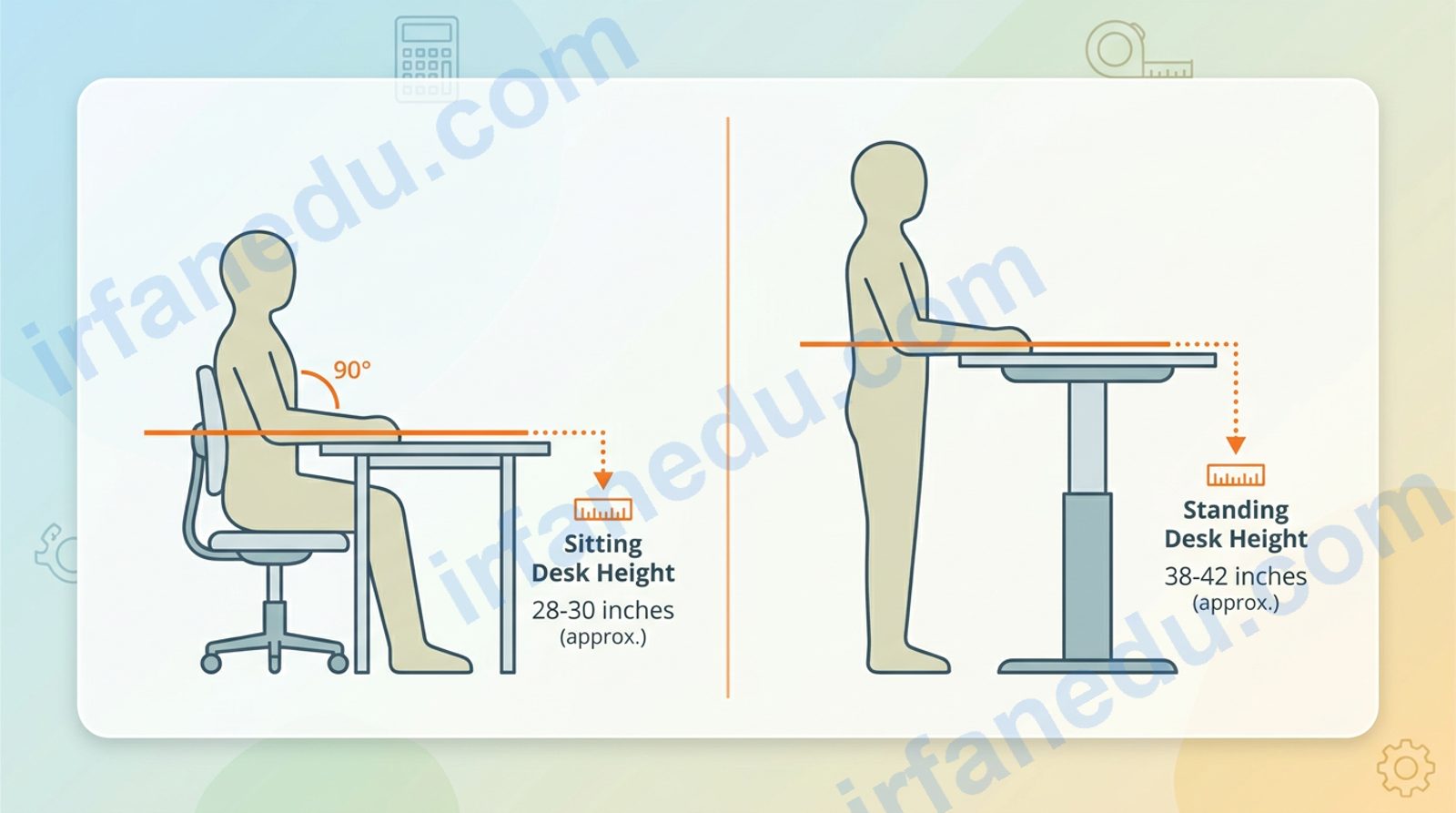
Normal desk height for sitting is 28 to 30 inches (71 to 76 cm) for an average adult. Your ideal desk height equals your seated elbow height minus 2 to 3 inches. For a standing desk, match the surface to your standing elbow height, typically 38 to 42 inches (97 to 107 cm). Use your own elbow measurement for the most accurate personal fit.
- Standard sitting desk height: 28 to 30 inches (71 to 76 cm).
- Standard standing desk height: 38 to 42 inches (97 to 107 cm).
- Formula: ideal desk height = seated elbow height minus 2 to 3 inches.
- Measure your elbow height while seated with feet flat and back straight.
- Taller or shorter than average? Use this calculator for a personalized number.
- Wrong desk height causes neck, shoulder, and wrist strain over time.
Normal Desk Height Calculator
Enter your elbow height to get your ideal desk height instantly
in
Sit upright, feet flat, elbow bent 90°. Measure floor to elbow bottom.
How to use this calculator
The calculator needs one measurement: your elbow height from the floor. Here is how to get it right.
- Choose your unit (inches or centimeters) from the dropdown.
- Select a mode: Sitting Desk if you work seated, Standing Desk if you use a height-adjustable desk while standing.
- Measure your elbow height: For sitting mode, sit in your chair with feet flat and back straight, bend your elbow to 90 degrees, and measure from the floor to the bottom of your elbow. For standing mode, stand straight, bend your elbow to 90 degrees, and measure the same way.
- Enter the value and click Calculate.
- Read your result: the card shows your ideal desk height, the acceptable range, and the conversion to the other unit.
Sitting vs. standing desk: which height is right for you?
The right desk type depends on how you work, not just your height. Here is a direct comparison to help you decide.
| Factor | Sitting desk | Standing desk |
|---|---|---|
| Typical height range | 28–30 in (71–76 cm) | 38–42 in (97–107 cm) |
| Formula | Seated elbow height − 2–3 in | Standing elbow height (±1 in) |
| Best for | Long focused work sessions | Alternating posture throughout the day |
| Risk if wrong height | Shoulder shrug, wrist extension | Neck tilt, lower back fatigue |
| Adjustability needed | Low (fixed desk fine if measured) | High (motorized desk recommended) |
| Chair height matters? | Yes, critical | Less so |
In my experience helping students and remote workers set up home offices, the single biggest mistake is buying a standing desk and setting it to a fixed height that works for standing only. If you stand at the correct elbow height but then sit down without lowering the desk, you end up reaching up to type, which is worse than a desk that is slightly too low. If you invest in a height-adjustable desk, measure both your sitting and standing elbow heights and save both presets from day one.
The formula for ideal desk height
The ergonomic desk height formula is based on your elbow height, the single most reliable predictor of a comfortable working surface.
SITTING DESK HEIGHT FORMULA
----------------------------
Desk height (min) = Seated elbow height - 3 in (7.6 cm)
Desk height (max) = Seated elbow height - 2 in (5.1 cm)
Ideal             = Seated elbow height - 2.5 in (6.4 cm)

STANDING DESK HEIGHT FORMULA
-----------------------------
Desk height       = Standing elbow height ± 0.5 in (1.3 cm)

WHERE:
  Seated elbow height   = distance from floor to bent elbow while seated
  Standing elbow height = distance from floor to bent elbow while standing
| Symbol | Meaning | Unit |
|---|---|---|
| D | Ideal desk height | inches or cm |
| Esit | Seated elbow height from floor | inches or cm |
| Estand | Standing elbow height from floor | inches or cm |
| 2–3 in | Ergonomic offset (sitting) | inches (5.1–7.6 cm) |
The 2 to 3 inch offset for sitting exists because resting your forearms on the desk surface at exactly elbow height creates upward shoulder tension. Dropping the surface slightly below elbow height lets your shoulders relax while keeping your wrists neutral.
Worked examples
Seated elbow height: 27 inches.
Desk height range: 27 − 3 = 24 in to 27 − 2 = 25 in.
Ideal desk height: 27 − 2.5 = 24.5 inches (62.2 cm).
Note: this is slightly below the 28–30 in standard, which assumes a higher chair. With a properly adjusted chair, 24.5 in is correct for this person.
Seated elbow height: 24 inches.
Desk height range: 24 − 3 = 21 in to 24 − 2 = 22 in.
Ideal desk height: 21.5 inches (54.6 cm).
A standard 30-inch desk would be 8.5 inches too high for this person, forcing a constant shoulder shrug.
Standing elbow height: 45 inches.
Ideal standing desk height: 45 − 0.5 = 44.5 inches (113 cm).
Most standing desks max out at 48 inches, so this is achievable on any quality adjustable frame.
Desk height by body height: quick reference
If you do not have a tape measure handy, this table gives a starting estimate. Always verify with your actual elbow measurement.
| Body height | Approx. sitting desk height | Approx. standing desk height |
|---|---|---|
| 5 ft 0 in (152 cm) | 24–25 in (61–64 cm) | 36–38 in (91–97 cm) |
| 5 ft 4 in (163 cm) | 25–27 in (64–69 cm) | 38–40 in (97–102 cm) |
| 5 ft 8 in (173 cm) | 27–28 in (69–71 cm) | 40–42 in (102–107 cm) |
| 6 ft 0 in (183 cm) | 28–30 in (71–76 cm) | 43–45 in (109–114 cm) |
| 6 ft 4 in (193 cm) | 30–32 in (76–81 cm) | 45–47 in (114–119 cm) |
Common mistakes when setting desk height
Most ergonomic problems at a desk come from one of four avoidable errors.
The 28 to 30 inch figure cited everywhere was derived from furniture industry averages in the mid-20th century, when the average office worker was a 5 ft 10 in male. It has never been a universal ergonomic standard. The American National Standards Institute (ANSI) and the Human Factors and Ergonomics Society both recommend adjustable workstations precisely because no fixed height fits the full range of adult body sizes.
What most guides get wrong: they present the 29-inch figure as if it is a safe default. For anyone under 5 ft 6 in, it is not. A person who is 5 ft 2 in tall working at a 29-inch desk is effectively working with their arms raised 4 to 6 inches above their natural elbow height all day. That is the equivalent of a slight constant shoulder shrug, which is a well-documented cause of trapezius overload and upper back pain. The elbow-height formula in this calculator corrects for that.
Quick quiz: test your knowledge
1. What is the correct formula for sitting desk height?
2. A person has a seated elbow height of 25 inches. What is their ideal desk height?
3. Which body measurement is used to calculate standing desk height?
Select an answer to see if it is correct (green = correct, red = wrong).
Practice problems
Sources & References
Written and fact-checked by Dr Irfan Mansuri. External links open in a new tab and are provided for further reading and verification.