
Rebar Cost Calculator: Estimate Steel Reinforcement Price Fast
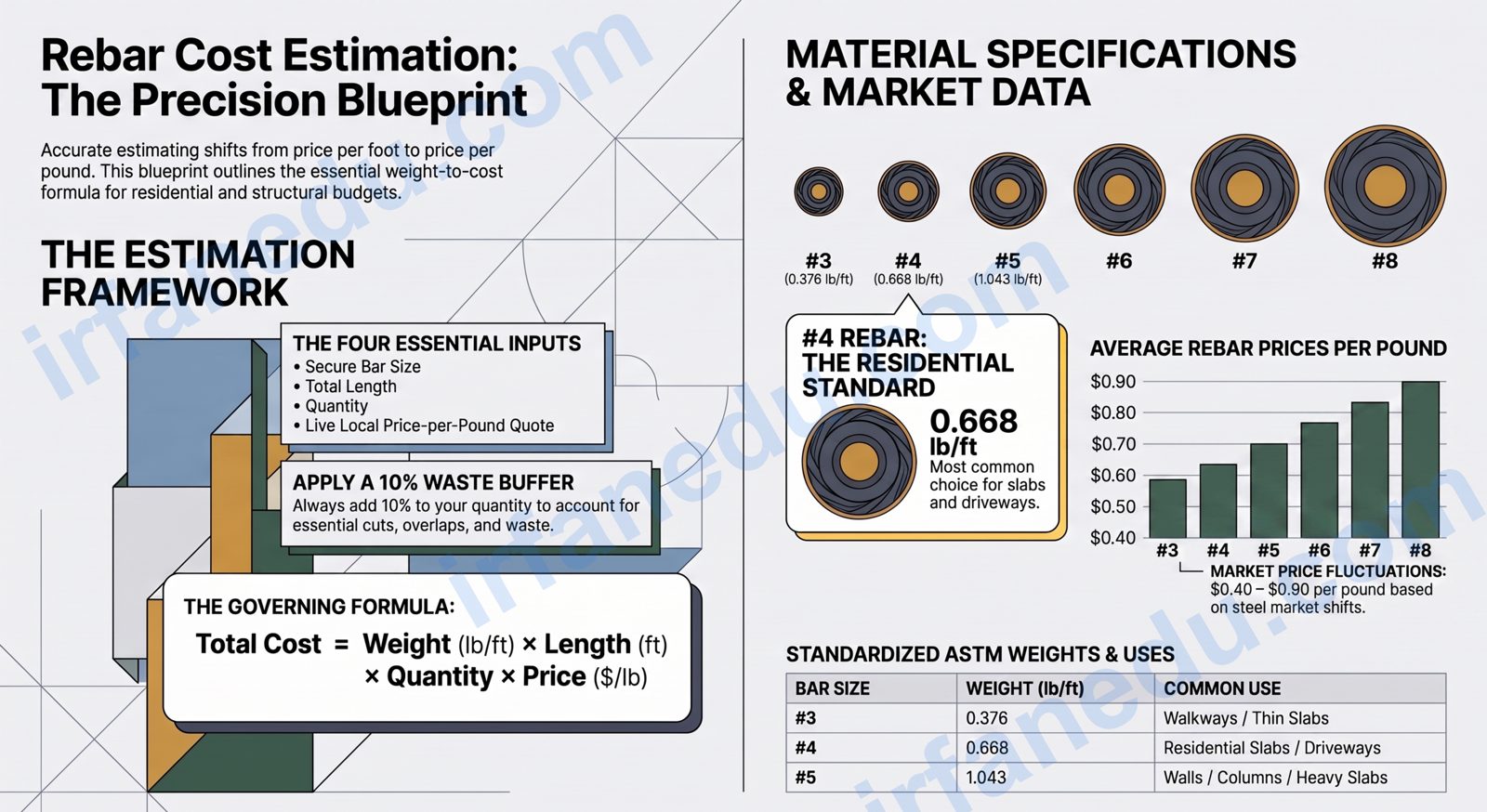
To get an accurate estimate, have three numbers ready: (1) the bar size you plan to use (e.g. #4), (2) the total length of rebar your project needs in feet, and (3) a current price per pound from your local steel supplier or hardware store. Rebar is a commodity — prices shift weekly, so a live quote beats any published average.
Rebar costs between $0.40 and $0.90 per pound, or roughly $0.25 to $0.75 per linear foot depending on bar size. A standard 20-foot #4 rebar stick typically costs $4 to $9. Total cost equals the bar’s weight per foot multiplied by total length, quantity, and your local price per pound: Cost = (lb/ft) × Length × Quantity × Price/lb.
- #4 rebar (0.668 lb/ft) is the standard for residential slabs and driveways.
- Total cost formula: weight per foot × total length × quantity × price per pound.
- Rebar prices fluctuate with steel markets — always get a current supplier quote.
- Buying in bundles from a steel service center saves 15–25% vs. hardware stores.
- Add 10% waste factor to your quantity estimate for cuts and overlaps.
- This free calculator shows total weight, total cost, and a numbered step-by-step.
Estimating rebar cost is one of the first steps in budgeting any concrete project — from a backyard patio to a full foundation. The math is straightforward once you know your bar size, but most online guides skip the weight-per-foot table that makes the formula work. This calculator does the heavy lifting for you and shows every step so you can verify the result.
Interactive Rebar Cost Calculator
Rebar Cost Calculator
Enter bar size, length, quantity, and price per pound
How to Use This Calculator
- Select your bar size from the dropdown. If you are unsure, #4 is the residential standard.
- Enter the length per bar in feet. Standard stock lengths are 20 ft, but cut-to-length orders vary.
- Enter the number of bars you need. Add a 10% buffer for cuts and overlaps.
- Enter the current price per pound from your supplier quote. If unknown, use $0.50–$0.60 as a rough mid-range estimate.
- Click Calculate Cost. The result card shows total cost, total weight, cost per bar, cost per foot, and a numbered solution.
Quick Facts: Rebar Weight and Price Reference
| Bar Size | Diameter (in) | Weight (lb/ft) | Typical Cost/ft* | Common Use |
|---|---|---|---|---|
| #3 | 3/8 | 0.376 | $0.19–$0.34 | Walkways, thin slabs |
| #4 | 1/2 | 0.668 | $0.33–$0.60 | Residential slabs, driveways, footings |
| #5 | 5/8 | 1.043 | $0.52–$0.94 | Walls, columns, heavier slabs |
| #6 | 3/4 | 1.502 | $0.75–$1.35 | Structural beams, commercial foundations |
| #7 | 7/8 | 2.044 | $1.02–$1.84 | Heavy structural, bridge work |
| #8 | 1 | 2.670 | $1.34–$2.40 | High-load columns, industrial |
*Based on $0.50–$0.90/lb market range. Verify with your local supplier before budgeting.
What Is Rebar and Why Does Bar Size Matter?
Rebar (short for reinforcing bar) is deformed steel rod embedded in concrete to handle tensile stress. Concrete is strong in compression but weak in tension — rebar compensates for that weakness. The ASTM bar number system in the US designates size by the bar's diameter in eighths of an inch: a #4 bar is 4/8 = 1/2 inch in diameter.
Bar size directly drives cost because the weight-per-foot increases roughly with the square of the diameter. A #8 bar weighs more than seven times as much as a #3 bar per linear foot. Choosing a bar size larger than your engineer specifies wastes money; choosing one too small is a structural risk.
In my experience reviewing residential project budgets, the single most common cost overrun I see is people ordering #5 or #6 rebar for a standard driveway slab when #4 is what the concrete mix design calls for. The upgrade feels like a safety margin, but it adds 50–120% to the rebar line item with no structural benefit. Always check your local building code or engineer's spec first — then price it out.
The Rebar Cost Formula Explained
The governing formula is straightforward:
  REBAR COST FORMULA
  ─────────────────────────────────────────────────
  Total Cost ($) = W × L × Q × P

  Where:
    W  = Weight per foot of chosen bar size  (lb/ft)
    L  = Length per bar                      (ft)
    Q  = Number of bars (quantity)
    P  = Price per pound                     ($/lb)

  Derived quantities:
    Total Length  = L × Q                   (ft)
    Total Weight  = W × L × Q               (lb)
    Cost per bar  = W × L × P               ($)
    Cost per foot = W × P                   ($/ft)
  ─────────────────────────────────────────────────
Variables and Symbols Table
| Symbol | Meaning | SI / US Unit |
|---|---|---|
| W | Weight per linear foot of rebar | lb/ft (kg/m in SI) |
| L | Length of one bar | feet (m in SI) |
| Q | Quantity of bars | dimensionless |
| P | Market price per pound | USD/lb (USD/kg in SI) |
| W×L×Q | Total weight of all rebar | lb (kg) |
| W×L×Q×P | Total material cost | USD |
The weight-per-foot values (W) are standardized by ASTM A615 and do not change between suppliers — only the price per pound (P) varies by market and location.
Worked Examples
Example 1: Residential Driveway Slab
A homeowner needs 25 bars of #4 rebar, each 20 ft long. The local steel yard quotes $0.55/lb.
- Bar size #4 → W = 0.668 lb/ft
- Total length = 20 ft × 25 bars = 500 ft
- Total weight = 0.668 × 500 = 334 lb
- Total cost = 334 lb × $0.55/lb = $183.70
Example 2: Concrete Footing with #5 Rebar
A contractor orders 40 bars of #5 rebar at 20 ft each. Price per pound is $0.62.
- Bar size #5 → W = 1.043 lb/ft
- Total length = 20 × 40 = 800 ft
- Total weight = 1.043 × 800 = 834.4 lb
- Total cost = 834.4 × $0.62 = $517.33
Example 3: Small Retaining Wall with #3 Rebar
A DIYer needs 15 bars of #3 rebar at 10 ft each. Hardware store price: $0.80/lb.
- Bar size #3 → W = 0.376 lb/ft
- Total length = 10 × 15 = 150 ft
- Total weight = 0.376 × 150 = 56.4 lb
- Total cost = 56.4 × $0.80 = $45.12
Common Mistakes When Estimating Rebar Cost
| Wrong Approach | Correct Approach |
|---|---|
| Using a price-per-foot from an old article without checking current rates | Get a live quote from your supplier — steel prices shift 20–40% per year |
| Ordering exact quantity with no waste allowance | Add 10% to your bar count for cuts, overlaps, and waste |
| Comparing hardware-store price to contractor price (apples vs. oranges) | Compare on a per-pound basis — the unit that normalizes across bar sizes |
| Assuming all bar sizes cost the same per foot | Cost per foot scales with weight — a #8 bar costs 7× more per foot than a #3 |
| Forgetting labor, tie wire, and chairs in the total budget | Material cost is only 40–60% of installed rebar cost — add labor and accessories |
The waste-factor mistake is the one I see most often in DIY project forums. Someone calculates exactly 48 bars, orders 48, and then discovers they need to cut 6 bars to fit corners — leaving them short. I always tell people: round up to the nearest bundle size and add 10%. The leftover rebar is never wasted on a property; it ends up in the next project.
Most rebar cost guides focus on price per foot, but price per pound is the only fair comparison unit across bar sizes. Here is the non-obvious implication: if your supplier charges $0.55/lb for #4 and $0.53/lb for #5, the #5 is cheaper per pound but costs 56% more per linear foot. Switching bar sizes to "save money" can easily increase your total bill if you are comparing per-foot prices instead of per-pound. Always run the weight calculation first — that is what this calculator does automatically.
Explore More Engineering Calculators
Quick Quiz: Test Your Rebar Knowledge
Q1. What is the weight per foot of #4 rebar?
Q2. You need 10 bars of #5 rebar, each 20 ft long, at $0.60/lb. What is the total cost?
Sources & References
Written and fact-checked by Dr Irfan Mansuri. External links open in a new tab and are provided for further reading and verification.