
Std Rug Sizes Calculator: Find Your Perfect Rug
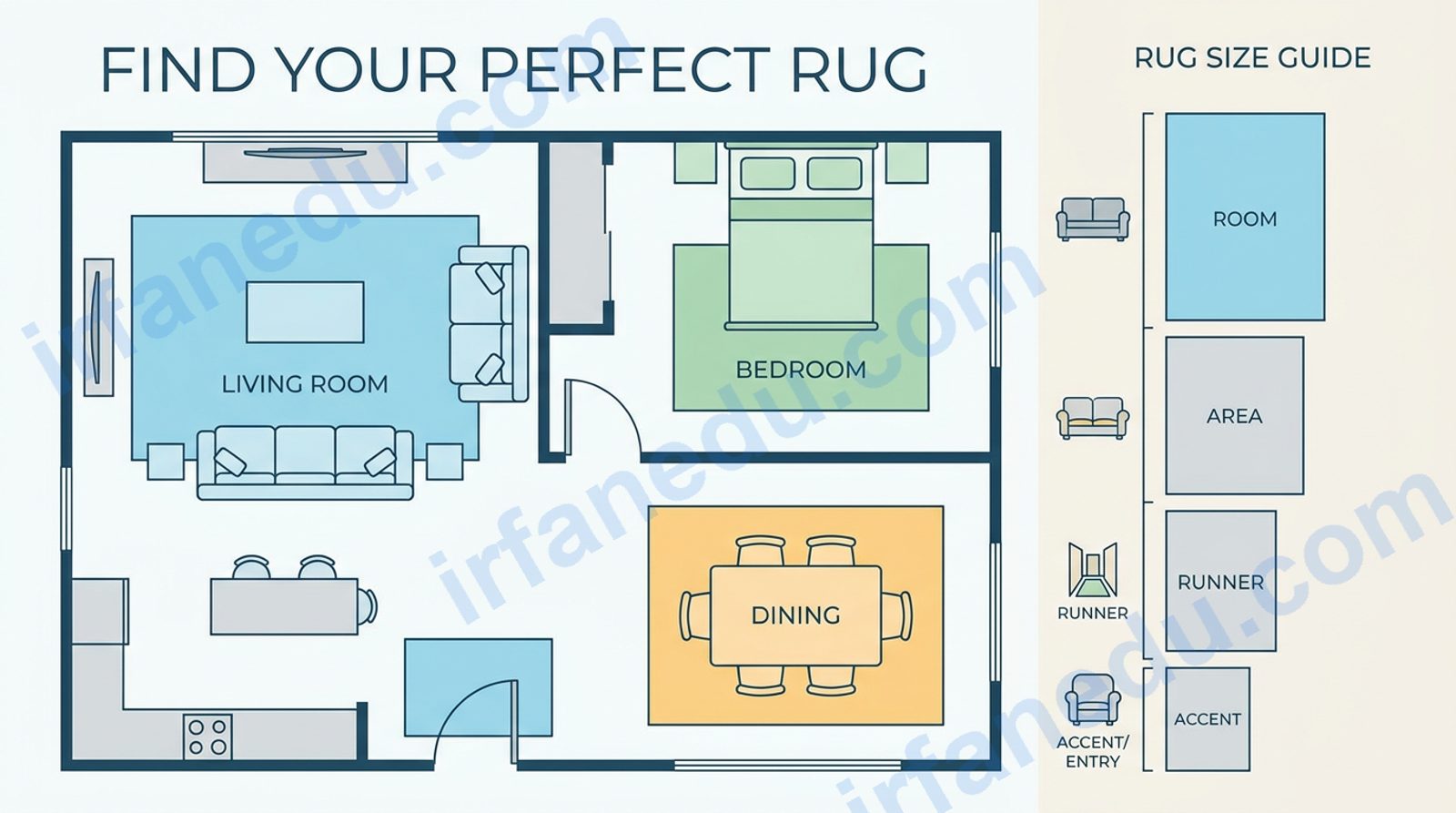
8×10 ft
8×10 ft
6×9 ft
2×3 ft
5×8 ft
That diagram gives you a fast answer, but every room is different. The interactive calculator below takes your exact room dimensions and tells you the best standard rug size — with a full step-by-step explanation of why.
⚡ TL;DR
- 🏠 Leave 18–24 inches of bare floor between the rug and each wall.
- 📏 Most popular sizes: 5×8, 8×10, and 9×12 ft — cover ~80% of rooms.
- 🛋 In a living room, front sofa legs should always sit on the rug.
- 🍽 Dining rugs need 24 inches beyond the table on every side.
- 🛏 For a king bed, an 8×10 ft rug placed two-thirds under the frame works well.
- 🔢 Use the calculator below to get an exact recommendation for your room.
Rug Size Calculator
Enter your room dimensions and type to get an instant rug size recommendation.
feet
feet
📋 Step-by-step solution
How to use this rug size calculator
The calculator follows the standard interior-design rule: leave an 18–24 inch bare-floor border around the rug in most rooms, and 24 inches in dining rooms so chairs can slide freely. Here is the exact process:
- Enter room length — measure wall to wall in feet, not including baseboards.
- Enter room width — the shorter wall-to-wall dimension.
- Select room type — this sets the correct border rule (dining rooms need more clearance than living rooms).
- Click Calculate — the tool subtracts the border, finds the largest standard size that fits, and shows the result with metric conversions and a step-by-step breakdown.
What are standard rug sizes?
Standard rug sizes are the fixed dimensions that most manufacturers produce in volume, making them widely available and easier to replace. They range from 2×3 ft accent rugs up to 10×14 ft room-filling area rugs.
| Size (ft) | Size (cm) | Best use | Room size fits |
|---|---|---|---|
| 2 × 3 | 61 × 91 | Entryway, sink mat | Any small entry |
| 3 × 5 | 91 × 152 | Accent, hallway | Narrow hall |
| 4 × 6 | 122 × 183 | Small bedroom, reading nook | Up to 8×10 ft room |
| 5 × 8 | 152 × 244 | Medium living room, home office | 10×12 ft room |
| 6 × 9 | 183 × 274 | Dining room (4-seat table) | 11×13 ft room |
| 8 × 10 | 244 × 305 | Large living room, master bedroom | 12×14 ft room |
| 9 × 12 | 274 × 366 | Large living/dining, king bedroom | 13×16 ft room |
| 10 × 14 | 305 × 427 | Open-plan, great room | 14×18 ft+ room |
The formula for choosing a rug size
The core formula is simple: subtract twice the border allowance from each room dimension, then round down to the nearest standard size.
  ┌──────────────────────────────────────────┐
  │           ROOM (length × width)          │
  │  ←─ border ─→             ←─ border ─→  │
  │  ┌──────────────────────────────────┐    │
  │  │                                  │    │
  │  │         RUG AREA                 │    │
  │  │                                  │    │
  │  └──────────────────────────────────┘    │
  │  ↑ border ↑                              │
  └──────────────────────────────────────────┘

  Max rug length = Room length − (2 × border)
  Max rug width  = Room width  − (2 × border)
  Then: pick the largest STANDARD size ≤ max dimensions
| Symbol | Meaning | Typical value / unit |
|---|---|---|
| Lroom | Room length | feet (ft) |
| Wroom | Room width | feet (ft) |
| b | Bare-floor border each side | 1.5 ft (18 in) standard; 2 ft (24 in) dining |
| Lmax | Max rug length = Lroom − 2b | feet |
| Wmax | Max rug width = Wroom − 2b | feet |
| Sizestd | Largest standard size ≤ Lmax × Wmax | feet × feet |
Worked examples matching the calculator’s steps
Example 1 — Living room 14 × 12 ft
- Room: 14 ft × 12 ft, room type: living room.
- Border: 18 in = 1.5 ft each side.
- Max rug length: 14 − 2(1.5) = 11 ft.
- Max rug width: 12 − 2(1.5) = 9 ft.
- Largest standard size that fits 11×9: 9×12 ft (oriented 9 wide × 12 long — wait, 12 > 11). Try next: 8×10 ft ✓ (8 ≤ 9, 10 ≤ 11).
- Actual border: length sides = (14−10)/2 × 12 = 24 in; width sides = (12−8)/2 × 12 = 24 in. ✅
Example 2 — Dining room 13 × 11 ft
- Room: 13 ft × 11 ft, room type: dining room.
- Border: 24 in = 2 ft each side.
- Max rug length: 13 − 4 = 9 ft.
- Max rug width: 11 − 4 = 7 ft.
- Largest standard size that fits 9×7: 6×9 ft ✓ (6 ≤ 7, 9 ≤ 9).
- Actual border: length sides = (13−9)/2 × 12 = 24 in; width sides = (11−6)/2 × 12 = 30 in. ✅
Example 3 — Bedroom 12 × 10 ft
- Room: 12 ft × 10 ft, room type: bedroom.
- Border: 18 in = 1.5 ft each side.
- Max rug length: 12 − 3 = 9 ft.
- Max rug width: 10 − 3 = 7 ft.
- Largest standard size that fits 9×7: 6×9 ft ✓.
- Actual border: length sides = (12−9)/2 × 12 = 18 in; width sides = (10−6)/2 × 12 = 24 in. ✅
The “all legs on the rug” rule is a myth for most rooms. Most interior designers actually recommend the “front legs on” rule for sofas — meaning only the front two sofa legs rest on the rug, not all four. This makes a smaller rug look intentional rather than undersized, and it works in rooms where a full 9×12 ft rug would overwhelm the space. The “all legs on” rule only applies when you want a rug to define a distinct zone in a very large open-plan room. Knowing this distinction can save you from buying a rug one size too big.
In my experience helping students and families set up study spaces, the single most common rug mistake I see is buying a rug that is too small. People eyeball the room, pick a 5×8, and then wonder why the space feels disconnected. My rule of thumb: when in doubt, go one size up. A slightly large rug that you tuck under furniture always looks more intentional than a small rug floating in the middle of a room.
Common rug sizing mistakes — and how to avoid them
| ❌ Wrong approach | ✅ Correct approach |
|---|---|
| Choosing a rug based on how it looks rolled up in the store | Measure your room first; tape out the rug size on the floor before buying |
| Placing a dining rug so chairs catch the edge when pulled out | Extend the rug at least 24 in beyond the table on all sides |
| Using a 5×8 in a 15×20 ft open-plan room | Use an 9×12 or 10×14 to anchor the seating zone properly |
| Centering a rug under a bed so it sticks out equally on all sides | Place 2/3 of the rug under the bed so it extends 18–24 in on the foot and sides |
| Ignoring rug pad thickness when measuring clearance under doors | Add 0.25–0.5 in for the pad when checking door clearance |
🔢 Explore More Free Calculators on IrfanEdu →
I always tell people: tape is your best friend before you buy. Grab a roll of painter’s tape and mark the rug dimensions on your actual floor. Live with it for a day. Walk around it, sit in your chairs, pull out a dining seat. That 10-minute test has saved more people from expensive returns than any chart ever could. The calculator gives you the right number — the tape test confirms it feels right.
🧠 Quick quiz: test your rug knowledge
1. Your living room is 12 × 15 ft. Which rug size is most appropriate?
2. For a dining table that seats 6, what is the minimum rug extension beyond the table?
3. Which statement about the “all legs on the rug” rule is TRUE?
Sources & References
Written and fact-checked by Dr Irfan Mansuri. External links open in a new tab and are provided for further reading and verification.