
Candidates Test: The Fastest Way to Find Absolute Extrema
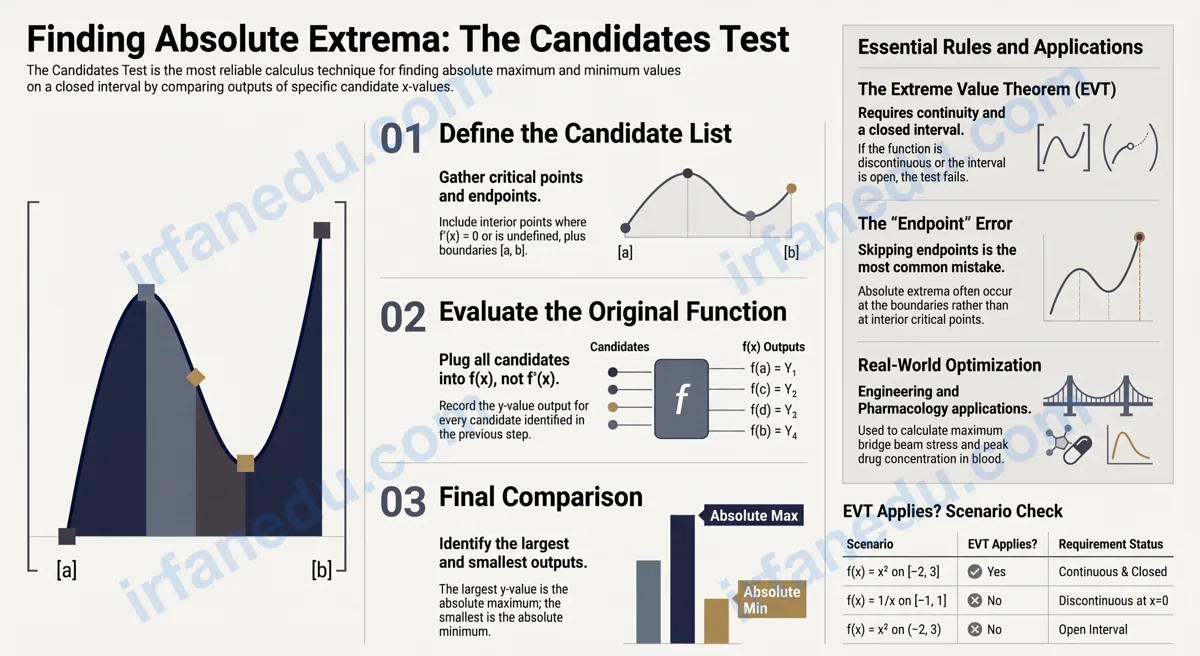
Structural engineers calculate the maximum stress a bridge beam can bear before it fails. Pharmacologists find the peak concentration of a drug in the bloodstream after a dose. Both problems reduce to the same calculus question: where does this function reach its highest or lowest value on a specific interval? The candidates test answers that question in a handful of arithmetic steps.
The candidates test is a calculus method for finding the absolute maximum and minimum values of a continuous function on a closed interval. You collect a short list of “candidate” x-values — the critical points inside the interval plus both endpoints — evaluate the function at each one, and compare the results. No sign charts, no second derivatives required.
In this guide, I walk through every step with two fully worked examples, a visual diagram, a comparison table, and the exact mistakes I see students make most often. By the end, you will be able to apply the candidates test confidently on any AP Calculus or college calculus exam.
- Understand what the candidates test is and why it works.
- Apply the 6-step procedure to any continuous function on a closed interval.
- Distinguish the candidates test from the first derivative test.
- Avoid the four most common errors that cost students points.
TL;DR – Quick Summary
- The candidates test finds absolute (global) max and min on a closed interval.
- Candidates = critical points inside the interval + both endpoints.
- Evaluate f(x) at every candidate, then compare the y-values.
- Largest y-value = absolute maximum; smallest = absolute minimum.
- Works only on closed intervals where the function is continuous.
- Skipping the endpoints is the most common — and most costly — mistake.
| Feature | Detail |
|---|---|
| Also called | Closed Interval Method |
| What it finds | Absolute (global) maximum and minimum |
| Requirement | Function must be continuous on a closed interval [a, b] |
| Theoretical basis | Extreme Value Theorem |
| Steps required | 6 (differentiate, find critical points, list candidates, evaluate, compare) |
| Sign chart needed? | No |
| Works on open intervals? | No |
| Typical exam context | AP Calculus AB/BC, College Calculus 1 |
Why Engineers and Scientists Use This Every Day
Before touching a single derivative, consider this scenario: a civil engineer is designing a cable-stayed bridge. The tension in a support cable varies with position along the deck. The engineer needs to know the maximum tension anywhere along the cable’s span — because that is the value the cable must be rated to handle. The span has fixed endpoints (the two towers), so the problem lives on a closed interval.
The engineer models tension as a function T(x) on [0, L], differentiates to find where tension peaks or dips, then checks those interior peaks alongside the two tower endpoints. That procedure is exactly the candidates test.
The same logic appears in drug dosing (peak plasma concentration on [0, 24 hours]), economics (maximum profit over a production run), and thermodynamics (highest temperature in a rod over its length). Every time a real-world quantity is bounded by two fixed limits, the candidates test is the tool that finds the extreme values.
In my experience teaching calculus, students who learn the candidates test through a real application first — like the bridge cable example — retain it far longer than students who start with the abstract definition. The “why” makes the “how” stick. I always open with a concrete scenario before writing a single formula.
What Is the Candidates Test?
The candidates test is a procedure for finding the absolute maximum and minimum values of a continuous function f on a closed interval [a, b]. It is also called the closed interval method.
The word “candidates” is deliberate. Every x-value that could possibly host an absolute extremum is a candidate. The Extreme Value Theorem (covered next) tells us that the absolute extrema must occur at one of two types of points:
- Critical points inside the interval — x-values in (a, b) where f'(x) = 0 or f'(x) does not exist.
- The endpoints — x = a and x = b.
No other type of point can be an absolute extremum on a closed interval. So you collect all the candidates, evaluate f(x) at each one, and the largest output is the absolute maximum, the smallest is the absolute minimum. That is the entire test.
The Extreme Value Theorem: The Rule Behind the Test
The Extreme Value Theorem (EVT) is the mathematical guarantee that makes the candidates test valid. It states: if f is continuous on a closed interval [a, b], then f attains both an absolute maximum and an absolute minimum on [a, b].
Two conditions are non-negotiable: the function must be continuous, and the interval must be closed (both endpoints included). Remove either condition and the guarantee disappears.
| Scenario | EVT Applies? | Why |
|---|---|---|
| f(x) = x² on [−2, 3] | Yes | Continuous, closed interval |
| f(x) = 1/x on [−1, 1] | No | Discontinuous at x = 0 |
| f(x) = x² on (−2, 3) | No | Open interval — endpoints excluded |
| f(x) = sin(x) on [0, 2π] | Yes | Continuous, closed interval |
The EVT does not tell you where the extrema are — only that they exist. The candidates test is the procedure that locates them.
How to Apply the Candidates Test: 6 Steps
Follow these six steps in order every time. Skipping any step is the source of most errors.
- Verify continuity. Confirm that f is continuous on the entire closed interval [a, b]. If it is not, the EVT does not apply and the test cannot be used without modification.
- Differentiate. Find f'(x).
- Find critical points. Solve f'(x) = 0 and identify any x-values where f'(x) is undefined. Keep only those that fall strictly inside (a, b) — discard any outside the interval.
- List all candidates. Write down every critical point from Step 3, plus both endpoints a and b. This is your complete candidate list.
- Evaluate f(x) at each candidate. Plug each candidate x-value into the original function f(x) — not the derivative. Record every output.
- Compare and conclude. The largest y-value is the absolute maximum. The smallest y-value is the absolute minimum. State the value (the y-output) and the location (the x-input).
  f(x)
   |
   |          * abs max
   |         / \
   |        /   \
   |   *   /     \
   |    \ /       \
   |     *         \     *
   |   crit pt      \   /
   |                 \ /
   |                  * abs min
   +----+------+-------+-----> x
        a    c1  c2     b

  Candidates: { a,  c1,  c2,  b }
  Evaluate:   f(a) f(c1) f(c2) f(b)
  Compare:    largest  = absolute maximum
              smallest = absolute minimum
Worked Example 1: Polynomial Function
Find the absolute maximum and minimum values of f(x) = 2x³ − 9x² + 12x − 4 on [0, 3].
Step-by-Step Solution
Step 1 — Verify continuity: f is a polynomial, so it is continuous everywhere, including on [0, 3]. The EVT applies.
Step 2 — Differentiate:
f'(x) = 6x² − 18x + 12
Step 3 — Find critical points:
Set f'(x) = 0:
6x² − 18x + 12 = 0
x² − 3x + 2 = 0
(x − 1)(x − 2) = 0
x = 1 and x = 2
Both 1 and 2 lie inside (0, 3), so both are candidates.
Step 4 — List all candidates:
x = 0 (left endpoint), x = 1, x = 2, x = 3 (right endpoint)
Step 5 — Evaluate f(x):
| x | f(x) = 2x³ − 9x² + 12x − 4 |
|---|---|
| 0 | 2(0) − 9(0) + 12(0) − 4 = −4 |
| 1 | 2(1) − 9(1) + 12(1) − 4 = 1 |
| 2 | 2(8) − 9(4) + 12(2) − 4 = 16 − 36 + 24 − 4 = 0 |
| 3 | 2(27) − 9(9) + 12(3) − 4 = 54 − 81 + 36 − 4 = 5 |
Step 6 — Compare:
Largest value: f(3) = 5 → Absolute Maximum = 5 at x = 3
Smallest value: f(0) = −4 → Absolute Minimum = −4 at x = 0
Notice that both extrema occur at endpoints, not at the interior critical points. This is a common surprise for students who assume the extrema must be at the critical points.
Worked Example 2: Trigonometric Function
Find the absolute maximum and minimum of f(x) = sin(x) + cos(x) on [0, π].
Step-by-Step Solution
Step 1 — Verify continuity: sin and cos are continuous everywhere. The EVT applies on [0, π].
Step 2 — Differentiate:
f'(x) = cos(x) − sin(x)
Step 3 — Find critical points:
Set f'(x) = 0:
cos(x) = sin(x)
tan(x) = 1
x = π/4 on [0, π] (also x = 5π/4, but that is outside the interval — discard it)
f'(x) is defined everywhere, so no additional critical points from undefined derivative.
Step 4 — List all candidates:
x = 0, x = π/4, x = π
Step 5 — Evaluate f(x):
| x | f(x) = sin(x) + cos(x) |
|---|---|
| 0 | sin(0) + cos(0) = 0 + 1 = 1 |
| π/4 | sin(π/4) + cos(π/4) = √2/2 + √2/2 = √2 ≈ 1.414 |
| π | sin(π) + cos(π) = 0 + (−1) = −1 |
Step 6 — Compare:
Largest value: f(π/4) = √2 → Absolute Maximum = √2 at x = π/4
Smallest value: f(π) = −1 → Absolute Minimum = −1 at x = π
Here the absolute maximum is at an interior critical point and the absolute minimum is at an endpoint — a different pattern from Example 1. This is why you always evaluate all candidates.
What Most Guides Get Wrong: Common Mistakes and How to Fix Them
Most textbooks list the steps correctly but fail to explain why students keep getting the wrong answer. Here are the four mistakes I see most often — and the mental fix for each.
| Mistake | What Students Do | Correct Approach |
|---|---|---|
| Skipping endpoints | Only evaluate at critical points | Always include x = a and x = b in the candidate list |
| Including out-of-interval critical points | Use a critical point at x = 5 when the interval is [0, 3] | Discard any critical point outside (a, b) |
| Evaluating f'(x) instead of f(x) | Plug candidates into the derivative | Always plug into the original function f(x) |
| Confusing local and absolute extrema | Report a local max from a sign chart as the absolute max | The candidates test gives absolute extrema — compare all y-values |
Here is something most guides never mention: when a function has no critical points inside the interval, the absolute maximum and minimum are always at the two endpoints — and you can identify them without any calculus at all, just by evaluating f(a) and f(b). This happens more often on exams than students expect (for example, f(x) = e^x on any closed interval, since f'(x) = e^x is never zero). Recognizing this case instantly saves time. The candidates test does not require critical points to exist — it simply requires you to check all candidates, and sometimes the only candidates are the endpoints.
Candidates Test vs. First Derivative Test: Which One Do You Use?
Students often confuse these two tests because both involve critical points. They answer different questions.
| Feature | Candidates Test | First Derivative Test |
|---|---|---|
| Finds | Absolute (global) max and min | Local max and min |
| Requires | Closed interval | Any interval (open or closed) |
| Method | Evaluate and compare y-values | Check sign change of f'(x) |
| Endpoints included? | Yes, always | No (endpoints not critical points) |
| Sign chart needed? | No | Yes |
| Typical use | Optimization on a bounded domain | Curve sketching, local behavior |
The rule of thumb: if the problem gives you a closed interval and asks for the absolute maximum or minimum, use the candidates test. If the problem asks about local extrema or the function’s behavior over an open interval, use the first derivative test.
In my experience, the most common exam mistake is applying the first derivative test when the problem is asking for absolute extrema on a closed interval. The first derivative test will find local extrema, but it will miss the possibility that an endpoint is the absolute maximum or minimum. If you see a closed interval and the words “absolute maximum” or “absolute minimum,” reach for the candidates test every single time.
Quick Quiz: Test Your Understanding
1. You are applying the candidates test to f(x) = x³ − 6x on [−2, 4]. Which of the following is the correct candidate list?
Show Answer
2. After evaluating f(x) at all candidates, you get the values: f(−2) = 4, f(1) = −3, f(3) = 7, f(5) = 2. What is the absolute minimum?
Show Answer
3. The candidates test cannot be applied directly to f(x) = tan(x) on [0, π]. Why?
Show Answer
Practice Problems
Try each problem, then click to reveal the full solution.
Problem 1: Find the absolute extrema of f(x) = x⁴ − 8x² + 3 on [−3, 3].
Step 1: f is a polynomial — continuous on [−3, 3]. EVT applies.
Step 2: f'(x) = 4x³ − 16x
Step 3: 4x³ − 16x = 0 → 4x(x² − 4) = 0 → x = 0, x = 2, x = −2. All three lie inside (−3, 3).
Step 4: Candidates: x = −3, −2, 0, 2, 3
Step 5:
- f(−3) = 81 − 72 + 3 = 12
- f(−2) = 16 − 32 + 3 = −13
- f(0) = 3
- f(2) = 16 − 32 + 3 = −13
- f(3) = 81 − 72 + 3 = 12
Step 6: Absolute Maximum = 12, at x = −3 and x = 3. Absolute Minimum = −13, at x = −2 and x = 2.
Note: it is valid for absolute extrema to occur at multiple x-values.
Problem 2: Find the absolute extrema of f(x) = x·e^(−x) on [0, 4].
Step 1: f is continuous on [0, 4]. EVT applies.
Step 2: f'(x) = e^(−x) + x·(−e^(−x)) = e^(−x)(1 − x)
Step 3: e^(−x) is never 0, so set 1 − x = 0 → x = 1. x = 1 is inside (0, 4).
Step 4: Candidates: x = 0, 1, 4
Step 5:
- f(0) = 0·e⁰ = 0
Sources & References
Written and fact-checked by Dr Irfan Mansuri. External links open in a new tab and are provided for further reading and verification.