
SAT Prep for Sophomores: Start Early and Score Higher
SAT Terminology Primer: Know These Terms First
- SAT (Scholastic Assessment Test)
- A standardized college admissions test scored 400-1600, covering Reading and Writing (combined) and Math. Administered by the College Board.
- Digital SAT (dSAT)
- The current adaptive, computer-based version of the SAT. Shorter than the old paper test at approximately 2 hours and 14 minutes total.
- PSAT / NMSQT
- Preliminary SAT / National Merit Scholarship Qualifying Test. A practice version of the SAT taken in October, typically in 10th and 11th grade.
- Adaptive Testing
- A format where the difficulty of the second module in each section adjusts based on your performance in the first module. Doing well in Module 1 unlocks harder (higher-scoring) questions in Module 2.
- Evidence-Based Reading and Writing (EBRW)
- The old combined score for reading and writing (200-800). In the digital SAT, this is now a single “Reading and Writing” section scored 200-800.
- Bluebook App
- The official College Board application used to take the digital SAT on a laptop or tablet. Free to download. Sophomores can use it to take official practice tests.
- Percentile Rank
- The percentage of test-takers you scored higher than. A 75th percentile score means you outperformed 75% of all students who took that test.
- Baseline / Diagnostic Score
- Your score on a full-length practice test taken before any focused prep. This is your starting point, not your ceiling.
- Score Superscoring
- A policy used by many colleges where they take your highest section scores across multiple SAT sittings to create a composite “superscore.” This makes retaking the SAT strategically valuable.
Why Starting SAT Prep in 10th Grade Is a Smart Move
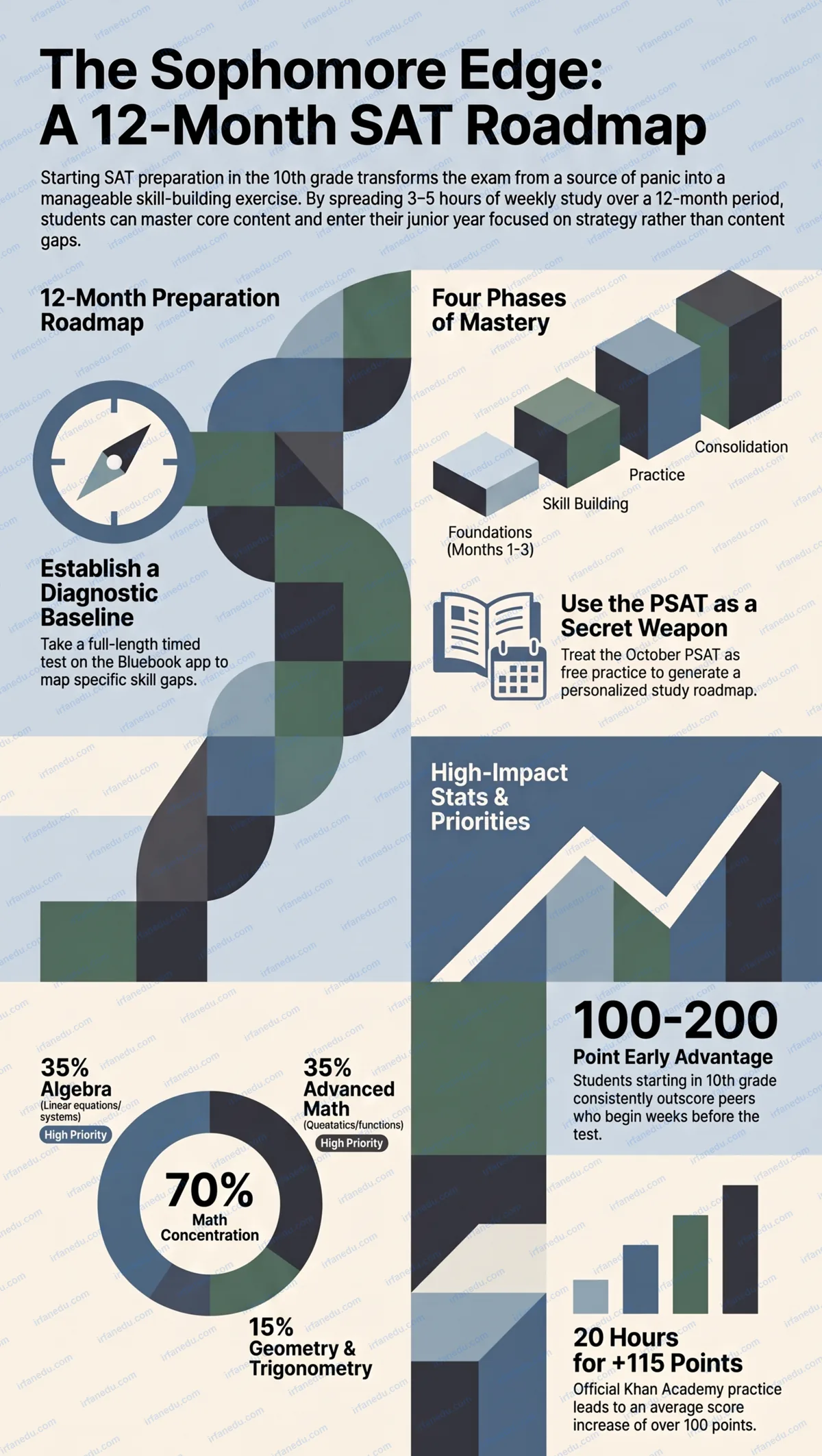
SAT prep for sophomores means using 10th grade to build the core reading, writing, and math skills the SAT tests, so that by junior year you are refining strategy rather than learning content from scratch. Students who start early consistently score 100-200 points higher than peers who begin prep just weeks before test day.
I have worked with hundreds of students over 15 years, and the ones who start in sophomore year share one thing: they are not panicking in junior year. They walk into test day with confidence because the material feels familiar, not foreign.
The SAT is not a test of raw intelligence. It tests a specific set of skills, and those skills improve with deliberate, consistent practice over time. Starting in 10th grade gives you that time.
After reading this guide, you will be able to:
- Understand exactly what the digital SAT tests and how it is scored
- Take a diagnostic test and interpret your results
- Build a realistic weekly study schedule that fits your school life
- Identify the highest-priority math and reading skills to develop
- Avoid the most common mistakes 10th-grade test preppers make
- Use free resources effectively without spending money on expensive courses
⚡ TL;DR – Quick Summary
- Sophomores should build SAT skills now, not cram later – time is your biggest advantage.
- Take a free diagnostic test first to find your baseline score and weak spots.
- Study 3-5 hours per week: algebra, data analysis, and reading comprehension are top priorities.
- Take the PSAT in October – it is free practice with a real score report.
- Khan Academy’s free SAT prep is official, personalized, and genuinely effective.
- Aim to take the official SAT in spring of junior year after a full year of prep.
Quick Facts About the Digital SAT
| Feature | Details |
|---|---|
| Score Range | 400-1600 (200-800 per section) |
| Sections | Reading and Writing + Math |
| Total Time | ~2 hours 14 minutes |
| Format | Digital, adaptive (2 modules per section) |
| Calculator | Allowed on all Math questions (built-in Desmos) |
| Test Frequency | Multiple dates per year (March, May, June, August, October, November) |
| Best Time for Sophomores to Take Official SAT | Spring of Junior Year (Grade 11) |
| PSAT Date for Sophomores | October (check with your school) |
| Free Official Prep | Khan Academy + College Board Bluebook App |
Step 1: Take a Diagnostic Test Before Anything Else
The single most important thing a sophomore can do before opening any prep book is to take a full-length, timed practice SAT. This gives you a real baseline score and, more importantly, a map of exactly where your gaps are.
Download the free Bluebook app from the College Board website. It contains official digital SAT practice tests in the same adaptive format as the real exam. Set aside about two and a half hours, sit at a desk, and take it seriously. Treat it like the real thing.
How to Analyze Your Diagnostic Results
After the test, do not just look at your total score. Break it down:
- Reading and Writing: Which question types did you miss most? Vocabulary in context, command of evidence, or grammar and usage?
- Math: Were your errors in algebra, geometry, data analysis, or advanced math? Were they careless errors or genuine knowledge gaps?
- Time management: Did you run out of time on any module, or did you finish with minutes to spare?
In my experience, students who skip the diagnostic and jump straight into prep books waste weeks studying the wrong things. Your diagnostic score is not a judgment of your intelligence. It is a navigation tool. Use it like one. I have seen students go from 1050 to 1380 in eight months simply because they studied what their diagnostic told them to study, not what they assumed they needed.
Step 2: Build a Realistic Sophomore Study Plan
A good sophomore SAT study plan is not about studying more. It is about studying consistently and strategically. Three to five hours per week, spread across multiple sessions, beats a six-hour Saturday cram every single time.
MONTH       FOCUS                          WEEKLY TARGET
---------   ----------------------------   ---------------
Aug-Oct     Foundations + PSAT Prep        3-4 hrs/week
            [Algebra I, Reading habits,
             Vocabulary, Grammar basics]

Nov-Jan     Skill Building                 4 hrs/week
            [Algebra II, Data Analysis,
             Evidence questions, Essays]

Feb-Apr     Practice + Weak Area Drills    4-5 hrs/week
            [Full practice tests every
             3-4 weeks, timed drills]

May-Jul     Consolidation + Strategy       3-4 hrs/week
            [Test strategy, pacing,
             Review error logs]

MILESTONE CHECKPOINTS:
  Oct  --> Take PSAT (official practice)
  Dec  --> Score diagnostic #2, compare to baseline
  Mar  --> Score diagnostic #3, plan junior year test date
  May  --> Decide on spring vs. fall junior year SAT date
Sample Weekly Schedule (School Year)
| Day | Activity | Time |
|---|---|---|
| Monday | Math skill drill (Khan Academy) | 35 min |
| Tuesday | Reading passage + questions | 30 min |
| Wednesday | Grammar and writing rules review | 30 min |
| Thursday | Math problem set (timed) | 40 min |
| Saturday | Full practice module OR review error log | 60 min |
| Sunday | Vocabulary and reading (any challenging article) | 20 min |
Step 3: Master the Math Skills That Matter Most
SAT Math is not a broad survey of everything you have ever studied. It focuses heavily on a specific set of skills. Knowing which topics carry the most weight lets you study smarter.
SAT Math Topic Breakdown by Weight
| Topic Area | Approx. % of Math Section | Sophomore Priority |
|---|---|---|
| Algebra (linear equations, systems, inequalities) | 35% | HIGH |
| Problem-Solving and Data Analysis (ratios, percentages, statistics) | 15% | HIGH |
| Advanced Math (quadratics, polynomials, functions) | 35% | Medium |
| Geometry and Trigonometry | 15% | Medium |
As a sophomore, you are likely finishing Algebra I or starting Algebra II. That means the highest-priority topics align almost perfectly with what you are already studying in class. Use your schoolwork as prep material.
Three Math Habits That Build SAT Scores
- Show all work, always. The SAT rewards systematic thinking. Students who write out each step make fewer careless errors.
- Use the built-in Desmos calculator strategically. It is powerful, but relying on it for every question slows you down. Practice doing simple algebra mentally.
- Read word problems twice. Most SAT Math errors are not calculation errors. They are misreading errors. Slow down on the setup, speed up on the calculation.
I tell every sophomore I work with the same thing: if you can solve linear equations fluently and interpret graphs accurately, you can score above 600 in SAT Math before you even touch a prep book. Those two skills alone cover a massive portion of the test. Master them in your regular math class first, then layer on SAT-specific strategy. That sequence works every time.
For a deeper look at the geometry and coordinate math that shows up in the SAT, my guide on the Complete Geometry Formula Sheet covers every formula you need to have memorized before test day.
Step 4: Build Reading and Writing Strength
The Reading and Writing section of the digital SAT tests your ability to understand complex texts, interpret evidence, and apply grammar rules. Unlike math, you cannot cram these skills in a few weeks. They build over months of consistent reading and practice.
Reading: Build Stamina and Vocabulary in Context
The SAT does not test whether you have memorized vocabulary lists. It tests whether you can figure out what a word means from context. The best way to build this skill is to read challenging material regularly.
- Read one nonfiction article per day (science, history, economics, social science)
- When you encounter an unfamiliar word, guess its meaning from context first, then look it up
- Practice summarizing each paragraph in one sentence – this builds the “main idea” skill the SAT tests heavily
- Read primary source documents (historical speeches, scientific abstracts) – the SAT loves these text types
Writing: Know the Grammar Rules the SAT Actually Tests
The SAT Writing questions are not random grammar drills. They focus on a specific, predictable set of rules. Learn these and you can answer most writing questions quickly and confidently.
| Grammar Rule | SAT Frequency | Example Error Type |
|---|---|---|
| Subject-verb agreement | Very High | “The list of items are” (should be is) |
| Pronoun-antecedent agreement | High | Unclear pronoun reference |
| Punctuation (commas, semicolons, colons) | High | Comma splice errors |
| Parallel structure | Medium | Inconsistent verb forms in a list |
| Transition words and logical flow | High | Wrong transition connecting two ideas |
| Conciseness (eliminating redundancy) | Medium | Wordy phrases that can be shortened |
For a focused review of subject-verb agreement, one of the most frequently tested grammar concepts, check out this guide on Subject Verb Agreement Rules.
Common Mistakes Sophomores Make (and How to Avoid Them)
Starting early is an advantage, but only if you use that time well. These are the most common traps I see 10th graders fall into when they begin SAT prep.
| Mistake | Why It Hurts | What to Do Instead |
|---|---|---|
| Studying without a diagnostic baseline | You waste time on strengths, ignore real weaknesses | Take a full practice test first, always |
| Memorizing vocabulary lists | SAT tests words in context, not definitions | Read widely and practice context-based guessing |
| Skipping the error log | You repeat the same mistakes indefinitely | Write down every wrong answer and why it was wrong |
| Studying in long, infrequent sessions | Information does not stick without spaced repetition | Study 30-45 minutes daily, 5-6 days per week |
| Ignoring the PSAT | You miss free official practice and a real score report | Register for the PSAT every October |
| Treating SAT prep as separate from schoolwork | You double your workload unnecessarily | Use your algebra homework as SAT math practice |
| Buying expensive courses before trying free options | Khan Academy is free, official, and equally effective | Start with Khan Academy and College Board materials |
Best Free and Paid Resources for Sophomore SAT Prep
You do not need to spend money to prepare effectively for the SAT. The best resources available are free. Here is an honest breakdown of what works and what is worth paying for.
Free Resources (Start Here)
- Khan Academy Official SAT Prep: Linked directly to College Board data. Personalizes practice based on your diagnostic results. This is the gold standard for free prep.
- College Board Bluebook App: Contains full-length official digital SAT practice tests. Essential for realistic timed practice.
- College Board SAT Practice Tests (PDF): Older paper-format tests still useful for skill practice, available free on the College Board website.
- YouTube (Khan Academy, College Board channels): Video explanations for every tested skill, free and high quality.
Paid Resources (Worth It If Budget Allows)
- Princeton Review or Kaplan SAT Prep Books: Useful for structured content review and additional practice problems. One book is enough.
- Tutoring (targeted, not general): Only worth the cost if you have a specific, persistent weakness that self-study has not fixed after 4-6 weeks of effort.
The PSAT: Your Sophomore Secret Weapon
The PSAT is one of the most underused tools available to 10th graders. Most students treat it as an afterthought. The students I have seen improve the fastest treat it as a serious milestone.
Here is what the PSAT gives you as a sophomore:
- A real score report that breaks down your performance by skill category
- Official test-day experience in a real testing environment, which reduces anxiety when you take the actual SAT
- A personalized Khan Academy practice plan automatically generated from your PSAT results
- A benchmark to measure your improvement when you take the PSAT again in 11th grade
Your 10th-grade PSAT score does not count for National Merit Scholarship purposes. That only applies to the 11th-grade PSAT. So take the 10th-grade PSAT with full effort but zero pressure. It is free practice with real data attached.
Quick Knowledge Check: SAT Prep for Sophomores
1. What is the total score range for the digital SAT?
2. Which topic area makes up the largest portion of SAT Math?
3. What is the main benefit of linking your Khan Academy account to your College Board account?
Practice Problems: Test Your SAT Readiness
Problem 1 (Algebra): If 3x + 7 = 22, what is the value of 6x?
Step 1: Solve for x.
3x + 7 = 22
3x = 15
x = 5
Step 2: Find 6x.
6x = 6(5) = 30
SAT Tip: The question asks for 6x, not x. Always re-read what the question is asking for before writing your answer. This is one of the most common careless errors on SAT Math.
Problem 2 (Data Analysis): A student scored 72, 85, 90, and 83 on four tests. What score does she need on a fifth test to achieve a mean of 85?
Step 1: Find the total needed for a mean of 85 across 5 tests.
85 x 5 = 425
Step 2: Find the current total.
72 + 85 + 90 + 83 = 330
Step 3: Subtract.
425 – 330 = 95
She needs a 95 on the fifth test.
Problem 3 (Reading): A passage states: “The policy, while initially unpopular, ultimately reduced traffic fatalities by 23%.” What does the word “ultimately” most nearly mean in this context?
“Ultimately” here means in the end / after all was said and done.
The sentence sets up a contrast: the policy was unpopular at first, but the result that followed over time was positive. “Ultimately” signals that final outcome.
SAT Tip: For vocabulary-in-context questions, always read the full sentence and identify the contrast or relationship. The word’s meaning in context often differs from its most common dictionary definition.
Problem 4 (Grammar): Choose the correct version: “The team of researchers (A) are / (B) is presenting their findings tomorrow.”
The subject is “team,” which is a collective noun treated as singular in standard written English. The prepositional phrase “of researchers” is not the subject.
Correct sentence: “The team of researchers is presenting their findings tomorrow.”
SAT Tip: Cross out prepositional phrases between the subject and verb to identify the true subject. This technique works on nearly every subject-verb agreement question.
Frequently Asked Questions: SAT Prep for Sophomores
Should sophomores take the SAT?
How many hours a week should a sophomore study for the SAT?
What math topics should sophomores focus on for the SAT?
Is the PSAT useful for sophomores?
Sources & References
Reviewed by Dr. Irfan Mansuri. External links open in a new tab and are provided for further reading and verification.