
Multiply Polynomials Worksheet: Free Printable PDF + Lesson
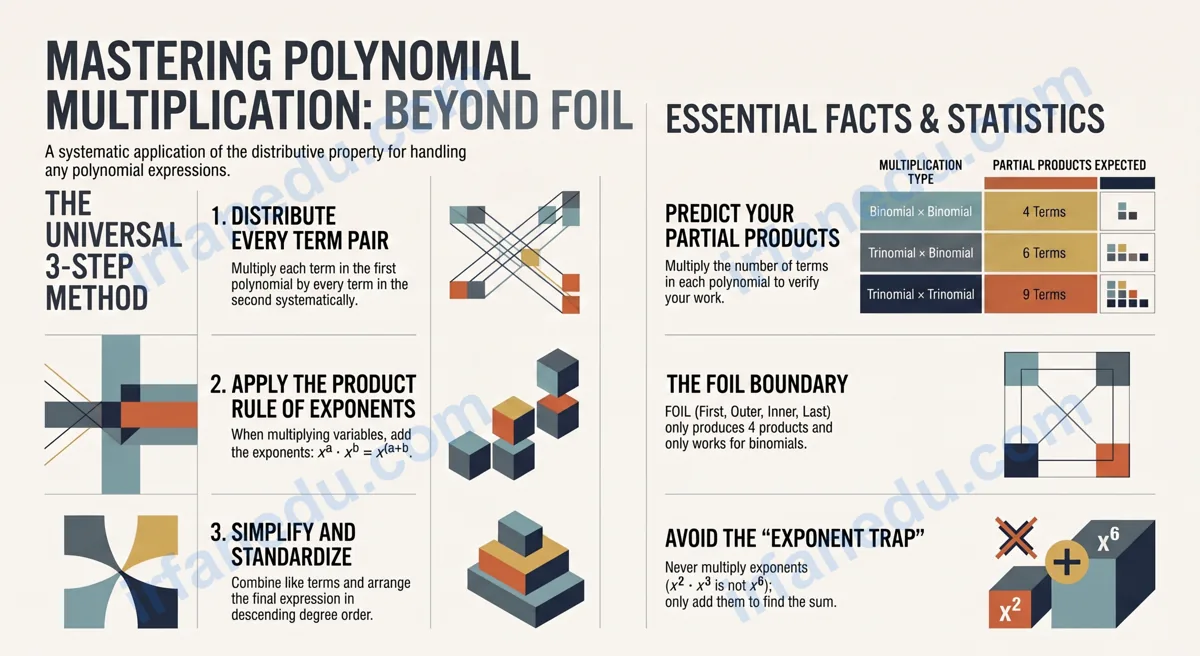
Most students can multiply two binomials with a little practice. The trouble starts when the polynomials get bigger — a trinomial times a binomial, or squaring a binomial — and the shortcut they memorised stops working. I have seen this exact gap trip up students right before their algebra exam, and it is entirely preventable.
Multiplying polynomials is the process of applying the distributive property to find the product of two or more polynomial expressions. Every term in the first polynomial multiplies every term in the second. The result is simplified by combining like terms and written in standard form (highest degree first).
- Understand why the distributive property is the only rule you truly need.
- Apply the FOIL method correctly — and know exactly when it breaks down.
- Spot and fix the four most common multiplication errors.
- Complete 10 graded practice problems and check your work with the answer key.
- Download the free printable PDF worksheet to use offline or in class.
Free Printable PDF Worksheet (with Answer Key)
10 graded problems, easy to hard. Print and practise right away.
⚡ TL;DR — Quick Summary
- Polynomial multiplication = distributive property applied to every term pair.
- FOIL is a shortcut for binomial x binomial only — not for trinomials.
- Two binomials always produce exactly 4 partial products before combining.
- Add exponents when multiplying same-base variables: x^2 * x^3 = x^5.
- Always write the final answer in standard form (descending degree).
- 10 practice problems below, plus a free downloadable PDF with answer key.
| Fact | Detail |
|---|---|
| Core rule | Distributive property: a(b + c) = ab + ac |
| Shortcut for 2 binomials | FOIL — First, Outer, Inner, Last |
| Exponent rule used | x^a * x^b = x^(a+b) |
| Partial products: binomial x binomial | 4 (before combining like terms) |
| Partial products: trinomial x binomial | 6 (before combining like terms) |
| Final form | Standard form — descending degree |
| Grade level | Grades 8-10 (Algebra 1 and 2) |
| Prerequisite skills | Distributive property, exponent rules, combining like terms |
What Are Polynomials, and Why Does Multiplying Them Matter?
A polynomial is an expression made of one or more terms, where each term is a number, a variable, or a product of numbers and variables with whole-number exponents. Examples: 3x, x^2 + 5, 2x^3 – 4x + 1. Multiplying polynomials is the skill of finding the product of two such expressions.
This matters far beyond the algebra classroom. Polynomial multiplication is the direct prerequisite for factoring (you cannot factor what you cannot first expand), solving quadratic equations, working with polynomial division, and understanding calculus concepts like the product rule for derivatives. In my experience teaching algebra, students who struggle to factor quadratics almost always have a gap in polynomial multiplication — not factoring itself.
► MY POV: Most textbooks introduce FOIL as if it is the definition of polynomial multiplication. It is not — it is a memory device for one specific case. I have watched students confidently apply FOIL to a trinomial times a binomial and get a wrong answer every single time, because nobody told them FOIL has a boundary. Teach the distributive property first, let FOIL be a speed tool for the binomial-binomial case, and the confusion disappears.
How to Multiply Polynomials: The Step-by-Step Method That Always Works
The distributive property is the only rule you need for all polynomial multiplication. Every other technique — FOIL, the box method, vertical multiplication — is just a way of organising the same underlying process.
-
Write both polynomials clearly in parentheses.
Place them side by side: (first polynomial)(second polynomial). This visual separation prevents sign errors. -
Pick one term from the first polynomial and distribute it across every term in the second.
Multiply that single term by each term of the second polynomial in order, left to right. -
Repeat for every remaining term in the first polynomial.
Each term in the first polynomial gets its own row of partial products. For a binomial times a binomial, you get two rows of two products each (4 total). For a trinomial times a binomial, three rows of two (6 total). -
Multiply coefficients and apply the exponent rule.
When multiplying variable terms: multiply the numbers out front, then add the exponents of matching variables. Example: (3x^2)(4x^3) = 12x^5. -
Collect and combine like terms.
Group terms that share the same variable and exponent. Add or subtract their coefficients. A term with x^2 and a term with x are NOT like terms — do not combine them. -
Write the answer in standard form.
Arrange terms from highest degree to lowest. The constant (no variable) goes last.
Three Fully Worked Examples — From Basic to Advanced
Each example below uses the same five-step method. Work through them in order — the difficulty increases deliberately.
Example 1: Binomial x Binomial (FOIL)
Multiply: (2x + 3)(x + 5)
Step 1 — First: 2x * x = 2x^2
Step 2 — Outer: 2x * 5 = 10x
Step 3 — Inner: 3 * x = 3x
Step 4 — Last: 3 * 5 = 15
Step 5 — Combine like terms: 10x + 3x = 13x
Answer: 2x^2 + 13x + 15
  FOIL Diagram: (2x + 3)(x + 5)
  ┌─────────────────────────────────────┐
  │  F:  2x * x   =  2x²               │
  │  O:  2x * 5   =  10x  ─┐           │
  │  I:   3 * x   =   3x  ─┴─ 13x      │
  │  L:   3 * 5   =   15               │
  │                                     │
  │  Result:  2x² + 13x + 15           │
  └─────────────────────────────────────┘
Example 2: Perfect Square Binomial
Multiply: (2x – 5)^2 = (2x – 5)(2x – 5)
First: 2x * 2x = 4x^2
Outer: 2x * (-5) = -10x
Inner: (-5) * 2x = -10x
Last: (-5) * (-5) = +25
Combine: -10x + (-10x) = -20x
Answer: 4x^2 – 20x + 25
Pattern check: (a – b)^2 = a^2 – 2ab + b^2. Here a = 2x, b = 5: (2x)^2 – 2(2x)(5) + 5^2 = 4x^2 – 20x + 25. Confirmed.
Example 3: Binomial x Trinomial (FOIL does NOT apply)
Multiply: (x + 2)(x^2 – 3x + 4)
Distribute x: x * x^2 = x^3 | x * (-3x) = -3x^2 | x * 4 = 4x
Distribute +2: 2 * x^2 = 2x^2 | 2 * (-3x) = -6x | 2 * 4 = 8
All partial products: x^3 – 3x^2 + 4x + 2x^2 – 6x + 8
Combine like terms: -3x^2 + 2x^2 = -x^2 | 4x – 6x = -2x
Answer: x^3 – x^2 – 2x + 8
Common Mistakes When Multiplying Polynomials — and the Right Fix
These four errors account for the majority of wrong answers I see on polynomial multiplication problems. Recognise them now so you do not make them on a test.
| Wrong (What Students Do) | Right (What to Do Instead) |
|---|---|
| Using FOIL on (x + 1)(x^2 – 2x + 3) and getting x^3 + 3 (only multiplying first and last) | Distribute each term of (x + 1) across all three terms of the trinomial. Expect 6 partial products. |
| Writing x^2 * x^3 = x^6 (multiplying exponents) | Add exponents: x^2 * x^3 = x^(2+3) = x^5. Multiply the exponents only when raising a power to a power: (x^2)^3 = x^6. |
| Dropping a negative sign: (x – 3)(x + 2) gives x^2 + 2x – 3x – 6 but student writes x^2 – x + 6 | (-3)(+2) = -6, not +6. Track signs carefully. Circle every negative sign before multiplying. |
| Combining unlike terms: writing 3x^2 + 2x as 5x^2 | 3x^2 and 2x have different exponents — they are NOT like terms. Only combine terms with identical variable-and-exponent combinations. |
► MY POV: In my experience, the exponent rule confusion — multiplying vs. adding exponents — is not a careless error. It is a conceptual gap. Students who understand that x^2 means “x times x” (two factors) and x^3 means “x times x times x” (three factors) immediately see why multiplying them gives five factors, not six. Spend 60 seconds on that conceptual explanation and the rule sticks permanently. Skip it, and students will keep making the same mistake under exam pressure.
💡 Unique Insight: The Real Reason Students Fail Polynomial Multiplication
Most guides teach FOIL as the primary method and the distributive property as a footnote. That is backwards. FOIL is a mnemonic for one specific case. The distributive property is the universal rule. When students learn FOIL first, they pattern-match: “two parentheses = FOIL.” Then they apply it to a trinomial times a binomial, get a wrong answer, and conclude they “don’t understand polynomials.” The actual fix is to teach students to count terms first: if either polynomial has more than two terms, FOIL is off the table. Distribute systematically, row by row. In my classroom, I stopped teaching FOIL for the first two weeks of polynomial multiplication entirely — students who learned the distributive property first had zero trouble with FOIL later, but students taught FOIL first consistently struggled when polynomials got larger.
On-Page Practice Worksheet: 10 Problems, Easy to Hard
How to use this worksheet: work through each problem on paper, show all your partial products, then check your answers using the collapsible key below. If you get a problem wrong, go back to the worked examples and identify which step you missed. Print the PDF version using the download button for offline or classroom use.
- (x + 2)(x + 3)
- (x – 4)(x + 1)
- (2x + 3)(x + 5)
- (3x – 2)(x – 4)
- (x + 6)^2
- (2x – 5)^2
- 3x(x^2 – 4x + 7)
- (x + 2)(x^2 – 3x + 4)
- (2x – 1)(3x^2 + x – 5)
- (x^2 + 3x – 2)(x^2 – x + 1)
Show Answer Key
- (x + 2)(x + 3) = x^2 + 5x + 6
- (x – 4)(x + 1) = x^2 – 3x – 4
- (2x + 3)(x + 5) = 2x^2 + 13x + 15
- (3x – 2)(x – 4) = 3x^2 – 14x + 8
- (x + 6)^2 = x^2 + 12x + 36
- (2x – 5)^2 = 4x^2 – 20x + 25
- 3x(x^2 – 4x + 7) = 3x^3 – 12x^2 + 21x
- (x + 2)(x^2 – 3x + 4) = x^3 – x^2 – 2x + 8
- (2x – 1)(3x^2 + x – 5) = 6x^3 – x^2 – 11x + 5
- (x^2 + 3x – 2)(x^2 – x + 1) = x^4 + 2x^3 – 4x^2 + 5x – 2
Want a printable version? Download the PDF — includes all 10 problems and a separate answer key page, formatted for A4 and US Letter.
Quick Quiz: Test Your Understanding
Polynomial Multiplication Quiz
Q1. What is (x + 4)(x – 2)?
Show answer
Correct: x^2 + 2x – 8. FOIL: First = x^2, Outer = -2x, Inner = 4x, Last = -8. Combine: -2x + 4x = +2x.
Q2. What is x^3 * x^4?
Show answer
Correct: x^7. Product Rule: add the exponents. 3 + 4 = 7.
Q3. How many partial products does (x + 2)(x^2 – x + 3) produce before combining like terms?
Show answer
Correct: 6. A binomial (2 terms) times a trinomial (3 terms) produces 2 x 3 = 6 partial products.
Reveal-on-Click Practice Problems
Practice: Expand (3x + 1)(2x – 7) — click to see full solution
First: 3x * 2x = 6x^2
Outer: 3x * (-7) = -21x
Inner: 1 * 2x = 2x
Last: 1 * (-7) = -7
Combine: -21x + 2x = -19x
Answer: 6x^2 – 19x – 7
Practice: Expand 4x^2(2x^3 – 5x + 3) — click to see full solution
Distribute 4x^2 across each term:
4x^2 * 2x^3 = 8x^5
4x^2 * (-5x) = -20x^3
4x^2 * 3 = 12x^2
Answer: 8x^5 – 20x^3 + 12x^2
Practice: Expand (x – 3)(x^2 + 3x + 9) — click to see full solution
Distribute x: x^3 + 3x^2 + 9x
Distribute -3: -3x^2 – 9x – 27
Combine: 3x^2 – 3x^2 = 0 | 9x – 9x = 0
Answer: x^3 – 27
Note: This is the Difference of Cubes pattern: (x – 3)(x^2 + 3x + 9) = x^3 – 3^3 = x^3 – 27.
Frequently Asked Questions
What is the FOIL method for multiplying polynomials?
FOIL stands for First, Outer, Inner, Last. It is a memory device for applying the distributive property to two binomials. Multiply the First terms, then the Outer terms, then the Inner terms, then the Last terms, and combine like terms. FOIL only works for binomial times binomial; for larger polynomials use the full distributive property.
How do you multiply a monomial by a polynomial?
Multiply the monomial by each term of the polynomial separately using the distributive property. For example, 3x(x^2 – 4x + 7) = 3x*x^2 – 3x*4x + 3x*7 = 3x^3 – 12x^2 + 21x. Multiply coefficients and add exponents of like bases.
What grade level covers multiplying polynomials?
Sources & References
Written and fact-checked by Dr Irfan Mansuri. External links open in a new tab and are provided for further reading and verification.