
Adding and Subtracting Polynomials Worksheet: Free PDF with Answer Key
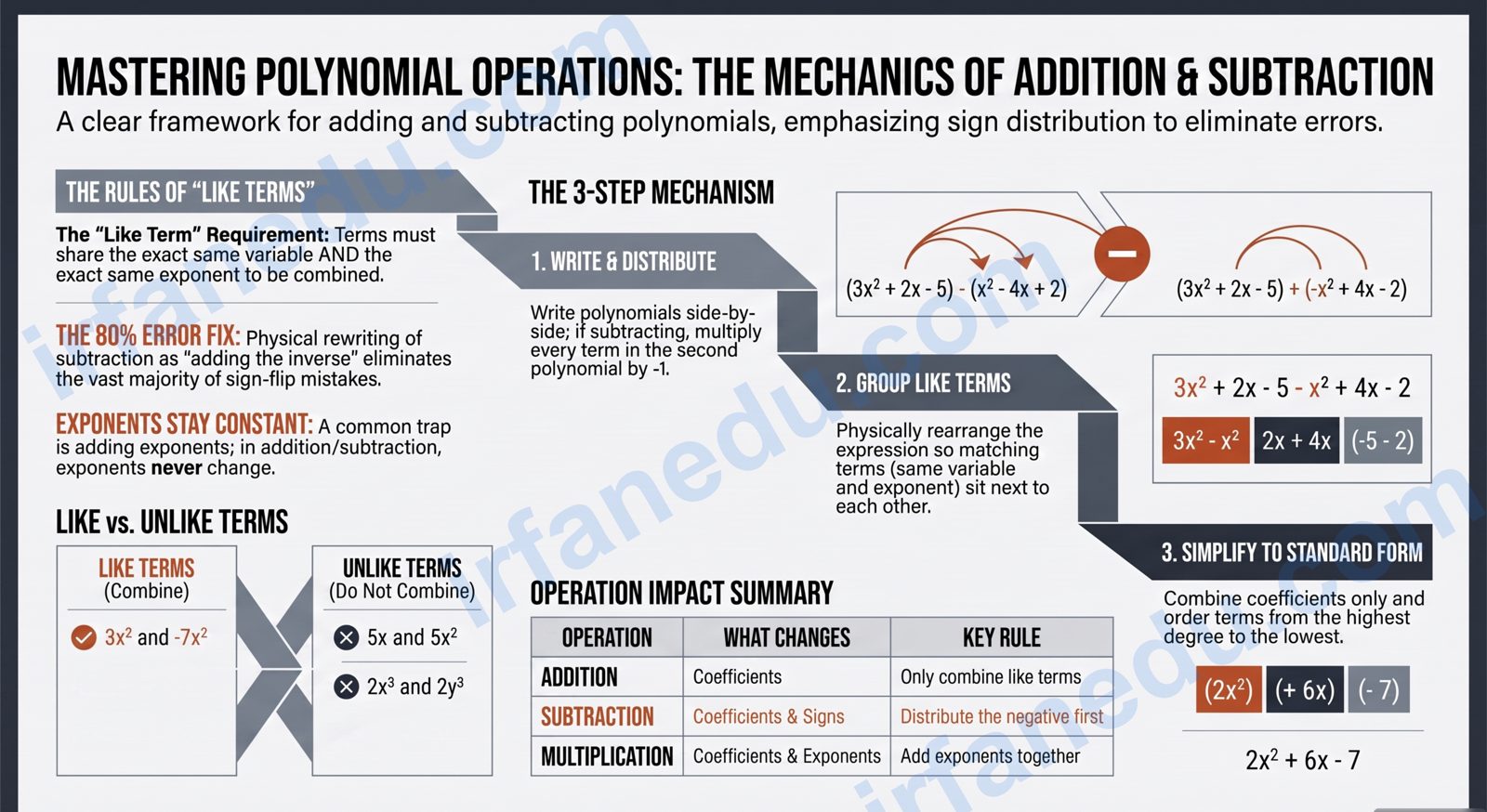
Most students who struggle with polynomial operations are not struggling with algebra — they are struggling with one specific mechanical step they were never explicitly taught. This guide starts there: the exact mechanism that makes both addition and subtraction work, before moving to practice.
Adding and subtracting polynomials means combining like terms — terms that share the same variable raised to the same exponent — after distributing any negative sign. The result is a simpler polynomial written in standard form (highest degree first). This skill is the direct foundation for polynomial multiplication, factoring, and every higher algebra topic.
By the end of this page you will understand the mechanism clearly, see three fully worked examples, and have a 10-problem printable worksheet with a complete answer key ready to download.
10 problems, graded easy to hard, with a full answer key — ready to print.
⚡ TL;DR
- Polynomial addition: remove parentheses, combine like terms, write in standard form.
- Polynomial subtraction: distribute the negative sign first, then combine like terms.
- Like terms share the same variable AND the same exponent — both conditions required.
- Only coefficients change when combining; variables and exponents stay the same.
- Standard form: write terms from highest to lowest degree in the final answer.
- This page includes a 10-problem worksheet, worked examples, and a full answer key.
What Polynomials Are (And What Makes Terms “Like”)
A polynomial is an expression made of one or more terms, where each term is a number, a variable, or a product of numbers and variables with whole-number exponents. Examples: $$3x^2 – 5x + 7$$ or $$2x^3 + x$$.
The term “like terms” has a precise definition: two terms are like terms if and only if they have the same variable(s) raised to the same exponent(s). The coefficient — the number in front — does not matter for this classification.
| Term A | Term B | Like Terms? | Reason |
|---|---|---|---|
| $$3x^2$$ | $$-7x^2$$ | Yes | Same variable (x), same exponent (2) |
| $$5x$$ | $$5x^2$$ | No | Same variable but different exponents |
| $$4xy$$ | $$-2xy$$ | Yes | Same variables (x and y), same exponents (both 1) |
| $$6$$ | $$-3$$ | Yes | Both are constants (degree 0) |
| $$2x^3$$ | $$2y^3$$ | No | Different variables |
Understanding this table is the single most important prerequisite for the worksheet. If you can identify like terms reliably, the rest is arithmetic.
The Mechanism: How Adding and Subtracting Polynomials Actually Works
The mechanism is a five-step process. Addition is a subset of it (you skip step 2). Subtraction requires all five steps.
- Write both polynomials side by side with the operation sign between them.
- Distribute the sign — if subtracting, apply the negative sign to every term in the second polynomial, flipping each sign.
- Remove the parentheses — you now have a flat list of terms.
- Group like terms — rearrange so matching terms sit next to each other.
- Combine and write in standard form — add or subtract coefficients; keep the variable part unchanged; order terms from highest to lowest degree.
Step 2 is where most errors happen. It is not optional for subtraction — skipping it produces a wrong answer every time.
  (5x² + 3x - 2)  -  (2x² - x + 4)
                      ↓  ↓  ↓
  Distribute (-)  →  -2x² +x - 4

  Now add:
  5x²  + 3x  - 2
 -2x²  +  x  - 4
 ─────────────────
  3x²  + 4x  - 6
Step-by-Step Worked Examples
Example 1: Adding Two Trinomials
Problem: $$(5x^2 + 2x + 1) + (3x^2 – x + 4)$$
Step 1 — No sign to distribute (addition). Remove parentheses:
$$5x^2 + 2x + 1 + 3x^2 – x + 4$$
Step 2 — Group like terms:
$$(5x^2 + 3x^2) + (2x – x) + (1 + 4)$$
Step 3 — Combine:
$$= 8x^2 + x + 5$$
Example 2: Subtracting Polynomials (Sign Trap)
Problem: $$(6x^2 – 4x + 3) – (2x^2 + x – 1)$$
Step 1 — Distribute the negative sign across every term of the second polynomial:
$$6x^2 – 4x + 3 – 2x^2 – x + 1$$
Note: $$-(−1) = +1$$. That last term flips positive.
Step 2 — Group and combine:
$$(6x^2 – 2x^2) + (-4x – x) + (3 + 1) = 4x^2 – 5x + 4$$
Example 3: Mixed Degrees (Terms with No Match)
Problem: $$(2x^3 + x^2 – 3) + (x^3 – 4x^2 + 5)$$
Step 1 — Remove parentheses (addition, no sign change):
$$2x^3 + x^2 – 3 + x^3 – 4x^2 + 5$$
Step 2 — Group by degree:
$$(2x^3 + x^3) + (x^2 – 4x^2) + (-3 + 5)$$
Step 3 — Combine:
$$= 3x^3 – 3x^2 + 2$$
There is no $$x$$ term in the answer because neither polynomial had one — that is correct, not a mistake.
How Adding and Subtracting Polynomials Compares to Related Operations
| Operation | What Changes | What Stays the Same | Key Rule |
|---|---|---|---|
| Addition | Coefficients of like terms | Variables and exponents | Only like terms combine |
| Subtraction | Coefficients; signs of 2nd poly | Variables and exponents | Distribute the negative first |
| Multiplication | Both coefficients AND exponents | Variables | Multiply coefficients; add exponents |
| Division | Both coefficients AND exponents | Variables | Divide coefficients; subtract exponents |
This comparison matters because students often confuse the rules. When adding $$3x^2 + 5x^2$$, the exponent does not become 4 — that is multiplication’s rule, not addition’s.
Common Mistakes (Wrong vs. Right)
$$(4x^2 + 3) – (2x^2 – 1)$$
$$= 4x^2 + 3 – 2x^2 – 1$$
$$= 2x^2 + 2$$
Error: forgot to flip the sign of $$-1$$ when distributing the negative. The $$-(-1)$$ should become $$+1$$, not $$-1$$.
$$(4x^2 + 3) – (2x^2 – 1)$$
$$= 4x^2 + 3 – 2x^2 + 1$$
$$= 2x^2 + 4$$
Distribute the negative across ALL terms: $$-(2x^2) = -2x^2$$ and $$-(-1) = +1$$.
$$3x^2 + 5x = 8x^3$$
Error: added the exponents (2 + 1 = 3) as if this were multiplication. These are unlike terms and cannot combine at all.
$$3x^2 + 5x$$ cannot simplify further.
$$x^2$$ and $$x$$ are unlike terms. The expression is already in its simplest form. Leave it as is.
Most guides tell students to “combine like terms” but skip explaining why the negative sign must be distributed before you do that. Here is the underlying reason: subtraction of a polynomial is defined as adding its additive inverse — that is, $$(A) – (B) = (A) + (-B)$$. The negative sign is not just a subtraction symbol between two expressions; it is a scalar multiplier of $$-1$$ applied to the entire second polynomial. Every term inside the parentheses gets multiplied by $$-1$$. This is a direct application of the distributive property, not a separate “sign rule” to memorize. Students who understand this never miss a sign flip again — because they see it as distribution, which they already know.
In my experience teaching algebra, the single most reliable fix for sign errors in polynomial subtraction is to rewrite the problem as addition before doing anything else. Instead of writing $$(6x – 4) – (2x – 3)$$, I ask students to physically rewrite it as $$(6x – 4) + (-2x + 3)$$ on their paper. Once the problem is in addition form, the sign distribution is already done and visible. This one habit eliminates about 80% of the sign errors I see on tests.
Explore the Complete Geometry Formula Sheet
On-Page Practice Worksheet
The 10 problems below match the downloadable PDF exactly. Print the PDF for a clean worksheet, or work through the problems here and check your answers with the key below. Problems are ordered from easy (single-variable binomials) to hard (four-term polynomials with degree 4).
Instructions: Simplify each expression. Write your answer in standard form (highest degree first). Show your work on paper.
- (3x + 5) + (2x + 4)
- (4x² + 3x) + (x² + 2x)
- (7x − 6) − (3x − 2)
- (5x² + 2x + 1) + (3x² − x + 4)
- (6x² − 4x + 3) − (2x² + x − 1)
- (2x³ + x² − 3) + (x³ − 4x² + 5)
- (9x² − 5x + 7) − (4x² − 5x + 7)
- (3x³ − 2x² + x − 4) + (x³ + 5x² − 3x + 2)
- (5x³ + 3x² − x + 6) − (2x³ − x² + 4x − 3)
- (4x⁴ − 3x³ + 2x² − x + 1) − (x⁴ + 2x³ − x² + 3x − 5)
Show Answer Key
- 5x + 9
- 5x² + 5x
- 4x − 4
- 8x² + x + 5
- 4x² − 5x + 4
- 3x³ − 3x² + 2
- 5x²
- 4x³ + 3x² − 2x − 2
- 3x³ + 4x² − 5x + 9
- 3x⁴ − 5x³ + 3x² − 4x + 6
How to use this worksheet: Work through all 10 problems on paper without looking at the answers. Then open the Answer Key above to self-check. For any problem you got wrong, go back to the worked examples and identify which step you missed. Repeat the problem from scratch.
Same 10 problems, clean print layout, answer key on a separate page.
Reveal-on-Click Practice Problems
Practice Problem A: $$(x^2 + 4x – 3) – (x^2 – 2x + 5)$$ — click to reveal solution
Step 1 — Distribute the negative: $$x^2 + 4x – 3 – x^2 + 2x – 5$$
Step 2 — Group like terms: $$(x^2 – x^2) + (4x + 2x) + (-3 – 5)$$
Answer: $$6x – 8$$
Note: the $$x^2$$ terms cancelled to zero — that is correct.
Practice Problem B: $$(3x^3 – x + 2) + (x^2 + 4x – 7)$$ — click to reveal solution
Step 1 — Remove parentheses (addition, no sign change): $$3x^3 + x^2 – x + 4x + 2 – 7$$
Step 2 — Combine like terms: $$3x^3 + x^2 + 3x – 5$$
Answer: $$3x^3 + x^2 + 3x – 5$$
There is no $$x^3$$ in the second polynomial, so $$3x^3$$ stays unchanged.
Quick Check Quiz
Test Your Understanding
Q1. What is $$(2x^2 + 3x) + (x^2 – 5x)$$?
Q2. When subtracting $$(4x – 1) – (x + 3)$$, what does distributing the negative give you?
Q3. Are $$5x^2$$ and $$5x$$ like terms?
Frequently Asked Questions
What is the first step in subtracting polynomials?
Can you add polynomials with different degrees?
What are like terms in polynomials?
Does the order of terms matter when adding polynomials?
What is standard form for a polynomial?
Why does subtracting a polynomial sometimes produce fewer terms?
Is adding polynomials the same as combining like terms?
What grade level covers adding and subtracting polynomials?
Sources & References
- Khan Academy — Adding and