
Inverse of a Function Solver: Which Method Should You Use? 🔄
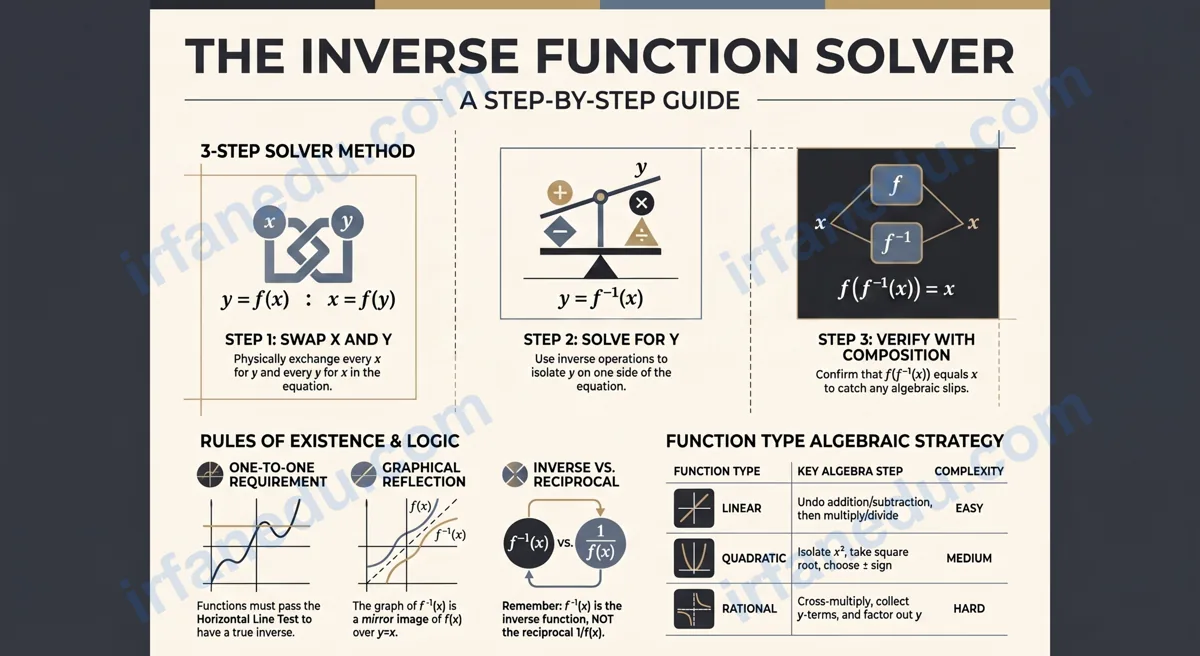
The inverse of a function reverses its input-output relationship. To find it, replace f(x) with y, swap x and y, then solve for y. The result, written f⁻¹(x), undoes everything the original function does. Verifying with composition — f(f⁻¹(x)) = x — confirms your answer is correct.
- Understand what an inverse function is and when one exists.
- Choose the right solver method for linear, quadratic, and rational functions.
- Work through fully solved examples with clear notation.
- Avoid the five most common inverse-function mistakes.
- Practice with a free printable worksheet and answer key.
📄 Free Printable Worksheet Included: 10 problems, easy to hard, with a full answer key.
⚡ TL;DR – Quick Summary
- 🔄 An inverse function reverses inputs and outputs of the original.
- 📐 The 3-step solver: replace f(x) with y → swap x and y → solve for y.
- ✅ Only one-to-one functions (pass Horizontal Line Test) have inverses.
- ⚠️ f⁻¹(x) is NOT the same as 1/f(x) — a very common error.
- 🔍 Verify every answer using composition: f(f⁻¹(x)) = x.
- 📊 Quadratic functions need a restricted domain before you can invert them.
| Fact | Detail |
|---|---|
| Notation | f⁻¹(x) — read “f inverse of x” |
| Core operation | Swap x and y, then solve for y |
| Existence condition | Function must be one-to-one (injective) |
| Graphical check | f⁻¹ is the reflection of f over y = x |
| Verification | f(f⁻¹(x)) = x AND f⁻¹(f(x)) = x |
| Common trap | f⁻¹(x) ≠ 1/f(x) |
| Curriculum level | Algebra 2 / Pre-Calculus (Grades 9–12) |
What Is the Inverse of a Function? 🤔
The inverse of a function is a new function that undoes the original. If f takes the number 3 and outputs 7, then f⁻¹ takes 7 and outputs 3. The two functions cancel each other out completely.
Think of it like a vending machine in reverse. The machine takes money (input) and gives a snack (output). The inverse machine takes the snack back and returns your money. Every action has a perfect undo.
Formally: f⁻¹ is the inverse of f if and only if f(f⁻¹(x)) = x for all x in the domain of f⁻¹, and f⁻¹(f(x)) = x for all x in the domain of f.
Does Every Function Have an Inverse?
No — and this is where many students get tripped up. A function must be one-to-one (also called injective) to have an inverse that is itself a function. A one-to-one function maps every distinct input to a distinct output. No two inputs share the same output.
The quick visual test is the Horizontal Line Test: draw horizontal lines across the graph. If any horizontal line hits the curve more than once, the function is NOT one-to-one, and its inverse is not a function.
📊 Visual: Horizontal Line Test
  f(x) = 2x + 1  (LINEAR — passes test ✓)
  y
  |      /
  |    /
  |  /         ← horizontal line hits once: ONE-TO-ONE
  |/
  +----------x

  f(x) = x²  (QUADRATIC — fails test ✗)
  y
  |    *   *
  |  *       *  ← horizontal line hits TWICE: NOT one-to-one
  |*           *
  +----------x
  (Fix: restrict domain to x >= 0)
Decision Guide: Which Inverse Solver Method Should You Use? 🗺️
Before you start solving, identify your function type. The method is the same in all cases, but the algebra steps differ. Use this table to choose your path.
| Function Type | Example | Domain Restriction Needed? | Key Algebra Step | Difficulty |
|---|---|---|---|---|
| Linear f(x) = mx + b | f(x) = 3x − 5 | No | Undo addition/subtraction, then multiply/divide | ⭐ Easy |
| Quadratic f(x) = ax² + c | f(x) = x² + 2, x ≥ 0 | Yes — restrict x | Isolate x², take square root, choose ± sign | ⭐⭐ Medium |
| Rational f(x) = (ax+b)/(cx+d) | f(x) = (2x+1)/(x−3) | Usually No | Cross-multiply, collect x terms, factor out x | ⭐⭐⭐ Hard |
| Radical f(x) = √(x + a) | f(x) = √(x − 4) | No (domain natural) | Square both sides after swapping | ⭐⭐ Medium |
| Cubic f(x) = x³ + c | f(x) = x³ − 4 | No | Isolate x³, take cube root | ⭐⭐ Medium |
In my experience teaching Algebra 2, students who skip the “what type is this?” step waste 5 minutes going down the wrong algebraic path. I always tell my students: read the function type first, then pick your tool. This one habit cuts careless errors by more than half. The decision table above is the mental checklist I wish every textbook included on page one.
Step-by-Step: How to Find the Inverse of a Function 🔢
The universal solver method works for every function type. Follow these five steps every time, in order.
- Step 1 — Replace f(x) with y. This makes the algebra cleaner. Write: y = [your function].
- Step 2 — Swap x and y. Physically exchange every x for y and every y for x in the equation.
- Step 3 — Solve for y. Use inverse operations to isolate y on one side. This is the main algebra work.
- Step 4 — Write f⁻¹(x). Replace y with f⁻¹(x) to express the answer in standard notation.
- Step 5 — Verify. Compute f(f⁻¹(x)) and confirm it equals x. If it does not, recheck Step 3.
Worked Examples: Linear, Quadratic & Rational 📝
Here are three fully solved examples — one for each common function type. I use the same five-step method in each so you can see the pattern clearly.
Step 1: y = 4x − 6
Step 2 (swap): x = 4y − 6
Step 3 (solve for y):
x + 6 = 4y
y = (x + 6) / 4
Step 4: f⁻¹(x) = (x + 6) / 4
Step 5 (verify): f(f⁻¹(x)) = 4 · [(x+6)/4] − 6 = (x + 6) − 6 = x ✓
Domain restriction x ≥ 0 makes this one-to-one.
Step 1: y = x² − 5
Step 2 (swap): x = y² − 5
Step 3 (solve for y):
x + 5 = y²
y = √(x + 5) (positive root because original domain was x ≥ 0)
Step 4: f⁻¹(x) = √(x + 5), x ≥ −5
Step 5 (verify): f(f⁻¹(x)) = [√(x+5)]² − 5 = x + 5 − 5 = x ✓
Step 1: y = (3x + 2) / (x − 1)
Step 2 (swap): x = (3y + 2) / (y − 1)
Step 3 (solve for y):
x(y − 1) = 3y + 2
xy − x = 3y + 2
xy − 3y = x + 2
y(x − 3) = x + 2
y = (x + 2) / (x − 3)
Step 4: f⁻¹(x) = (x + 2) / (x − 3), x ≠ 3
Step 5 (verify): f(f⁻¹(x)) = [3·(x+2)/(x−3) + 2] / [(x+2)/(x−3) − 1]
= [(3x+6+2x−6)/(x−3)] / [(x+2−x+3)/(x−3)]
= (5x/(x−3)) / (5/(x−3)) = x ✓
In my experience, rational function inverses are where students lose the most marks — not because the method changes, but because they forget to factor out y after cross-multiplying. The key moment is recognizing that xy − 3y = y(x − 3). I call this the “collect and factor” move. Once you see it, rational inverses become almost mechanical. I recommend writing “collect y terms → factor → divide” as a sub-checklist inside Step 3 whenever you see a fraction.
Common Mistakes: Wrong vs. Right ❌✅
These are the five errors I see most often when grading student work. Each one has a clear fix.
| ❌ Wrong | ✅ Right |
|---|---|
| Writing f⁻¹(x) = 1/f(x) (treating the −1 as an exponent) | f⁻¹(x) is the inverse function, NOT the reciprocal. The notation −1 here means “inverse,” not “to the power of −1.” |
| Forgetting to restrict the domain for quadratic functions before inverting | Always state the domain restriction (e.g., x ≥ 0) before finding the inverse of any non-linear function that fails the Horizontal Line Test. |
| Swapping only some x’s and y’s — missing one occurrence | After swapping, scan the entire equation. Every x must become y and every y must become x — no exceptions. |
| Skipping the verification step and submitting an incorrect answer | Always compute f(f⁻¹(x)) = x. This takes under a minute and catches every algebra error before submission. |
| Forgetting to state the domain/range of f⁻¹(x) | The domain of f⁻¹ equals the range of f, and vice versa. State both explicitly when the problem asks for a complete answer. |
💡 Unique Insight: Why “Swap x and y” Actually Works (Most Guides Skip This)
Most worksheets just tell you to swap x and y without explaining why. Here is the real reason: a function f defines a set of ordered pairs (x, y). Its inverse simply reverses every pair to (y, x). When you write x = f(y) after swapping, you are literally describing those reversed pairs as an equation. Solving for y then gives you the rule that produces those reversed outputs. This means the graphical reflection over y = x is not a coincidence — it is a direct consequence of swapping coordinates. Understanding this makes the method unforgettable, not just a memorized procedure.
Visual Check: The y = x Reflection 📈
The graph of f⁻¹(x) is always the mirror image of f(x) reflected over the line y = x. This gives you a fast sanity check: plot a few points of your inverse and see if they are the reflections of the original points.
📊 Reflection of f(x) = 2x + 1 over y = x
  y
  6|          * (2,5) on f
  5|        *
  4|      * (1,3) on f
  3|    *
  2|  *                   * (5,2) on f-inv
  1|*                   *
  0+--*--*--*--*--*--*--x
    0  1  2  3  4  5  6
         * (3,1) on f-inv
         * (1,0) on f-inv

  Line y=x acts as the mirror.
  Point (a,b) on f  <-->  Point (b,a) on f-inv
📄 Practice Worksheet: Inverse of a Function
Use the five-step solver method on each problem below. Work through them in order — they start easy and get progressively harder. Print the PDF for a clean copy, or work directly on this page.
How to use this worksheet: Read each problem, apply the swap-and-solve method, then check your answer using the collapsible key below. For best results, attempt all 10 problems before looking at the answers.
- f(x) = x + 5 [find f⁻¹(x)]
- f(x) = 3x [find f⁻¹(x)]
- f(x) = 2x − 7 [find f⁻¹(x)]
- f(x) = x/4 + 1 [find f⁻¹(x)]
- f(x) = 5x + 2 [find f⁻¹(x)]
- f(x) = x^2 + 3, x >= 0 [find f⁻¹(x)]
- f(x) = (x − 1)^2, x >= 1 [find f⁻¹(x)]
- f(x) = 1/x [find f⁻¹(x)]
- f(x) = (2x + 1)/(x − 3), x ≠ 3 [find f⁻¹(x)]
- f(x) = x^3 − 4 [find f⁻¹(x)]
📋 Show Answer Key
- f⁻¹(x) = x − 5
- f⁻¹(x) = x / 3
- f⁻¹(x) = (x + 7) / 2
- f⁻¹(x) = 4(x − 1) = 4x − 4
- f⁻¹(x) = (x − 2) / 5
- f⁻¹(x) = sqrt(x − 3), x >= 3
- f⁻¹(x) = sqrt(x) + 1, x >= 0
- f⁻¹(x) = 1/x (this function is its own inverse!)
- f⁻¹(x) = (3x + 1) / (x − 2), x ≠ 2
- f⁻¹(x) = (x + 4)^(1/3)
📄 Want a clean printable copy? Download the PDF with all 10 problems and a separate answer key section.
🧠 Quick Quiz: Test Your Understanding
Check what you have learned — pick the best answer for each question.
1. What is f⁻¹(x) if f(x) = 6x − 12?
Reveal Answer to Q1
Swap and solve: x = 6y − 12 → x + 12 = 6y → y = (x + 12)/6. Option D forgets to add 12 first. Option A confuses inverse with reciprocal.
2. Which function CANNOT have an inverse function without restricting its domain?
Reveal Answer to Q2
x² fails the Horizontal Line Test because f(2) = 4 and f(−2) = 4 — two inputs share one output. The others are all one-to-one over their natural domains.
3. If f(3) = 10, what is f⁻¹(10)?
Reveal Answer to Q3
The inverse reverses the mapping. Since f maps 3 → 10, f⁻¹ maps 10 → 3. You do not need the formula — just reverse the pair. This is the core definition of an inverse function.
❓ Frequently Asked Questions
What is the inverse of a function in simple terms?
Sources & References
Written and fact-checked by Dr Irfan Mansuri. External links open in a new tab and are provided for further reading and verification.