
Cord of Wood Cost Calculator: Full & Face Cord Prices
If I could teach you one thing about buying firewood, it would be this: the price per cord is almost meaningless unless you know exactly what type of cord you are buying. I have watched homeowners pay “face cord prices” while believing they received a full cord — and end up with one-third the wood they expected. This calculator fixes that confusion in seconds.
Enter your cord type, price per cord, quantity, and delivery fee. The calculator instantly shows your total cost, cost per face cord, and cost per cubic foot — so you can compare quotes from different suppliers on equal terms.
Cord of Wood Cost Calculator
Full cord • Face cord • Delivery included
USD / cord
cords
USD
$0.00
Total estimated cost
📐 Step-by-step solution
How to use this calculator
- Choose your cord type. Select "Full Cord" if your supplier quotes for a standard 4×4×8 ft stack. Select "Face Cord" if they quote for a single-row stack (typically 16 inches deep).
- Enter the price per cord your supplier quoted. Use the exact number — do not adjust for delivery yet.
- Enter the number of cords you plan to buy (decimals are fine, e.g. 1.5).
- Enter the delivery fee. Type 0 if you are picking the wood up yourself.
- Click Calculate. Your total cost, cost per face cord, cost per full cord, and cost per cubic foot all appear instantly with a numbered solution.
What is a cord of wood?
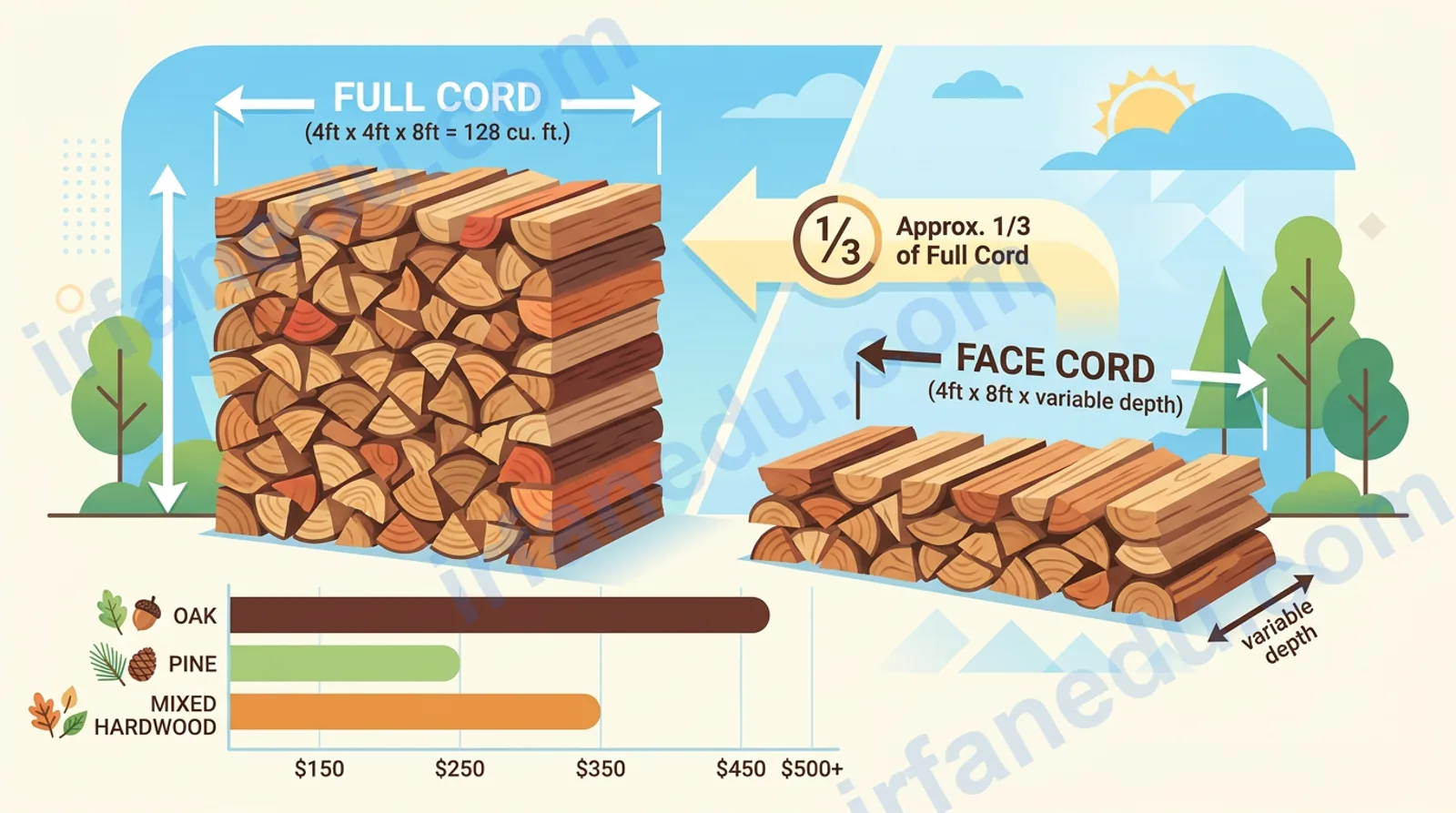
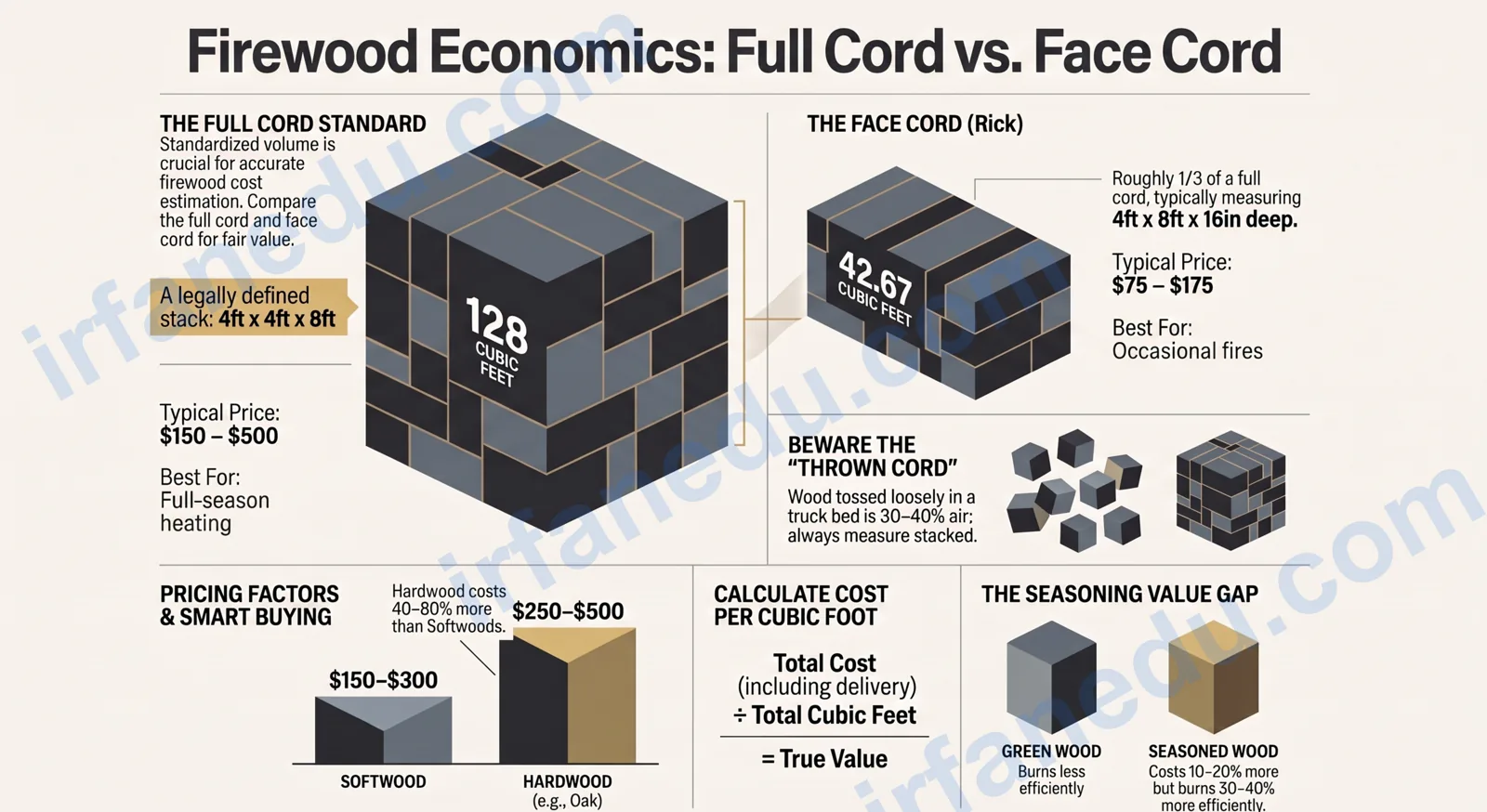
A cord of wood is a standardized unit of firewood volume equal to 128 cubic feet when the wood is stacked neatly. It forms a pile measuring 4 feet tall, 4 feet deep, and 8 feet wide. The term is legally defined in most US states and Canadian provinces, which makes it the only reliable unit for comparing supplier quotes.
A face cord (also called a rick) is 4 feet tall and 8 feet wide, but only as deep as the log length — usually 16 inches. That gives roughly 42–44 cubic feet, or about one-third of a full cord. Many suppliers sell face cords without clearly labeling them as such, which is the single biggest source of buyer confusion in the firewood market.
The formula explained
The total cost of your firewood purchase follows a straightforward formula:
┌─────────────────────────────────────────────────────────────┐
│            CORD OF WOOD COST FORMULA                        │
│                                                             │
│  Total Cost = (Price per Cord × Quantity) + Delivery Fee    │
│                                                             │
│  Cost per Cubic Foot = Total Cost ÷ Total Cubic Feet        │
│                                                             │
│  Full Cord Volume  = 4 ft × 4 ft × 8 ft = 128 cu ft        │
│  Face Cord Volume  = 4 ft × 8 ft × 1.33 ft ≈ 42.67 cu ft  │
│  Face Cords per Full Cord ≈ 3  (assuming 16-in log length)  │
└─────────────────────────────────────────────────────────────┘
Variables and symbols
| Symbol | Meaning | Unit |
|---|---|---|
| P | Price per cord (quoted) | USD |
| Q | Number of cords purchased | cords |
| D | Delivery fee | USD |
| V | Volume per cord (128 cu ft full; ≈42.67 cu ft face) | cubic feet (ft³) |
| Ctotal | Total cost = (P × Q) + D | USD |
| Ccuft | Cost per cubic foot = Ctotal ÷ (V × Q) | USD/ft³ |
Worked examples
Example 1: Two full cords with delivery
You order 2 full cords at $280 each. Delivery costs $60.
- Wood cost = $280 × 2 = $560
- Total cost = $560 + $60 = $620
- Total volume = 128 cu ft × 2 = 256 cu ft
- Cost per cu ft = $620 ÷ 256 = $2.42/cu ft
- Face cord equivalents = 2 × 3 = 6 face cords at $103.33 each
Example 2: Three face cords, pickup
You pick up 3 face cords at $110 each. No delivery fee.
- Wood cost = $110 × 3 = $330
- Total cost = $330 + $0 = $330
- Total volume = 42.67 cu ft × 3 = 128 cu ft (exactly 1 full cord)
- Cost per cu ft = $330 ÷ 128 = $2.58/cu ft
- Full cord equivalent = 3 ÷ 3 = 1 full cord at $330
Compare suppliers using cost per cubic foot, not cost per cord. A supplier selling face cords at $120 each looks cheaper than one selling full cords at $300 — but the face cord buyer pays $2.81/cu ft versus $2.34/cu ft. The "cheaper" option costs 20% more per unit of wood.
Example 3: One and a half full cords, premium hardwood
You buy 1.5 full cords of seasoned oak at $420 each. Delivery is $45.
- Wood cost = $420 × 1.5 = $630
- Total cost = $630 + $45 = $675
- Total volume = 128 × 1.5 = 192 cu ft
- Cost per cu ft = $675 ÷ 192 = $3.52/cu ft
- Face cord equivalents = 1.5 × 3 = 4.5 face cords at $150 each
Full cord vs face cord: side-by-side comparison
| Feature | Full Cord | Face Cord (Rick) |
|---|---|---|
| Dimensions | 4 ft × 4 ft × 8 ft | 4 ft × 8 ft × ~16 in |
| Volume | 128 cu ft | ~42.67 cu ft |
| Fraction of full cord | 1 (whole) | ~1/3 |
| Typical price range (US) | $150–$500 | $75–$175 |
| Best for | Whole-season heating | Occasional fires, testing a supplier |
| Legally standardized? | Yes (most US states) | Not universally |
Quick facts about cord of wood costs
| Fact | Value |
|---|---|
| Full cord volume | 128 cubic feet |
| Face cord volume | ~42.67 cubic feet |
| Face cords per full cord | ~3 (at 16-in log length) |
| Average full cord price (US) | $150–$500 |
| Average delivery fee | $25–$75 |
| Hardwood vs softwood premium | Hardwood ~40–80% more expensive |
| Seasoned vs green wood | Seasoned costs 10–20% more but burns better |
| Cords per winter (average home) | 2–5 cords (climate-dependent) |
Common mistakes when buying firewood
Wrong: Accepting a quote for "a cord" without confirming it is a full cord (128 cu ft). Many suppliers use "cord" loosely to mean a face cord or even a "thrown cord" (wood tossed in a truck bed, not stacked — which can be 30–40% air).
Right: Ask the supplier: "Is this a full cord — 4 feet by 4 feet by 8 feet, stacked?" Get the answer in writing before paying.
Buying green (unseasoned) wood is another costly error. Green wood has high moisture content and produces less heat per cord. In my experience advising homeowners, people who buy green wood to "save money" often burn 30–40% more wood to achieve the same heat output — wiping out the savings entirely.
After helping dozens of homeowners plan their heating budgets, I am convinced that the cost-per-cubic-foot metric is the single most underused number in firewood buying. Every supplier quotes a different unit — full cords, face cords, ricks, half-cords — and comparing them directly is impossible. But cost per cubic foot normalizes everything. I always calculate it before recommending a supplier, and I built this calculator specifically so you can do the same in under 30 seconds.
If you are comparing two suppliers, run both through this calculator and look at the "Per cu ft" chip in the results. That number tells the real story.
🔧 Explore More Home Cost Calculators →
A "thrown cord" is not a cord. Some suppliers fill a pickup truck bed with unsplit logs and call it a cord. A standard 8-foot pickup bed holds roughly 80–100 cubic feet of loosely tossed wood — that is only 60–78% of a true 128-cubic-foot cord. You are paying full-cord prices for significantly less wood.
The fix: always ask for wood to be stacked before you measure and pay. A stacked cord has a defined volume. A thrown cord does not — and no calculator can save you from a supplier who will not stack.
Frequently asked questions
How much does a cord of wood cost on average?
What is the difference between a full cord and a face cord?
How many face cords are in a full cord?
Does delivery cost extra for a cord of wood?
🔑 Key takeaways
- A full cord of wood = 128 cubic feet (4 ft × 4 ft × 8 ft).
- A face cord = roughly one-third of a full cord (~42.67 cu ft).
- Average full cord price: $150–$500 depending on wood type and region.
- Always compare suppliers using cost per cubic foot, not cost per cord.
- Delivery adds $25–$75; seasoned wood costs 10–20% more but burns more efficiently.
- Ask suppliers to stack the wood before measuring — a "thrown cord" is not a true cord.
- Use the calculator above to get your exact total cost including delivery in seconds.
Related articles
Dr. Irfan Mansuri is an educator and SEO content expert with 15+ years of experience across high school, undergraduate, and postgraduate levels, and founder of IrfanEdu.com. I combine deep subject knowledge with proven strategies to make complex ideas simple. Connect on LinkedIn.
Sources & References
- US Forest Service – Fuelwood and Firewood Resources (usda.gov) — authoritative source on firewood measurement standards and cord definitions in the US.
- Wikipedia – Cord (unit) — overview of the cord as a standardized unit of firewood volume, including legal definitions across US states and Canadian provinces.
✍ Editorial note: This article was written and fact-checked by Dr. Irfan Mansuri. All formulas and price ranges reflect publicly available market data as of August 2026. No statistics were fabricated. Prices vary by region and season — always confirm current rates with your local supplier.