
Interval Notation Calculator: Convert Any Inequality Instantly 🔢
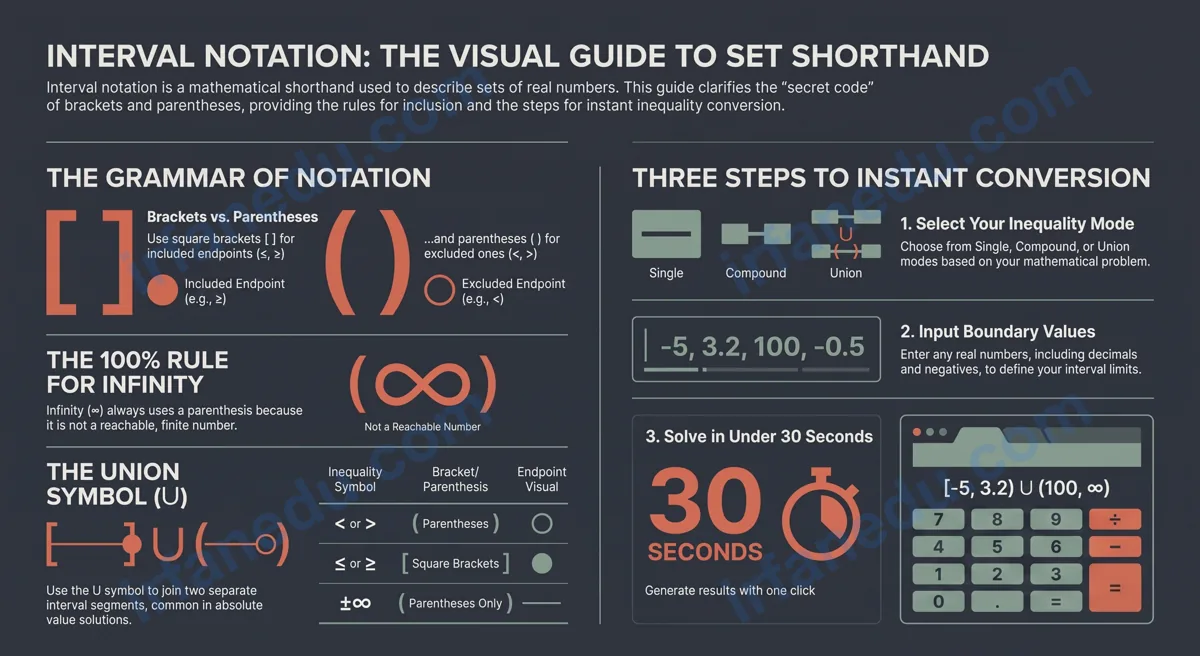
If interval notation has ever confused you, you are absolutely not alone. 😊 Brackets, parentheses, infinity symbols — it looks like a secret code the first time you see it. I have watched hundreds of students freeze up on this exact topic, and I promise: once the logic clicks, it never leaves you.
This free interval notation calculator converts any inequality — simple, compound, or infinite — into correct interval notation in one click, with a full step-by-step explanation so you understand why the answer is what it is.
Interval notation is a shorthand for writing sets of real numbers. Square brackets [ ] include an endpoint; parentheses ( ) exclude it. Infinity always takes a parenthesis. For example, 2 ≤ x < 7 becomes [2, 7).
- A working calculator that converts inequalities to interval notation instantly
- A clear reference table of every interval type
- Three fully worked examples with step-by-step breakdowns
- The single most common mistake students make (and how to avoid it)
( ) for excluded endpoints and square brackets [ ] for included endpoints. The inequality 2 ≤ x < 7 becomes [2, 7). Infinity always uses a parenthesis — never a bracket — because infinity is not a reachable number. Use this calculator to convert any inequality in seconds.
⚡ TL;DR – Quick Summary
- 📌 [ ] = endpoint included (≤ or ≥); ( ) = endpoint excluded (< or >)
- 📌 Infinity always uses a parenthesis — no exceptions
- 📌
x > 3→(3, ∞)|x ≤ 3→(-∞, 3] - 📌 Compound inequality
a ≤ x < b→[a, b) - 📌 Use ∪ to join two separate intervals (e.g., gaps from absolute value inequalities)
- 📌 Enter your values below — the calculator shows every step
Interval Notation Calculator
Convert inequalities to interval notation — with step-by-step solutions
How to Use This Interval Notation Calculator 🛠️
Using this tool takes under 30 seconds. Here is the exact process:
- Pick a mode. Choose Single Inequality (like x > 3), Compound Inequality (like 2 ≤ x < 7), or Union of Two Intervals (for gaps in a solution set).
- Select the inequality type from the dropdown — strictly greater, greater-or-equal, strictly less, or less-or-equal.
- Enter your bound value(s). Type any real number. Decimals and negatives work fine.
- Click Calculate. The result appears instantly with the correct bracket symbols and a
Sources & References
Reviewed by Dr. Irfan Mansuri. External links open in a new tab and are provided for further reading and verification.