
🌱 Types of Seeds: The Complete Student Guide (With Examples & Diagrams)
🚨 Here is the problem most students face: You open your biology textbook to the chapter on seeds, and within two pages you are drowning in Latin terms — monocotyledonous, dicotyledonous, testa, endosperm, radicle, plumule. You memorize the definitions the night before the test, pass, and forget everything by Monday.
That pattern is frustrating — and it is also unnecessary. Seeds are one of the most tangible, hands-on topics in all of biology. Every piece of fruit you eat, every grain of rice, every kernel of corn is a seed or came from one. Once you understand the logic behind the classification, the vocabulary sticks on its own.
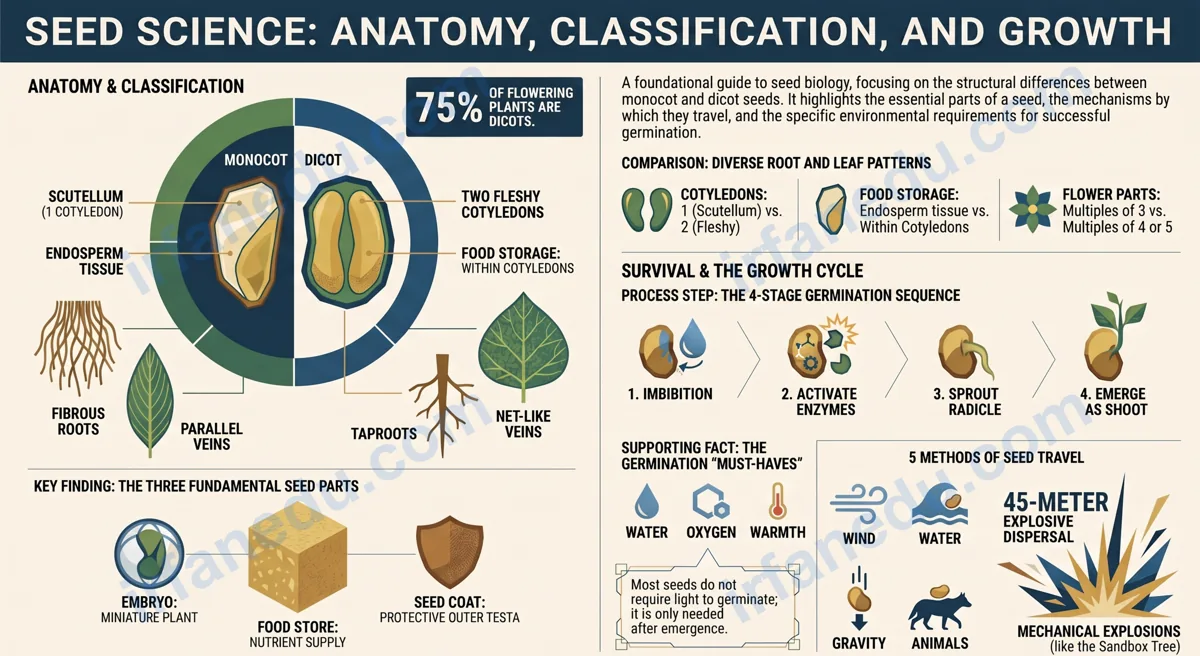
Seeds are the reproductive units of flowering plants (angiosperms) and conifers (gymnosperms). Every seed contains a tiny embryo plant, a food store to fuel early growth, and a protective outer coat. Scientists classify seeds primarily by the number of cotyledons (seed leaves) — one for monocots, two for dicots — and secondarily by how they travel to new locations (dispersal method).
- 🎯 Understand the three parts of every seed and what each does
- 🎯 Tell a monocot seed from a dicot seed with confidence
- 🎯 Name and explain all five seed dispersal methods with examples
- 🎯 Describe the germination process step by step
- 🎯 Correct the most common misconceptions that lose students marks
Seeds are classified into two main types: monocot seeds (one cotyledon — e.g., corn, wheat, rice) and dicot seeds (two cotyledons — e.g., beans, peas, sunflowers). Seeds are also grouped by dispersal method: wind, water, animal, mechanical, and gravity. Every seed contains three core parts — an embryo, a food store (endosperm or cotyledon), and a seed coat.
⚡ TL;DR – Quick Summary
- 🌾 Monocot seeds have 1 cotyledon; examples: corn, wheat, rice, grass.
- 🫘 Dicot seeds have 2 cotyledons; examples: beans, peas, sunflower, mango.
- 🔬 Every seed has 3 parts: embryo, food store (endosperm/cotyledon), seed coat.
- 💨 Five dispersal methods: wind, water, animal, mechanical explosion, gravity.
- 💧 Germination needs water, oxygen, and the right temperature — NOT light.
- 🚫 Biggest student error: confusing the cotyledon’s role in monocots vs dicots.
📊 Quick Facts at a Glance
| Feature | Detail |
|---|---|
| Topic | Types of Seeds |
| Main Classification | Monocot (1 cotyledon) vs Dicot (2 cotyledons) |
| Monocot examples | Corn, wheat, rice, barley, onion, lily |
| Dicot examples | Bean, pea, sunflower, mango, apple, oak |
| Seed dispersal types | Wind, water, animal, mechanical, gravity |
| Germination requirements | Water, oxygen, suitable temperature |
| Curriculum level | Grades 5–10 (middle & high school biology) |
| Related concept | Plant reproduction, angiosperms, gymnosperms |
🌿 What Is a Seed, Exactly?
A seed is a mature, fertilized ovule — the packaged next generation of a plant. It contains everything a new plant needs to survive until it can make its own food through photosynthesis.
Seeds evolved roughly 360 million years ago and gave plants a massive survival advantage: the ability to pause development, survive drought or cold, and resume growth only when conditions are right. That pause is called dormancy.
Seeds belong to two broad plant groups:
- Angiosperms (flowering plants) — seeds are enclosed inside a fruit. Examples: apples, beans, sunflowers.
- Gymnosperms (non-flowering, cone-bearing plants) — seeds are “naked,” sitting on cone scales. Examples: pine, spruce, fir.
In most school curricula, “types of seeds” refers to angiosperm seeds, specifically the monocot/dicot split. That is what this guide focuses on.
🔬 What Are the Parts of a Seed?
Every seed — whether a tiny poppy seed or a large coconut — has the same three fundamental parts. Understanding these parts makes the rest of seed biology click into place.
1. The Embryo
The embryo is the miniature plant inside the seed. It has three sub-parts:
- Radicle — becomes the root system
- Plumule — becomes the shoot and first leaves
- Hypocotyl — the stem connecting radicle and plumule
2. The Food Store (Endosperm or Cotyledon)
The embryo cannot photosynthesize until it has leaves above ground. Until then, it burns stored food. In monocots, this food is held in a tissue called the endosperm. In dicots, the food is packed directly into the thick, fleshy cotyledons.
3. The Seed Coat (Testa)
The seed coat is the tough outer layer that protects the embryo from physical damage, drying out, and pathogens. Its thickness varies enormously — paper-thin in peas, rock-hard in coconuts.
🖼️ Visual: Cross-Section of a Dicot Seed (Bean)
  ┌─────────────────────────────────┐
  │         SEED COAT (Testa)       │  ← Hard outer protection
  │  ┌───────────────────────────┐  │
  │  │   COTYLEDON 1  (food)     │  │  ← Food store (dicot has 2)
  │  │   COTYLEDON 2  (food)     │  │
  │  │                           │  │
  │  │   ┌───────────────────┐   │  │
  │  │   │     EMBRYO        │   │  │
  │  │   │  Plumule (shoot)  │   │  │
  │  │   │  Hypocotyl (stem) │   │  │
  │  │   │  Radicle (root)   │   │  │
  │  │   └───────────────────┘   │  │
  │  └───────────────────────────┘  │
  └─────────────────────────────────┘
🫘 The Two Main Types of Seeds: Monocot vs Dicot
The single most important seed classification in school biology is the monocot/dicot split, based on the number of cotyledons (seed leaves) inside the seed.
Monocot Seeds (Monocotyledonous)
Monocot seeds contain one cotyledon. The cotyledon in monocots is called the scutellum, and its job is to absorb nutrients from the endosperm and pass them to the embryo — it does not store food itself.
- Examples: corn (maize), wheat, rice, barley, oat, onion, lily, banana, palm
- Leaf venation when grown: parallel veins
- Flower parts: multiples of 3 (3 petals, 6 stamens, etc.)
- Root system: fibrous roots
Dicot Seeds (Dicotyledonous)
Dicot seeds contain two cotyledons, which are thick and fleshy because they directly store the food the embryo will use.
- Examples: bean, pea, lentil, sunflower, mango, apple, oak, rose, tomato, peanut
- Leaf venation when grown: net-like (reticulate) veins
- Flower parts: multiples of 4 or 5
- Root system: taproot
| Feature | 🌾 Monocot Seed | 🫘 Dicot Seed |
|---|---|---|
| Cotyledons | 1 | 2 |
| Food storage | Endosperm (separate tissue) | Cotyledons (thick & fleshy) |
| Leaf veins (adult plant) | Parallel | Net-like (reticulate) |
| Flower parts | Multiples of 3 | Multiples of 4 or 5 |
| Root type | Fibrous | Taproot |
| Pollen pores | 1 pore (monosulcate) | 3 pores (trisulcate) |
| Common examples | Corn, wheat, rice, lily | Bean, pea, mango, sunflower |
| % of flowering plants | ~25% | ~75% |
In my experience teaching biology, the monocot/dicot distinction trips students up not because it is hard, but because textbooks present it as a list of six separate facts to memorize. The real insight is that it is one underlying difference — cotyledon count — that cascades into all the other differences (venation, root type, flower parts). Once a student grasps that single root cause, the rest of the table above becomes logical rather than arbitrary.
🔎 How to Identify a Seed Type in 5 Steps
Follow this ordered process to classify any seed you encounter — useful for lab practicals and science fair projects.
- Soak the seed overnight in water. This softens the seed coat and makes the internal structures visible without damaging them.
- Carefully split the seed along its natural seam (the hilum line on a bean, for example) using your fingernail or a blunt knife.
- Count the cotyledons. One thick leaf-like structure = monocot. Two thick leaf-like structures = dicot. This single observation is definitive.
- Locate the embryo. Find the tiny shoot tip (plumule) and root tip (radicle) at one end of the cotyledon(s). In monocots like corn, the embryo sits to the side of the large starchy endosperm.
- Confirm with adult plant traits if a seedling is available: parallel leaf veins = monocot; net-like veins = dicot.
Soak a kidney bean and a corn kernel overnight. Split the bean: you will see two identical fleshy halves (cotyledons) with a tiny embryo at one end. Split the corn: you will see a large white starchy mass (endosperm) with a small shield-shaped structure (scutellum/cotyledon) and a tiny embryo on one side. The bean is a dicot; the corn is a monocot. You can verify this in under two minutes with seeds from your kitchen.
💨 What Are the 5 Methods of Seed Dispersal?
Seed dispersal is how seeds travel away from the parent plant to reduce competition and colonize new areas. Each method involves a specific structural adaptation in the seed or fruit.
1. 🌬️ Wind Dispersal (Anemochory)
Seeds adapted for wind are lightweight and often have wings or feathery tufts. Examples: dandelion (parachute of hairs), maple (winged samara), cottonwood (cottony fibers), orchid (dust-like seeds).
2. 💧 Water Dispersal (Hydrochory)
Seeds adapted for water have buoyant, waterproof coats. The coconut is the classic example — its fibrous husk traps air and keeps it afloat for months across ocean currents. Water lilies and mangroves also disperse by water.
3. 🐾 Animal Dispersal (Zoochory)
Animals disperse seeds in two ways:
- External (epizoochory): Seeds with hooks or barbs attach to fur or clothing. Examples: burdock (inspired Velcro), beggar’s lice, cocklebur.
- Internal (endozoochory): Animals eat fleshy fruits; seeds pass through the digestive system unharmed and are deposited elsewhere. Examples: berries, cherries, tomatoes.
4. 💥 Mechanical / Explosive Dispersal (Autochory)
Some plants build up tension in their seed pods and explode when ripe, flinging seeds outward. Examples: touch-me-not (Impatiens), squirting cucumber, witch hazel, sandbox tree (can fling seeds up to 45 meters).
5. 🍂 Gravity Dispersal (Barochory)
Heavy seeds simply fall from the parent plant and roll or slide to a new location. Examples: acorns, horse chestnuts, coconuts (also water-dispersed). Gravity dispersal is often combined with animal caching (squirrels burying acorns).
The dispersal chapter is where biology becomes genuinely fascinating, in my view. The fact that burdock burrs directly inspired George de Mestral to invent Velcro in 1941 is not a trivia footnote — it is a perfect illustration of biomimicry, the field where engineers copy nature’s solutions. I always share this story in class because it transforms a dry taxonomy lesson into a story about human ingenuity. Students remember it years later.
🌱 How Does a Seed Germinate? (Step-by-Step)
Germination is the process by which a dormant seed resumes active growth and develops into a seedling. It requires three — and only three — essential conditions.
The Three Conditions for Germination
- Water: Activates enzymes, softens the seed coat, and triggers metabolic processes.
- Oxygen: Powers cellular respiration so the embryo can generate energy.
- Suitable temperature: Most seeds germinate best between 15°C–30°C (59°F–86°F). Extreme cold or heat inhibits enzyme activity.
The 4 Stages of Germination
- Imbibition: The seed absorbs water, swells, and the seed coat cracks open.
- Enzyme activation: Stored starch and proteins are broken down into sugars and amino acids the embryo can use.
- Radicle emergence: The root tip (radicle) pushes out first — always downward due to gravitropism.
- Shoot emergence: The plumule pushes upward toward light. The seedling is now established and begins photosynthesis.
In epigeal germination (e.g., bean), the cotyledons are pushed above the soil surface and turn green, briefly photosynthesizing. In hypogeal germination (e.g., pea, corn), the cotyledons stay below the soil and only the plumule emerges. This distinction appears on many standardized tests and is rarely explained well in basic textbooks.
🚫 Common Mistakes Students Make About Seeds
These are the errors I see most often in student work — and the corrections that earn back marks.
| ❌ Wrong Idea | ✅ Correct Understanding |
|---|---|
| “Seeds need light to germinate” | Seeds need water, oxygen, and warmth. Light is not required for germination in most species. |
| “The cotyledon IS the embryo” | The cotyledon is part of the embryo but specifically the food-storage leaf. The embryo includes radicle, plumule, and cotyledon(s). |
| “Monocots have no endosperm” | Monocots have a large endosperm — it is the main food store. The single cotyledon (scutellum) absorbs food FROM the endosperm. |
| “A peanut is a nut (seed)” | A peanut is a legume seed inside a pod (fruit). Botanically, it is a seed — but the “nut” label is culinary, not botanical. |
| “Coconut is only water-dispersed” | Coconuts are dispersed by both water AND gravity. Multiple dispersal mechanisms can apply to one seed. |
| “All dicots have a taproot” | Most dicots develop a taproot, but some (like ivy) develop adventitious roots. Taproot is the general rule, not an absolute. |
🌍 Real-World Applications of Seed Science
Understanding seed types is not just an exam topic — it drives decisions in agriculture, conservation, and technology.
- 🌾 Agriculture: Monocot crops (wheat, rice, corn, barley) provide the majority of the world’s caloric intake. Agronomists use seed biology to improve germination rates, drought resistance, and yield.
- 🏦 Seed banks: The Svalbard Global Seed Vault in Norway stores over 1.3 million seed varieties as insurance against crop extinction. Seeds are stored in conditions that exploit dormancy — cold, dry, and dark.
- 🔬 Genetic engineering: Understanding seed structure helps scientists insert genes into the embryo to create pest-resistant or nutrient-enhanced crops (e.g., Golden Rice, which is a monocot engineered to produce beta-carotene).
- 🏗️ Biomimicry: Velcro was directly inspired by burdock seed hooks. Maple seed aerodynamics have influenced drone and helicopter blade design.
- 🌿 Ecological restoration: Conservationists choose seed dispersal methods deliberately when replanting forests — wind-dispersed seeds for open areas, animal-dispersed seeds where wildlife corridors exist.
💡 Unique Insight: What Most Seed Guides Get Wrong
The “monocot vs dicot” split is actually outdated as a complete classification. Modern molecular phylogenetics (DNA-based plant classification) has revealed that “dicots” are not a natural group — they are paraphyletic. What we call dicots actually includes two separate lineages: the true eudicots (roses, oaks, sunflowers) and the magnoliids (magnolias, avocados, black pepper). Monocots evolved from within the dicot lineage, not alongside it.
For school exams, the monocot/dicot framework is still the correct answer to use. But if you want to impress a biology teacher or ace an advanced question, knowing that “dicot” is a convenience term — not a strict evolutionary category — shows genuine scientific literacy. The formal terms are monocotyledons and eudicotyledons.
In my experience, students who learn this nuance early develop a much stronger intuition for why classification systems get revised — which is a core scientific thinking skill, not just a botany fact.
🧠 Quick Quiz: Test Your Seed Knowledge
Q1. A seed contains two thick, fleshy cotyledons. What type of seed is it?
Q2. Which THREE conditions are essential for seed germination?
Written and fact-checked by Dr Irfan Mansuri. External links open in a new tab and are provided for further reading and verification.