
Cold War Timeline for Students: Every Key Event from 1945 to 1991
Before You Start: What You Should Already Know
This guide assumes you have a basic familiarity with the following concepts. If any of these feel unfamiliar, spend five minutes reviewing them before reading on.
- World War II (1939-1945): The global conflict that ended with Allied victory and left the US and USSR as the world’s two dominant powers.
- Capitalism vs. Communism: The US championed free-market capitalism and democratic elections; the USSR promoted state-controlled communism and one-party rule.
- Nuclear weapons: The US used atomic bombs in 1945; the USSR developed its own by 1949. Both sides eventually built thousands of warheads.
- The concept of “superpower”: A nation with overwhelming military, economic, and political influence capable of shaping global events.
With that foundation in place, the Cold War timeline will make much more sense from the very first event.
Table of Contents
- Introduction: What Was the Cold War?
- The Root Causes
- Phase 1: Early Cold War (1945-1953)
- Phase 2: Escalation and Crisis (1953-1962)
- Phase 3: Detente and Proxy Wars (1963-1979)
- Phase 4: End Game (1979-1991)
- Visual Timeline Chart
- Common Student Mistakes
- Why the Cold War Still Matters
- Quick Knowledge Quiz
- Practice Problems
- Frequently Asked Questions
- Sources & References
Introduction: What Was the Cold War?
The Cold War was a prolonged period of political tension and ideological rivalry between the United States and the Soviet Union lasting from 1945 to 1991. It was called “cold” because the two superpowers never fought each other directly in open warfare, instead competing through arms races, space exploration, economic pressure, and proxy conflicts around the world.
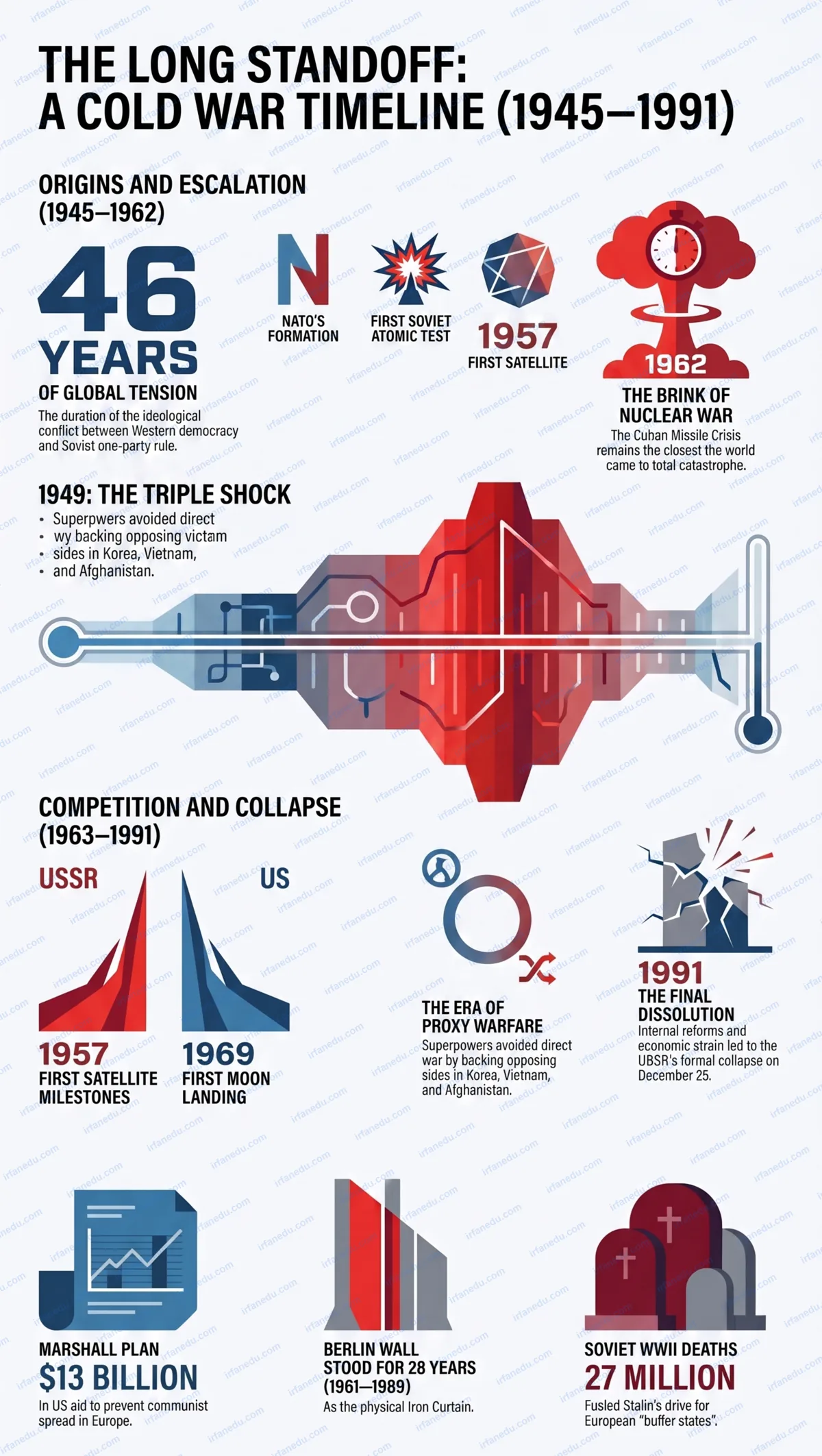
Forty-six years. That is how long the world held its breath, waiting to see whether two nuclear-armed superpowers would tip from rivalry into catastrophe. They never did, but the Cold War reshaped every continent, toppled governments, sent humans to the Moon, and left a geopolitical legacy that shapes international relations to this day.
For students, the Cold War timeline can feel overwhelming. Dozens of events, two massive powers, and a cast of world leaders spread across nearly five decades. My goal in this guide is to give you a clear, structured map of the entire period, phase by phase, so you can see how each event connects to the next.
- Understand the ideological split that started the Cold War
- Identify the four main phases of the conflict
- Recall at least 15 key events with their dates and significance
- Explain how the Cold War ended and why it matters today
TL;DR – Quick Summary
- The Cold War ran from 1945 to 1991 between the US and USSR.
- It was ideological: capitalism vs. communism, democracy vs. one-party rule.
- Key crises include the Berlin Blockade, Korean War, and Cuban Missile Crisis.
- The Space Race saw Sputnik (1957) and the Moon landing (1969).
- Gorbachev’s reforms and the Berlin Wall’s fall (1989) ended the conflict.
- The USSR formally dissolved on December 25, 1991.
| Fact | Detail |
|---|---|
| Duration | 1945-1991 (approx. 46 years) |
| Main Rivals | United States vs. Soviet Union (USSR) |
| Ideology (US) | Capitalism, liberal democracy |
| Ideology (USSR) | Communism, one-party state |
| Direct combat? | No — rivalry was political, economic, and through proxies |
| Most dangerous moment | Cuban Missile Crisis, October 1962 |
| Space Race winner | US (Moon landing, July 1969) |
| End date | December 25, 1991 (USSR dissolution) |
The Root Causes: Why Did the Cold War Begin?
The Cold War did not start with a single event. It grew from a deep structural incompatibility between two systems that had been uneasy allies during World War II.
The US and USSR cooperated to defeat Nazi Germany, but their alliance was always fragile. Once the common enemy was gone, the underlying tensions surfaced fast. The Soviet Union had suffered 27 million deaths in World War II and was determined to create a buffer zone of friendly (communist) states in Eastern Europe. The US saw this as aggressive expansion and a threat to democracy worldwide.
The Five Core Causes
- Ideological conflict: Capitalism and communism are fundamentally incompatible economic and political systems. Each side believed its model was superior and saw the other as a threat.
- Post-war power vacuum: With Germany and Japan defeated, only two powers had the military and economic strength to shape the new world order.
- Soviet expansion in Eastern Europe: The USSR installed communist governments in Poland, Czechoslovakia, Hungary, Romania, and Bulgaria between 1945 and 1948.
- Nuclear weapons: The US atomic bombing of Japan in 1945 alarmed the Soviets. Once the USSR developed its own bomb in 1949, both sides entered a dangerous arms race.
- Mutual distrust: Decades of ideological hostility, plus wartime disagreements at conferences like Yalta and Potsdam, left both sides deeply suspicious of the other’s intentions.
In my experience teaching Cold War history, students often ask which side was “right.” I think that framing misses the point. Both superpowers genuinely believed they were defending their people and their way of life. The tragedy of the Cold War is that two legitimate fears, amplified by secrecy and propaganda, nearly destroyed the world. Understanding both perspectives, not just one, is what separates a good history student from a great one.
Phase 1: Early Cold War (1945-1953)
The early Cold War was defined by the division of Europe, the first nuclear standoffs, and the establishment of the two competing alliance systems that would define the next four decades.
1945: The Yalta and Potsdam Conferences
In February 1945, US President Franklin Roosevelt, British Prime Minister Winston Churchill, and Soviet leader Joseph Stalin met at Yalta to plan the post-war world. They agreed on free elections in liberated countries, but the Soviets interpreted “free” very differently from the Western Allies. The Potsdam Conference (July 1945) deepened the rift, with the new US President Harry Truman and Stalin clashing over Germany’s future and reparations.
1946: Churchill’s Iron Curtain Speech
On March 5, 1946, Winston Churchill delivered his famous speech in Fulton, Missouri, warning that “an iron curtain has descended across the Continent.” This phrase gave the world a vivid image of Europe’s division and is often cited as the moment the Cold War was publicly named.
1947: The Truman Doctrine and Marshall Plan
President Truman announced in March 1947 that the US would support any nation threatened by communist takeover. This became known as the Truman Doctrine and marked the formal start of the US “containment” policy. The Marshall Plan (June 1947) followed, offering $13 billion in economic aid to rebuild war-damaged Western European nations, partly to prevent economic desperation from driving them toward communism.
1948-1949: The Berlin Blockade
Germany was divided into four occupation zones after the war. Berlin, deep inside the Soviet zone, was also split. When the Western Allies introduced a new currency in their zones, Stalin responded by blockading all road and rail access to West Berlin in June 1948. The US and Britain responded with the Berlin Airlift, flying in supplies for 11 months until Stalin lifted the blockade in May 1949. It was the first major Cold War crisis, and the West won it without firing a shot.
1949: NATO, the Soviet Bomb, and China
Three seismic events happened in 1949. The North Atlantic Treaty Organization (NATO) was formed in April, creating a military alliance among Western nations. In August, the USSR successfully tested its first atomic bomb, ending the US nuclear monopoly. In October, Mao Zedong’s Communist Party won China’s civil war, creating the People’s Republic of China. Suddenly, communism controlled the world’s most populous nation.
1950-1953: The Korean War
When communist North Korea invaded South Korea in June 1950, the US led a United Nations force to defend the South. China entered the war on the North’s side in late 1950. The conflict ended in a stalemate armistice in July 1953, with Korea still divided at roughly the 38th parallel, where it remains today. The Korean War was the first major “hot” proxy conflict of the Cold War.
Phase 2: Escalation and Crisis (1953-1962)
The mid-Cold War period saw the arms race accelerate, the Space Race begin, and the world come closer to nuclear war than at any other point in history.
1953-1955: Stalin Dies, New Leaders Emerge
Stalin’s death in March 1953 briefly raised hopes for a thaw. His successor, Nikita Khrushchev, eventually denounced Stalin’s crimes in a 1956 “Secret Speech” and spoke of “peaceful coexistence” with the West. However, when Hungary tried to leave the Soviet sphere in 1956, Soviet tanks crushed the uprising, killing thousands. The message was clear: Eastern Europe was not free to leave.
1955: The Warsaw Pact
In response to West Germany joining NATO, the Soviet Union formed the Warsaw Pact in May 1955, a military alliance binding the USSR, East Germany, Poland, Czechoslovakia, Hungary, Romania, Bulgaria, and Albania. Europe was now formally divided into two armed camps.
1957: Sputnik and the Space Race Begins
On October 4, 1957, the USSR launched Sputnik 1, the world’s first artificial satellite. It was a small metal sphere, but its beeping signal heard around the world sent a clear message: Soviet rockets were powerful enough to reach American cities. The US responded by creating NASA in 1958 and dramatically increasing science and education funding.
[IMAGE: Sputnik satellite orbiting Earth with stars in background | ALT: Sputnik 1 the first artificial satellite launched by USSR in 1957 during Cold War Space Race]
1961: The Berlin Wall and Yuri Gagarin
In April 1961, Soviet cosmonaut Yuri Gagarin became the first human in space, another major propaganda victory for the USSR. Four months later, in August 1961, East Germany began building the Berlin Wall to stop the flood of East Germans escaping to the West. The Wall became the most powerful physical symbol of the Iron Curtain.
1962: The Cuban Missile Crisis
This was the closest the world came to nuclear war. In October 1962, US spy planes photographed Soviet nuclear missile installations under construction in Cuba, just 90 miles from Florida. President John F. Kennedy announced a naval blockade of Cuba and demanded the missiles be removed. For 13 tense days, the world watched. Soviet ships carrying more missiles turned back. The Soviets agreed to remove the missiles in exchange for a US pledge not to invade Cuba and a secret agreement to remove US missiles from Turkey. The crisis led directly to the creation of a direct telephone “hotline” between Washington and Moscow.
The Cuban Missile Crisis is the event I spend the most time on when teaching Cold War history, and for good reason. It shows that even rational leaders, under extreme pressure and with incomplete information, can bring the world to the edge of catastrophe. What saved everyone was a combination of back-channel diplomacy, personal courage from both Kennedy and Khrushchev, and a fair amount of luck. That lesson is as relevant today as it was in 1962.
Phase 3: Detente and Proxy Wars (1963-1979)
After the near-catastrophe of the Cuban Missile Crisis, both sides sought ways to reduce tension. This period of “detente” (relaxation) coexisted uneasily with bloody proxy wars in Asia, Africa, and Latin America.
1963-1968: The Space Race Intensifies
President Kennedy’s 1961 pledge to land a man on the Moon by the end of the decade drove massive US investment in the Apollo program. The USSR raced ahead with early milestones: the first spacewalk (Alexei Leonov, 1965) and the first woman in space (Valentina Tereshkova, 1963). But the US Apollo program, despite the tragic Apollo 1 fire in 1967, kept pushing forward.
1964-1975: The Vietnam War
The Vietnam War was the Cold War’s longest and most costly proxy conflict for the US. North Vietnam, backed by the USSR and China, fought to reunify the country under communism. South Vietnam, backed by the US, resisted. The US committed over 500,000 troops at its peak. The war ended with North Vietnamese victory in 1975, a significant blow to US credibility and the containment doctrine.
1969: The Moon Landing
On July 20, 1969, Apollo 11 astronauts Neil Armstrong and Buzz Aldrin became the first humans to walk on the Moon. It was the defining US victory of the Space Race and a massive propaganda triumph. The USSR never landed humans on the Moon and quietly abandoned its lunar program.
1972: Nixon Visits China and SALT I
President Richard Nixon’s historic visit to China in February 1972 was a masterstroke of Cold War diplomacy. By opening relations with China, the US exploited the Sino-Soviet split (China and the USSR had become rivals by the 1960s) and increased pressure on the Soviets. That same year, Nixon and Soviet leader Leonid Brezhnev signed SALT I, the first Strategic Arms Limitation Treaty, agreeing to cap the number of nuclear missiles each side could hold.
1979: Soviet Invasion of Afghanistan
The Soviet invasion of Afghanistan in December 1979 effectively ended the detente era. The US responded by boycotting the 1980 Moscow Olympics, imposing grain embargoes, and secretly funding Afghan resistance fighters (the Mujahideen). The war became the USSR’s Vietnam, a costly, unwinnable conflict that drained Soviet resources for a decade.
Phase 4: End Game (1979-1991)
The final phase of the Cold War saw a brief return to high tension under US President Ronald Reagan, followed by a rapid and largely peaceful collapse of the Soviet system.
1981-1985: Reagan’s Military Buildup
President Reagan called the USSR an “evil empire” and launched the largest peacetime military buildup in US history. He proposed the Strategic Defense Initiative (SDI), a space-based missile defense system nicknamed “Star Wars.” Whether SDI was technically feasible or not, it forced the USSR to consider spending even more on defense, a burden their struggling economy could not sustain.
1985: Gorbachev Takes Power
Mikhail Gorbachev became Soviet leader in March 1985 and immediately recognized that the USSR’s economy was in serious trouble. He introduced two landmark reform policies: glasnost (openness, allowing more freedom of speech and press) and perestroika (restructuring, decentralizing the economy). These reforms, intended to save the Soviet system, ultimately accelerated its collapse by unleashing forces Gorbachev could not control.
1989: The Fall of the Berlin Wall
Through 1989, communist governments across Eastern Europe fell one by one as popular uprisings swept the region. On November 9, 1989, the East German government announced that citizens could cross the Berlin Wall freely. Crowds gathered and began physically tearing down the Wall with hammers and their bare hands. It was the most powerful symbolic moment of the Cold War’s end.
[IMAGE: People celebrating at the Berlin Wall in November 1989 | ALT: Fall of the Berlin Wall November 1989 marking the end of the Cold War]
1991: The Soviet Union Dissolves
A failed coup attempt against Gorbachev in August 1991 accelerated the USSR’s breakup. One by one, Soviet republics declared independence. On December 25, 1991, Gorbachev resigned as president of the USSR, and the Soviet flag was lowered over the Kremlin for the last time. The Cold War was over.
Visual Timeline Chart
Use this ASCII timeline to see the Cold War’s major events at a glance. Each decade is clearly marked.
COLD WAR TIMELINE: 1945-1991
============================================================
1945 |--[Yalta Conference]--[Potsdam Conference]--[WW2 ends]
     |
1946 |--[Churchill's "Iron Curtain" Speech]
     |
1947 |--[Truman Doctrine]--[Marshall Plan]--[CIA founded]
     |
1948 |--[Berlin Blockade begins]--[Israel founded]
1949 |--[Berlin Airlift ends]--[NATO formed]--[USSR atomic bomb]
     |--[China goes communist]
     |
1950 |--[Korean War begins]
1953 |--[Korean War armistice]--[Stalin dies]
     |
1955 |--[Warsaw Pact formed]
1956 |--[Hungarian Uprising crushed]--[Suez Crisis]
1957 |--[SPUTNIK launched - Space Race begins!]
     |
1961 |--[Gagarin first human in space]--[Berlin Wall built]
     |--[Bay of Pigs invasion fails]
1962 |--[CUBAN MISSILE CRISIS - closest to nuclear war]
     |
1963 |--[JFK assassinated]--[Nuclear Test Ban Treaty]
1965 |--[US troops enter Vietnam in force]
     |
1969 |--[APOLLO 11 - Moon Landing - US wins Space Race]
     |
1972 |--[Nixon visits China]--[SALT I signed]
1973 |--[Vietnam ceasefire]
1975 |--[Vietnam War ends - North wins]
     |
1979 |--[SALT II signed]--[USSR invades Afghanistan]
     |
1981 |--[Reagan's military buildup begins]
1983 |--[SDI "Star Wars" announced]
     |
1985 |--[Gorbachev takes power]--[Glasnost & Perestroika]
1986 |--[Chernobyl nuclear disaster]--[Reykjavik Summit]
1987 |--[INF Treaty signed - nuclear missiles reduced]
     |
1989 |--[Berlin Wall FALLS - Nov 9]--[Eastern Europe freed]
     |
1991 |--[Gulf War]--[USSR DISSOLVES - Dec 25]
     |
     END OF COLD WAR
============================================================
Common Student Mistakes: Wrong vs. Right
These are the errors I see most often in Cold War essays and exams. Avoiding them will immediately improve your grade.
| Common Mistake | Correct Understanding |
|---|---|
| Saying the US and USSR “fought each other” in the Cold War | They never fought directly. All combat was through proxy wars (Korea, Vietnam, Afghanistan). |
| Claiming the Space Race started with the Moon landing | The Space Race started with Sputnik in 1957. The Moon landing (1969) was its climax. |
| Saying the Berlin Wall separated East and West Germany | The Wall divided the city of Berlin, which sat inside East Germany. Germany itself was divided by a longer border. |
| Thinking detente meant the Cold War ended in the 1970s | Detente reduced tension but did not end the rivalry. The Soviet invasion of Afghanistan in 1979 restarted hostilities. |
| Crediting Reagan alone for ending the Cold War | Gorbachev’s internal reforms, Soviet economic collapse, and Eastern European popular movements were equally important causes. |
| Confusing the Truman Doctrine with the Marshall Plan | The Truman Doctrine was a political/military commitment; the Marshall Plan was an economic aid program. Both served containment. |
Why the Cold War Still Matters Today
The Cold War ended in 1991, but its consequences shape the world you live in right now. Understanding this history is not just an academic exercise.
- NATO still exists and continues to expand, a source of ongoing tension with Russia.
- Nuclear weapons developed during the Cold War arms race still exist in the thousands. Nine countries currently hold nuclear weapons.
- Korea remains divided at the armistice line established in 1953, with North Korea now a nuclear state.
- Afghanistan’s instability traces directly to the Soviet invasion of 1979 and the subsequent US-backed Mujahideen, some of whom later formed the Taliban.
- US-China tensions echo Cold War dynamics, with ideological, economic, and military competition between the world’s two largest economies.
- Space exploration as a national priority was born from Cold War competition. NASA’s entire early program was driven by the need to beat the Soviets.
Quick Knowledge Quiz: Cold War Timeline
Answer each question, then click “Show Answer” to check.
1. Which event is considered the most dangerous moment of the Cold War?
2. What was the name of the Soviet satellite that launched the Space Race in 1957?
3. Gorbachev’s policy of openness and transparency in the USSR was called:
Practice Problems: Reveal on Click
Practice 1: Explain the significance of the Truman Doctrine (1947) in the context of Cold War containment.
Model Answer: The Truman Doctrine (March 1947) was a formal US commitment to support any nation threatened by communist takeover, announced in response to communist insurgencies in Greece and Turkey. Its significance was threefold. First, it marked the official start of the US “containment” policy, the strategic goal of preventing communism from spreading beyond its existing borders. Second, it represented a permanent shift away from US isolationism, committing America to global engagement indefinitely. Third, it set a precedent for future US interventions in Korea, Vietnam, and elsewhere. Critics argued it gave the US a blank check to intervene anywhere in the world, regardless of local context.
Practice 2: Why did the Berlin Airlift (1948-1949) matter for the Cold War?
Model Answer: The Berlin Airlift mattered for three reasons. First, it was the first direct confrontation between the US and USSR over a specific territory, and the West won without military force. Second, it demonstrated Western resolve to defend Berlin and, by extension, all of Western Europe. Third, it was a propaganda victory: the image of Western planes delivering food and coal to a besieged city contrasted sharply with the Soviet blockade, winning international sympathy. Stalin’s decision to lift the blockade in May 1949 was an admission that the tactic had failed.
Practice 3: Compare the causes of the Korean War and the Vietnam War as Cold War proxy conflicts.
Model Answer: Both wars were proxy conflicts where the US supported non-communist governments against communist forces backed by the USSR and/or China. In Korea (1950-1953), the conflict began with a clear military invasion across the 38th parallel and ended in a stalemate armistice, with the country still divided. In Vietnam (1955-1975), the conflict was more complex, involving a communist insurgency in the South as well as North Vietnamese military pressure. The US committed far more troops and resources to Vietnam, and the outcome was a communist victory, a significant difference from Korea. Both wars showed the limits of US military power in fighting ideologically motivated opponents on their home terrain.
Frequently Asked Questions
When did the Cold War start and end?
The Cold War began in 1945 after World War II ended and the US-Soviet alliance broke down over ideological differences. It officially ended in 1991 when the Soviet Union dissolved. The 46-year period was defined by political rivalry, arms races, and proxy conflicts rather than direct military combat between the two superpowers.
What caused the Cold War?
The Cold War was caused by deep ideological differences between US capitalism and Soviet communism, mutual distrust after World War II, disagreements over the future of Europe, Soviet expansion into Eastern Europe, and the US desire to contain communism globally. The development of nuclear weapons by both sides made the rivalry especially dangerous and high-stakes.
What was the most dangerous moment of the Cold War?
The Cuban Missile Crisis of October 1962 is widely considered the most dangerous moment. For 13 days, the US and USSR stood on the brink of nuclear war after Soviet missiles were discovered in Cuba. The crisis was resolved through direct negotiation, with the Soviets removing missiles in exchange for a US pledge not to invade Cuba.
What was the Iron Curtain?
The Iron Curtain was a political and ideological boundary dividing Europe into two separate areas from the end of World War II until the end of the Cold War. Countries to the east fell under Soviet influence and adopted communist governments, while countries to the west aligned with the US and maintained democratic, capitalist systems. Churchill coined the term in his 1946 Fulton speech.
What was the Space Race?
The Space Race was a competition between the US and USSR from 1957 to 1969 to achieve supremacy in space exploration. The USSR launched the first satellite (Sputnik, 1957) and sent the first human to space (Yuri Gagarin, 1961). The US won the race by landing astronauts on the Moon in July 1969 during the Apollo 11 mission, fulfilling Kennedy’s 1961 pledge.
Why did the Cold War end?
The Cold War ended due to a combination of factors: Soviet economic stagnation, the costly arms race, Mikhail Gorbachev’s reform policies (glasnost and perestroika), the fall of the Berlin
Sources & References
Reviewed by Dr. Irfan Mansuri. External links open in a new tab and are provided for further reading and verification.