
Industrial Revolution Facts for Students: Numbers, Inventions & Real Impact
| Last Updated: July 2026
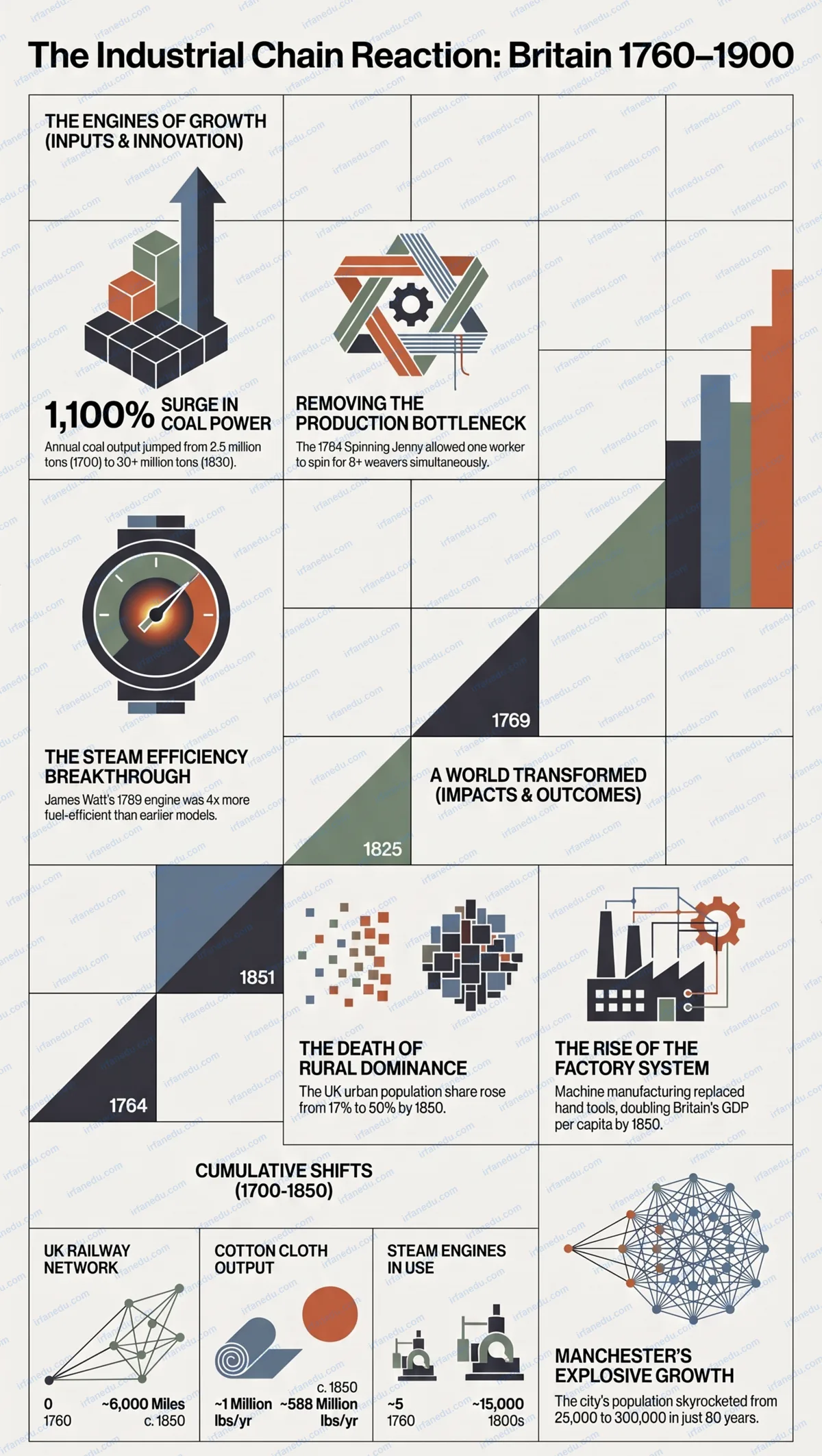
Britain’s coal output jumped from 2.5 million tons per year in 1700 to over 30 million tons by 1830 — a 12-fold increase in just 130 years. That single data point tells you more about the Industrial Revolution than almost any textbook paragraph can.
The Industrial Revolution was a period of rapid technological, economic, and social change that began in Britain around 1760 and spread globally through the 1800s. It replaced hand production with machine manufacturing, shifted populations from farms to cities, and permanently raised living standards through innovations in steam power, textiles, iron, and transport.
In my experience teaching history to students at every level, the Industrial Revolution is one of those topics where knowing the right numbers and facts makes the difference between a mediocre answer and a top-grade one. This guide gives you exactly that: precise data, clear explanations, and exam-ready facts you can use right away.
By the end of this article, you will be able to:
- State the key dates, causes, and effects of the Industrial Revolution with confidence
- Name the major inventions and the people behind them
- Explain why Britain industrialized first using specific evidence
- Avoid the five most common student mistakes on this topic
- Apply a structured study method for any history exam
Core Concept
The Industrial Revolution was not a single event. It was a compounding process where each invention made the next one possible, and each economic gain funded further innovation. Understanding that chain reaction is the key to mastering this topic.
⚡ TL;DR – Quick Summary
- The Industrial Revolution ran from approximately 1760 to 1840 in Britain, then spread globally.
- Steam power, textile machinery, and iron production were the three core technological pillars.
- Britain’s coal output rose 12x between 1700 and 1830, fueling the entire transformation.
- Urban populations exploded: Manchester grew from 25,000 to 300,000 in under 80 years.
- Child labor, long hours, and poor conditions were real costs; rising wages and new laws followed.
- The Second Industrial Revolution (1870-1914) added electricity, steel, and chemicals globally.
The Numbers That Define the Industrial Revolution
Before diving into causes and effects, look at the raw data. These numbers are the foundation of every strong exam answer on this topic.
| Metric | Before (c.1700) | After (c.1850) | Change |
|---|---|---|---|
| Britain’s annual coal output | 2.5 million tons | 30+ million tons | +1,100% |
| Manchester population | ~25,000 (1772) | ~300,000 (1850) | +1,100% |
| UK urban population share | ~17% | ~50% | +33 percentage points |
| Cotton cloth output (Britain) | ~1 million lbs/yr | ~588 million lbs/yr | ~588x increase |
| Steam engines in use (Britain) | ~5 (1760) | ~15,000 (1800s) | Exponential growth |
| Average factory working day | N/A (pre-factory) | 12-16 hours | Newly introduced |
| UK railway network length | 0 miles (1820) | ~6,000 miles (1850) | Built from zero |
These figures are not decorative. In any essay or short-answer question, dropping two or three of these numbers signals to your examiner that you understand the scale of change, not just the story.
What Was the Industrial Revolution?
The Industrial Revolution was a fundamental shift in how goods were made, how energy was generated, and how people lived and worked. It replaced cottage industries and hand tools with factories and machines.
The change happened in two broad phases:
| Phase | Period | Core Technologies | Key Regions |
|---|---|---|---|
| First Industrial Revolution | 1760-1840 | Steam engine, spinning jenny, power loom, iron | Britain (then Western Europe) |
| Second Industrial Revolution | 1870-1914 | Electricity, steel (Bessemer process), chemicals, internal combustion engine | USA, Germany, France, Japan |
The word “revolution” is apt because the changes were not gradual adjustments. They were structural breaks with the past. A farmer in 1750 lived and worked in ways not dramatically different from a farmer in 1250. A factory worker in 1850 lived in a world that would have been unrecognizable to their great-grandparents.
[IMAGE: A side-by-side comparison of a pre-industrial cottage workshop and an 1840s textile factory floor | ALT: industrial revolution before and after comparison cottage industry vs factory system]
Key Causes: Why Did Britain Industrialize First?
Britain’s head start was not accidental. It resulted from a specific combination of geographic, economic, political, and social factors that no other country had at the same time.
1. Natural Resources
Britain sat on enormous deposits of coal and iron ore, often close to each other and near navigable rivers or coastlines. This made extraction and transport cheaper than almost anywhere else in the world at the time.
2. Agricultural Revolution
Enclosure acts and new farming techniques from the early 1700s onward displaced millions of rural workers. These people moved to towns and became the labor force that factories needed. Without this surplus of workers, factories could not have scaled.
3. Political Stability and Property Rights
Britain’s constitutional monarchy and legal system protected private property and enforced contracts. Inventors could patent their ideas. Investors could lend money with confidence. This stability attracted capital and encouraged risk-taking.
4. Colonial Trade Networks
Britain’s empire supplied cheap raw materials (especially cotton from the Americas and India) and provided large markets for finished goods. This two-way flow funded industrial investment and kept factories running at full capacity.
5. Culture of Practical Innovation
Britain had a strong tradition of practical tinkerers and mechanics. The Royal Society and later the Lunar Society of Birmingham brought together scientists, engineers, and manufacturers who shared ideas freely. James Watt, Matthew Boulton, and Josiah Wedgwood all knew each other personally.
In my view, the single most underrated cause of the Industrial Revolution is the agricultural displacement that preceded it. Students focus on steam engines and miss the fact that you need a workforce willing to move into factories before any machine matters. The enclosure movement created that workforce. It was painful social disruption that became the human fuel of industrialization.
Timeline: 10 Dates Every Student Must Know
Memorizing a handful of precise dates gives your exam answers a backbone. Here are the ten I consider non-negotiable for any student studying this period.
1764 ----[ Spinning Jenny invented by James Hargreaves ]
         |
1769 ----[ James Watt patents improved steam engine ]
         |  (also: Arkwright's water frame, same year)
         |
1779 ----[ Crompton's spinning mule combines jenny + frame ]
         |
1785 ----[ Cartwright's power loom mechanizes weaving ]
         |
1807 ----[ Robert Fulton launches first commercial steamboat ]
         |
1825 ----[ World's first public steam railway opens (Stockton-Darlington) ]
         |
1830 ----[ Liverpool-Manchester Railway: first inter-city passenger line ]
         |
1851 ----[ Great Exhibition, London: Britain showcases industrial supremacy ]
         |
1856 ----[ Bessemer process makes cheap steel production possible ]
         |
1879 ----[ Edison demonstrates practical electric light bulb ]
         |
1903 ----[ Wright Brothers: first powered flight (Second Industrial era) ]
Major Inventions and Their Inventors
Each invention below solved a specific bottleneck in production or transport. Understanding what problem each one solved is far more useful than just memorizing names.
| Invention | Inventor | Year | Problem It Solved |
|---|---|---|---|
| Spinning Jenny | James Hargreaves | 1764 | One spinner could now work 8 (later 80+) spindles at once |
| Water Frame | Richard Arkwright | 1769 | Water-powered spinning produced stronger thread than hand methods |
| Improved Steam Engine | James Watt | 1769 | Separate condenser made engines 4x more fuel-efficient than Newcomen’s |
| Spinning Mule | Samuel Crompton | 1779 | Combined jenny and water frame to produce fine, strong yarn at scale |
| Power Loom | Edmund Cartwright | 1785 | Mechanized weaving to match the speed of mechanized spinning |
| Steam Locomotive | George Stephenson | 1814 | Moved heavy goods overland faster and cheaper than horse-drawn carts |
| Bessemer Converter | Henry Bessemer | 1856 | Reduced the cost of steel production by ~80%, enabling railways and skyscrapers |
| Practical Electric Light | Thomas Edison | 1879 | Extended the working day and made factories safer than gas lighting |
Before 1764, one spinner produced thread for roughly one weaver. The jenny allowed a single worker to spin for 8 weavers at once. This removed the “spinning bottleneck” that had kept textile output low for centuries. Within 20 years, Britain’s cotton cloth output began its climb toward the 588-fold increase recorded by 1850.
Effects on Society, Economy, and Environment
The Industrial Revolution created winners and losers simultaneously. Understanding both sides is essential for balanced exam answers.
Economic Effects
- Britain’s GDP per capita roughly doubled between 1760 and 1850.
- A new middle class of factory owners, managers, and professionals emerged.
- International trade expanded dramatically; Britain became the “workshop of the world.”
- Banking and finance grew to fund industrial investment, laying the groundwork for modern capitalism.
Social Effects
- Urbanization accelerated: by 1851, more than half of Britain’s population lived in towns for the first time in any nation’s history.
- Child labor became widespread in factories and mines before reform laws restricted it.
- The working class developed a collective identity, eventually leading to trade unions and labor movements.
- Women entered paid factory work in large numbers, though wages remained lower than men’s.
Environmental Effects
- Air pollution from coal burning created the first urban smog events, notably in London and Manchester.
- Rivers near industrial towns became heavily polluted with chemical and organic waste.
- Deforestation accelerated as demand for timber for construction and charcoal rose sharply.
- These environmental costs were largely unregulated until the late 19th century.
[IMAGE: A Victorian-era industrial cityscape with factory chimneys and smog over a river | ALT: industrial revolution environmental effects factory pollution Victorian city]
Students often write about the Industrial Revolution as if it was purely a story of progress. In my experience, the strongest exam answers acknowledge the genuine suffering it caused, especially for children and unskilled workers, while also recognizing that the long-run gains in health, wealth, and freedom were real. History rarely offers clean heroes and villains. The Industrial Revolution is a perfect case study in that complexity.
Common Mistakes Students Make on This Topic
These are the five errors I see most often in student essays and short-answer responses. Avoiding them is a fast route to better grades.
Right: The steam engine was one of several interacting causes. Agricultural displacement, coal availability, colonial markets, and political stability all contributed. No single invention caused the revolution.
Right: Short-term conditions for many workers were harsh. Real wage improvements took decades to materialize, and they were uneven across regions and skill levels.
Right: Thomas Newcomen built the first practical steam engine in 1712. Watt improved it dramatically in 1769 with a separate condenser, making it far more efficient and versatile. Watt improved the steam engine; he did not invent it.
Right: It began in Britain but spread to Belgium, France, Germany, and the USA by the mid-1800s, and to Japan, Russia, and other regions by the late 1800s. Britain had a head start, not a monopoly.
Right: The first phase ended around 1840 in Britain. The Second Industrial Revolution (1870-1914) continued and deepened the transformation globally. Many historians argue industrialization is still ongoing in parts of the world today.
How to Study the Industrial Revolution for Exams
Here is the five-step method I recommend to every student tackling this topic for the first time or reviewing it before an exam.
- Anchor the timeline first. Memorize four key dates: 1764 (spinning jenny), 1769 (Watt’s steam engine), 1825 (first steam railway), and 1851 (Great Exhibition). Every other fact connects to one of these anchors.
- Group inventions by sector. Sort them into textiles, power, transport, and iron/steel. This prevents the common mistake of mixing up inventors and their fields under exam pressure.
- Build cause-effect chains. Practice writing one-sentence chains: coal surplus leads to steam power, steam power leads to the factory system, the factory system leads to urbanization, urbanization leads to public health crises, public health crises lead to reform laws. Each link is a potential exam question.
- Use data to support arguments. Pick three or four numbers from the Quick Facts table above and memorize them. Specific data in an essay answer earns marks that vague claims cannot.
- Practice the wrong-vs-right corrections. Read each common mistake above and write a corrected version in your own words. This active recall method is far more effective than re-reading notes passively.
Quick Knowledge Check (3 Questions)
Select your answer. The correct choice highlights green; incorrect choices highlight red.
1. James Watt’s key improvement to the steam engine in 1769 was:
2. Britain’s coal output between 1700 and 1830 increased by approximately:
3. The Bessemer process (1856) was significant because it:
Reveal-on-Click Practice Problems
Q1: Explain two reasons why Britain industrialized before France or Germany.
Model Answer: First, Britain had abundant, accessible coal and iron deposits located close together and near navigable waterways, reducing the cost of fuel and raw materials for factories. Second, Britain’s political system, established through the constitutional settlement of 1688, protected private property and enforced contracts reliably, which encouraged investors to fund industrial ventures without fear of arbitrary seizure. France was disrupted by revolution and war from 1789 onward, and German states remained politically fragmented until 1871, both of which delayed sustained industrial investment.
Q2: Using specific data, describe the scale of urbanization during the Industrial Revolution.
Model Answer: Urbanization during the Industrial Revolution was dramatic and historically unprecedented. Manchester’s population grew from approximately 25,000 in 1772 to over 300,000 by 1850, a twelve-fold increase in under 80 years. By 1851, more than 50% of Britain’s population lived in urban areas, making Britain the first nation in history to have a majority urban population. This shift was driven by factory employment pulling workers from rural areas and by the agricultural displacement caused by enclosure acts earlier in the century.
Q3: Why is it inaccurate to say the Industrial Revolution was purely beneficial?
Model Answer: While the Industrial Revolution generated long-run economic growth and rising living standards, its short-term human costs were severe. Factory workers, including children as young as five or six, worked shifts of 12 to 16 hours in dangerous conditions. Urban overcrowding produced disease outbreaks, including cholera epidemics in 1831 and 1848. Air and water pollution from coal burning and industrial waste degraded public health in industrial cities. These costs fell disproportionately on the poorest workers, who had little legal protection until reform laws were passed later in the 19th century. A balanced assessment must weigh both the gains and the genuine suffering the revolution caused.
Frequently Asked Questions
When did the Industrial Revolution start and end?
What was the most important invention of the Industrial Revolution?
Why did the Industrial Revolution start in Britain?
How did the Industrial Revolution affect ordinary workers?
What role did coal play in the Industrial Revolution?
What is the difference between the First and Second Industrial Revolution?
How did the Industrial Revolution change cities?
Key Takeaways
- The Industrial Revolution began in Britain around 1760 and transformed how goods were made, how energy was used, and how people lived.
- Britain’s head start came from coal, iron, political stability, colonial trade, and a displaced agricultural workforce, not from any single invention.
- James Watt improved (not invented) the steam engine in 1769; Thomas Newcomen built the first practical version in 1712.
- Coal output rose 12-fold between 1700 and 1830; Manchester’s population rose 12-fold between 1772 and 1850. These parallel numbers are not a coincidence.
- The revolution had real human costs: child labor, long hours, pollution, and disease were widespread before reform laws took effect.
- The Second Industrial Revolution (1870-1914) introduced electricity, steel, and chemicals and spread industrialization globally.
- In any exam answer, specific data (dates, percentages, population figures) earns marks that vague claims cannot.
Related Articles
Dr. Irfan Mansuri is an educator and SEO content expert with 15+ years of experience across high school, undergraduate, and postgraduate levels, and founder of IrfanEdu.com. I combine deep subject knowledge with proven test-taking strategies to make complex ideas simple. Connect on LinkedIn.
Sources & References
-
Britannica: Industrial Revolution – Overview, History, and Significance
– Encyclopaedia Britannica editorial team. Comprehensive reference covering causes, key figures, and global spread. -
Khan Academy: The Industrial Revolution
– Free educational resource covering the origins, technology, and social impact of industrialization. -
Wikipedia: Industrial Revolution
– Extensively cited overview with primary source references, data tables, and historiography. - Allen, R.C. (2009). The British Industrial Revolution in Global Perspective. Cambridge University Press. – Academic source for coal output data, wage statistics, and comparative industrialization analysis.
- Wrigley, E.A. (2010). Energy and the English Industrial Revolution. Cambridge University Press. – Foundational text on the role of coal and energy transition in British industrialization.
Editorial note: All statistics cited in this article are drawn from peer-reviewed academic sources and high-DA reference databases. Data points for coal output, population figures, and cotton production reflect scholarly consensus as of 2026. Where ranges exist in the literature, I have used the most widely cited estimates.