
APES Study Guide: Score 4 or 5 on AP Environmental Science
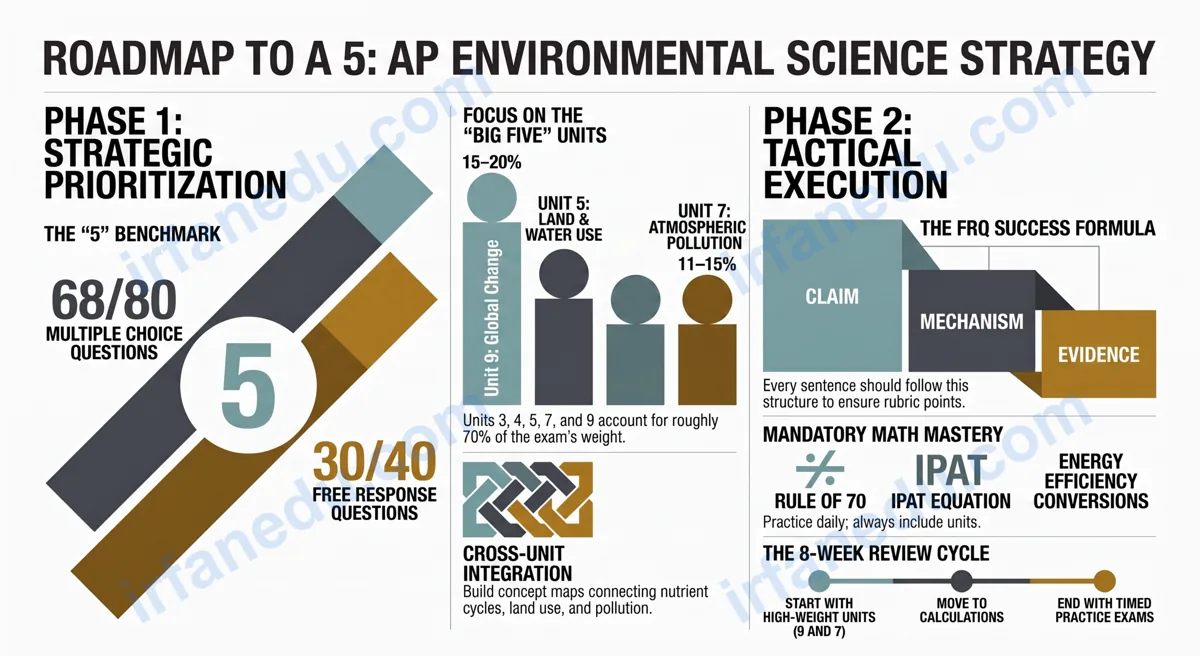
Here is the end result first: a student who scores a 5 on APES typically answers about 68 of 80 MCQs correctly and earns roughly 30 of 40 FRQ points. Now let me reverse-engineer exactly how to get there, unit by unit, calculation by calculation, and FRQ sentence by sentence.
The APES (AP Environmental Science) exam tests nine units across Earth systems, ecology, land use, energy, pollution, and global change. A score of 4 or 5 requires mastering high-weight units, performing environmental calculations accurately, and writing structured FRQ responses that directly address each rubric point.
- You will know which four units carry more than half the exam weight.
- You will have a concrete 8-week study plan with weekly targets.
- You will be able to perform every APES calculation the exam tests.
- You will know the exact FRQ sentence structure that earns rubric points.
- You will understand the two mistakes that separate a 3 from a 5.
The APES exam covers nine units from Earth systems to environmental policy. To score a 4 or 5, prioritize Units 3, 4, 5, and 7 (roughly 55% of MCQ content), master environmental calculations like the Rule of 70 and IPAT equation, and practice the three FRQ types weekly. Most students need 8-10 weeks of structured review.
TL;DR – Quick Summary
- APES = 80 MCQ (60%) + 3 FRQ (40%), 3 hours total.
- Units 3, 4, 5, and 7 make up ~55% of MCQ questions.
- Environmental math (Rule of 70, IPAT, energy conversions) appears on every exam.
- FRQ points are earned per sentence — lead with a direct claim, then evidence.
- 8-10 weeks of structured review is the sweet spot for most students.
- The biggest score killer is skipping FRQ practice until the week before the exam.
| Fact | Detail |
|---|---|
| Full name | AP Environmental Science (APES) |
| Exam length | 3 hours |
| Section I | 80 MCQ, 90 minutes, 60% of score |
| Section II | 3 FRQ, 70 minutes, 40% of score |
| Number of units | 9 |
| Score range | 1-5 (4+ = college credit at most schools) |
| % scoring 3 or higher (2024) | ~54% |
| % scoring 5 (2024) | ~9% |
| Math required | Algebra only (no calculus) |
| Formula sheet provided | Yes, during the exam |
What a Passing Score Actually Looks Like (Start Here)
A score of 3 on APES means you answered roughly 50-55 MCQs correctly and earned about 20-22 FRQ points. A score of 5 means roughly 68+ correct MCQs and 30+ FRQ points. The gap between a 3 and a 5 is not about knowing more facts — it is about performing calculations without errors and writing FRQ answers that match the rubric’s exact language.
In my experience reviewing hundreds of student practice exams, the students who jump from a 3 to a 5 almost always do so by fixing two things: they stop skipping the calculation questions on practice tests, and they start writing FRQ answers in the specific structure the College Board rewards. Both are trainable skills, not talent.
GOAL: Score 5 on APES
|
+-- Section I: MCQ (80 questions, 90 min)
|   Target: ~68 correct = ~85% accuracy
|   |
|   +-- High-weight units (3,4,5,7): aim for 90%+ here
|   +-- Calculation questions: practice daily, never skip
|   +-- Graph/data questions: read axes before answer choices
|
+-- Section II: FRQ (3 questions, 70 min)
    Target: ~30/40 points
    |
    +-- Q1 (Design investigation): 10 pts
    |   Lead with hypothesis, ID variables, describe procedure
    +-- Q2 (Analyze data): 10 pts
    |   State trend, cite specific data point, explain mechanism
    +-- Q3 (Environmental solution): 10 pts (+ 4 bonus)
        Propose solution, justify with science, address drawback
What Is the APES Exam Format?
The AP Environmental Science exam is 3 hours long and divided into two sections. Section I contains 80 multiple-choice questions to be completed in 90 minutes; it counts for 60% of your total score. Section II contains 3 free-response questions to be completed in 70 minutes; it counts for the remaining 40%.
The three FRQ types are fixed every year: Question 1 asks you to design an environmental investigation, Question 2 asks you to analyze a set of data or graphs, and Question 3 asks you to propose and justify an environmental solution. Knowing the type in advance means you can rehearse each format specifically rather than preparing for a mystery.
The Nine Units: Weight, Priority, and What to Know
The College Board assigns each unit a percentage range of MCQ content. Here is the full breakdown, ranked by exam weight so you can prioritize your study time correctly.
| Unit | Name | MCQ Weight | Priority | Key Concepts |
|---|---|---|---|---|
| Unit 5 | Land and Water Use | 12-15% | Highest | Agriculture, irrigation, deforestation, fishing |
| Unit 7 | Atmospheric Pollution | 11-15% | Highest | Smog, acid rain, ozone depletion, indoor air quality |
| Unit 4 | Earth Systems and Resources | 10-15% | High | Rock cycle, soil, water cycle, plate tectonics |
| Unit 3 | Populations | 10-15% | High | Population growth, survivorship curves, age structure |
| Unit 6 | Energy Resources and Consumption | 10-15% | High | Fossil fuels, nuclear, renewables, EROI |
| Unit 8 | Aquatic and Terrestrial Pollution | 7-10% | Medium | Eutrophication, biomagnification, waste management |
| Unit 2 | Biodiversity | 6-8% | Medium | Biomes, species interactions, ecosystem services |
| Unit 9 | Global Change | 15-20% | Very High | Climate change, ozone, biodiversity loss, sustainability |
| Unit 1 | The Living World: Ecosystems | 6-8% | Foundation | Energy flow, nutrient cycles, food webs |
Unit 9 (Global Change) often surprises students with its weight. It consistently appears at 15-20% of MCQ content, yet many study guides bury it at the end as an afterthought. Treat it as a co-equal priority alongside Units 5 and 7.
In my experience, students spend too much time on Unit 1 (Ecosystems) because it feels foundational and familiar from biology class. It is foundational, but it only accounts for 6-8% of the MCQ. I tell my students: Unit 1 is your warm-up, not your main event. Spend one week on it, then move on. The students who over-invest in Unit 1 often run out of time before they properly cover Unit 9, which costs them far more points.
How Should You Structure an 8-Week APES Study Plan?
An 8-week plan works for most students who have already completed the course. If you are self-studying from scratch, extend it to 12 weeks by adding one week per high-weight unit.
- Week 1: Units 9 (Global Change) and 7 (Atmospheric Pollution) — highest combined weight; start here.
- Week 2: Units 5 (Land and Water Use) and 6 (Energy Resources).
- Week 3: Units 3 (Populations) and 4 (Earth Systems) — heavy on calculations.
- Week 4: Units 1 (Ecosystems), 2 (Biodiversity), and 8 (Pollution) — lower weight, faster review.
- Week 5: Environmental calculations only — Rule of 70, IPAT, energy conversions, percent change. Do 10 problems per day.
- Week 6: FRQ writing practice — one full FRQ per day using released College Board prompts; self-grade against scoring guidelines.
- Week 7: Full timed practice exam #1 under real conditions; review every wrong answer.
- Week 8: Full timed practice exam #2; light review of your three weakest topics only.
Which APES Calculations Appear on Every Exam?
Environmental math is tested on every APES exam, and it is the area where prepared students gain the most ground. The College Board provides a formula sheet, but you must know when to apply each formula and how to set up the units correctly.
A country has a population growth rate of 2.5% per year. How long will it take for the population to double?
Formula: Doubling Time = 70 / Growth Rate (%)
Solution: 70 / 2.5 = 28 years
What students miss: The growth rate must be entered as a percentage (e.g., 2.5), not as a decimal (0.025). Using 0.025 gives 2,800 years — a common exam error.
Country A has a population of 50 million, an affluence level of $30,000 GDP per capita, and a technology factor of 0.0002 tons CO2 per dollar. What is the environmental impact?
Formula: I = P x A x T
Solution: I = 50,000,000 x 30,000 x 0.0002 = 300,000,000 tons CO2
FRQ application: APES FRQs often ask you to explain how changing one variable (e.g., improving technology) reduces I while P and A stay constant. Always show your arithmetic and label units.
A coal plant generates 500 MW of electricity but only operates at 35% efficiency. How much energy is wasted as heat per hour?
Total energy input: 500 MW / 0.35 = 1,428.6 MW
Wasted energy: 1,428.6 MW – 500 MW = 928.6 MW wasted as heat
This type of calculation appears in Unit 6 and tests whether you understand the second law of thermodynamics in a real-world context.
| Calculation | Formula | Unit | Common Mistake |
|---|---|---|---|
| Doubling time | 70 / growth rate (%) | Years | Using decimal instead of % |
| IPAT | I = P x A x T | Varies | Forgetting to label units |
| Percent change | (New – Old) / Old x 100 | % | Dividing by new instead of old |
| Energy efficiency | Useful output / Total input x 100 | % | Inverting numerator/denominator |
| Gross Primary Productivity | GPP = NPP + R | g C/m²/yr | Confusing GPP and NPP |
| LD50 / Dose-Response | Dose = Amount / Body weight | mg/kg | Not converting units |
How Do You Write a High-Scoring APES FRQ?
Each FRQ point is earned independently — you do not need a flowing essay. The rubric rewards one specific piece of information per point, so your goal is to deliver exactly that, clearly and concisely.
The most reliable FRQ sentence structure is: Claim + Mechanism + Evidence. Write your claim first, explain the environmental mechanism that connects it to the question, then cite a specific piece of evidence or data from the prompt.
Weak answer (earns 0 points): “Deforestation is bad for the environment because it hurts biodiversity.”
Strong answer (earns 1 point): “Deforestation reduces biodiversity because it destroys habitat, eliminating food and shelter for species that cannot survive outside the forest ecosystem.”
The strong answer names the mechanism (habitat destruction) and the consequence (loss of food and shelter), which is exactly what the rubric rewards.
The single most effective FRQ practice technique I have seen is self-grading with the official College Board scoring guidelines. Not a teacher’s rubric — the actual released guidelines from College Board’s AP Central. When you grade your own answer against the exact language the readers use, you internalize what earns points far faster than any review book can teach. Do this for at least one FRQ per week for six weeks and your FRQ score will improve measurably.
What Are the Most Common APES Mistakes That Drop Your Score?
These are the patterns I see most often in student practice exams, and they are all fixable before test day.
| Wrong Approach | Right Approach |
|---|---|
| Study all nine units equally | Weight study time by MCQ percentage |
| Skip calculation questions on practice tests | Attempt every calculation; review errors immediately |
| Write FRQ answers as essays | Write one claim + one mechanism per rubric point |
| Use a review book as your only FRQ source | Use released College Board FRQs with official scoring guidelines |
| Cram vocabulary the night before | Learn 3-5 terms per day throughout the study period |
| Ignore the formula sheet layout | Practice using the formula sheet under timed conditions |
Most APES study guides tell you to memorize the nine units in order. That is the wrong mental model for the exam. The College Board does not test units in isolation — it writes MCQs that blend concepts across units. A single question might require you to connect the nitrogen cycle (Unit 1), agricultural runoff (Unit 5), and eutrophication (Unit 8) in one answer.
In my experience, students who study units as isolated silos score 3s. Students who build cross-unit concept maps — explicitly connecting nutrient cycles to land use to pollution — score 4s and 5s. After completing each unit, spend 20 minutes asking: “How does this unit’s content interact with every unit I have already studied?” That cross-linking exercise is the information-gain step that most guides skip entirely.
Quick Knowledge Check
Test Yourself: APES Fundamentals
1. A country has a population growth rate of 3.5% per year. What is its population doubling time?
2. Which type of succession occurs on a lava field after a volcanic eruption?
3. In the IPAT equation, what does the “T” variable represent?
Practice Problems (Reveal the Solution)
Problem 1: Calculate the percent change in a species population
A bird species had a population of 12,000 in 2010. By 2024, the population had fallen to 8,400. Calculate the percent change.
Solution:
Percent change = (New – Old) / Old x 100
= (8,400 – 12,000) / 12,000 x 100
= (-3,600) / 12,000 x 100
= -30% (a 30% decrease)
FRQ note: Always state whether the change is an increase or decrease and include the % symbol.
Problem 2: Identify the environmental impact using IPAT
A nation has a population of 80 million, an affluence of $20,000 per capita, and a technology factor of 0.0003 tons CO2 per dollar. A new policy reduces T by 40%. What is the new environmental impact?
Original I: 80,000,000 x 20,000 x 0.0003 = 480,000,000 tons CO2
New T: 0.0003 x (1 – 0.40) = 0.00018
New I: 80,000,000 x 20,000 x 0.00018 = 288,000,000 tons CO2
The policy reduces environmental impact by 192,000,000 tons CO2 (a 40% reduction, as expected).
Problem 3: Interpret an age structure diagram
A country’s age structure diagram shows a very wide base (large proportion of children and young adults) and a narrow top (small proportion of elderly). What does this indicate about the country’s population growth?
Answer: A wide-base age structure indicates rapid population growth. A large proportion of the population is in pre-reproductive or early reproductive age groups, meaning birth rates are high relative to death rates. This country will likely experience significant population increase in the coming decades unless birth rates decline.
APES connection: This type of question links Unit 3 (Populations) to Unit 9 (Global Change) — rapid population growth increases resource demand and environmental pressure.
Frequently Asked Questions About APES
What is the APES exam format?
The AP Environmental Science exam is 3 hours long. Section I has 80 multiple-choice questions (90 minutes, worth 60% of the score). Section II has 3 free-response questions (70 minutes, worth 40% of the score). The three FRQ types are: Question 1 (design an investigation), Question 2 (analyze data or graphs), and Question 3 (propose and justify an environmental solution).
Which APES units are most important for the exam?
Units 3 (Populations), 4 (Earth Systems and Resources), 5 (Land and Water Use), 7 (Atmospheric Pollution), and 9 (Global Change) together account for roughly 65-75% of MCQ content according to the College Board curriculum framework. Prioritize these five units in your study plan, especially if time is limited.
How hard is it to get a 5 on APES?
Roughly 9-11% of test-takers score a 5 on APES in a typical year, and about 50-55% score a 3 or higher. It is considered one of the more accessible AP science exams because it does not require calculus. Consistent weekly review of calculations, vocabulary, and FRQ practice is the key differentiator between a 3 and a 5.
What math do I need to know for APES?
APES requires basic algebra and specific environmental calculations: energy conversions (kWh to BTU), population growth (Rule of 70, IPAT equation), water flow rates, and percent change. No calculus is needed. The College Board provides a formula sheet for the exam, but you must know when and how to apply each formula under timed conditions.
How should I write an APES FRQ answer?
Write in complete sentences and directly answer the verb in the prompt (identify, describe, explain, justify). Each point on the rubric is earned independently — you do not need a flowing essay. Lead with your claim, then add one specific piece of evidence or reasoning. Avoid restating the question and never leave a part blank — a partial answer can still earn partial credit.
How many weeks should I study for APES?
Eight to ten weeks of structured review is ideal for most students who have completed the course. Spend the first six weeks covering two units per week (prioritizing high-weight units first), week seven on FRQ practice and calculations, week eight on timed full practice exams, and the final days on light review of weak areas only. Cramming the night before is ineffective for a content-heavy exam like APES.