
Baseboard Calculator: Measure & Estimate Trim Fast
Before I built this tool, I watched a neighbor buy two extra boxes of baseboard trim for a single bedroom because she guessed high “just to be safe.” She returned none of it. The fix is simple math, and this calculator does it in seconds.
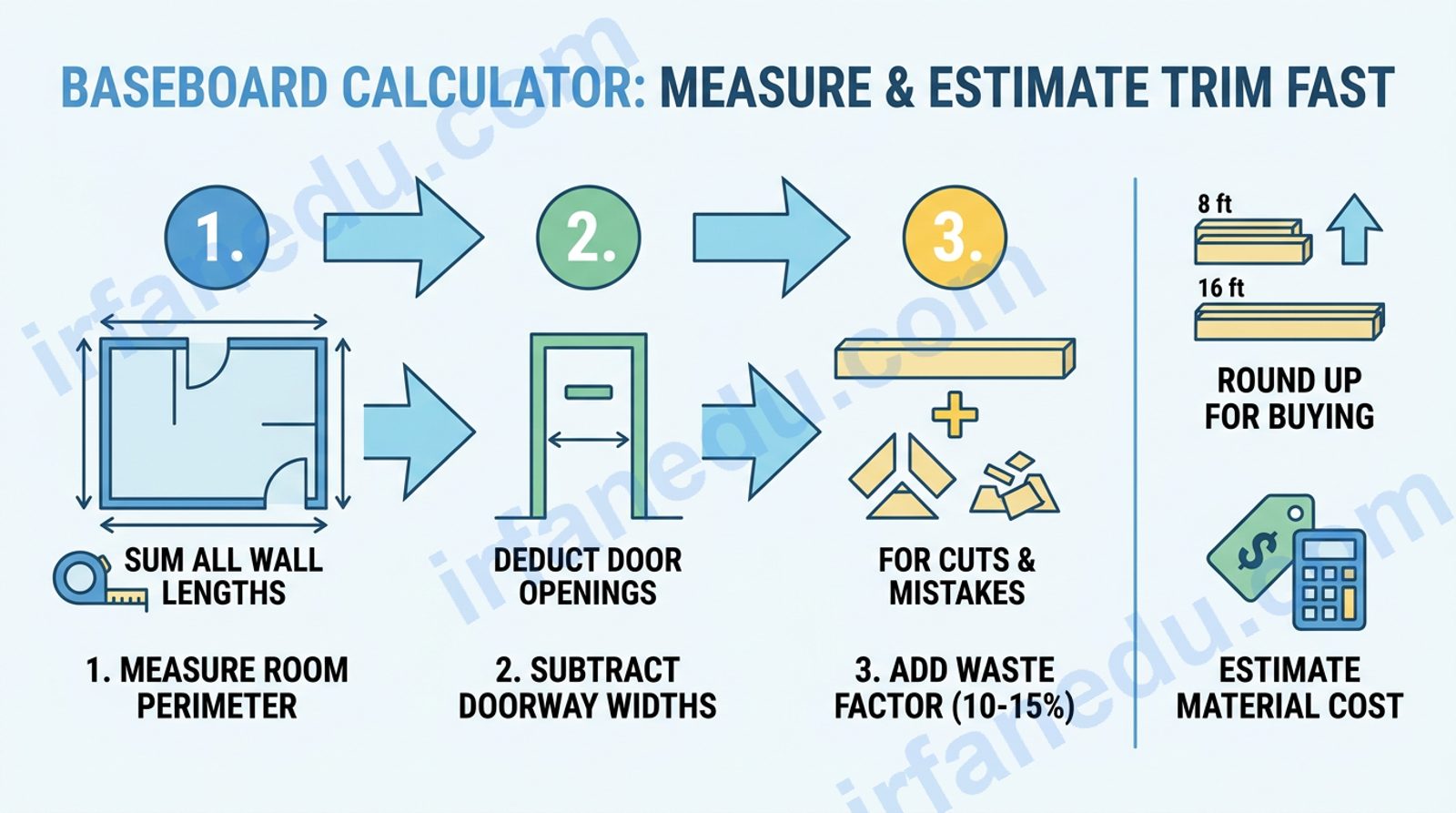
A baseboard calculator computes the total linear feet of trim needed for a room by summing all wall lengths (the perimeter), subtracting doorway widths, and adding a waste factor for miter cuts. It removes the guesswork from buying trim and prevents costly over-purchasing or frustrating mid-job shortages.
To find how much baseboard you need: add all wall lengths to get the room perimeter, subtract each doorway width (typically 3 ft each), then add 10% for waste. For a 12 ft x 14 ft room with one door: (12+14+12+14) – 3 = 49 ft, plus 10% = 53.9 ft. Round up when buying. Use the calculator below for an instant result with cost estimate.
- Baseboard quantity = room perimeter minus doorway widths, plus a waste factor.
- Standard waste factor is 10%; use 15% for rooms with many corners or angles.
- Windows above floor level are NOT deducted from baseboard calculations.
- Always round up to the nearest board length your supplier sells (usually 8 ft or 16 ft sticks).
- Multiply total linear feet by price per foot for a fast material cost estimate.
| Fact | Value |
|---|---|
| Standard doorway deduction | 3 linear feet per door |
| Recommended waste factor | 10% (simple rooms), 15% (complex rooms) |
| Common board lengths sold | 8 ft, 12 ft, 16 ft sticks |
| Average baseboard price (US, 2026) | $1.50 – $4.00 per linear foot |
| Windows deducted? | No (baseboard runs below window sills) |
| Unit of measurement | Linear feet (LF) |
Interactive Baseboard Calculator
Baseboard Calculator
feet
feet
each ~3 ft wide
feet per door
% (enter 10 for 10%)
USD (optional)
linear feet needed
How to Use This Calculator
- Enter Room Length and Width in feet. For non-rectangular rooms, break them into rectangles and add the results.
- Enter the number of doorways and the width of each door (standard interior door = 3 ft; exterior door = 3.5 ft).
- Set the waste factor. Use 10% for a simple four-wall room. Use 15% if the room has bay windows, alcoves, or more than four corners.
- Enter price per linear foot (optional) to get an instant material cost estimate.
- Click Calculate. The result card shows total linear feet, a breakdown of each step, and the estimated cost.
- Round up to the nearest board length your supplier sells before placing your order.
What Is Baseboard Trim?
Baseboard trim is the molding strip installed along the bottom of interior walls where they meet the floor. It covers the gap left by flooring installation, protects the wall from scuffs, and adds a finished look to any room.
Baseboard is sold in linear feet, either as individual sticks (commonly 8 ft, 12 ft, or 16 ft long) or by the box. The key measurement you need before buying is the total linear footage required for your room.
In my experience helping people plan renovation projects, the single most common mistake is treating baseboard like tile and buying by area. Baseboard is a perimeter product. Area is irrelevant. A 400 sq ft room and a 200 sq ft room with the same perimeter need the same amount of trim. Once you internalize that, the math becomes trivial.
The Formula Explained
    Perimeter = 2 × (Length + Width)

    Net Perimeter = Perimeter - (Number of Doors × Door Width)

    Total LF = Net Perimeter × (1 + Waste Factor / 100)

    Estimated Cost = Total LF × Price per Linear Foot
| Symbol | Meaning | Unit |
|---|---|---|
| L | Room length | feet (ft) |
| W | Room width | feet (ft) |
| P | Room perimeter | linear feet (LF) |
| D | Number of doorways | count |
| d | Width of each doorway | feet (ft) |
| WF | Waste factor | % (decimal: 0.10 = 10%) |
| LFtotal | Total linear feet to purchase | linear feet (LF) |
| C | Estimated material cost | USD ($) |
Worked Examples
Example 1: Standard Bedroom (12 ft x 14 ft, 1 Door)
- Perimeter = 2 × (12 + 14) = 52 ft
- Door deduction = 1 × 3 ft = 3 ft
- Net perimeter = 52 – 3 = 49 ft
- Waste (10%) = 49 × 1.10 = 53.9 ft
- Buy 54 linear feet. At $2.50/ft, cost = $135.00.
Example 2: Open-Plan Living Room (20 ft x 16 ft, 2 Doors)
- Perimeter = 2 × (20 + 16) = 72 ft
- Door deduction = 2 × 3.5 ft = 7 ft
- Net perimeter = 72 – 7 = 65 ft
- Waste (15% for extra corners) = 65 × 1.15 = 74.75 ft
- Buy 75 linear feet. At $3.00/ft, cost = $225.00.
  TOP-DOWN FLOOR PLAN (12 ft x 14 ft room)

  +-------------- 12 ft ---------------+
  |                                     |
  14 ft                               14 ft
  |                                     |
  +----[DOOR 3ft]----------- 12 ft ----+

  Perimeter path:  12 + 14 + 12 + 14 = 52 ft
  Minus door:      52 - 3 = 49 ft
  Plus 10% waste:  49 x 1.10 = 53.9 ft
Example 3: Small Bathroom (8 ft x 6 ft, 1 Door)
- Perimeter = 2 × (8 + 6) = 28 ft
- Door deduction = 1 × 2.5 ft = 2.5 ft
- Net perimeter = 28 – 2.5 = 25.5 ft
- Waste (10%) = 25.5 × 1.10 = 28.05 ft
- Buy 29 linear feet. At $2.00/ft, cost = $58.00.
Common Mistakes and How to Avoid Them
| Wrong Approach | Correct Approach |
|---|---|
| Deducting windows from the total | Windows sit above the floor; baseboard runs below them. Do not deduct. |
| Skipping the waste factor | Always add at least 10%. Miter cuts waste 2-4 inches per joint. |
| Measuring in square feet | Baseboard is a perimeter product. Measure in linear feet only. |
| Using one door width for all doors | Interior doors are ~3 ft; exterior doors are ~3.5 ft. Measure each. |
| Rounding down to save money | Always round UP. Running short mid-job means a second store trip and possible dye-lot mismatch. |
The “round down to save money” trap costs more in the long run. I have seen contractors make two extra supply runs for a single room because they shaved off the waste factor. The fuel, time, and risk of a color mismatch on a second batch far outweigh the cost of one extra 8 ft stick of trim. Buy slightly more than you think you need. Return what you do not open.
Explore More Calculators on IrfanEdu
Every guide tells you to add 10% waste. What almost none of them mention: the waste factor interacts with the board lengths your supplier sells. If you need 54 linear feet and your supplier sells 8 ft sticks, you need 7 sticks (56 ft) — not 6.75. But if they sell 12 ft sticks, you need 5 sticks (60 ft). The practical waste in the second scenario is 6 ft, not 2 ft. Always divide your total by the stick length sold and round up to whole sticks. That is the number you actually order, and it is often higher than the percentage formula alone suggests.
Quick Quiz: Test Your Knowledge
Baseboard Quiz
1. A room is 10 ft x 10 ft with one 3 ft door. What is the net perimeter before adding waste?
2. Should you deduct a window from your baseboard calculation?
3. You need 60 linear feet of baseboard. Your supplier sells 8 ft sticks. How many sticks do you buy?
Frequently Asked Questions
How do I calculate how much baseboard I need?
Should I include windows when calculating baseboard?
What waste factor should I use for baseboard?
How many linear feet of baseboard does a 12×12 room need?
- Baseboard is measured in linear feet, not square feet. Perimeter is all that matters.
- The formula: Perimeter – Door Deductions, then multiply by (1 + Waste%).
- Deduct doorways only. Never deduct windows.
- Use 10% waste for simple rooms; 15% for complex layouts.
- Always divide by stick length and round up to whole boards before ordering.
- Enter a price per linear foot to get an instant material cost estimate from the calculator above.
- This Old House: How to Install Baseboard Molding — professional installation guidance and measurement best practices.
- Wikipedia: Baseboard (architecture) — definition and construction context.
✍ Written & fact-checked by Dr. Irfan Mansuri. Content reflects standard US construction practice as of August 2026. Prices cited are indicative US market ranges and may vary by region and supplier.