
TL;DR – Quick Summary
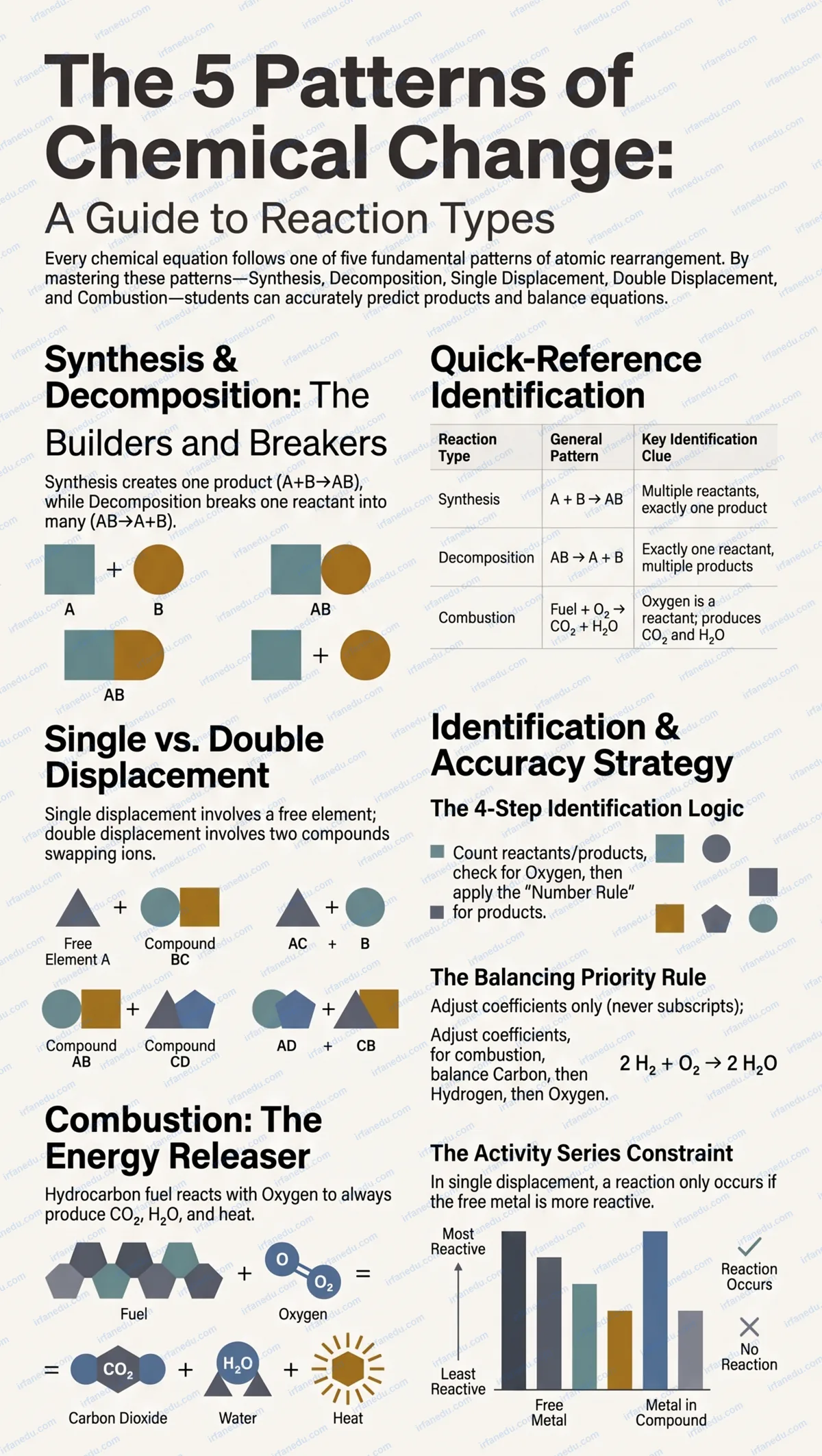
- Five reaction types: synthesis, decomposition, single displacement, double displacement, combustion.
- Synthesis: two reactants combine into one product (A + B → AB).
- Decomposition: one compound breaks into two or more simpler substances.
- Single displacement: one element swaps into a compound, pushing another out.
- Double displacement: two compounds swap ions to form two new compounds.
- Combustion: a fuel reacts with oxygen, always releasing energy as heat and light.
Types of Chemical Reactions Worksheet: Complete Guide with Examples
✓ Expert Reviewed by Dr. Irfan Mansuri | Last Updated: July 2026
Why Reaction Types Matter in Chemistry
The five types of chemical reactions — synthesis, decomposition, single displacement, double displacement, and combustion — are the backbone of general chemistry. Once you recognize the pattern of a reaction, you can predict its products without memorizing every equation individually.
Every chemical equation tells a story. Atoms rearrange, bonds break, and new substances form. But here is the thing: there are only five fundamental patterns those rearrangements follow. Master those five patterns and you can handle almost any reaction your chemistry class throws at you.
I have tutored hundreds of students who struggled with chemistry worksheets not because the chemistry was hard, but because they tried to memorize individual reactions instead of learning the underlying patterns. This guide fixes that. You will learn each type, see worked examples, and then test yourself with a quiz and practice problems.
- Name and define all five types of chemical reactions.
- Identify the reaction type from a given equation.
- Predict products for each reaction type.
- Balance equations for all five types.
- Avoid the most common classification mistakes.
The Five Types of Chemical Reactions at a Glance
Before diving deep, here is a reference table you can use as a quick lookup during any worksheet or test.
| Reaction Type | General Pattern | Simple Example | Key Clue |
|---|---|---|---|
| Synthesis | A + B → AB | 2H₂ + O₂ → 2H₂O | Multiple reactants, one product |
| Decomposition | AB → A + B | 2H₂O → 2H₂ + O₂ | One reactant, multiple products |
| Single Displacement | A + BC → AC + B | Zn + 2HCl → ZnCl₂ + H₂ | Free element replaces one in compound |
| Double Displacement | AB + CD → AD + CB | NaCl + AgNO₃ → AgCl + NaNO₃ | Two compounds swap partners |
| Combustion | Fuel + O₂ → CO₂ + H₂O | CH₄ + 2O₂ → CO₂ + 2H₂O | Oxygen is always a reactant; energy released |
Keep this table open while you work through the sections below. Each reaction type has its own logic, and once you see the pattern clearly, identification becomes almost automatic.
Synthesis Reactions: Building Something New
A synthesis reaction takes two or more reactants and combines them into a single product. The pattern is always A + B → AB. Think of it as construction: separate pieces come together to build one structure.
Synthesis reactions are common in nature and industry. When iron rusts, iron and oxygen combine to form iron(III) oxide. When your body builds proteins, amino acids link together in a biological synthesis process.
Magnesium burns in oxygen to form magnesium oxide.
Unbalanced: Mg + O₂ → MgO
Balanced: 2Mg + O₂ → 2MgO
Check: Left side has 2 Mg and 2 O. Right side has 2 Mg and 2 O. Balanced.
Nitrogen and hydrogen combine to form ammonia (Haber process).
Balanced: N₂ + 3H₂ → 2NH₃
Check: Left: 2N, 6H. Right: 2N, 6H. Balanced.
How to spot it: Count the products. If there is exactly one product and two or more reactants, you are looking at a synthesis reaction.
[IMAGE: Diagram showing two separate atoms combining into one molecule | ALT: synthesis reaction diagram showing A plus B forming AB compound]
In my experience, synthesis reactions are the easiest type for students to identify correctly. The single-product rule is a reliable shortcut. Where students slip up is in the balancing step. They see 2Mg + O₂ → 2MgO and want to write O₂ on the right side. Always balance coefficients, never subscripts.
Decomposition Reactions: Breaking Things Apart
Decomposition is the exact reverse of synthesis. One compound breaks down into two or more simpler substances. The pattern is AB → A + B. Energy input (heat, light, or electricity) is usually required to drive the reaction.
Electrolysis of water is a classic decomposition example taught in almost every chemistry course. Passing electricity through water splits it into hydrogen and oxygen gases.
Hydrogen peroxide decomposes into water and oxygen gas.
Balanced: 2H₂O₂ → 2H₂O + O₂
Check: Left: 4H, 4O. Right: 4H, 2O (water) + 2O (oxygen) = 4O total. Balanced.
Calcium carbonate (limestone) decomposes when heated.
Balanced: CaCO₃ → CaO + CO₂
Check: Left: 1Ca, 1C, 3O. Right: 1Ca, 1O + 1C, 2O = 1Ca, 1C, 3O. Balanced.
DECOMPOSITION - Visual Pattern
================================
        HEAT / LIGHT / ELECTRICITY
               |
    [AB] ------+------> [A] + [B]
               |
    One reactant        Two+ products

Example:
    [CaCO3] ---HEAT---> [CaO] + [CO2]
    Limestone           Quicklime  Carbon dioxide
Single Displacement Reactions: The Swap
In a single displacement reaction, a free element replaces one element inside a compound. The pattern is A + BC → AC + B. The displaced element is pushed out and becomes a free element in the products.
Whether displacement actually occurs depends on the activity series of metals. A more reactive metal will displace a less reactive one, but not the other way around. This is a key concept for predicting whether a single displacement reaction will actually happen.
Zinc metal reacts with hydrochloric acid.
Balanced: Zn + 2HCl → ZnCl₂ + H₂
Zinc (more reactive) displaces hydrogen from HCl. Hydrogen gas is released.
Iron reacts with copper(II) sulfate solution.
Balanced: Fe + CuSO₄ → FeSO₄ + Cu
Iron displaces copper. Copper metal deposits out of solution.
[IMAGE: Activity series of metals chart showing reactivity from most to least reactive | ALT: activity series of metals for single displacement reactions]
Double Displacement Reactions: The Partner Swap
Double displacement reactions involve two ionic compounds exchanging their positive ions (cations) to form two new compounds. The pattern is AB + CD → AD + CB. Think of it as two couples swapping dance partners.
These reactions often produce a precipitate (an insoluble solid), a gas, or water. The formation of a precipitate is the most common sign that a double displacement reaction has occurred.
Silver nitrate reacts with sodium chloride.
Balanced: AgNO₃ + NaCl → AgCl↓ + NaNO₃
AgCl is insoluble and precipitates out of solution (shown by the downward arrow).
Hydrochloric acid reacts with sodium hydroxide.
Balanced: HCl + NaOH → NaCl + H₂O
An acid-base neutralization is a special case of double displacement. The products are a salt and water.
Students often confuse double displacement with synthesis because both involve two reactants. The difference is clear once you look at the products: synthesis gives one product, double displacement gives two. I always tell students to count the products first, then look at the structure of the reactants.
Combustion Reactions: Fuel Meets Oxygen
Combustion reactions occur when a fuel (usually a hydrocarbon) reacts with oxygen gas and releases energy in the form of heat and light. Complete combustion always produces carbon dioxide and water as products.
Combustion is the reaction powering car engines, gas stoves, and power plants. It is one of the most economically important reaction types in the world.
Methane (natural gas) burns in air.
Balanced: CH₄ + 2O₂ → CO₂ + 2H₂O
Check: Left: 1C, 4H, 4O. Right: 1C, 2O + 4H, 2O = 1C, 4H, 4O. Balanced.
Propane burns in a gas grill.
Balanced: C₃H₈ + 5O₂ → 3CO₂ + 4H₂O
Tip for balancing combustion: balance C first, then H, then O last.
COMBUSTION - Balancing Strategy
=================================
Step 1: Write the unbalanced equation
   C3H8 + O2 --> CO2 + H2O

Step 2: Balance Carbon (3 on left -> 3CO2 on right)
   C3H8 + O2 --> 3CO2 + H2O

Step 3: Balance Hydrogen (8 on left -> 4H2O on right)
   C3H8 + O2 --> 3CO2 + 4H2O

Step 4: Count Oxygen on right (3x2 + 4x1 = 10 O atoms)
   Need 5 O2 molecules on left

Step 5: Final balanced equation
   C3H8 + 5O2 --> 3CO2 + 4H2O  [DONE]
How to Identify Any Reaction Type: Step-by-Step
Identifying a reaction type is a skill you can apply systematically. Follow these four steps every time and you will classify correctly on any worksheet or exam.
- Count the reactants and products. Note how many distinct substances appear on each side of the arrow.
- Check if oxygen is a reactant. If yes, and the other reactant is a fuel (hydrocarbon or carbon-containing compound), it is combustion.
- Apply the number rule:
- Many reactants + one product = Synthesis
- One reactant + many products = Decomposition
- For two reactants and two products:
- If one reactant is a free element = Single Displacement
- If both reactants are compounds = Double Displacement
Common Mistakes and How to Fix Them
After reviewing hundreds of chemistry worksheets, I have seen the same errors come up repeatedly. Here are the most frequent mistakes and the correct approach for each.
| Common Mistake | Correct Approach |
|---|---|
| Changing subscripts to balance an equation (e.g., writing H₃ instead of H₂) | Only change coefficients. Subscripts define the compound and cannot be altered. |
| Calling any two-reactant reaction a synthesis | Check the products. Two products with two reactants means displacement, not synthesis. |
| Forgetting to check the activity series for single displacement | A less reactive element cannot displace a more reactive one. The reaction simply does not occur. |
| Balancing oxygen before carbon and hydrogen in combustion | Always balance C first, then H, then O last. Oxygen is easiest to adjust at the end. |
| Treating acid-base neutralization as its own separate type | Neutralization is a subcategory of double displacement. The pattern AB + CD → AD + CB still applies. |
Quick Quiz: Test Your Knowledge
Q1. Which reaction type follows the pattern A + B → AB?
Not quite. The single-product pattern defines synthesis.
Q2. The reaction 2H₂O₂ → 2H₂O + O₂ is an example of which type?
Look again. One reactant, two products = decomposition.
Q3. In the reaction Fe + CuSO₄ → FeSO₄ + Cu, what type of reaction is this?
Not quite. A free element (Fe) is replacing an element in a compound: single displacement.
Practice Problems: Reveal-on-Click
Try each problem on your own first, then click to reveal the answer and explanation.
Problem 1: Classify and balance: Na + Cl₂ → NaCl
Balanced: 2Na + Cl₂ → 2NaCl
Explanation: Sodium and chlorine gas combine to form sodium chloride (table salt). We need 2 Na atoms to balance the 2 Cl atoms from Cl₂, giving 2 NaCl on the right.
Problem 2: Classify and balance: Al + Fe₂O₃ → Al₂O₃ + Fe
Balanced: 2Al + Fe₂O₃ → Al₂O₃ + 2Fe
Explanation: Aluminum is more reactive than iron, so it displaces iron from iron(III) oxide. This is the thermite reaction, which produces intense heat.
Problem 3: Classify and balance: BaCl₂ + Na₂SO₄ → BaSO₄ + NaCl
Balanced: BaCl₂ + Na₂SO₄ → BaSO₄↓ + 2NaCl
Explanation: Ba²⁺ and SO₄²⁻ combine to form barium sulfate, which is insoluble and precipitates. We need a coefficient of 2 in front of NaCl to balance the 2 Cl atoms from BaCl₂.
Problem 4: Classify and balance: C₂H₆ + O₂ → CO₂ + H₂O (ethane combustion)
Balanced: 2C₂H₆ + 7O₂ → 4CO₂ + 6H₂O
Explanation: Balance C first (2 carbons per molecule → 4CO₂ for 2 molecules). Then H (6 hydrogen per molecule → 6H₂O for 2 molecules). Then O: right side has 4(2) + 6(1) = 14 O atoms, so 7O₂ on the left.
Problem 5: Classify: KClO₃ → KCl + O₂ (with heat)
Balanced: 2KClO₃ → 2KCl + 3O₂
Explanation: Potassium chlorate decomposes when heated (often with a MnO₂ catalyst) to produce potassium chloride and oxygen gas. This is a standard lab method for generating oxygen.
Frequently Asked Questions
What are the 5 types of chemical reactions?
How do I identify a synthesis reaction?
What is the difference between single and double displacement reactions?
What are the products of a combustion reaction?
How do I balance a chemical equation step by step?
Is a precipitation reaction the same as double displacement?
Can a reaction belong to more than one type?
Key Takeaways
- The five reaction types are synthesis, decomposition, single displacement, double displacement, and combustion.
- Synthesis: many reactants → one product. Decomposition: one reactant → many products.
- Single displacement requires a free element as one reactant; double displacement requires two compounds.
- Combustion always involves oxygen as a reactant and always releases energy.
- Balance coefficients only, never subscripts.
- For combustion, balance C, then H, then O in that order.
- Use the activity series to determine if a single displacement reaction will actually occur.
Related Articles
Dr. Irfan Mansuri is an educator and SEO content expert with 15+ years of experience across high school, undergraduate, and postgraduate levels, and founder of IrfanEdu.com. I combine deep subject knowledge with proven test-taking strategies to make complex ideas simple. Connect on LinkedIn
Sources & References
- Khan Academy: Types of Chemical Reactions – Comprehensive overview of reaction classification with practice exercises.
- Wikipedia: Chemical Reaction – Encyclopedic reference covering reaction types, mechanisms, and thermodynamics.
- Britannica: Chemical Reaction – Expert-reviewed scientific reference on chemical reaction fundamentals.
Editorial note: All chemical equations in this article have been verified for accuracy and balance. Content is reviewed periodically to reflect current chemistry curriculum standards.