
😤 Genetics Problems Stumping You? Here Are the Answers (With Full Working)
You stare at a genetics problem. You read it three times. You still have no idea where to start. 😩 That feeling is more common than you think — genetics is one of the most frequently failed topics in biology, not because it is truly difficult, but because most students never learn a clear, repeatable method for solving problems.
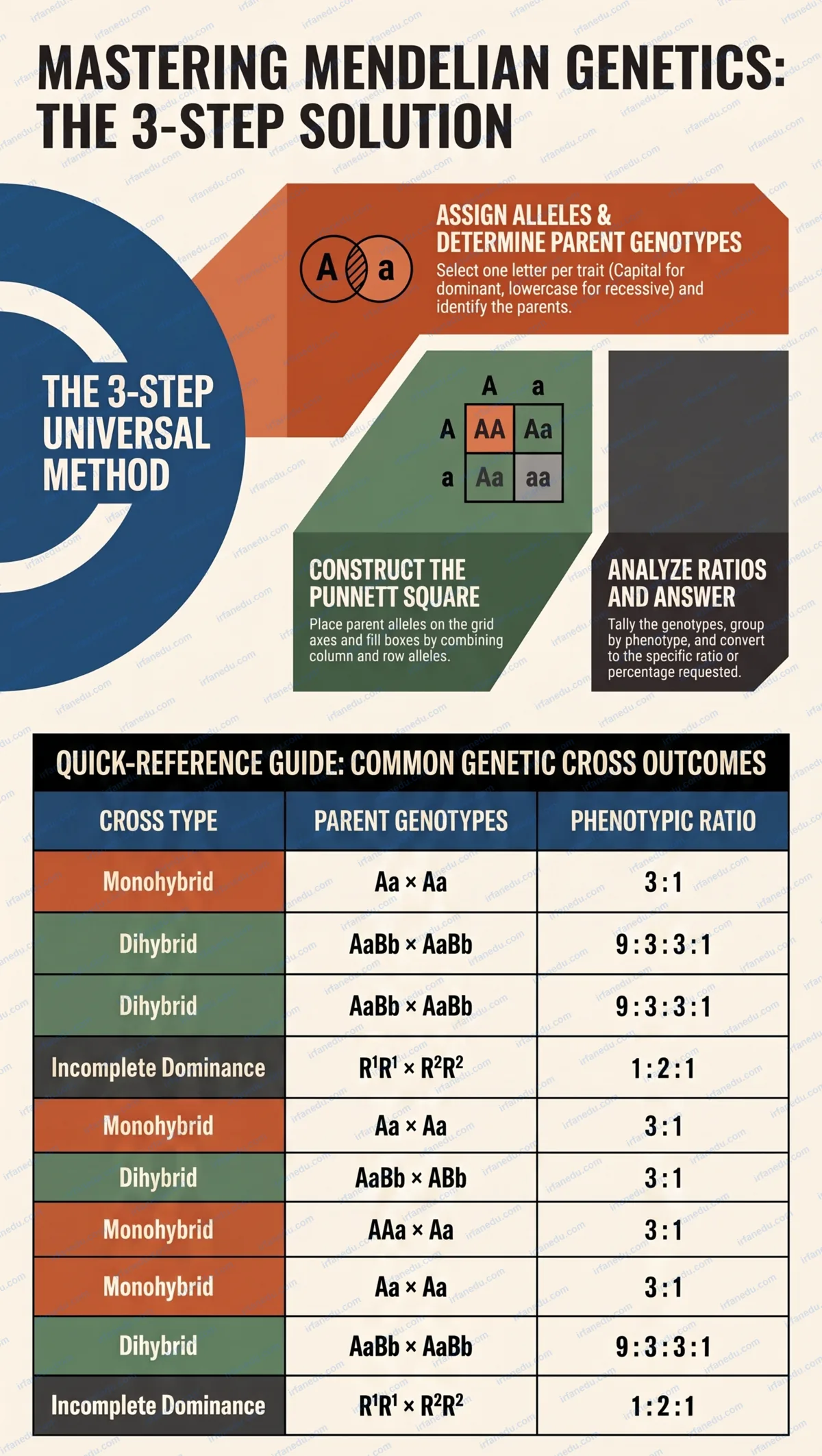
Genetics practice problems test your ability to predict offspring genotypes and phenotypes using Punnett squares, probability rules, and Mendel’s laws. To solve them correctly, you need to: (1) assign allele symbols, (2) determine parent genotypes, (3) build the Punnett square, (4) read the ratios, and (5) answer the specific question asked. Once you follow this five-step method consistently, every genetics problem becomes manageable.
In this guide, I walk you through every major genetics problem type — monohybrid crosses, dihybrid crosses, incomplete dominance, codominance, and test crosses — with full step-by-step worked answers. I also include a quiz and reveal-on-click practice problems so you can test yourself before your next exam.
- 🧬 Understand dominant, recessive, genotype, and phenotype
- 📐 Draw and read Punnett squares for mono- and dihybrid crosses
- 🔢 Calculate genotypic and phenotypic ratios
- ⚠️ Avoid the top mistakes students make on genetics tests
- ✅ Solve incomplete dominance and test cross problems with confidence
⚡ TL;DR – Quick Summary
- 🧬 Dominant alleles (capital) mask recessive alleles (lowercase) in offspring
- 📊 Monohybrid Aa × Aa gives a 3:1 phenotypic ratio and 1:2:1 genotypic ratio
- 🔢 Dihybrid AaBb × AaBb gives the classic 9:3:3:1 phenotypic ratio
- 🌸 Incomplete dominance produces a blended phenotype in heterozygotes
- 🧪 A test cross reveals whether an unknown genotype is AA or Aa
- ✅ Follow 5 steps every time: assign, determine, draw, count, answer
| Cross Type | Parents | Grid Size | Phenotypic Ratio |
|---|---|---|---|
| Monohybrid (complete dominance) | Aa × Aa | 2 × 2 | 3:1 |
| Monohybrid (homozygous × hetero) | AA × Aa | 2 × 2 | All dominant |
| Dihybrid | AaBb × AaBb | 4 × 4 | 9:3:3:1 |
| Incomplete dominance | R¹R¹ × R²R² | 2 × 2 | 1:2:1 |
| Test cross | A? × aa | 2 × 2 | 1:1 or all dominant |
🔤 Core Vocabulary You Must Know First
Before touching a single Punnett square, you need these terms locked in. Skipping this step is the number one reason students get confused mid-problem.
| Term | Definition | Example |
|---|---|---|
| Allele | A version of a gene | B (brown eyes) or b (blue eyes) |
| Dominant | Allele that is expressed when present | B masks b in Bb |
| Recessive | Allele expressed only when homozygous | bb shows blue eyes |
| Genotype | The actual allele combination | BB, Bb, or bb |
| Phenotype | The observable trait | Brown eyes or blue eyes |
| Homozygous | Both alleles are the same | BB or bb |
| Heterozygous | Two different alleles | Bb |
| Carrier | Heterozygous for a recessive trait | Bb — shows dominant, carries recessive |
🪜 5 Steps to Solve Any Genetics Problem
This five-step method works for every genetics problem type. Commit it to memory and use it every single time.
- Step 1 – Assign allele symbols. Pick a letter for the trait. Dominant = capital, recessive = lowercase. Example: T = tall, t = short.
- Step 2 – Determine parent genotypes. Read the problem carefully. “Homozygous dominant” = TT. “Heterozygous” = Tt. “Homozygous recessive” = tt.
- Step 3 – Draw the Punnett square. Write one parent’s alleles across the top (one allele per column) and the other’s down the side (one allele per row). Fill in each box by combining the column and row alleles.
- Step 4 – Count genotype and phenotype ratios. Tally how many boxes show each genotype. Group genotypes by phenotype (dominant or recessive expression).
- Step 5 – Answer the question. Convert your tally to a ratio, fraction, or percentage as the question requires.
  Parent 1 (Tt) alleles across top:   T        t
                                    ┌────────┬────────┐
  Parent 2 (Tt)  T  →               │  TT    │  Tt    │
  alleles down   t  →               │  Tt    │  tt    │
  the side:                         └────────┴────────┘

  Genotype count:  TT = 1,  Tt = 2,  tt = 1
  Genotypic ratio:  1 : 2 : 1
  Phenotypic ratio: 3 (tall) : 1 (short)
In my experience tutoring biology students, the single biggest mistake I see is jumping straight to drawing the Punnett square without first writing out the parent genotypes. That shortcut costs marks every time. Spend 30 extra seconds on Steps 1 and 2 — it makes Steps 3 through 5 almost automatic.
🌱 Monohybrid Cross – Worked Examples
A monohybrid cross tracks a single trait across one generation. It uses a 2×2 Punnett square and is the foundation for all other genetics problems.
Problem: In pea plants, tall (T) is dominant over short (t). A heterozygous tall plant is crossed with a short plant. What fraction of offspring will be tall?
Step 1: T = tall (dominant), t = short (recessive)
Step 2: Parent 1 = Tt (heterozygous tall), Parent 2 = tt (short)
Step 3: Punnett square (Tt × tt):
         T      t
    ┌────────┬────────┐
 t  │  Tt    │  tt    │
    ├────────┼────────┤
 t  │  Tt    │  tt    │
    └────────┴────────┘
Step 4: Tt = 2, tt = 2
Step 5: Phenotypic ratio = 1 tall : 1 short. Answer: 1/2 (50%) of offspring will be tall.
Problem: A homozygous dominant brown-eyed person (BB) has a child with a blue-eyed person (bb). What are the possible eye colors of the children?
Step 1: B = brown (dominant), b = blue (recessive)
Step 2: Parent 1 = BB, Parent 2 = bb
Step 3: All offspring = Bb
Answer: 100% of children will have brown eyes (all are Bb — heterozygous, but brown is dominant).
🔬 Dihybrid Cross – Worked Examples
A dihybrid cross tracks two traits simultaneously. It uses a 4×4 Punnett square with 16 boxes and follows Mendel’s Law of Independent Assortment.
Problem: In peas, round seed (R) is dominant over wrinkled (r), and yellow seed (Y) is dominant over green (y). Cross two double heterozygotes: RrYy × RrYy. What is the phenotypic ratio?
Step 1: R = round, r = wrinkled, Y = yellow, y = green
Step 2: Both parents = RrYy
Step 3: Each parent produces 4 gamete types: RY, Ry, rY, ry
         RY      Ry      rY      ry
    ┌────────┬────────┬────────┬────────┐
 RY │ RRYY   │ RRYy   │ RrYY   │ RrYy   │
    ├────────┼────────┼────────┼────────┤
 Ry │ RRYy   │ RRyy   │ RrYy   │ Rryy   │
    ├────────┼────────┼────────┼────────┤
 rY │ RrYY   │ RrYy   │ rrYY   │ rrYy   │
    ├────────┼────────┼────────┼────────┤
 ry │ RrYy   │ Rryy   │ rrYy   │ rryy   │
    └────────┴────────┴────────┴────────┘
Step 4: Count by phenotype:
- Round + Yellow (R_Y_): 9 boxes
- Round + Green (R_yy): 3 boxes
- Wrinkled + Yellow (rrY_): 3 boxes
- Wrinkled + Green (rryy): 1 box
Answer: Phenotypic ratio = 9:3:3:1
🌸 Incomplete Dominance and Codominance
Not all genetics problems follow simple dominant-recessive rules. Incomplete dominance and codominance are two important exceptions that appear frequently on exams.
Incomplete Dominance
In incomplete dominance, neither allele is fully dominant. The heterozygote shows a blended intermediate phenotype.
Problem: In snapdragons, red flower (R¹R¹) crossed with white flower (R²R²) produces pink offspring. Cross two pink flowers. What are the offspring phenotypes and their ratio?
Step 1: R¹ = red allele, R² = white allele (neither dominates)
Step 2: Both parents = R¹R² (pink)
           R¹       R²
    ┌──────────┬──────────┐
 R¹ │  R¹R¹    │  R¹R²    │
    ├──────────┼──────────┤
 R² │  R¹R²    │  R²R²    │
    └──────────┴──────────┘
Answer: 1 Red (R¹R¹) : 2 Pink (R¹R²) : 1 White (R²R²) — ratio 1:2:1
Note: In incomplete dominance, the phenotypic ratio equals the genotypic ratio (1:2:1), unlike complete dominance where phenotypic ratio is 3:1.
Codominance
In codominance, both alleles are fully expressed simultaneously in the heterozygote. Neither blends nor masks the other.
Problem: A person with blood type I^A I^B has children with a person who is blood type ii (type O). What blood types are possible in the children?
Parents: I^A I^B × ii
           I^A      I^B
    ┌──────────┬──────────┐
  i │  I^A i   │  I^B i   │
    ├──────────┼──────────┤
  i │  I^A i   │  I^B i   │
    └──────────┴──────────┘
Answer: 50% Type A (I^A i) and 50% Type B (I^B i). No Type AB or Type O children are possible from this cross.
I find that students confuse incomplete dominance and codominance more than any other genetics concept. My trick: if the heterozygote looks like a mix of both parents (like pink from red and white), that is incomplete dominance. If the heterozygote shows both traits at the same time (like a red-and-white spotted flower, or Type AB blood), that is codominance. One blends, one displays both. Keep that image in your head.
🧪 Test Cross Problems Solved
A test cross is used to determine whether an organism with a dominant phenotype is homozygous (AA) or heterozygous (Aa). You cross it with a homozygous recessive individual (aa) and observe the offspring.
Problem: A tall pea plant is crossed with a short plant (tt). Half the offspring are tall and half are short. What is the genotype of the tall parent?
Analysis:
- If the tall parent were AA: all offspring would be Aa (all tall). But we see 50% short.
- If the tall parent is Aa: cross is Aa × tt → 50% Tt (tall), 50% tt (short). ✓ This matches.
Answer: The tall parent is heterozygous (Aa = Tt).
| Test Cross Result | Interpretation | Unknown Genotype |
|---|---|---|
| All offspring show dominant phenotype | Unknown parent is homozygous dominant | AA |
| 50% dominant, 50% recessive offspring | Unknown parent is heterozygous | Aa |
❌ Common Mistakes and How to Fix Them
These are the errors I see most often in student work. Knowing them in advance gives you a real advantage on exam day.
| ❌ Wrong Approach | ✅ Correct Approach |
|---|---|
| Mixing allele letters (T and s for same gene) | Use the same letter: T and t for one gene |
| Putting both alleles of one parent in a single box | Each box gets exactly one allele from each parent |
| Calling Tt “dominant” as a genotype | Tt is heterozygous; the phenotype is dominant |
| Forgetting to separate dihybrid gametes correctly | AaBb → gametes: AB, Ab, aB, ab (4 types) |
| Applying 3:1 ratio to incomplete dominance | Incomplete dominance gives 1:2:1 phenotypic ratio |
| Assuming dominant = more common in population | Dominant only means it is expressed when present — frequency is separate |
🧠 Quick Quiz – Test Yourself
🎯 3-Question Genetics Quiz
Q1. Two heterozygous tall plants (Tt × Tt) are crossed. What fraction of offspring will be short?
Reveal Answer
Q2. A red snapdragon (R¹R¹) is crossed with a white snapdragon (R²R²). What color are all the F1 offspring? (Incomplete dominance applies.)
Reveal Answer
Q3. A test cross of an unknown tall plant produces 50% tall and 50% short offspring. What is the genotype of the unknown parent?
Reveal Answer
📝 Practice Problems (Click to Reveal Answers)
Try each problem on your own first, then click to check your work.
🔹 Practice 1: In cats, black coat (B) is dominant over orange (b). A heterozygous black cat mates with an orange cat. List all possible offspring genotypes and their phenotypic ratio.
Parent genotypes: Bb × bb
Punnett square: Bb and bb → offspring: Bb, Bb, bb, bb
Genotypes: 2 Bb, 2 bb
Phenotypic ratio: 1 black (Bb) : 1 orange (bb) — 50% black, 50% orange
🔹 Practice 2: In humans, free earlobes (F) are dominant over attached earlobes (f). Two parents with free earlobes have a child with attached earlobes. What are the parents’ genotypes?
Reasoning: The child has attached earlobes (ff), so the child must have received one f allele from each parent. Both parents show free earlobes, so they must each carry one F and one f allele.
Answer: Both parents are Ff (heterozygous). The cross Ff × Ff produces a 3:1 ratio, with a 25% chance of ff (attached) offspring.
🔹 Practice 3: In guinea pigs, black coat (B) is dominant over white (b), and rough fur (R) is dominant over smooth (r). Cross BbRr × BbRr. How many of the 16 offspring boxes show white smooth coat?
Target genotype: bbRR, bbRr, or bbrr? No — white smooth = bb AND rr = bbrr
Probability of bb: 1/4. Probability of rr: 1/4.
Combined probability: 1/4 × 1/4 = 1/16
Answer: 1 out of 16 offspring boxes shows white smooth coat (bbrr). This is the last entry in the 9:3:3:1 ratio.
🔹 Practice 4: A woman with blood type A (I^A i) and a man with blood type B (I^B i) have children. What blood types are possible in their children?
Cross: I^A i × I^B i
Punnett square offspring: I^A I^B (Type AB), I^A i (Type A), I^B i (Type B), ii (Type O)
Answer: All four blood types — A, B, AB, and O — are possible, each with a 25% probability. This is a classic exam question.
❓ Frequently Asked Questions
What is the first step to solve any genetics problem?
What is the phenotypic ratio for a monohybrid cross between two heterozygotes?
What is the 9:3:3:1 ratio in genetics?
How is incomplete dominance different from complete dominance?
What is a test cross and why is it used?
What does it mean if a trait “skips a generation”?
How do I calculate the probability of a specific genotype from a cross?
Sources & References
Reviewed by Dr. Irfan Mansuri. External links open in a new tab and are provided for further reading and verification.