
How to Balance Chemical Equations: Step-by-Step with Worked Examples
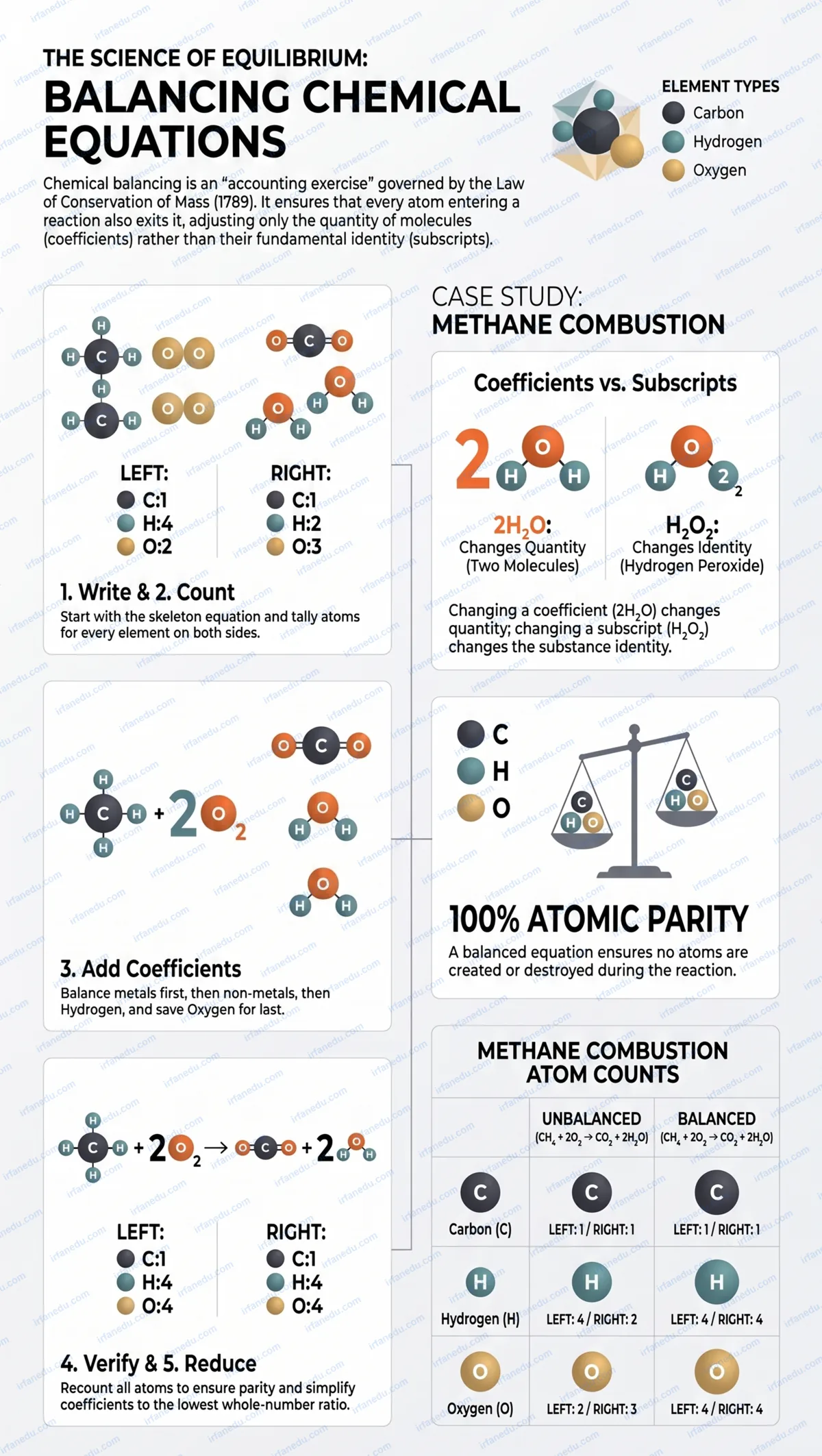
Table of Contents
- Start Here: A Fully Solved Example
- What Balancing Actually Means
- The 5-Step Balancing Method
- Worked Example 2: Combustion of Methane
- Common Mistakes and How to Avoid Them
- Balancing Equations with Polyatomic Ions
- Why This Matters in the Real World
- Quick Knowledge Check
- Practice Problems
- Frequently Asked Questions
Most chemistry students hit a wall the first time they see an unbalanced equation. The formulas look right, but the numbers feel random. I want to flip that experience completely — so I am starting this guide with a real equation, fully solved, before explaining a single rule. Once you see the process in action, the theory clicks instantly.
To balance a chemical equation, place whole-number coefficients in front of each chemical formula so that the number of atoms of every element is equal on both the reactant side and the product side. Never change subscripts. Work element by element, verify your counts, and reduce coefficients to the lowest whole-number ratio.
- Understand what balancing means and why it is required by the Law of Conservation of Mass.
- Apply a reliable 5-step method to any equation.
- Balance combustion, synthesis, and ionic equations with confidence.
- Spot and fix the three most common balancing mistakes.
- Test yourself with a quiz and three practice problems.
TL;DR – Quick Summary
- Write the skeleton equation with correct formulas first.
- Count atoms of each element on both sides of the arrow.
- Add coefficients — never change subscripts — to equalize counts.
- Balance metals first, then non-metals, then hydrogen and oxygen last.
- Verify every element and reduce to the simplest whole-number ratio.
- Polyatomic ions that appear unchanged can be counted as one unit.
| Fact | Detail |
|---|---|
| Governing law | Law of Conservation of Mass (Antoine Lavoisier, 1789) |
| What you adjust | Coefficients only (numbers in front of formulas) |
| What you never change | Subscripts inside formulas |
| Primary method | Trial and error (inspection method) |
| Advanced method | Algebraic / oxidation-number method |
| Minimum skill level | Grade 8 / Year 9 chemistry |
Start Here: A Fully Solved Example
Before any theory, look at this equation and watch how it gets balanced from scratch. The reaction is iron reacting with oxygen to form iron(III) oxide — rust.
Fe + O2 → Fe2O3
Step 1 — Count atoms as they are:
| Element | Reactant side | Product side | Balanced? |
|---|---|---|---|
| Fe | 1 | 2 | No |
| O | 2 | 3 | No |
Step 2 — Balance iron first. The product has 2 Fe, so place a coefficient of 2 in front of Fe on the left:
2 Fe + O2 → Fe2O3
Fe is now balanced (2 = 2). Oxygen is still off: 2 on the left, 3 on the right.
Step 3 — Balance oxygen. The left has O2 (groups of 2) and the right has O3 (groups of 3). The lowest common multiple of 2 and 3 is 6. Place 3 in front of O2 and 2 in front of Fe2O3:
2 Fe + 3 O2 → 2 Fe2O3
Now oxygen is balanced (6 = 6), but iron is off again: 2 on the left, 4 on the right.
Step 4 — Adjust iron again. Place 4 in front of Fe:
4 Fe + 3 O2 → 2 Fe2O3
Step 5 — Verify:
| Element | Reactant side | Product side | Balanced? |
|---|---|---|---|
| Fe | 4 | 4 | Yes |
| O | 6 | 6 | Yes |
4 Fe + 3 O2 → 2 Fe2O3
That is the complete process. Everything else in this guide builds on exactly what you just saw.
My POV: The single biggest reason students struggle with balancing is that they try to do it in their head. I always tell my students: draw the atom-count table first, every single time. It takes 30 seconds and eliminates 80% of errors. The table makes the problem visual, and visual problems are far easier to solve.
What Balancing Actually Means
A balanced chemical equation is a direct expression of the Law of Conservation of Mass. This law, established by Antoine Lavoisier in 1789, states that the total mass of reactants equals the total mass of products in any chemical reaction.
Since mass comes from atoms, and atoms have fixed masses, the only way to conserve mass is to ensure the same number of each type of atom appears on both sides of the equation. Atoms are rearranged during a reaction — bonds break and form — but no atom is created or destroyed.
An unbalanced equation is not just mathematically wrong. It implies atoms appear from nowhere or vanish into nothing, which violates a fundamental law of nature. In practical chemistry, an unbalanced equation also produces completely wrong stoichiometric calculations, meaning you would predict the wrong amounts of reactants and products.
The 5-Step Balancing Method
This method works for the vast majority of equations you will encounter in introductory and intermediate chemistry. It is systematic, repeatable, and fast once you practice it a few times.
Step 1: Write the Correct Skeleton Equation
Write the unbalanced equation using the correct chemical formulas for every reactant and product. Do not guess formulas. If you write the wrong formula, no amount of balancing will fix it. Confirm each formula before you start.
Step 2: Count Atoms on Each Side
Make a simple two-column table. List every element that appears in the equation. Count how many atoms of each element appear on the reactant side and on the product side. Include atoms inside brackets multiplied by subscripts — for example, Ca(OH)2 contains 1 Ca, 2 O, and 2 H.
Step 3: Add Coefficients to Balance
Place whole-number coefficients in front of formulas to make the counts equal. Follow this priority order: metals first, then non-metals, then hydrogen, then oxygen last. Oxygen is left for last because it almost always appears in multiple compounds and is easiest to fix at the end.
Step 4: Verify Every Element
After placing all coefficients, recount every element from scratch. Do not trust your mental arithmetic. Recount with the table. A single missed atom invalidates the entire equation.
Step 5: Reduce to Lowest Whole-Number Ratio
Check whether all coefficients share a common factor. If they do, divide every coefficient by that factor. For example, 4 H2 + 2 O2 → 4 H2O reduces to 2 H2 + O2 → 2 H2O. The simplest ratio is the conventional standard.
  THE 5-STEP BALANCING FLOWCHART
  ================================

  [1] Write skeleton equation
         |
         v
  [2] Build atom-count table
         |
         v
  [3] Add coefficients
      (metals -> non-metals -> H -> O)
         |
         v
  [4] Verify all counts match
         |
       /   \
     YES    NO
      |      \
      v       --> back to [3]
  [5] Reduce to lowest ratio
         |
         v
  DONE: Balanced equation
Worked Example 2: Combustion of Methane
Combustion reactions are the most commonly tested type in introductory chemistry. Here is the combustion of methane (CH4), the main component of natural gas, balanced from scratch using the 5-step method.
CH4 + O2 → CO2 + H2O
Atom count (unbalanced):
| Element | Reactants | Products | Status |
|---|---|---|---|
| C | 1 | 1 | Balanced |
| H | 4 | 2 | Not balanced |
| O | 2 | 3 | Not balanced |
Balance hydrogen first (non-metal, before oxygen). The left has 4 H. H2O has 2 H per molecule. Place a coefficient of 2 in front of H2O:
CH4 + O2 → CO2 + 2 H2O
H: 4 = 4. Now recount oxygen: left has 2, right has 2 + 2 = 4. Place a coefficient of 2 in front of O2:
CH4 + 2 O2 → CO2 + 2 H2O
Final verification:
| Element | Reactants | Products | Balanced? |
|---|---|---|---|
| C | 1 | 1 | Yes |
| H | 4 | 4 | Yes |
| O | 4 | 4 | Yes |
CH4 + 2 O2 → CO2 + 2 H2O
Coefficients are already in the lowest ratio (no common factor). The equation is complete.
[IMAGE: Diagram showing methane combustion with color-coded atoms | ALT: methane combustion balanced chemical equation diagram showing carbon hydrogen and oxygen atoms]
Common Mistakes and How to Avoid Them
After working with hundreds of students, I have seen the same errors appear again and again. Knowing them in advance saves significant time and frustration.
| Wrong Approach | Correct Approach |
|---|---|
| Changing subscripts: H2O → H3O to get more hydrogen | Add a coefficient: 2 H2O gives 4 H and 2 O |
| Forgetting to multiply atoms inside brackets: Ca(OH)2 counted as 1 O and 1 H | Multiply by subscript: Ca(OH)2 = 1 Ca, 2 O, 2 H |
| Balancing oxygen first in combustion reactions | Balance C first, then H, then O last |
| Leaving coefficients as fractions (e.g., 1/2 O2) | Multiply the whole equation by the denominator to clear fractions |
| Not rechecking after each coefficient change | Update the atom-count table after every change |
My POV: In my experience, the bracket-multiplication error is the one that trips up even confident students. I recommend a specific habit: whenever you see parentheses in a formula, circle the subscript outside the bracket and draw arrows to each atom inside. This physical act of marking forces you to multiply correctly before you even start counting.
Balancing Equations with Polyatomic Ions
When a polyatomic ion such as sulfate (SO42-), nitrate (NO3–), or carbonate (CO32-) appears on both sides of the equation unchanged, you can treat it as a single unit. This shortcut makes balancing ionic equations much faster.
Ca(OH)2 + H3PO4 → Ca3(PO4)2 + H2O
The PO4 group appears on both sides. Count it as one unit.
Left: 1 PO4 unit. Right: 2 PO4 units. Place 2 in front of H3PO4.
Left: 1 Ca. Right: 3 Ca. Place 3 in front of Ca(OH)2.
Left: 3 Ca(OH)2 gives 6 OH groups = 6 H and 6 O. Plus 2 H3PO4 gives 6 H. Total H on left = 12. Right: H2O needs coefficient 6 to give 12 H and 6 O.
3 Ca(OH)2 + 2 H3PO4 → Ca3(PO4)2 + 6 H2O
Why This Matters in the Real World
Balancing equations is not a purely academic exercise. It is the foundation of stoichiometry, which chemists and engineers use every day to calculate exact quantities of reactants and products.
In pharmaceutical manufacturing, a balanced equation tells engineers exactly how much of each reagent to use to produce a target quantity of a drug compound. Using the wrong ratio wastes expensive materials or, worse, leaves toxic byproducts in the final product.
In environmental science, balanced combustion equations help calculate carbon dioxide emissions from burning fossil fuels. The equation CH4 + 2 O2 → CO2 + 2 H2O tells us that burning one mole of methane produces exactly one mole of CO2. That ratio drives climate models and emissions policy.
In metallurgy, the balanced equation for iron smelting (Fe2O3 + 3 CO → 2 Fe + 3 CO2) tells engineers how much carbon monoxide is needed per tonne of iron ore. Get the ratio wrong and the furnace either wastes fuel or produces impure iron.
Quick Knowledge Check
Test Yourself: Balancing Chemical Equations
1. Which of the following is the correctly balanced form of: H2 + O2 → H2O ?
2. When balancing an equation, what are you allowed to change?
3. How many atoms of oxygen are in 3 Ca(OH)2?
Practice Problems
Try each equation on your own first. Click to reveal the fully worked solution.
Problem 1: Balance the equation for the formation of ammonia: N2 + H2 → NH3
Step 1 — Count atoms (unbalanced): N: 2 vs 1. H: 2 vs 3. Neither balanced.
Step 2 — Balance nitrogen: Place 2 in front of NH3: N2 + H2 → 2 NH3. Now N: 2 = 2. H: 2 vs 6.
Step 3 — Balance hydrogen: Need 6 H on the left. H2 provides 2 H per molecule. Place 3 in front of H2: N2 + 3 H2 → 2 NH3.
Verify: N: 2 = 2. H: 6 = 6.
N2 + 3 H2 → 2 NH3
Problem 2: Balance the combustion of ethane: C2H6 + O2 → CO2 + H2O
Balance C first: 2 C on left, 1 C per CO2. Place 2 in front of CO2: C2H6 + O2 → 2 CO2 + H2O.
Balance H: 6 H on left, 2 H per H2O. Place 3 in front of H2O: C2H6 + O2 → 2 CO2 + 3 H2O.
Balance O last: Right has 4 + 3 = 7 O. Left needs 7 O. O2 comes in pairs, so use 7/2 O2, then multiply entire equation by 2:
2 C2H6 + 7 O2 → 4 CO2 + 6 H2O
Verify: C: 4 = 4. H: 12 = 12. O: 14 = 14. Correct.
Problem 3: Balance the double displacement reaction: AgNO3 + NaCl → AgCl + NaNO3
Count atoms: Ag: 1 = 1. N: 1 = 1. O: 3 = 3. Na: 1 = 1. Cl: 1 = 1.
Every element already balances with coefficients of 1. This equation is balanced as written.
AgNO3 + NaCl → AgCl + NaNO3
This is a good reminder: always count before assuming an equation needs work. Sometimes it is already balanced.
Frequently Asked Questions
What does it mean to balance a chemical equation?
Balancing a chemical equation means adjusting the coefficients in front of each formula so that the number of atoms of every element is identical on both the reactant side and the product side. This satisfies the Law of Conservation of Mass, which states that matter cannot be created or destroyed in a chemical reaction. An unbalanced equation violates this fundamental law.
Can I change the subscripts to balance an equation?
No. Changing subscripts changes the identity of the substance. For example, changing H2O to H3O makes it a completely different compound. You may only change the coefficients — the large numbers placed in front of each formula. Coefficients change the quantity of a substance; subscripts define what the substance is.
What is the best order to balance elements?
A reliable order is: balance metals first, then non-metals, and leave hydrogen and oxygen for last. In combustion reactions specifically, balance carbon first, then hydrogen, and balance oxygen last because it usually appears in multiple products (CO2 and H2O). Following this order reduces the number of adjustment cycles you need.
Why must chemical equations be balanced?
Chemical equations must be balanced because of the Law of Conservation of Mass. In any chemical reaction, atoms are rearranged but never created or destroyed. An unbalanced equation implies atoms appear or vanish, which is physically impossible. Beyond theory, an unbalanced equation gives completely wrong stoichiometric ratios, leading to incorrect predictions of reactant and product quantities.
What if I get fractional coefficients?
Fractional coefficients are mathematically valid but conventionally avoided in standard notation. Multiply every coefficient in the equation by the denominator of the fraction to convert all coefficients to whole numbers. For example, if you arrive at 1/2 O2, multiply the entire equation by 2. This clears all fractions while keeping the equation balanced.
How do I balance equations with polyatomic ions?
When a polyatomic ion such as SO4 or NO3 appears unchanged on both sides of the equation, treat it as a single unit rather than counting individual atoms. This shortcut significantly speeds up the balancing process and reduces counting errors. Always verify by counting individual atoms at the end to confirm the shortcut was applied correctly.
Is there a method for very complex equations?
Yes. For complex redox reactions, the half-reaction method (ion-electron method) is more reliable than trial and error. You split the reaction into an oxidation half and a reduction half, balance each separately, then combine them. For very large systems, the algebraic method assigns variables to each coefficient and solves a system of linear equations. Both methods are covered in advanced chemistry courses.
Key Takeaways
- Balancing enforces the Law of Conservation of Mass — atoms in must equal atoms out.
- Only coefficients can be changed; subscripts define the substance and are fixed.
- Use an atom-count table every time — it prevents the most common errors.
- Balance metals first, then non-metals, then H, then O.
- Treat unchanged polyatomic ions as single units to save time.
- Always reduce final coefficients to the lowest whole-
Sources & References
Reviewed by Dr. Irfan Mansuri. External links open in a new tab and are provided for further reading and verification.