
🌍 World War 1 Causes Summary: Why Did the World Go to War in 1914?
📋 Table of Contents
- The Quote That Frames Everything
- The MAIN Framework: Your Master Key
- Militarism: The Arms Race That Scared Everyone
- Alliances: The Tripwire Across Europe
- Imperialism: Competing for the World’s Resources
- Nationalism: Pride, Powder, and the Balkans
- The Spark: Assassination of Franz Ferdinand
- The Chain Reaction: From Sarajevo to World War
- Common Mistakes Students Make
- Why WWI Causes Still Matter Today
- Quick Knowledge Check
- Practice Problems
- Frequently Asked Questions
- Key Takeaways
- Related Articles
- Sources & References
— Sir Edward Grey, British Foreign Secretary, August 3, 1914
Sir Edward Grey spoke those words the night before Britain entered World War 1. He was right — and he was also describing something that had been building for decades. The war did not start in a single moment. It started with four slow-burning forces that turned Europe into a room full of gunpowder, waiting for a spark.
That spark came on June 28, 1914, in Sarajevo. But understanding why the spark caused such a massive explosion is the real lesson of WWI.
In this guide, I break down every cause clearly, show you how they connected, and give you the tools to answer any exam question on WWI origins with confidence.
By the end of this article, you will be able to:
- 🎯 Explain each MAIN cause with specific examples
- 🔗 Describe how the alliance system turned a regional crisis into a world war
- 📅 Trace the chain of events from the assassination to the outbreak of war
- ✏️ Identify and avoid the most common mistakes students make on this topic
- 🌐 Connect WWI causes to events in the modern world
⚡ TL;DR – Quick Summary
- 🪖 Militarism: European powers spent decades building massive armies and navies
- 🤝 Alliances: Two armed blocs meant any conflict could pull in all of Europe
- 🌍 Imperialism: Competition for colonies created rivalry and resentment between powers
- 🏴 Nationalism: Ethnic pride destabilized empires, especially in the Balkans
- 💥 Trigger: Assassination of Franz Ferdinand on June 28, 1914 activated the alliance system
- 📜 Result: 4+ years of war, 20 million deaths, and a reshaped world map
| Quick Fact | Detail |
|---|---|
| 📅 War began | July 28, 1914 (Austria-Hungary declares war on Serbia) |
| 📅 War ended | November 11, 1918 (Armistice Day) |
| 🌍 Nations involved | 30+ countries across 6 continents |
| 💀 Total deaths | ~20 million (military + civilian) |
| 🔥 Immediate trigger | Assassination of Archduke Franz Ferdinand, Sarajevo |
| 📚 Memory tool | MAIN (Militarism, Alliances, Imperialism, Nationalism) |
| ⚖️ Peace treaty | Treaty of Versailles, June 28, 1919 |
| 🗺️ Major alliance blocs | Triple Alliance vs. Triple Entente |
🗝️ The MAIN Framework: Your Master Key to WWI Causes
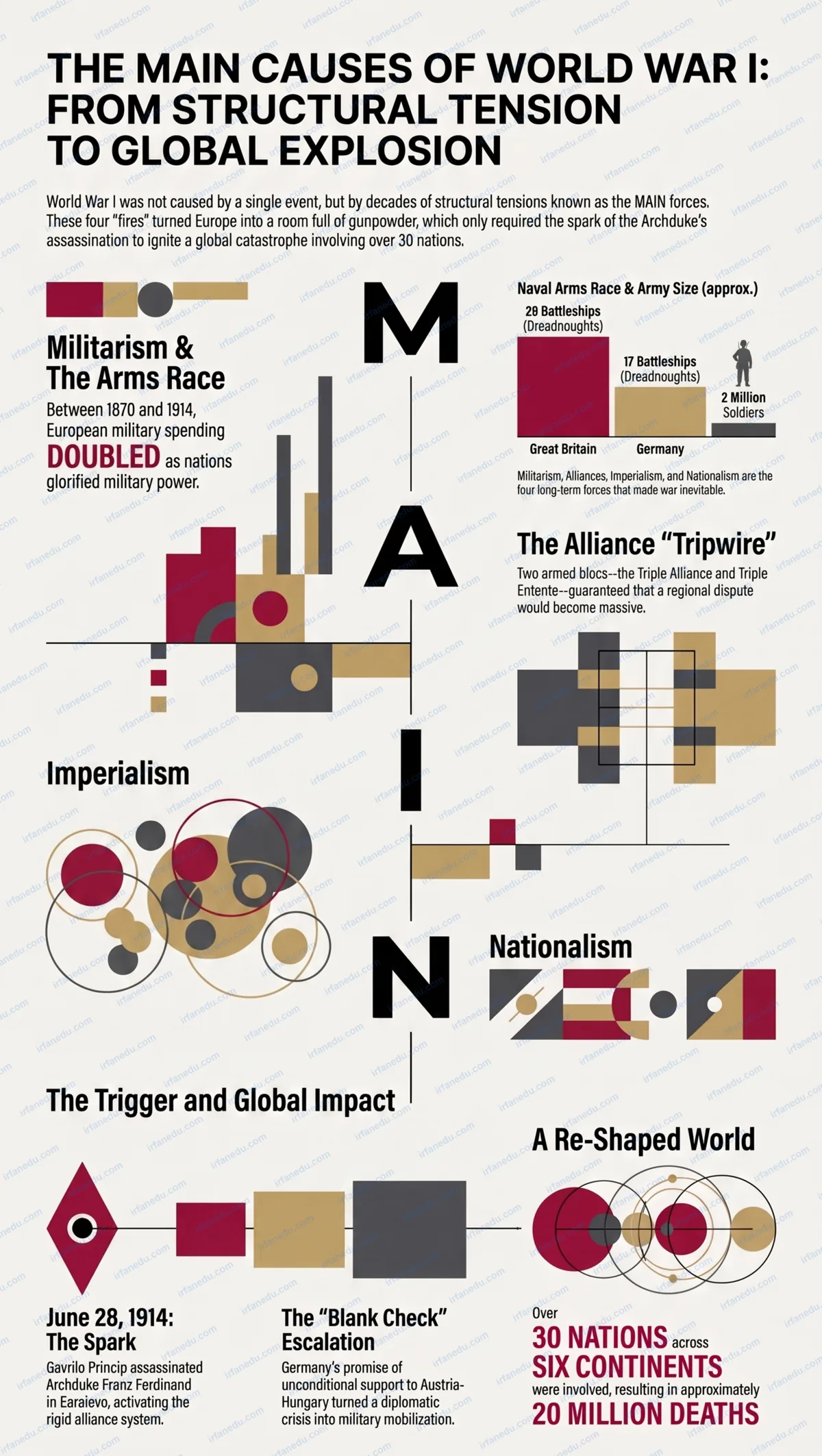
The MAIN acronym is the single most useful tool for understanding and explaining WWI causes. It organizes four complex historical forces into a memorable structure that works for essays, exams, and genuine understanding.
Think of MAIN as four separate fires burning across Europe. Each fire was dangerous on its own. Together, they created an inferno that only needed one spark to explode.
🗺️ Visual: The MAIN Framework — Four Forces, One War
  ┌─────────────────────────────────────────────────────────┐
  │              THE MAIN CAUSES OF WWI                     │
  │                                                         │
  │   🪖 MILITARISM          🤝 ALLIANCES                   │
  │   ─────────────          ──────────                     │
  │   Arms race              Triple Alliance                │
  │   Military culture       (Germany, A-H, Italy)         │
  │   Schlieffen Plan        Triple Entente                 │
  │   Naval rivalry          (France, Russia, UK)          │
  │                                                         │
  │              ╔═══════════════════╗                      │
  │              ║  💥 SPARK: 1914   ║                      │
  │              ║  Franz Ferdinand  ║                      │
  │              ║  Assassination    ║                      │
  │              ╚═══════════════════╝                      │
  │                                                         │
  │   🌍 IMPERIALISM         🏴 NATIONALISM                  │
  │   ─────────────          ────────────                   │
  │   Colonial rivalry       Pan-Slavism                   │
  │   Morocco Crises         Pan-Germanism                 │
  │   Economic competition   Balkan nationalism            │
  │   Resource competition   Black Hand (Serbia)           │
  └─────────────────────────────────────────────────────────┘
Each of the four sections below explores one of these forces in depth. I recommend reading them in order — they build on each other.
🪖 Militarism: The Arms Race That Scared Everyone
Militarism means a nation’s culture, government, and economy are organized around building and glorifying military power. By 1914, this was not just a policy in Europe — it was a way of life.
Between 1870 and 1914, European military spending roughly doubled. Germany’s army grew from 400,000 soldiers to over 2 million. Britain and Germany locked into a fierce naval arms race, each trying to outbuild the other in battleships (called Dreadnoughts). France, Russia, and Austria-Hungary all followed the same pattern.
In 1906, Britain launched HMS Dreadnought, the most powerful battleship ever built. Germany immediately began building its own fleet to match. By 1914, Britain had 29 Dreadnoughts and Germany had 17. Both sides spent enormous national wealth on ships they hoped never to use — but having them made war feel more thinkable, not less.
Militarism also created a dangerous culture inside government. Military leaders gained enormous political influence. War was seen as a test of national strength, not a catastrophe to avoid. The German Schlieffen Plan — a pre-written script for invading France through Belgium — shows how deeply military thinking had penetrated political decision-making.
When the crisis of 1914 arrived, military timetables and mobilization plans moved faster than diplomats could negotiate. The machinery of war was already running before politicians fully grasped what was happening.
In my experience teaching this topic, students often underestimate militarism as “just building armies.” But the deeper point is psychological: when a nation spends 40 years glorifying military power, its leaders start to see war as a solution rather than a failure. That mindset shift is what made WWI possible. The weapons did not cause the war — the belief that using them was acceptable did.
🤝 Alliances: The Tripwire Across Europe
The alliance system was the mechanism that turned a regional conflict into a world war. By 1914, Europe was divided into two armed camps, each bound by treaty to defend the others.
The Triple Alliance (formed 1882) linked Germany, Austria-Hungary, and Italy. The Triple Entente (consolidated by 1907) linked France, Russia, and Britain. These were not just political friendships — they were military commitments. If one member was attacked, the others were obligated to respond.
| Alliance Bloc | Members | Key Treaty | Later Known As |
|---|---|---|---|
| Triple Alliance | Germany, Austria-Hungary, Italy | Treaty of the Triple Alliance (1882) | Central Powers |
| Triple Entente | France, Russia, Britain | Franco-Russian Alliance + Entente Cordiale + Anglo-Russian Convention | Allied Powers |
The problem with these alliances was their rigidity. They were designed to deter war through mutual threat — but when war came anyway, they guaranteed it would be massive. A dispute between Austria-Hungary and Serbia automatically activated obligations involving Germany, Russia, France, and Britain.
There were also secret clauses and competing interpretations. Italy, for example, refused to join the Central Powers in 1914, arguing the alliance was defensive and Austria-Hungary was the aggressor. This shows how the alliance system was both a cause of war and a source of confusion during it.
🌍 Imperialism: Competing for the World’s Resources
Imperialism — the practice of extending a nation’s power through colonization and economic control — created bitter rivalries between European powers in the decades before WWI.
By 1900, Britain and France controlled vast colonial empires across Africa, Asia, and the Pacific. Germany, which had unified only in 1871, felt it deserved a larger share of global power and resources. This resentment drove repeated confrontations.
Germany twice challenged France’s control over Morocco — first in 1905 (the Tangier Crisis) and again in 1911 (the Agadir Crisis). Both times, Germany backed down after diplomatic pressure from Britain and France. These crises did not start a war, but they deepened German resentment, strengthened the Franco-British alliance, and convinced German military planners that war with the Entente was eventually inevitable.
Imperialism also created economic competition. European powers competed for trade routes, raw materials, and markets. This economic rivalry translated directly into political and military tension. Nations that felt economically threatened were more likely to see war as a way to change the balance of power.
In the Balkans, the declining Ottoman Empire left a power vacuum that Austria-Hungary and Russia both wanted to fill. This “Eastern Question” was a form of imperial rivalry that directly fed into the crisis of 1914.
🏴 Nationalism: Pride, Powder, and the Balkans
Nationalism — the belief that people sharing a common language, culture, or ethnicity should form their own independent nation — was perhaps the most emotionally explosive force in pre-war Europe.
It operated in two dangerous ways. First, it made great powers unwilling to accept diplomatic defeats, because backing down felt like national humiliation. Second, it fueled independence movements inside multi-ethnic empires — especially Austria-Hungary and the Ottoman Empire — creating constant political instability.
The Balkan region saw two major wars in 1912 and 1913 as Serbia, Bulgaria, Greece, and Montenegro fought to expand at the expense of the Ottoman Empire. Serbia nearly doubled in size, which alarmed Austria-Hungary. Serbian nationalists dreamed of uniting all South Slavic peoples — a direct threat to Austria-Hungary’s multi-ethnic empire. This tension set the stage for the assassination of 1914.
Pan-Slavism — the idea that all Slavic peoples should unite under Russian leadership — put Russia and Austria-Hungary on a collision course in the Balkans. Pan-Germanism pushed Germany toward aggressive foreign policy. French nationalism, still bitter over the loss of Alsace-Lorraine to Germany in 1871, created a desire for revenge (revanchism).
Nationalism made compromise feel like betrayal. That is why the July Crisis of 1914 escalated so fast — every nation felt its honor was at stake.
I find nationalism the most difficult MAIN cause to explain clearly, because it is both a cause and an amplifier. It did not just create the conditions for war — it made every other tension worse. When I teach this, I ask students: “What happens when pride makes compromise impossible?” That question unlocks the emotional logic of 1914 better than any textbook paragraph.
💥 The Spark: Assassination of Archduke Franz Ferdinand
On June 28, 1914, Archduke Franz Ferdinand — heir to the Austro-Hungarian throne — was shot and killed in Sarajevo, Bosnia. His wife, Sophie, was also killed. The assassin was Gavrilo Princip, a 19-year-old Bosnian Serb nationalist connected to a secret society called the Black Hand.
The assassination itself was almost accidental in its success. The original attack — a grenade thrown at the Archduke’s motorcade — failed. Franz Ferdinand changed his route to visit the injured from the grenade attack, and his car took a wrong turn, stopping directly in front of Princip, who fired two shots.
[IMAGE: Map showing Sarajevo 1914 assassination route | ALT: Map of Archduke Franz Ferdinand assassination route in Sarajevo 1914]
- June 28, 1914: Assassination of Franz Ferdinand in Sarajevo
- July 5–6: Germany gives Austria-Hungary the “blank check” — unconditional support
- July 23: Austria-Hungary issues harsh ultimatum to Serbia
- July 25: Serbia accepts most demands but not all; Austria-Hungary rejects the response
- July 28: Austria-Hungary declares war on Serbia
- July 30: Russia begins full military mobilization
- August 1: Germany declares war on Russia
- August 3: Germany declares war on France; invades Belgium
- August 4: Britain declares war on Germany (citing Belgian neutrality)
The assassination was the trigger, not the cause. Without the MAIN forces already in place, the killing of one royal — however tragic — would not have started a world war. Dozens of political assassinations occurred in Europe during this era without triggering global conflict. What made 1914 different was the powder keg those four forces had already built.
🔗 The Chain Reaction: From Sarajevo to World War
The speed of the July Crisis shocked even the people living through it. Within 37 days of the assassination, the major European powers were at war. The alliance system acted like a set of dominoes — once the first fell, the rest followed automatically.
Austria-Hungary blamed Serbia for the assassination and used it as a pretext to crush Serbian nationalism once and for all. Germany gave Austria-Hungary its famous “blank check” — a promise of unconditional support — which emboldened Austria-Hungary to issue an ultimatum Serbia could not fully accept.
When Austria-Hungary declared war on Serbia, Russia mobilized to protect its Slavic ally. Germany, bound by the Schlieffen Plan’s timetable, declared war on Russia and then France, and invaded neutral Belgium to execute the plan. Britain, which had guaranteed Belgian neutrality in an 1839 treaty, declared war on Germany.
The Schlieffen Plan also backfired strategically. It was designed to win a quick war in the west before turning east. Instead, France held firm, and Germany found itself in exactly the two-front war the plan was designed to prevent. The war that was supposed to last months lasted four years.
🚫 Common Mistakes Students Make About WWI Causes
After years of reviewing student essays and exam answers on this topic, I have noticed the same errors appearing again and again. Here are the most damaging ones — and how to fix them.
| ❌ Common Mistake | ✅ Correct Understanding |
|---|---|
| “The assassination caused WWI” | The assassination was the trigger. The MAIN forces were the actual causes. Without them, the assassination would not have started a world war. |
| “Germany alone caused WWI” | The Treaty of Versailles blamed Germany (War Guilt Clause), but historians today recognize shared responsibility across Austria-Hungary, Russia, and the alliance system. |
| Confusing Triple Alliance with Allied Powers | Triple Alliance (1882) = Germany, Austria-Hungary, Italy. In WWI, this became the Central Powers. The Allied Powers were France, Britain, Russia (and later the USA). |
| “Nationalism only mattered in Serbia” | Nationalism was a Europe-wide force. Pan-Slavism (Russia/Serbia), Pan-Germanism (Germany), revanchism (France), and Irish nationalism (Britain) all played roles. |
| Ignoring imperialism as a cause | Colonial rivalry — especially the Morocco Crises — created deep resentment and hardened alliance blocs years before 1914. |
🌐 Why WWI Causes Still Matter Today
Understanding why WWI started is not just a history exercise. The patterns that caused WWI — arms races, rigid alliance systems, aggressive nationalism, imperial competition — appear in international relations today.
Political scientists and historians frequently compare modern geopolitical tensions to the pre-WWI period. The concept of “alliance entrapment” — being dragged into a conflict by a treaty partner — is still a live concern in international security discussions.
The WWI alliance system is one reason modern international organizations like the United Nations were designed to create forums for negotiation rather than automatic military triggers. The architects of the post-WWII order specifically studied WWI to understand how rigid alliances and miscommunication accelerate conflicts. Understanding 1914 literally shaped the world you live in today.
The Treaty of Versailles, which ended WWI, imposed harsh penalties on Germany — including the War Guilt Clause (Article 231) and massive reparations. Most historians now argue these terms were so punishing that they directly contributed to the economic instability and political resentment that enabled the rise of Adolf Hitler and World War 2.
In that sense, understanding WWI causes is also understanding the causes of WWII. The two wars are deeply connected — many historians call them a “Thirty Years’ War” from 1914 to 1945.
🧠 Quick Knowledge Check: WWI Causes
Select an answer — instant feedback appears below each question.
1. What does the “A” in the MAIN acronym stand for?
2. Which country gave Austria-Hungary the “blank check” of unconditional support in July 1914?
3. What was the primary reason Britain declared war on Germany in August 1914?
✏️ Practice Problems: Test Your Understanding
Question 1: Explain how the alliance system made WWI worse than it might otherwise have been.
The alliance system transformed a dispute between Austria-Hungary and Serbia into a continent-wide war. Without alliances, the conflict might have remained regional. But because Austria-Hungary was allied with Germany, and Serbia had Russia’s backing, a bilateral conflict automatically triggered obligations across Europe. Russia’s mobilization brought in Germany, which then declared war on France (a Russian ally), and invaded Belgium — bringing in Britain. The alliance system acted as a multiplier, turning a local crisis into a global catastrophe within 37 days.
Question 2: Why is it inaccurate to say the assassination of Franz Ferdinand “caused” World War 1?
The assassination was the immediate trigger, not the underlying cause. Political assassinations were not uncommon in early 20th-century Europe, and most did not start world wars. What made the 1914 assassination so consequential was the environment it occurred in: decades of military buildup (militarism), rigid alliance commitments, imperial rivalry, and explosive nationalism had already created extreme tension. The assassination ignited a powder keg that the MAIN forces had spent 40 years building. Without those forces, the same assassination would likely have remained a tragic regional incident.
Question 3: How did nationalism in the Balkans specifically contribute to the outbreak of WWI?
Balkan nationalism created a direct threat to Austria-Hungary’s stability. Serbia’s goal of uniting South Slavic peoples under a Greater Serbia would require territory from Austria-Hungary, which contained large Slavic populations. The Black Hand, a Serbian nationalist secret society, trained and equipped Gavrilo Princip and his associates. Austria-Hungary saw Serbian nationalism as an existential threat and used the assassination as justification to crush it militarily. Russia, as the protector of Slavic peoples (Pan-Slavism), could not allow Austria-Hungary to destroy Serbia without losing credibility. This chain of nationalist commitments pulled the great powers into war.
❓ Frequently Asked Questions: WWI Causes
What were the main causes of World War 1?
What is the MAIN acronym for WWI causes?
Why was the assassination of Franz Ferdinand so important?
Sources & References
Reviewed by Dr. Irfan Mansuri. External links open in a new tab and are provided for further reading and verification.