
✓ Expert Reviewed by Dr. Irfan Mansuri | Last Updated: July 2026
French Revolution Summary Simple: Causes, Events & Impact
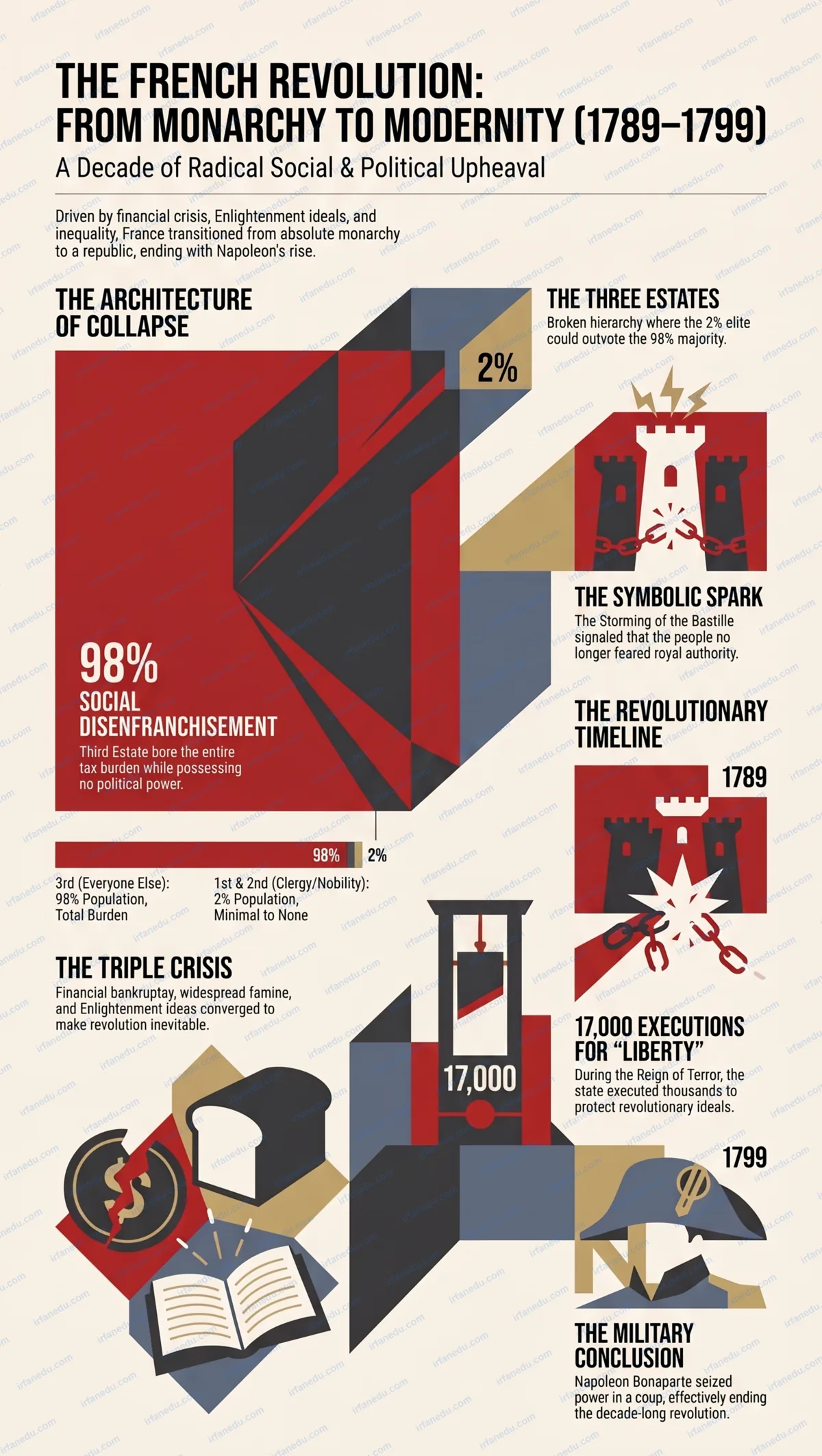
The French Revolution (1789-1799) was a decade-long political and social upheaval in which the French people overthrew their monarchy, dismantled a centuries-old feudal system, and built a republic founded on the ideals of liberty, equality, and popular sovereignty — ideas that reshaped the entire modern world.
If you have ever stared at a history textbook wondering why the French Revolution matters, you are not alone. In my experience, most students get lost in the dates and names before they ever grasp the big picture. This guide fixes that. I will walk you through every essential piece — causes, events, people, and impact — in plain, simple English you can actually use.
Think of this as your decision guide: which parts of the French Revolution do you actually need to understand? I have organized everything so you can jump straight to what matters most for your purpose — whether that is a class essay, an exam, or pure curiosity.
- Why France exploded into revolution in 1789
- The key events from the Bastille to Napoleon’s rise
- Who the major players were and what they did
- Why the Reign of Terror happened and what it means
- How the Revolution changed democracy worldwide
⚡ TL;DR – Quick Summary
- 🏰 France in 1789 was bankrupt, hungry, and deeply unequal — revolution was inevitable.
- ⚖️ The Three Estates system gave 97% of people almost zero political power.
- 🗓️ Key events: Bastille (1789), Declaration of Rights (1789), King’s execution (1793), Terror (1793-94).
- ☠️ The Reign of Terror killed ~17,000 people in the name of “protecting” the Revolution.
- 👑 Napoleon ended the Revolution in 1799 by seizing power in a military coup.
- 🌍 The Revolution’s ideals of liberty and equality inspired democracies around the globe.
| Quick Fact | Detail |
|---|---|
| 📅 Period | 1789 – 1799 (10 years) |
| 📍 Location | France (primarily Paris) |
| 👑 Monarchy overthrown | King Louis XVI & Marie Antoinette |
| 📜 Key document | Declaration of the Rights of Man (1789) |
| ☠️ Reign of Terror deaths | ~17,000 executed; up to 40,000 total |
| 🏁 How it ended | Napoleon’s coup of 18 Brumaire (1799) |
| 🌍 Global impact | Spread democracy, nationalism, human rights |
🧭 Which Version of This Story Should You Use?
Before diving in, let me give you a decision framework. The French Revolution is a massive topic, and different situations call for different depths of understanding. Use this table to find your path.
| Your Goal | Causes | Timeline | Key Figures | Terror | Impact | Recommended Focus |
|---|---|---|---|---|---|---|
| Quick exam review | ✔ Yes | ✔ Yes | ⚡ Brief | ✔ Yes | ⚡ Brief | TL;DR + Timeline + Causes |
| Essay writing | ✔ Yes | ⚡ Key dates | ✔ Yes | ✔ Yes | ✔ Yes | All sections |
| General knowledge | ✔ Yes | ⚡ Brief | ⚡ Brief | ⚡ Brief | ✔ Yes | What Was It + Impact |
| Deep research | ✔ Yes | ✔ Yes | ✔ Yes | ✔ Yes | ✔ Yes | Full article + external sources |
| Curious beginner | ✔ Yes | ✘ Skip | ⚡ Brief | ✘ Skip | ✔ Yes | What Was It + Causes + Impact |
Now that you know where to focus, let me walk you through each piece clearly and efficiently.
🏰 What Was the French Revolution?
The French Revolution was a period of radical political and social transformation in France that lasted from 1789 to 1799. It ended the absolute monarchy, abolished feudalism, and established a republic — all within a single turbulent decade.
Before 1789, France was ruled by King Louis XVI under a system called the Ancien Régime (Old Order). The king held absolute power, the Catholic Church owned vast land, and the nobility enjoyed enormous privileges — all while ordinary people paid crushing taxes and struggled to buy bread.
The Revolution did not happen overnight. It was the result of decades of financial mismanagement, social injustice, and the spread of new political ideas from philosophers like Voltaire, Rousseau, and Montesquieu. When the system finally broke, it broke completely.
🔥 The Root Causes: Why Did It Happen?
The French Revolution had multiple causes, but five stand out as the most important. Understanding these causes is the single most useful thing you can do for any history essay or exam.
1. 💸 Financial Bankruptcy
France was essentially bankrupt by the 1780s. The country had spent enormous sums supporting the American Revolution (1775-1783) and fighting costly wars across Europe. The national debt was so large that nearly half of all government spending went just to pay interest. King Louis XVI could not raise new taxes without calling the Estates-General — a political body that had not met since 1614.
2. 🍞 Food Shortages and Poverty
A series of bad harvests in the late 1780s sent bread prices soaring. In 1789, many French families spent up to 90% of their income on bread alone. Hunger is a powerful motivator. When people cannot feed their children, they stop being afraid of kings.
3. ⚖️ Extreme Social Inequality
The Three Estates system (explained in the next section) meant that 97% of the population bore almost all the tax burden while the privileged 3% — clergy and nobility — paid little or nothing. This was not just unfair; it was unsustainable.
4. 💡 Enlightenment Ideas
Philosophers of the 18th century — Rousseau, Voltaire, Montesquieu — argued that government should serve the people, not the other way around. These ideas spread through pamphlets, salons, and coffee houses. By 1789, millions of French people had a vocabulary for their grievances: liberty, equality, natural rights, social contract.
5. 👑 Weak Leadership
King Louis XVI was indecisive and out of touch. His wife, Marie Antoinette, was seen as extravagant and foreign (she was Austrian). The royal family’s failure to read the political situation — or act decisively when they did — accelerated the collapse of royal authority.
In my view, the single most underrated cause of the French Revolution is the Enlightenment. People often focus on bread prices and taxes — and those matter — but without the intellectual framework that Rousseau and others provided, French citizens might have simply endured their suffering as previous generations had. The idea that they had rights and that government could be different was the true spark. The bread crisis was just the match.
⚖️ The Three Estates: France’s Broken Social System
To understand the Revolution, you must understand the Three Estates. This was the official social hierarchy of France, and it was the source of enormous resentment.
┌─────────────────────────────────────────────────────┐
│              FRENCH SOCIETY (c. 1789)               │
├─────────────────────────────────────────────────────┤
│  1ST ESTATE — THE CLERGY                           │
│  ~0.5% of population │ Owned 10% of land           │
│  Paid NO regular taxes │ Had own courts             │
├─────────────────────────────────────────────────────┤
│  2ND ESTATE — THE NOBILITY                         │
│  ~1.5% of population │ Owned 25% of land           │
│  Exempt from most taxes │ Held top gov. positions   │
├─────────────────────────────────────────────────────┤
│  3RD ESTATE — EVERYONE ELSE                        │
│  ~98% of population │ Paid ALL major taxes         │
│  No real political power │ Bore all military burden │
│  ├── Bourgeoisie (merchants, lawyers, doctors)     │
│  ├── Urban workers (artisans, laborers)            │
│  └── Peasants (largest group, most burdened)       │
└─────────────────────────────────────────────────────┘

  KEY INJUSTICE: In the Estates-General, each Estate
  got ONE vote. So 2 privileged estates (3% of people)
  could always outvote the 98% in the 3rd Estate.
When the Estates-General met in May 1789, the Third Estate demanded that votes be counted by head (not by estate). The king refused. The Third Estate walked out, declared itself a National Assembly, and swore the famous Tennis Court Oath — promising not to disband until France had a new constitution. The Revolution had begun.
📅 Key Events Timeline (1789-1799)
Here is a clear, chronological walkthrough of the Revolution’s most important events. Each one builds on the last.
| Date | Event | Why It Matters |
|---|---|---|
| May 1789 | Estates-General convenes | First meeting in 175 years; exposed the political deadlock |
| June 1789 | Tennis Court Oath | Third Estate defies the king; National Assembly formed |
| July 14, 1789 | Storming of the Bastille | Symbolic start of the Revolution; Bastille Day is still celebrated |
| Aug 1789 | Declaration of the Rights of Man | Foundational document of human rights and democracy |
| Oct 1789 | Women’s March on Versailles | Thousands of women forced the royal family to Paris |
| 1791 | Constitutional Monarchy established | King kept his role but lost absolute power |
| 1792 | France declares war on Austria | Revolutionary wars begin; radical factions gain power |
| Jan 1793 | Louis XVI executed | Monarchy abolished; Europe’s kings horrified and threatened |
| 1793-94 | Reign of Terror | Robespierre’s Committee kills thousands of “enemies” |
| July 1794 | Thermidorian Reaction | Robespierre arrested and executed; Terror ends |
| 1795-99 | The Directory rules France | Unstable government; corruption widespread |
| Nov 1799 | Napoleon’s coup (18 Brumaire) | Revolution ends; Napoleon becomes First Consul |
The Bastille was a royal prison and fortress in Paris. On July 14, 1789, a crowd of Parisians stormed it, freed its (seven) prisoners, and seized its weapons. The Bastille held almost no prisoners at the time — but it was a powerful symbol of royal tyranny. Its fall told the world that the people of France were no longer afraid of their king. France still celebrates July 14 as Bastille Day, its national holiday.
👤 Key Figures You Must Know
The French Revolution had a large cast of characters. These are the ones that appear most often in exams and essays — and the ones whose actions actually shaped events.
| Person | Role | What They Did | Fate |
|---|---|---|---|
| King Louis XVI | King of France | Weak ruler who failed to manage the crisis; called the Estates-General | Executed by guillotine, Jan 1793 |
| Marie Antoinette | Queen of France | Seen as extravagant; symbol of royal excess; tried to flee France | Executed by guillotine, Oct 1793 |
| Maximilien Robespierre | Radical leader | Led the Committee of Public Safety; orchestrated the Reign of Terror | Executed by guillotine, July 1794 |
| Jean-Paul Marat | Radical journalist | Wrote inflammatory pamphlets; called for mass executions of enemies | Assassinated in his bath by Charlotte Corday, 1793 |
| Georges Danton | Revolutionary leader | Early hero of the Revolution; later opposed the Terror’s excesses | Executed by Robespierre, 1794 |
| Napoleon Bonaparte | Military general | Won major battles; exploited political instability to seize power | Became Emperor; exiled to St. Helena, died 1821 |
[IMAGE: Portrait collage of French Revolution key figures | ALT: French Revolution key figures Louis XVI Robespierre Napoleon Bonaparte portraits]
☠️ The Reign of Terror: When the Revolution Turned Dark
The Reign of Terror (September 1793 – July 1794) is the most disturbing phase of the French Revolution. It is also one of the most important for understanding how revolutions can go wrong.
After Louis XVI was executed, France faced war on multiple fronts — Austria, Prussia, and Britain all threatened the new republic. Inside France, counter-revolutionary uprisings broke out. The radical Jacobin faction, led by Robespierre, responded by creating the Committee of Public Safety — essentially a wartime emergency government with near-dictatorial powers.
What Happened During the Terror?
- The Revolutionary Tribunal tried and executed “enemies of the Revolution” — often with minimal evidence.
- Around 17,000 people were officially executed by guillotine.
- Up to 40,000 more died in prison or during mass executions in the provinces.
- Victims included not just aristocrats but also fellow revolutionaries, priests, and ordinary citizens accused of disloyalty.
- Robespierre justified it all as necessary to “save” the Revolution from its enemies.
Robespierre — the man who orchestrated the execution of thousands in the name of liberty — was himself arrested and guillotined in July 1794. His colleagues on the Committee, fearing they would be next on his list, turned on him first. The event is called the Thermidorian Reaction. It ended the Terror and began the more moderate phase of the Revolution.
The Reign of Terror is a lesson I think every student of history — and every citizen — should take seriously. It shows how quickly a movement built on ideals of freedom can become authoritarian when it feels threatened. Robespierre genuinely believed he was protecting the Revolution. That is what makes it so chilling. The road to political violence is often paved with sincere conviction. History repeats this pattern with disturbing regularity.
❌ Common Mistakes Students Make About the French Revolution
These are the errors I see most often in student essays and exams. Avoiding them will immediately improve your work.
| Common Mistake | The Reality |
|---|---|
| ❌ “The Revolution started because of one cause” | ✔ It had multiple overlapping causes: financial, social, intellectual, and political. |
| ❌ “The Revolution was only about poor vs. rich” | ✔ The bourgeoisie (middle class) played a huge role — they led most of the political action. |
| ❌ “The guillotine was invented during the Revolution” | ✔ It was introduced during the Revolution (1792) but named after Dr. Guillotin who proposed it as a humane method. |
| ❌ “Napoleon was a revolutionary” | ✔ Napoleon ended the Revolution. He preserved some reforms but restored authoritarian rule. |
| ❌ “The Bastille was full of political prisoners” | ✔ Only 7 prisoners were inside when it was stormed. Its importance was symbolic, not practical. |
| ❌ “The Revolution immediately created democracy” | ✔ France went through multiple governments after 1789 before achieving stable democracy — a process that took decades. |
🌍 The Lasting Impact on the World
The French Revolution’s most important legacy is not what it did to France — it is what it did to the entire world. The ideas unleashed in 1789 are still shaping politics, law, and society today.
1. 📜 The Declaration of the Rights of Man (1789)
This document declared that all men are born free and equal in rights, that sovereignty belongs to the nation (not the king), and that freedom of speech and religion are fundamental. It directly influenced the United Nations’ Universal Declaration of Human Rights (1948) and constitutions around the world.
2. 🗳️ The Spread of Democracy
The Revolution proved that ordinary people could overthrow an absolute monarchy and build a republic. This inspired revolutions across Latin America, Europe, and beyond throughout the 19th century. Simon Bolívar, who liberated much of South America, was directly inspired by French revolutionary ideals.
3. 🌐 The Rise of Nationalism
The Revolution created the idea of the nation as a community of citizens with shared rights and identity — not just subjects of a king. This concept of nationalism spread across Europe and became one of the defining forces of the 19th and 20th centuries.
4. ⚖️ The End of Feudalism in France
On the night of August 4, 1789, the National Assembly abolished feudal privileges in a single dramatic session. Serfdom, noble exemptions from taxes, and church tithes were all eliminated. This was one of the most sweeping social reforms in European history.
5. 🏛️ The Metric System
Yes, really. The French Revolution gave the world the metric system (1795), introduced as part of the revolutionary project to rationalize and modernize French society. It is now the standard measurement system used by almost every country on Earth.
When you see “Liberty, Equality, Fraternity” (Liberté, Égalité, Fraternité) — France’s national motto — you are looking at a direct product of the Revolution. When you read about human rights in international law, you are reading documents built on the foundation of the 1789 Declaration. The French Revolution is not ancient history. It is the architecture of the modern world.
🧠 Quick Knowledge Check — French Revolution
Select your answer for each question. Instant feedback below each choice.
Q1. What was the main symbolic event that marked the start of the French Revolution?
Q2. Who led the Reign of Terror (1793-1794)?
Q3. What document produced during the French Revolution most directly influenced modern human rights law?
✏️ Practice Problems — Test Your Understanding
Click each question to reveal a model answer. Try answering in your head first.
Practice Q1: Explain in 3-4 sentences why the Three Estates system caused resentment.
Practice Q2: How did Enlightenment ideas contribute to the French Revolution?
Practice Q3: Why did the Reign of Terror end, and what does it tell us about the Revolution?
❓ Frequently Asked Questions
What was the French Revolution in simple terms?
What were the main causes of the French Revolution?
Who were the key figures of the French Revolution?
What was the Reign of Terror?
How did the French Revolution end?
Sources & References
Reviewed by Dr. Irfan Mansuri. External links open in a new tab and are provided for further reading and verification.