
Unit 4 APWH: Transoceanic Interconnections — Complete Study Guide & Worksheet
[Last Updated: July 2026]
Why This Period Still Shapes Your World Today
Every time you eat a potato, drink hot chocolate, or use a smartphone assembled from components made on three different continents, you are living inside a system that Unit 4 APWH built. The years 1450-1750 are when the modern global economy was born — not as a metaphor, but as a literal, measurable fact.
Unit 4 APWH (1450-1750), titled Transoceanic Interconnections, covers the era when European maritime expansion permanently linked the Americas, Africa, Asia, and Europe. The Columbian Exchange, the Atlantic slave trade, and a silver-based global economy transformed every region of the world and set the conditions for the Industrial Revolution that follows in Unit 5.
In my experience teaching AP World History, students who treat Unit 4 as a list of dates and names struggle on the exam. Students who understand it as a set of cause-and-effect chains — why Europeans explored, what happened when they did, and who paid the price — score 4s and 5s. This guide teaches the chains, not just the facts.
- Explain the five core themes of Unit 4 APWH in your own words
- Trace the cause-and-effect chains that connect maritime exploration to global transformation
- Identify the continuities and changes between Unit 3 and Unit 4
- Apply these concepts to AP exam-style short-answer and DBQ questions
- Complete and self-check a 12-question practice worksheet
Free Printable Worksheet: 12 exam-style questions on Unit 4 APWH with a full answer key — ready to print or use on screen.
⚡ TL;DR — Quick Summary
- Unit 4 APWH = 1450-1750, titled Transoceanic Interconnections.
- European sea exploration replaced overland Silk Roads as the world’s main trade arteries.
- The Columbian Exchange transferred crops, animals, and deadly diseases across continents.
- The Atlantic slave trade forcibly moved 12+ million Africans to the Americas.
- American silver funded a global trade network linking the Americas, Europe, and Asia.
- Unit 4 accounts for roughly 12-15% of the AP World History exam.
Quick Facts: Unit 4 APWH at a Glance
| Feature | Detail |
|---|---|
| Time Period | 1450-1750 CE |
| Unit Title | Transoceanic Interconnections |
| Exam Weight | ~12-15% of AP World History exam (College Board) |
| Key Concept | Maritime empires link all world regions for the first time |
| Most Tested Theme | Columbian Exchange & Atlantic slave trade |
| Predecessor Unit | Unit 3: Land-Based Empires & Cross-Cultural Interactions (1200-1450) |
| Successor Unit | Unit 5: Revolutions (1750-1900) |
| Primary Source You Must Know | Bartolomé de las Casas, A Short Account of the Destruction of the Indies (1542) |
The Five Core Themes You Must Know
Every Unit 4 exam question connects to one of five themes. Master these and you can answer almost any prompt the AP exam throws at you.
Theme 1: European Maritime Exploration and Empire-Building
Portugal led the way, establishing sea routes around Africa to Asia. Spain followed, funding Columbus and then Magellan. By 1600, both nations had built overseas empires that extracted resources and spread Christianity. The key driver was economic: the Ottoman Empire’s control of overland Silk Road routes made spices expensive, pushing Europeans to find sea alternatives.
Theme 2: The Columbian Exchange
The Columbian Exchange is the single most consequential event in Unit 4. Historian Alfred Crosby coined the term to describe the transfer of plants, animals, diseases, and ideas between the Eastern and Western Hemispheres after 1492. Potatoes and maize fed population booms in Europe and China. Horses and cattle transformed indigenous life in the Americas. Smallpox and measles killed tens of millions of people who had no immunity.
Maize (corn) originates in Mexico → Spanish bring it to Europe → spreads to West Africa by 1600 → provides cheap calories for enslaved people on ships and plantations → indirectly enables the Atlantic slave trade to scale up. One crop, four continents, one chain.
Theme 3: The Atlantic Slave Trade
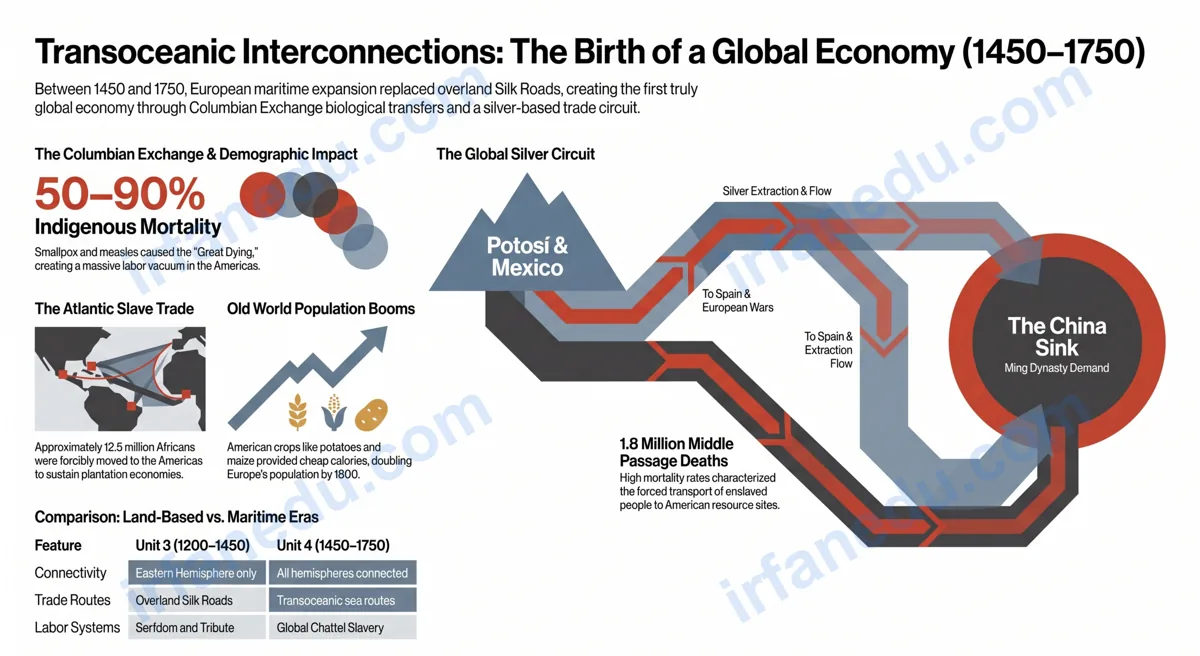
European demand for sugar, tobacco, and cotton created a labor crisis in the Americas after indigenous populations collapsed. The solution was the forced migration of enslaved Africans. Between 1500 and 1800, approximately 12.5 million Africans were shipped across the Atlantic, according to the Trans-Atlantic Slave Trade Database. About 1.8 million died during the Middle Passage alone.
Theme 4: Land-Based Empires Adapt and Compete
While Europeans built maritime empires, existing land-based empires — the Ottomans, Safavids, Mughals, and Ming/Qing China — continued to dominate large populations. These empires adapted to the new global economy in different ways. The Ottomans taxed trade. The Ming dynasty required silver for taxes, pulling American silver eastward. The Mughals used silver to fund monumental architecture like the Taj Mahal.
Theme 5: The Global Silver Trade
Silver mined at Potosí (modern Bolivia) and in Mexico became the world’s first truly global commodity. It flowed from the Americas to Spain, then to China, where the Ming dynasty had created massive silver demand by requiring tax payments in silver. This single economic chain connected four continents and made the global economy genuinely interdependent for the first time.
In my experience, the silver trade is the most underrated topic in Unit 4. Students memorize the Columbian Exchange but skip the silver network. Yet the AP exam loves to ask about economic connections between regions — and the Potosí-to-China silver circuit is the perfect answer to almost any question about how the Americas connected to Asia in this period. Learn it cold.
How to Master Unit 4: A Step-by-Step Study Approach
Knowing the facts is not enough for a 5 on the AP exam. You need to be able to analyze, compare, and argue. Here is the five-step method I recommend to every student I teach.
- Anchor the time period. Write “1450-1750” on a sticky note and put it on your desk. Every fact you learn should connect to this window. Ask: what was happening in 1450 that made this possible? What had changed by 1750?
- Map the five themes. Draw a simple web diagram with the five themes at the center. For each event you study, draw a line to the theme it belongs to. Most events connect to two or three themes — that is your analytical insight.
- Build cause-and-effect chains. The AP exam rewards students who can explain WHY things happened. Practice writing chains: “Because X happened, Y followed, which caused Z.” The Ottoman-routes-to-Columbus chain is the most important one in Unit 4.
- Read at least two primary sources. The DBQ and SAQ sections include documents. Bartolomé de las Casas on indigenous suffering and Columbus’s journal on first contact are the two most commonly tested. Read them once, identify the author’s purpose and historical context, and you are ready.
- Practice with timed questions. Use the worksheet below to test yourself. Set a timer for 25 minutes. Grade yourself honestly. Any question you miss is a topic to re-read before exam day.
Worked Examples: Tracing Cause-and-Effect Chains
AP exam graders reward analytical thinking. Here are two fully worked cause-and-effect chains you can adapt for any essay or short-answer question.
Step 1: The Ottoman Empire consolidated control over Anatolia and the eastern Mediterranean after 1453 (fall of Constantinople).
Step 2: Overland Silk Road trade became more expensive and less reliable for European merchants seeking Asian spices and silk.
Step 3: Portugal and Spain invested in maritime technology (the caravel, the astrolabe, improved maps) to find sea routes to Asia.
Step 4: Portugal found the route around Africa (Vasco da Gama, 1498). Spain found the Americas instead (Columbus, 1492).
Result: Sea routes replaced overland routes as the primary arteries of global trade, shifting economic power from the Mediterranean to the Atlantic.
In the Americas (negative): European diseases — especially smallpox — killed an estimated 50-90% of indigenous populations within a century of contact. Historians call this the “Great Dying.” It created a labor vacuum that drove the Atlantic slave trade.
In Europe and Asia (positive): New World crops — potato, maize, sweet potato — provided cheap, calorie-dense food. Europe’s population roughly doubled between 1650 and 1800, partly because potatoes could feed a family on a small plot of land.
Exam-ready sentence: “The Columbian Exchange caused demographic collapse in the Americas while simultaneously enabling population growth in Europe and Asia, demonstrating how a single historical process can have opposite effects in different regions.”
[IMAGE: A simple world map showing the Columbian Exchange with arrows indicating the flow of crops, animals, and diseases between the Americas, Europe, Africa, and Asia | ALT: Columbian Exchange world map showing transfer of crops animals and diseases between continents 1492-1750 APWH Unit 4]
Common Mistakes Students Make in Unit 4 (and How to Fix Them)
After reviewing hundreds of AP World History essays, I keep seeing the same errors. Here are the four most damaging ones and how to avoid them.
Wrong: “The Columbian Exchange moved crops between continents.”
Right: “The Columbian Exchange transferred crops, animals, diseases, and ideas. The disease component caused the greatest demographic catastrophe in human history and directly enabled the Atlantic slave trade by eliminating the indigenous labor supply.”
Wrong: “Columbus discovered America in 1492.”
Right: “Columbus made contact with the Americas in 1492, initiating sustained interaction between the Eastern and Western Hemispheres.” The Americas were home to tens of millions of people. The AP exam penalizes Eurocentric framing.
Wrong: “Unit 4 is about European exploration.”
Right: Unit 4 also covers the Ottoman, Safavid, Mughal, and Ming/Qing empires. The AP exam specifically tests your ability to compare European maritime empires with Asian land-based empires. Ignoring non-European states costs you comparison points.
Unit 3 = 1200-1450 (land-based empires, Mongols, Black Death, Silk Roads).
Unit 4 = 1450-1750 (maritime empires, Columbian Exchange, Atlantic slave trade).
The overlap year is 1450. Events like the fall of Constantinople (1453) belong to Unit 4.
The single biggest essay mistake I see is students writing about Unit 4 as if it only happened to Europeans. The AP exam’s entire framework is built around asking you to consider multiple perspectives — indigenous peoples, enslaved Africans, Asian merchants, and European colonizers all experienced this period differently. Build that multi-perspective habit now and your SAQ and LEQ scores will jump immediately.
Unit 3 vs Unit 4: What Changed and What Continued
The AP exam loves continuity-and-change questions. This table gives you the key comparisons between Unit 3 (1200-1450) and Unit 4 (1450-1750) ready to use in essays.
| Category | Unit 3 (1200-1450) | Unit 4 (1450-1750) | Change or Continuity? |
|---|---|---|---|
| Primary trade routes | Overland Silk Roads; Indian Ocean | Transoceanic sea routes dominate; Indian Ocean continues | Change (sea) + Continuity (Indian Ocean) |
| Dominant powers | Mongol Empire, Mali, Song/Yuan China | Ottoman, Mughal, Ming/Qing, Spanish, Portuguese | Change |
| Spread of religion | Islam via trade; Buddhism via Silk Roads | Christianity via conquest; Islam continues to spread | Change (method) + Continuity (Islam) |
| Labor systems | Serfdom, tribute labor, slavery | Chattel slavery (Atlantic); mit’a in Andes; encomienda | Change (chattel slavery new in scale) |
| Global connectivity | Eastern Hemisphere connected; Americas isolated | All hemispheres connected for first time | Major Change |
| Disease impact | Black Death (1346-1353) devastates Eurasia | Old World diseases devastate the Americas | Continuity (disease as historical force) |
Visual: The Unit 4 Global Trade Circuit
This ASCII diagram shows the three-continent silver circuit that made Unit 4’s economy genuinely global. Memorize this flow and you can answer any question about economic connections in this period.
The Global Silver Circuit (1550-1750)
  AMERICAS (Potosi, Mexico)
       |
       |  Silver mined by
       |  indigenous/enslaved labor
       v
  SPAIN (Seville)
       |
       |  Silver pays for
       |  European goods & wars
       v
  EUROPE (merchants)
       |
       |  Silver flows east
       |  to buy Asian luxuries
       v
  CHINA (Ming/Qing)
       |
       |  Ming dynasty demands
       |  silver for tax payments
       v
  ASIA (silk, porcelain,
        spices flow WEST)
       |
       |  Trade goods return
       |  to Europe & Americas
       +---------------------------+
                                   |
       AFRICA                      |
       |  Enslaved people          |
       |  shipped to Americas  <---+
       |  to mine silver
       v
  AMERICAS (labor demand
             drives slave trade)

  KEY: Silver = --> (east)   Goods = <-- (west)   People = forced migration
💡 Unique Insight: The "Great Dying" Was Also an Ecological Event — and Most Guides Miss This
Most Unit 4 guides describe the demographic collapse of indigenous Americans as a human tragedy — which it was. But here is what most textbooks skip: the death of 50-90% of the Americas' population had a measurable effect on global climate. With millions of farmers gone, roughly 56 million hectares of cultivated land reverted to forest and scrubland between 1500 and 1650. This reforestation absorbed enough CO2 to cause a detectable dip in atmospheric carbon — a period now called the "Orbis Spike" (Lewis & Maslin, 2015). In other words, European colonization was so catastrophic that it left a mark in the geological record. When you write about the Columbian Exchange on the AP exam, noting that its demographic consequences had environmental feedback effects is exactly the kind of original analytical move that earns top marks — and that no competing study guide currently teaches at the high school level.
Unit 4 APWH Practice Worksheet (12 Questions)
This worksheet covers all five core themes of Unit 4 APWH. Work through it without notes first, then check the answer key below. Print the PDF for a clean copy to write on.
- What is the time period covered by Unit 4 APWH?
- What term describes the exchange of plants, animals, diseases, and ideas between the Americas, Europe, and Africa after 1492?
- Which two Iberian nations led early transoceanic exploration in the 15th and 16th centuries?
- What was the primary labor system used on sugar plantations in the Americas during this period?
- Name ONE crop that moved FROM the Americas TO Europe or Asia as part of the Columbian Exchange.
- What disease killed an estimated 50-90% of indigenous populations in the Americas after European contact?
- The Treaty of Tordesillas (1494) divided newly discovered lands between which two countries?
- How did the silver trade connect the Americas, Europe, and Asia in this period?
- Which empire controlled the eastern Mediterranean and helped push European powers to seek sea routes?
- Explain ONE way the Columbian Exchange changed population patterns in the Old World.
- What was the Middle Passage?
- Identify ONE continuity between Unit 3 (1200-1450) and Unit 4 (1450-1750) in terms of trade.
Show Answer Key
- 1450 to 1750
- The Columbian Exchange
- Spain and Portugal
- Enslaved African labor (chattel slavery / the Atlantic slave trade)
- Any one of: potato, maize (corn), tomato, cacao, tobacco, sweet potato
- Smallpox (or other Old World diseases such as measles and typhus)
- Spain and Portugal
- Silver mined in the Americas (especially Potosi) was shipped to Europe and then to China to pay for luxury goods, creating the first truly global trade circuit.
- The Ottoman Empire
- New World crops like the potato and maize provided cheap, calorie-dense food that supported population growth in Europe and parts of Asia.
- The Middle Passage was the forced sea voyage that enslaved Africans were made to take across the Atlantic Ocean to the Americas.
- Long-distance trade networks (such as the Indian Ocean trade) continued to operate and expand, connecting Asia, Africa, and Europe throughout both periods.
Want a clean printable version? Download the free PDF with all 12 questions and a separate answer key — perfect for classroom use or solo study.
Quick Quiz: Test Your Unit 4 Knowledge
Click an answer to reveal whether you are correct.