
Classifying Triangles Worksheet: Free PDF + Answer Key
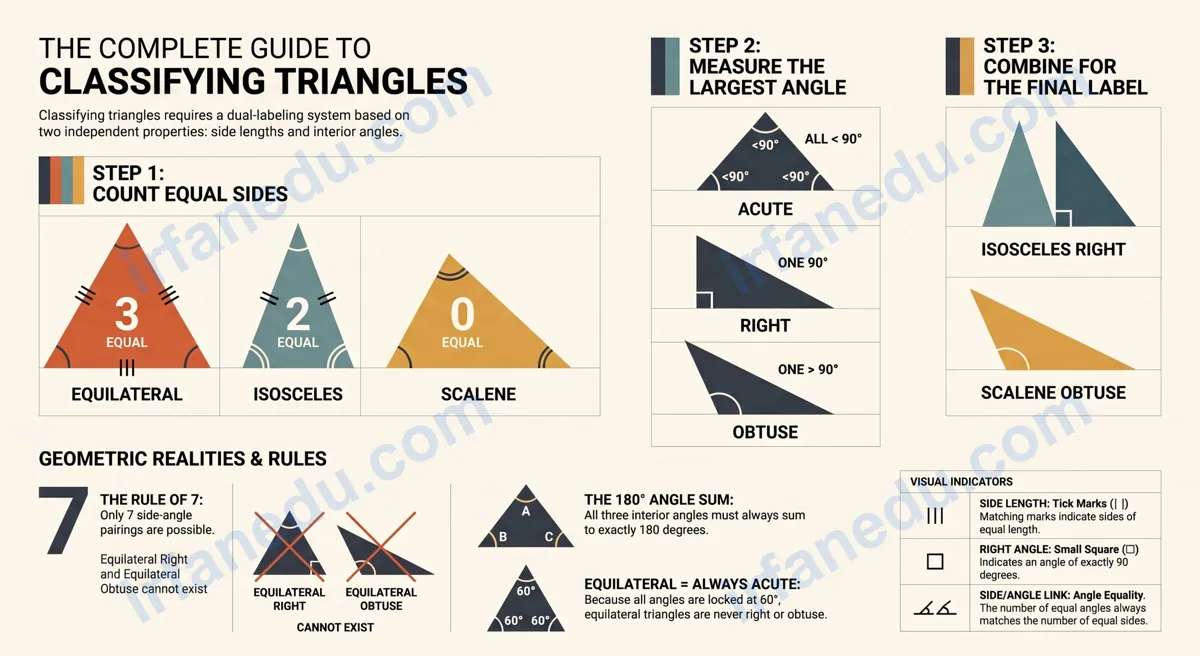
Here is a number that surprises most students: there are exactly 7 valid side-angle combinations for triangles — not 6, not 9. Once you know why one combination is impossible (equilateral + obtuse), the whole classification system clicks into place. This free worksheet and lesson will get you there in under 10 minutes.
Classifying triangles means sorting a triangle into a named type based on its side lengths or interior angles. There are three side-based types (equilateral, isosceles, scalene) and three angle-based types (acute, right, obtuse). Every triangle belongs to exactly one type from each group, giving six labels that combine into seven valid pairings.
After this lesson and worksheet, you will be able to:
- Name all six triangle types and define each precisely.
- Classify any triangle by both its sides and its angles.
- Explain why certain combinations (equilateral + obtuse) are impossible.
- Solve 10 graded practice problems with confidence.
Classifying triangles means sorting them by sides or angles. By sides: equilateral (3 equal sides), isosceles (2 equal sides), scalene (no equal sides). By angles: acute (all angles under 90°), right (one 90° angle), obtuse (one angle over 90°). Every triangle fits one side-type and one angle-type simultaneously, giving a two-part classification like “scalene right.”
Free Printable PDF: Download the full worksheet with 10 problems and a complete answer key — ready to print and use today.
All 6 Triangle Types at a Glance
This table is the fastest reference for classification. Every triangle in the worksheet maps to one row from each group below.
| Classification System | Type | Definition | Angle Range | Example Sides |
|---|---|---|---|---|
| By Sides | Equilateral | All 3 sides equal | All angles = 60° | 5, 5, 5 |
| Isosceles | Exactly 2 sides equal | 2 base angles equal | 6, 6, 4 | |
| Scalene | No sides equal | All angles different | 3, 4, 5 | |
| By Angles | Acute | All 3 angles < 90° | e.g. 60°, 70°, 50° | Any |
| Right | One angle = 90° | 90°, and two others summing to 90° | 3, 4, 5 | |
| Obtuse | One angle > 90° | e.g. 110°, 40°, 30° | Any |
⚡ TL;DR – Quick Summary
- Classify every triangle twice: once by sides, once by angles.
- By sides: equilateral (3 equal), isosceles (2 equal), scalene (none equal).
- By angles: acute (all <90°), right (one =90°), obtuse (one >90°).
- Only 7 of the 9 possible combinations actually exist in geometry.
- Equilateral + obtuse and equilateral + right are both impossible.
- The 3-4-5 right triangle is the most tested scalene right example.
| Fact | Detail |
|---|---|
| Total angle sum | Always 180° in any triangle |
| Equilateral angles | Always 60°, 60°, 60° |
| Right triangle square | The 90° angle is marked with a small square |
| Tick marks on sides | Equal tick marks = equal side lengths |
| Impossible combos | Equilateral+right, Equilateral+obtuse |
| Most common test combo | Isosceles right (45-45-90) |
What Is Classifying Triangles?
Classifying triangles is the process of assigning a triangle to a named category based on measurable properties — specifically side lengths and interior angles. It is one of the foundational skills in geometry because it connects visual shape recognition to precise mathematical definitions.
The two classification systems are independent. Side classification tells you about length relationships. Angle classification tells you about the largest angle. You always apply both, and you always state both in your answer.
In my experience teaching geometry to middle schoolers, the single biggest source of confusion is thinking classification is a one-answer task. Students write “isosceles” and stop. The complete answer is always two words: “isosceles acute” or “isosceles right.” I make students repeat this rule out loud until it sticks — and it works.
How to Classify Any Triangle (Step-by-Step)
Follow these three steps every time and you will never misclassify a triangle.
-
Step 1: Classify by sides.
Count how many sides are equal. Three equal sides = equilateral. Exactly two equal sides = isosceles. No equal sides = scalene. On a diagram, look for tick marks — matching tick marks mean equal sides. -
Step 2: Classify by angles.
Find the largest angle. If it is less than 90°, the triangle is acute. If it equals exactly 90° (look for the small square symbol), it is right. If it is greater than 90°, it is obtuse. You only need to check the largest angle — if even the largest is under 90°, all three must be. -
Step 3: Write both labels together.
Combine your two answers into a single description: “[side type] [angle type] triangle.” Example: “scalene right triangle.” This is the complete, correct answer format.
Worked Examples: Classifying Triangles
Work through these three examples before attempting the worksheet. Each one uses the three-step method above.
Example 1 — Sides Given
Problem: A triangle has sides of 7 cm, 7 cm, and 10 cm. All angles are less than 90°. Classify it.
Step 1 (sides): Two sides are equal (both 7 cm), so this is isosceles.
Step 2 (angles): All angles are less than 90°, so this is acute.
Answer: Isosceles acute triangle.
Example 2 — Angles Given
Problem: A triangle has angles of 90°, 45°, and 45°. Classify it.
Step 1 (sides): Two angles are equal (both 45°), which means the two sides opposite those angles are also equal. This is isosceles.
Step 2 (angles): One angle equals exactly 90°, so this is right.
Answer: Isosceles right triangle. (This is the famous 45-45-90 triangle.)
Example 3 — Mixed Information
Problem: A triangle has sides of 3 cm, 4 cm, and 5 cm. Classify it.
Step 1 (sides): No two sides are equal, so this is scalene.
Step 2 (angles): The 3-4-5 triangle satisfies the Pythagorean theorem (3² + 4² = 5²), which means one angle is exactly 90°. This is right.
Answer: Scalene right triangle.
Visual: The 7 Valid Triangle Combinations
  BY SIDES      BY ANGLES     VALID?   EXAMPLE ANGLES
  ----------    ----------    ------   ---------------
  Equilateral   Acute         YES      60°, 60°, 60°
  Equilateral   Right         NO       (impossible)
  Equilateral   Obtuse        NO       (impossible)
  Isosceles     Acute         YES      50°, 50°, 80°
  Isosceles     Right         YES      45°, 45°, 90°
  Isosceles     Obtuse        YES      100°, 40°, 40°
  Scalene       Acute         YES      50°, 60°, 70°
  Scalene       Right         YES      30°, 60°, 90°
  Scalene       Obtuse        YES      110°, 40°, 30°

  NOTE: Equilateral is ALWAYS acute (all angles = 60°).
  Only 7 of the 9 combinations can exist.
Common Mistakes When Classifying Triangles
These are the four errors I see most often on student worksheets. Recognizing them now will save you marks.
| Wrong | Right |
|---|---|
| Classifying only by sides: “It’s isosceles.” | Always give both: “Isosceles acute triangle.” |
| Saying a 60-60-60 triangle is “equilateral obtuse.” | Equilateral is always acute. 60° < 90°, so all angles are acute. |
| Assuming equal angles means equilateral. | Two equal angles = isosceles. All three equal = equilateral. |
| Checking the wrong angle for obtuse/right classification. | Always check the LARGEST angle. Only the largest can be ≥ 90°. |
The “equilateral is always acute” rule is the one that catches students most often on tests. I have seen it appear as a trap answer on multiple standardized assessments. If you remember nothing else from this lesson, remember this: equilateral = always acute, no exceptions.
💡 Unique Insight: Why Only 7 Combinations Exist (And Why Most Worksheets Don’t Explain This)
Most triangle worksheets list the six types and stop there. They never explain the constraint that makes two combinations impossible. Here is the actual reason: an equilateral triangle forces all three angles to be exactly 60° because the angles must sum to 180° and all be equal (180° ÷ 3 = 60°). Since 60° is strictly less than 90°, an equilateral triangle is always and only acute. There is no wiggle room — the moment all three sides are equal, the angles are locked at 60°. This means “equilateral right” and “equilateral obtuse” are not just rare — they are geometrically impossible. Understanding this constraint (not just memorizing it) is what separates a student who truly understands triangle classification from one who has only memorized a list.
Practice Worksheet: Classify Each Triangle
Instructions: Classify each triangle in two ways — first by its sides (equilateral, isosceles, or scalene), then by its angles (acute, right, or obtuse). Write both answers. Try all problems before checking the answer key.
- A triangle has sides of 5 cm, 5 cm, and 5 cm. Classify it by sides and by angles.
- A triangle has sides of 6 cm, 6 cm, and 4 cm, and all angles are less than 90°. Classify it by sides and by angles.
- A triangle has sides of 3 cm, 4 cm, and 5 cm, and one angle measures exactly 90°. Classify it by sides and by angles.
- A triangle has angles of 60°, 60°, and 60°. Classify it by sides and by angles.
- A triangle has angles of 90°, 45°, and 45°, with two equal sides. Classify it by sides and by angles.
- A triangle has angles of 110°, 40°, and 30°, with no equal sides. Classify it by sides and by angles.
- A triangle has sides of 7 cm, 7 cm, and 10 cm, and one angle measures 100°. Classify it by sides and by angles.
- A triangle has sides of 8 cm, 15 cm, and 17 cm, and one angle is 90°. Classify it by sides and by angles.
- Can a triangle be both equilateral and obtuse? Explain why or why not.
- A triangle has angles of 35°, 65°, and 80°, with sides of 9 cm, 13 cm, and 15 cm. Classify it by sides and by angles.
Show Answer Key
- Equilateral (sides); Acute (angles)
- Isosceles (sides); Acute (angles)
- Scalene (sides); Right (angles)
- Equilateral (sides); Acute (angles)
- Isosceles (sides); Right (angles)
- Scalene (sides); Obtuse (angles)
- Isosceles (sides); Obtuse (angles)
- Scalene (sides); Right (angles) — because 8² + 15² = 64 + 225 = 289 = 17²
- No. An equilateral triangle always has three 60° angles, so all angles are acute. An obtuse triangle requires one angle greater than 90°, which is impossible when all angles are 60°.
- Scalene (sides); Acute (angles) — all three angles are less than 90°, and all three sides are different lengths.
How to use this worksheet: Print the PDF or work directly on this page. Attempt every problem independently before revealing the answer key. For any problem you got wrong, re-read the relevant step in the lesson above, then try a similar problem from scratch.
Want a print-ready version? Download the PDF with all 10 problems and the full answer key formatted for easy printing.
Quick Quiz: Test Your Understanding
Q1. A triangle has sides 5, 12, and 13. Since 5² + 12² = 13², one angle is 90°. What is its full classification?
Correct! All three sides differ (5, 12, 13) = scalene. One angle is 90° = right. Answer: scalene right.
Not quite. Check the sides — are any equal? Then check the angle type using the Pythagorean theorem.
Q2. Which combination is geometrically impossible?
Correct! Equilateral triangles always have 60° angles. A right triangle needs one 90° angle, which is impossible when all angles are fixed at 60°.
Not quite. Think about what angles an equilateral triangle always has, and whether any of those options could include a 90° angle.
Q3. A triangle has angles 40°, 60°, and 80°. Classify it by angles.
Correct! All three angles (40°, 60°, 80°) are less than 90°, so this is an acute triangle.
Check each angle: 40° < 90°, 60° < 90°, 80° < 90°. What does that tell you?
Frequently Asked Questions
What are the 6 types of triangles?
Triangles are classified into six types across two systems. By sides: equilateral (3 equal sides), isosceles (2 equal sides), scalene (no equal sides). By angles: acute (all angles less than 90°), right (one angle exactly 90°), obtuse (one angle greater than 90°). Every triangle belongs to one type from each system simultaneously.
Can a triangle be both isosceles and right?
Yes. A 45-45-90 triangle is both isosceles (two equal 45° angles mean two equal legs) and right (one 90° angle). This is one of the most common triangle combinations in geometry and appears frequently on standardized tests. It is called an isosceles right triangle.
Can a triangle be equilateral and obtuse at the same time?
No. An equilateral triangle always has three angles of exactly 60°. An obtuse triangle requires one angle greater than 90°. Since 60° is less than 90°, an equilateral triangle is always acute, never obtuse or right. This is one of the two impossible combinations in triangle classification.
How do you classify a triangle by its sides?
Count the equal sides. Three equal sides = equilateral. Exactly two equal sides = isosceles. No equal sides = scalene. On diagrams, tick marks on sides show which sides are equal — one tick mark on two sides means those two sides are equal, making the triangle isosceles.
What is the difference between acute and obtuse triangles?
An acute triangle has all three interior angles less than 90°. An obtuse triangle has exactly one interior angle greater than 90°. A right triangle has exactly one angle equal to 90°. Since all angles in any triangle sum to 180°, only one angle can be 90° or more at a time.
How do I use this classifying triangles worksheet?
Read the lesson and worked examples first, then attempt the 10 problems on the page or print the PDF. Cover the answer key and try each problem independently. After finishing, reveal the answer key to self-check. Retry any problem you got wrong before moving on to more advanced geometry topics.
What grade level is this classifying triangles worksheet for?
This worksheet is designed for students in Grades 4 through 8. The early problems (1-5) suit Grades 4-5, the middle problems (6-8) suit Grades 6-7, and the final problems (9-10) — including the reasoning question — suit Grades 7-8 and above. The lesson is accessible to any student who knows what angles and sides are.
Key Takeaways
- Always classify a triangle twice: by sides AND by angles.
- By sides: equilateral (3 equal), isosceles (2 equal), scalene (0 equal).
- By angles: acute (all <90°), right (one =90°), obtuse (one >90°).
- Only 7 of the 9 possible combinations are geometrically valid.
- Equilateral is always acute — this is a fixed rule, not a coincidence.
- The 3-4-5 and 5-12-13 triangles are the most tested scalene right examples.
- Tick marks on a diagram indicate equal sides — read them before classifying.