
Functions of Lipids: Which One Does What — and Why It Matters
✍ Written & fact-checked by Dr. Irfan Mansuri | Last Updated: August 2026
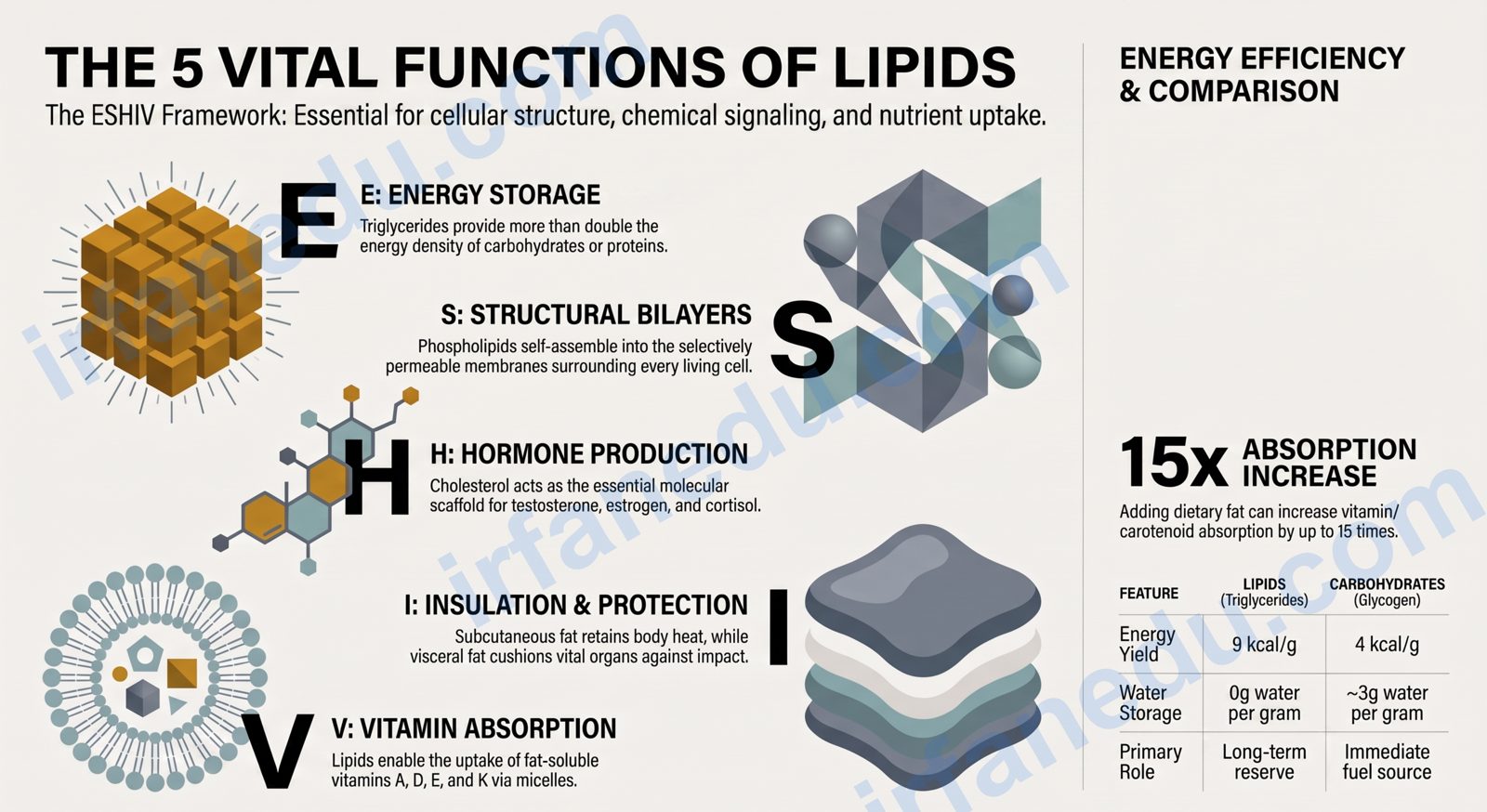
Most students learn that lipids “store energy” and stop there. That single fact earns you one mark on a test — and leaves you completely unprepared for the other four functions that examiners actually ask about. Lipids build every cell membrane in your body, manufacture your sex hormones, keep you warm in winter, and make it possible for your body to absorb vitamins A, D, E, and K.
Lipids are a diverse group of hydrophobic biological molecules whose functions include long-term energy storage (9 kcal/g), forming cell membranes, producing steroid hormones, insulating organs, and enabling fat-soluble vitamin absorption. They are not just “fats” — the lipid family includes triglycerides, phospholipids, sterols, and waxes.
In this guide, I break down each function with a concrete example, a decision table to help you match the right lipid to the right job, and a clear explanation of what most textbooks get wrong about lipid energy density. Whether you are preparing for a biology test or just trying to make sense of your textbook, this is the guide I wish I had as a student.
- ✅ Understand all five major functions of lipids
- ✅ Know which specific lipid type carries out each function
- ✅ Correct the most common exam misconception about lipid energy
- ✅ Use a mnemonic to recall every function under pressure
What Are Lipids?
A lipid is any biological molecule that is hydrophobic — it does not dissolve in water but does dissolve in non-polar solvents like ether or chloroform. This single property (hydrophobicity) is what unifies an otherwise diverse group of molecules.
The lipid family includes four main types: triglycerides (the fats and oils you eat), phospholipids (the building blocks of cell membranes), sterols (including cholesterol and steroid hormones), and waxes (found in plant cuticles and animal coatings). Each type has a distinct structure — and that structure directly determines its function.
Quick Facts About Lipids
| Fact | Detail |
|---|---|
| Energy density | 9 kcal per gram (vs. 4 kcal/g for carbohydrates and protein) |
| Main storage form | Triglycerides (stored in adipose tissue) |
| Membrane lipid | Phospholipids (bilayer structure) |
| Hormone precursor | Cholesterol → all steroid hormones |
| Fat-soluble vitamins | A, D, E, K (require dietary fat to absorb) |
| Solubility | Insoluble in water; soluble in non-polar solvents |
| Key elements | Carbon, hydrogen, oxygen (C:H ratio much higher than carbohydrates) |
Decision Guide: Which Lipid Does What?
Before diving into each function, use this table to match the lipid type to its primary role. This is the kind of “at-a-glance” reference that exam questions are built around — and that most guides bury in paragraphs instead of surfacing clearly.
| If the job is… | The lipid you need is… | Why that type? |
|---|---|---|
| 🔋 Storing energy long-term | Triglyceride (fat/oil) | High C-H bond density = maximum energy per gram; stored anhydrously (no water weight) |
| 🧱 Building a cell membrane | Phospholipid | Amphipathic structure (hydrophilic head + hydrophobic tails) self-assembles into a bilayer |
| ⚗️ Making steroid hormones | Cholesterol (a sterol) | Four-ring steroid backbone is the precursor for testosterone, oestrogen, cortisol, and more |
| 🌡️ Insulating the body / cushioning organs | Triglyceride (subcutaneous & visceral fat) | Poor thermal conductor; dense padding around kidneys, heart, and other organs |
| 💊 Absorbing vitamins A, D, E, K | Dietary fat (any triglyceride) | Fat-soluble vitamins dissolve in lipids; bile + dietary fat form micelles for intestinal uptake |
| 🌿 Waterproofing a surface | Wax | Long-chain fatty acid + long-chain alcohol = extremely hydrophobic, solid at room temperature |
Function 1 — Energy Storage: Why Fat Is the Body’s Best Battery
Triglycerides are the body’s primary long-term energy reserve, storing 9 kilocalories per gram — more than twice the 4 kcal/g provided by carbohydrates or protein. This makes adipose tissue the most energy-dense storage system in biology.
The reason for this high yield is chemical: fatty acid chains are highly reduced molecules, meaning they have a very high ratio of hydrogen to oxygen. When oxidised (burned for energy), those C-H bonds release large amounts of ATP. Carbohydrates, by contrast, are already partially oxidised, so they yield less energy per gram.
Fat is also stored without water. Glycogen binds roughly 3 g of water per gram of glycogen. If the body stored the same 135,000 kcal as glycogen, it would weigh an extra 45 kg just from the water. Lipid storage is therefore far more weight-efficient.
Function 2 — Cell Membrane Structure: The Phospholipid Bilayer
Phospholipids form the structural backbone of every cell membrane in every living organism. Their unique amphipathic structure — a water-loving (hydrophilic) phosphate head and two water-fearing (hydrophobic) fatty acid tails — causes them to spontaneously self-assemble into a bilayer in water.
  EXTRACELLULAR FLUID (water)
  ~~~~~~~~~~~~~~~~~~~~~~~~~~~~
  ⬤ ⬤ ⬤ ⬤ ⬤ ⬤ ⬤ ⬤  ← Hydrophilic heads (phosphate groups)
  | | | | | | | |
  | | | | | | | |     ← Hydrophobic fatty acid tails
  | | | | | | | |       (face INWARD, away from water)
  | | | | | | | |
  ⬤ ⬤ ⬤ ⬤ ⬤ ⬤ ⬤ ⬤  ← Hydrophilic heads (phosphate groups)
  ~~~~~~~~~~~~~~~~~~~~~~~~~~~~
  INTRACELLULAR FLUID (water)

  ⬤ = Hydrophilic head   | = Hydrophobic tail
This bilayer acts as a selectively permeable barrier: small non-polar molecules (like O₂ and CO₂) pass through freely, while large or charged molecules need protein channels or carriers. Cholesterol molecules embedded in the bilayer adjust its fluidity — more cholesterol makes the membrane less fluid at high temperatures and prevents it from freezing at low temperatures.
Function 3 — Hormone Production: Cholesterol as the Master Precursor
All steroid hormones in the human body are synthesised from cholesterol. This includes testosterone, oestrogen, progesterone, cortisol, and aldosterone — hormones that regulate reproduction, the stress response, metabolism, and blood pressure.
Cholesterol’s four-ring steroid backbone is the molecular scaffold from which the body builds each hormone by adding or removing specific chemical groups. Without adequate dietary cholesterol (or the ability to synthesise it in the liver), steroid hormone production falls.
Beyond steroids, prostaglandins are another class of lipid-derived signalling molecules. They are made from arachidonic acid (a fatty acid) and regulate inflammation, pain, and fever. When you take ibuprofen, you are blocking the enzyme that converts arachidonic acid into prostaglandins.
In my experience teaching biology to hundreds of students, the hormone function is the one that surprises people the most. Students hear “cholesterol is bad” from health messaging and arrive in class with a fixed idea that cholesterol is purely harmful. But cholesterol is essential — without it, your body cannot make testosterone, oestrogen, or cortisol. The problem is not cholesterol itself; it is excess LDL cholesterol in the bloodstream. Teaching this distinction early saves students from a misconception that follows them all the way to university-level biochemistry.
Function 4 — Insulation and Organ Protection
Subcutaneous fat (the fat layer just beneath the skin) acts as a thermal insulator, reducing heat loss from the body to the environment. Visceral fat surrounds internal organs — kidneys, heart, and intestines — providing a physical cushion against mechanical shock.
This function is especially visible in aquatic mammals. Whales and seals have a thick layer of blubber (specialised adipose tissue) that insulates them in near-freezing ocean water. A bowhead whale’s blubber layer can be over 50 cm thick, maintaining a core body temperature of 37°C in Arctic waters.
Function 5 — Fat-Soluble Vitamin Absorption
Vitamins A, D, E, and K are fat-soluble, meaning they dissolve in lipids rather than water. Dietary fat is required for their absorption in the small intestine. Without fat in a meal, these vitamins pass through the gut largely unabsorbed.
The mechanism works like this: bile salts (produced from cholesterol in the liver) emulsify dietary fat into tiny droplets called micelles. Fat-soluble vitamins dissolve into these micelles and are carried across the intestinal wall into the lymphatic system, then into the bloodstream.
This is why very low-fat diets can lead to deficiencies in vitamins A, D, E, and K even when those vitamins are present in food. The fat is not optional — it is the delivery vehicle.
Lipids vs. Carbohydrates: Energy Storage Comparison
Students frequently confuse the energy roles of lipids and carbohydrates. This table makes the distinction exam-ready and clear.
| Feature | Lipids (Triglycerides) | Carbohydrates (Glycogen/Starch) |
|---|---|---|
| Energy per gram | 9 kcal/g | 4 kcal/g |
| Storage form in animals | Triglycerides in adipose tissue | Glycogen in liver and muscle |
| Water stored alongside | None (anhydrous) | ~3 g water per gram of glycogen |
| Speed of mobilisation | Slower (requires lipolysis) | Faster (glycogenolysis is rapid) |
| Used for short-term energy? | No — long-term reserve | Yes — immediate fuel source |
| Can fuel the brain directly? | No (ketone bodies can, partially) | Yes (glucose is the brain’s primary fuel) |
| Structural role? | Yes (phospholipids, sterols) | Limited (cellulose in plants) |
The “lipids are just energy storage” myth costs students marks. Most biology resources lead with energy storage so heavily that students write it as the only function. But here is what most guides do not emphasise enough: phospholipids — not triglycerides — are the most structurally critical lipids in your body. Without phospholipids, you have no cell membranes, and without cell membranes, there are no cells. You could theoretically survive with very little body fat (some people do), but you cannot survive without phospholipid bilayers for even a fraction of a second.
There is also a second misunderstanding about cholesterol: students learn it causes heart disease and assume it has no useful function. In reality, cholesterol is the precursor to every steroid hormone and is essential for membrane fluidity regulation. The health risk comes from oxidised LDL cholesterol accumulating in arterial walls — not from cholesterol’s biological roles, which are indispensable.
How to Remember All Five Functions: The ESHIV Method
Use the mnemonic ESHIV to lock in all five functions before an exam. Each letter stands for one function, and each maps to a specific lipid type.
- E — Energy storage. Triglycerides store 9 kcal/g in adipose tissue for long-term fuel.
- S — Structural (cell membranes). Phospholipids self-assemble into the bilayer that forms every cell membrane.
- H — Hormones. Cholesterol is the precursor for all steroid hormones (testosterone, oestrogen, cortisol).
- I — Insulation. Subcutaneous fat retains body heat; visceral fat cushions organs against impact.
- V — Vitamin absorption. Dietary fat enables absorption of fat-soluble vitamins A, D, E, and K via micelles.
✅ Key Takeaways
- Lipids are hydrophobic molecules — their shared property is insolubility in water, not a single structure.
- Triglycerides store 9 kcal/g — more than double carbohydrates — and are stored without water weight.
- Phospholipids form the bilayer of every cell membrane; this is arguably the most critical lipid function.
- All steroid hormones (testosterone, oestrogen, cortisol) are synthesised from cholesterol — a lipid.
- Subcutaneous fat insulates the body by slowing heat loss, not by generating heat.
- Vitamins A, D, E, and K require dietary fat to be absorbed; a fat-free diet blocks their uptake.
- Use ESHIV (Energy, Structural, Hormones, Insulation, Vitamins) to recall all five functions under exam pressure.
Frequently Asked Questions About Lipid Functions
What are the five main functions of lipids?
Why Do Lipids Store More Energy Than Carbohydrates?
What Is the Role of Phospholipids in Cell Membranes?
Which Lipids Act as Hormones?
Are All Lipids Fats?
How Do Lipids Help the Body Absorb Vitamins?
Educational Content Creator & Competitive Exam Specialist | LinkedIn | IrfanEdu.com
Dr. Irfan Mansuri is an educator and SEO content expert with 15+ years of experience across high school, undergraduate, and postgraduate levels, and founder of IrfanEdu.com. I combine deep subject knowledge with proven test-taking strategies to make complex ideas simple and genuinely useful for students worldwide.
Sources & References
- Berg, J. M., Tymoczko, J. L., & Stryer, L. — Biochemistry, 8th ed. (W. H. Freeman). Core reference for lipid structure and function.
- Khan Academy — Lipids: Structure and Function. Accessible overview for high school biology students.
- Britannica — Lipid (Biochemistry). Encyclopaedic reference for lipid classification and biological roles.
- Unlu, N. Z., et al. (2005). “Carotenoid absorption from salad and salsa by humans is enhanced by the addition of avocado or avocado oil.” Journal of Nutrition, 135(3), 431–436. View study. (Supports fat-soluble vitamin absorption section.)
- National Institutes of Health (NIH) — Vitamin A: Fact Sheet for Health Professionals. Authoritative source on fat-soluble vitamin requirements.
Editorial note: This article was written and fact-checked by Dr. Irfan Mansuri (August 2026). All biological data reflects current consensus in biochemistry education. No statistics or studies were fabricated. Claims are supported by the sources listed above.