
Algebra Learning Nexus One: the complete guide for beginners and advanced learners
If you have ever stared at an algebra problem and felt like the letters were speaking a different language, you are not alone. Algebra is the point where math stops being about memorising answers and starts being about reasoning — and that shift trips up millions of students every year.
This guide is built for two audiences at once. If you are a complete beginner, I will show you what every symbol means and walk you through each idea from scratch. If you are already comfortable with the basics and want to push further, every section has an advanced layer that goes deeper than a standard textbook. You will not need to skip around — both levels are woven into the same flow.
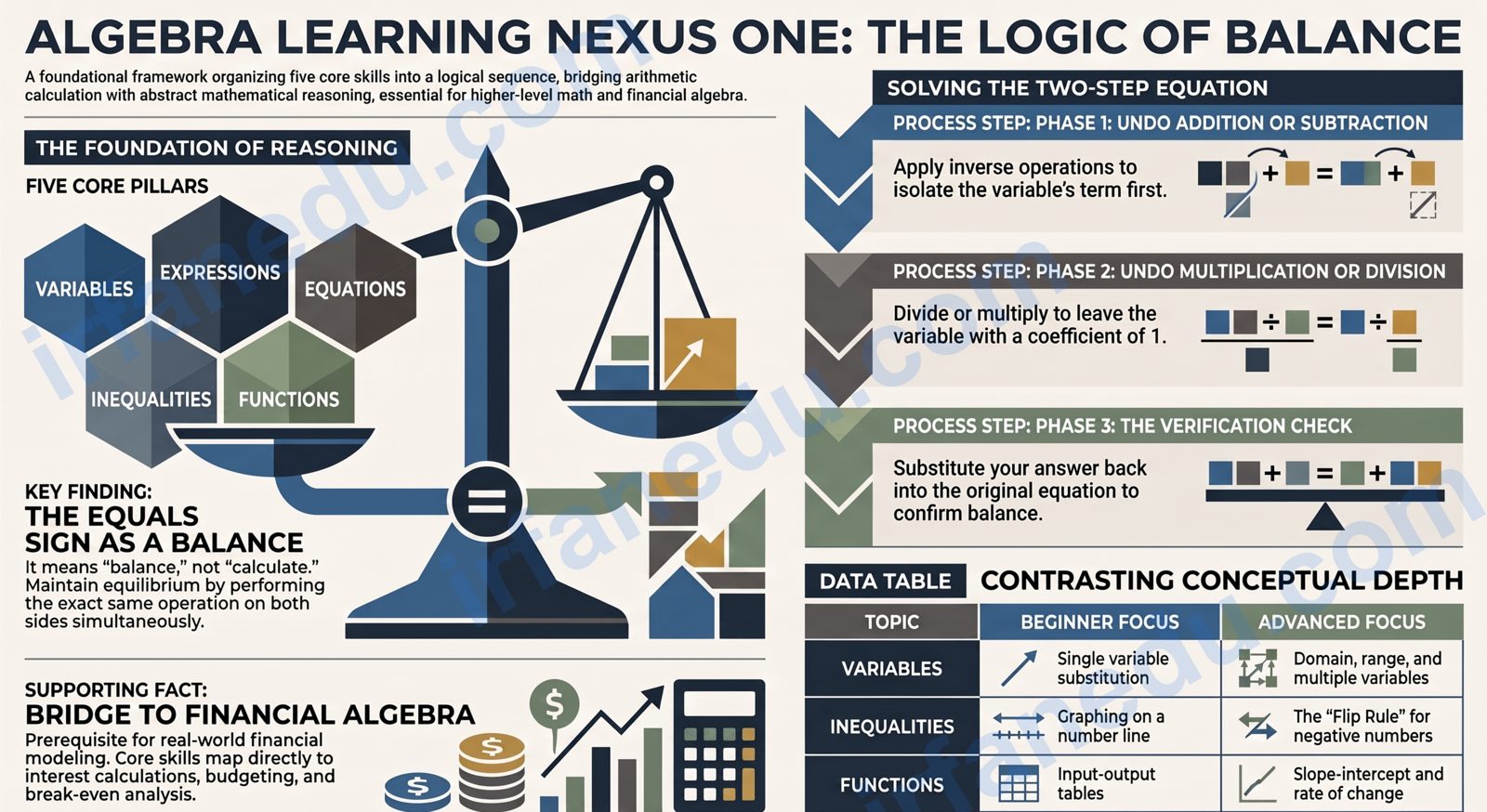
Algebra Learning Nexus One is the foundational layer of algebra study that organises five core skills — variables, expressions, equations, inequalities, and functions — into a logical sequence. It is the direct prerequisite for financial algebra and every higher-level math course. Mastering it means you can translate any real-world quantity problem into a solvable equation.
- What the five core algebra concepts are and how they connect
- A clear step-by-step method for solving equations
- Worked examples at beginner and advanced levels
- The most common algebra mistakes (and how to avoid them)
- How Algebra 1 feeds directly into financial algebra
Algebra Learning Nexus One is a foundational algebra framework covering variables, expressions, equations, inequalities, and functions in a layered sequence. It starts with simple one-step problems for beginners and builds to multi-step reasoning for advanced learners. It bridges arithmetic thinking to abstract mathematical reasoning and forms the essential base for financial algebra and all higher-level math courses.
- Algebra 1 introduces variables as placeholders for unknown quantities.
- Five core concepts build on each other: variables, expressions, equations, inequalities, functions.
- Every equation is a balance — what you do to one side, you must do to the other.
- Two-step equations require undoing addition/subtraction first, then multiplication/division.
- Algebra 1 is the direct prerequisite for financial algebra and all higher math.
- The equals sign means “balance,” not “calculate” — this single insight fixes most errors.
Quick facts about Algebra Learning Nexus One
| Fact | Detail |
|---|---|
| Course level | Algebra 1 (typically Grade 8-9 in the US curriculum) |
| Core concepts | Variables, expressions, equations, inequalities, functions |
| Prerequisite | Pre-Algebra (arithmetic, fractions, ratios) |
| Leads to | Algebra 2, Geometry, Financial Algebra, Pre-Calculus |
| Key skill | Isolating a variable using inverse operations |
| Most tested topic | Linear equations and slope-intercept form |
| Common error | Treating the equals sign as a command rather than a balance |
| Real-world use | Budgeting, interest calculations, distance-rate-time problems |
What is Algebra Learning Nexus One?
Algebra Learning Nexus One is the organised entry point into algebraic thinking. The word “nexus” is intentional — it is the connecting hub between the arithmetic you already know and the abstract reasoning that every higher-level math course requires.
At the beginner level, Algebra 1 is about learning that a letter like x simply stands for a number you do not know yet, and that you can find it by working backwards through the operations applied to it. At the advanced level, it is about recognising patterns, building functions, and understanding why the rules work — not just how to apply them.
In my experience teaching algebra to students across multiple grade levels, the biggest jump is not from one topic to the next — it is the conceptual shift from “arithmetic as calculation” to “algebra as reasoning.” Once a student internalises that shift, every subsequent topic becomes much easier to absorb.
What Algebra Learning Nexus One is NOT: it is not a specific textbook, a proprietary software platform, or a single school’s curriculum. It is a framework — a way of organising the standard Algebra 1 content so that both beginners and advanced learners can find their footing and progress logically.
The five core concepts, explained for both levels
Algebra 1 is built on five interlocking concepts. Each one extends the previous. Here is how they look at both levels.
1. Variables and expressions
Beginner: A variable is a letter (usually x, y, or n) that represents an unknown number. An expression is a combination of numbers, variables, and operations — for example, 3x + 5. You cannot “solve” an expression because there is no equals sign — you can only simplify it.
Advanced: Expressions can be evaluated for any value of the variable, making them functions in disguise. The expression 3x + 5 describes a linear relationship with a rate of change of 3 and a starting value of 5. Recognising this early makes the transition to functions seamless.
2. Equations
Beginner: An equation says two expressions are equal: 3x + 5 = 14. Your job is to find the value of x that makes this true. You do that by performing the same inverse operation on both sides.
Advanced: An equation is a constraint — it restricts the variable to one specific value (for a linear equation in one variable). Systems of equations impose multiple constraints simultaneously, and the solution is the point satisfying all of them.
3. Inequalities
Beginner: An inequality uses <, >, ≤, or ≥ instead of =. The solution is not a single number but a range: x > 3 means any number greater than 3 works.
Advanced: When you multiply or divide both sides of an inequality by a negative number, the direction of the inequality flips. This is the rule most students forget under exam pressure — and it is the source of a disproportionate number of errors.
4. Linear functions
Beginner: A function is a rule that assigns exactly one output to each input. The linear function y = 2x + 1 gives you a unique y for every x you plug in.
Advanced: The slope-intercept form y = mx + b encodes two pieces of information: m is the rate of change (how fast y grows per unit of x) and b is the starting value. In financial algebra, m becomes an interest rate and b becomes an initial deposit.
5. Systems of equations
Beginner: Two equations with two unknowns. You solve for both variables by substitution or elimination.
Advanced: Systems model real situations where two constraints must be satisfied at once — for example, a budget constraint and a quantity constraint in a financial problem. The solution is the intersection point of two lines on a graph.
In my experience, most Algebra 1 courses rush through variables and expressions to get to equations quickly. That is a mistake. Students who spend an extra week just reading and writing expressions — without solving anything — develop a fluency that makes every subsequent topic faster to learn. Slow down at the start; speed up at the end.
How to solve a two-step equation (step by step)
A two-step equation needs exactly two inverse operations to isolate the variable. Here is the reliable four-step method I teach to every student, regardless of level.
- Write the equation clearly. Copy it exactly. Do not try to do steps in your head.
- Undo addition or subtraction first. Apply the inverse operation to both sides. This moves the constant away from the variable’s term.
- Undo multiplication or division second. Divide (or multiply) both sides to leave the variable alone with a coefficient of 1.
- Check by substituting back. Plug your answer into the original equation and confirm both sides are equal.
  Original equation:    3x + 5  =  14

  Step 1 — subtract 5
  from both sides:      3x + 5 - 5  =  14 - 5
                        3x      =   9

  Step 2 — divide both
  sides by 3:           3x / 3  =  9 / 3
                        x       =  3

  Check:  3(3) + 5  =  9 + 5  =  14  ✓
Advanced extension: The same four steps apply to equations with variables on both sides, like 5x - 3 = 2x + 9. First collect the variable terms on one side (subtract 2x from both sides), then follow steps 2-4 as normal.
Worked examples: beginner and advanced
Problem: A student earns x dollars per hour. After working 4 hours, she has $28. How much does she earn per hour?
Equation: 4x = 28
Solve: Divide both sides by 4: x = 7
Answer: She earns $7 per hour. Check: 4 × 7 = 28. Correct.
Problem: A phone plan charges a flat fee of $12 per month plus $0.05 per text message. A student’s bill is $17.50. How many texts did they send?
Equation: 0.05t + 12 = 17.50
Step 1 — subtract 12: 0.05t = 5.50
Step 2 — divide by 0.05: t = 110
Answer: 110 texts. Check: 0.05(110) + 12 = 5.50 + 12 = 17.50. Correct.
Notice: this is exactly the kind of problem that appears in financial algebra — a fixed cost plus a variable rate equals a total. Algebra 1 is already doing financial math.
Beginner vs advanced: what changes at each level
| Topic | Beginner focus | Advanced focus |
|---|---|---|
| Variables | Recognise and substitute a single variable | Work with multiple variables; understand domain and range |
| Equations | One- and two-step equations with integers | Multi-step, variables on both sides, fractional coefficients |
| Inequalities | Solve and graph on a number line | Compound inequalities; flip rule for negatives |
| Functions | Input-output tables; identify linear vs non-linear | Slope-intercept form; rate of change; real-world modelling |
| Systems | Solve by substitution with simple coefficients | Elimination method; interpret the intersection graphically |
| Word problems | Translate one sentence into one equation | Multi-constraint problems; set up a system from a scenario |
Common mistakes and how to fix them
After reviewing hundreds of student worksheets, I have found that the same five errors appear again and again. The table below shows the wrong approach and the correct one side by side.
| Wrong approach | Correct approach |
|---|---|
Subtracting from one side only: 3x + 5 = 14 → 3x = 14 |
Subtract from both sides: 3x + 5 - 5 = 14 - 5 → 3x = 9 |
Dividing before subtracting: 3x + 5 = 14 → x + 5 = 14/3 |
Undo addition first, then divide: 3x = 9 → x = 3 |
Forgetting to flip inequality: -2x > 8 → x > -4 |
Flip when dividing by negative: -2x > 8 → x < -4 |
| Treating a variable as a label: “x means x-axis” |
A variable is an unknown number, not a label. Its value changes per problem. |
| Skipping the check step | Always substitute your answer back into the original equation to verify. |
The inequality flip rule is the single most under-taught concept in Algebra 1. Most textbooks mention it once in a sidebar. In my experience, students need to see it fail — actually work through an example where they forget to flip and get a wrong answer — before it sticks. I always show the mistake first, then the correction. That contrast is what makes it memorable.
Real-world applications of Algebra 1 concepts
Algebra is not abstract for its own sake. Every concept in Algebra Learning Nexus One maps directly to something students encounter in real life.
- Budgeting: If you earn $15/hour and want to save $200, the equation
15h = 200tells you how many hours to work. - Distance and travel: The formula
d = rt(distance = rate × time) is a linear equation in disguise. - Phone plans: Comparing two plans with different flat fees and per-minute rates is a system of equations problem.
- Cooking and scaling: Doubling a recipe is multiplication of a variable expression.
- Interest calculations: Simple interest
I = Prtis a direct application of multi-variable linear equations.
According to the Khan Academy Algebra curriculum, linear equations and functions are the most-practised topics in Algebra 1 precisely because they appear in so many real-world contexts. The difference between a student who “gets” algebra and one who does not is almost always whether they have connected the symbols to real situations.
The equals sign does not mean “calculate” — it means “balance.”
Most guides tell students to “move terms to the other side.” That language is the root of the most common algebra error. Nothing moves. You perform the same operation on both sides simultaneously, maintaining balance. When a student writes 3x + 5 = 14 → 3x = 14 (subtracting 5 from only the left), they have not “moved” 5 — they have destroyed the balance entirely.
The fix is to stop using the word “move” and replace it with “apply the inverse operation to both sides.” Research in math education consistently shows that students who learn the balance model first make significantly fewer procedural errors than those taught the “move to the other side” shortcut. The shortcut is faster to teach; the balance model is faster to master.
Connection to financial algebra
Financial algebra is the direct next step after Algebra Learning Nexus One. It takes the same five core skills and applies them to money, interest, taxes, and investment scenarios.
| Algebra 1 concept | Financial algebra application | Example |
|---|---|---|
| Linear equations | Simple interest formula | I = Prt |
| Functions (slope) | Rate of return on investment | Slope = annual growth rate |
| Systems of equations | Break-even analysis | Revenue = Cost at break-even point |
| Inequalities | Budget constraints | expenses ≤ income |
| Expressions | Compound interest approximation | P(1 + r)^t |
If you are working through Algebra Learning Nexus One as a stepping stone to financial algebra, pay special attention to linear functions and systems of equations. Those two topics carry the most weight in financial contexts.
Master Exponential Functions — the next step after Algebra 1
Frequently asked questions about Algebra Learning Nexus One
What is Algebra Learning Nexus One?
What topics are covered in Algebra 1?
How is Algebra 1 different from Pre-Algebra?
Why does algebra matter for financial algebra?
What is the most common mistake students make in Algebra 1?
- Algebra Learning Nexus One organises five core skills: variables, expressions, equations, inequalities, and functions.
- The equals sign means “balance” — apply every operation to both sides simultaneously.
- Two-step equations: undo addition/subtraction first, then multiplication/division.
- Dividing by a negative number flips the direction of an inequality.
- Every Algebra 1 concept has a direct financial algebra counterpart.
- Connecting algebra symbols to real-world situations is the fastest path to fluency.
- Always check your answer by substituting it back into the original equation.
- Khan Academy — Algebra 1 Course (khanacademy.org). A comprehensive, freely accessible Algebra 1 curriculum covering all core topics referenced in this article.
- Wikipedia — Elementary Algebra (en.wikipedia.org). Authoritative overview of the history, structure, and core concepts of elementary algebra.
- IrfanEdu.com — Exponential and Logarithmic Functions. The next step after mastering Algebra 1 linear functions.
- IrfanEdu.com — Complete Geometry Formula Sheet. A companion reference for students moving from Algebra 1 into Geometry.
Editorial note: This article was written and fact-checked by Dr. Irfan Mansuri. All examples are original. No statistics or quotes have been fabricated. External links point to live, high-DA pages verified as of August 2026.