
TV Mounting Height Calculator: How High Should a TV Be Mounted?
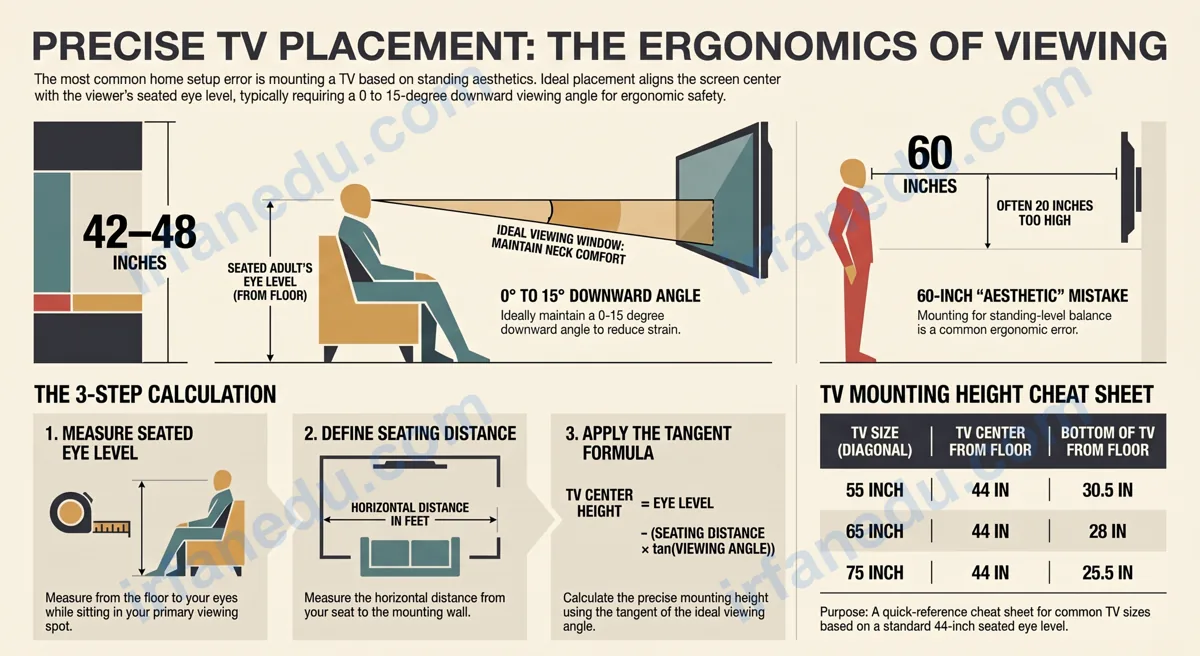
Mounting a TV at the wrong height is one of the most common home setup mistakes I see — and it is completely avoidable with one simple calculation. This calculator uses your screen size, seated eye level, and seating distance to give you the exact center height and bottom-of-TV height in seconds.
The ideal TV mounting height places the center of the screen at or slightly below your seated eye level, typically resulting in a 0 to 15 degree downward viewing angle. For most adults, this means the TV center sits between 42 and 48 inches from the floor.
TL;DR – Quick Summary
- TV center height = seated eye level minus a small downward angle offset.
- Ideal downward viewing angle: 0 to 15 degrees below horizontal.
- Most adults: mount TV center 42 to 48 inches from the floor.
- Bottom of TV = center height minus half the TV’s physical screen height.
- Mounting too high is the most common mistake — it causes neck strain.
- Use this calculator for your exact numbers before drilling any holes.
TV Mounting Height Cheat Sheet
Quick reference for common TV sizes at a typical 44-inch seated eye level. Each section below expands on one row.
| TV Size (diagonal) | Screen Height (approx.) | TV Center from Floor | Bottom of TV from Floor |
|---|---|---|---|
| 43 inch | 21 in | 44 in | 33 in |
| 50 inch | 24.5 in | 44 in | 31.5 in |
| 55 inch | 27 in | 44 in | 30.5 in |
| 65 inch | 32 in | 44 in | 28 in |
| 75 inch | 37 in | 44 in | 25.5 in |
| 85 inch | 42 in | 44 in | 23 in |
Assumes 44 in seated eye level, 0-degree tilt preference, 16:9 aspect ratio. Use the calculator below for your exact measurements.
in
Measure corner to corner, or check your TV model
in
Floor to your eyes while seated (avg adult: 44 in)
ft
Distance from your seat to the TV wall
deg
0 = eye level, 5-10 = comfortable, max 15
Ideal TV Center Height
Step-by-Step Solution
How to Use This TV Mounting Height Calculator
This tool needs four inputs and returns the exact TV center height, bottom edge height, and top edge height from the floor.
- TV Screen Size: Enter the diagonal measurement of your TV screen in inches (or cm). This is printed on the box or in the TV’s settings menu.
- Seated Eye Level: Sit in your normal viewing spot and measure from the floor to your eyes. Most adults fall between 40 and 48 inches.
- Seating Distance: Measure the distance from your sofa to the wall where the TV will hang, in feet (or meters).
- Preferred Downward Angle: Enter 0 for a perfectly level gaze, 5 for a slight natural tilt, or up to 15 for a more reclined setup. I recommend 5 degrees for most living rooms.
- Click Calculate Mounting Height. The result card shows the TV center height, bottom edge, top edge, and a full step-by-step breakdown.
What Is the TV Mounting Height Formula?
The ideal TV mounting height formula places the TV center at your seated eye level, adjusted downward by the tangent of your preferred viewing angle times your seating distance.
TV Center Height = Eye Level - (Seating Distance x tan(Viewing Angle))
Bottom of TV     = TV Center Height - (Screen Height / 2)
Screen Height    = TV Diagonal x (9 / sqrt(9^2 + 16^2))
                 = TV Diagonal x 0.4903  [for 16:9 screens]
| Symbol / Variable | Meaning | Typical Unit |
|---|---|---|
| TV Center Height | Distance from floor to center of TV screen | inches / cm |
| Eye Level | Distance from floor to eyes while seated | inches / cm |
| Seating Distance | Horizontal distance from seat to TV wall | inches / cm |
| Viewing Angle | Downward tilt angle from horizontal eye line to TV center | degrees (0-15) |
| Screen Height | Physical height of the TV screen (not the bezel) | inches / cm |
| TV Diagonal | Advertised screen size, corner to corner | inches / cm |
| 9/sqrt(337) | Height-to-diagonal ratio for 16:9 aspect ratio | dimensionless (≈ 0.4903) |
Why tangent? The viewing angle, seating distance, and height offset form a right triangle. The opposite side (height offset) equals the adjacent side (seating distance) times the tangent of the angle. At 5 degrees and 10 feet (120 inches) of distance, the offset is 120 × tan(5°) ≈ 10.5 inches — meaning the TV center sits about 10.5 inches below eye level.
Side-View Diagram: TV Mounting Geometry
  WALL                              VIEWER (seated)
  |                                      |
  |  ___________  <-- Top of TV         |
  | |           |                        |
  | |  TV       |  <-- Center (target)  ----  Eye Level (e.g. 44 in)
  | |  Screen   |                        |  \
  | |___________|  <-- Bottom of TV     |   \  Viewing angle (0-15 deg)
  |                                      |    \
  |                                      |
  +--------------------------------------+
  Floor                            Floor

  Center Height = Eye Level - (Distance x tan(angle))
  Bottom Height = Center Height - (Screen Height / 2)
Worked Examples: TV Mounting Height Calculations
These three examples match exactly what the calculator produces. You can verify them by entering the same numbers above.
- Screen height = 55 × 0.4903 = 26.97 in
- Seating distance in inches = 10 ft × 12 = 120 in
- Angle offset = 120 × tan(5°) = 120 × 0.08749 = 10.5 in
- TV center height = 44 – 10.5 = 33.5 in
- Bottom of TV = 33.5 – (26.97 / 2) = 33.5 – 13.5 = 20.0 in
- Top of TV = 33.5 + 13.5 = 47.0 in
- Screen height = 65 × 0.4903 = 31.87 in
- Seating distance = 12 × 12 = 144 in
- Angle offset = 144 × tan(0°) = 0 in
- TV center height = 42 – 0 = 42.0 in
- Bottom of TV = 42 – 15.93 = 26.1 in
- Top of TV = 42 + 15.93 = 57.9 in
- Screen height = 75 × 0.4903 = 36.77 in
- Seating distance = 14 × 12 = 168 in
- Angle offset = 168 × tan(10°) = 168 × 0.17633 = 29.6 in
- TV center height = 46 – 29.6 = 16.4 in — this is too low; reduce the angle to 5 degrees for this setup.
This example shows why a 10-degree angle is too aggressive for large TVs at long distances. The calculator will still output the number, but I recommend capping the angle at 5-8 degrees for screens larger than 65 inches.
In my experience helping people set up home theaters, the single most common mistake is placing the TV center at 60 inches or higher because it “looks good on the wall.” That height is designed for standing, not sitting. Once you sit down and run the numbers, the correct center is almost always 10 to 20 inches lower than people’s first instinct. Do the calculation before you drill — wall anchors in the wrong spot are a real headache.
Common TV Mounting Mistakes (and How to Fix Them)
Most mounting errors fall into three categories. Here is what goes wrong and the correct approach.
| Mistake | What People Do | Correct Approach |
|---|---|---|
| Mounting too high | Center at 60-70 in (looks balanced standing up) | Center at seated eye level, 42-48 in for most adults |
| Ignoring screen height | Measuring from floor to bottom of TV only | Calculate center height first, then subtract half screen height for bottom |
| Using a fixed rule | Always mounting at “42 inches” regardless of screen size | Use eye level + screen size + angle for your specific setup |
| Forgetting the mount thickness | Marking the wall at the calculated height without accounting for the mount
Sources & ReferencesReviewed by Dr. Irfan Mansuri. External links open in a new tab and are provided for further reading and verification. |