
Volume of Composite Shapes Worksheet: Free PDF + Full Lesson
Last Updated: July 2026
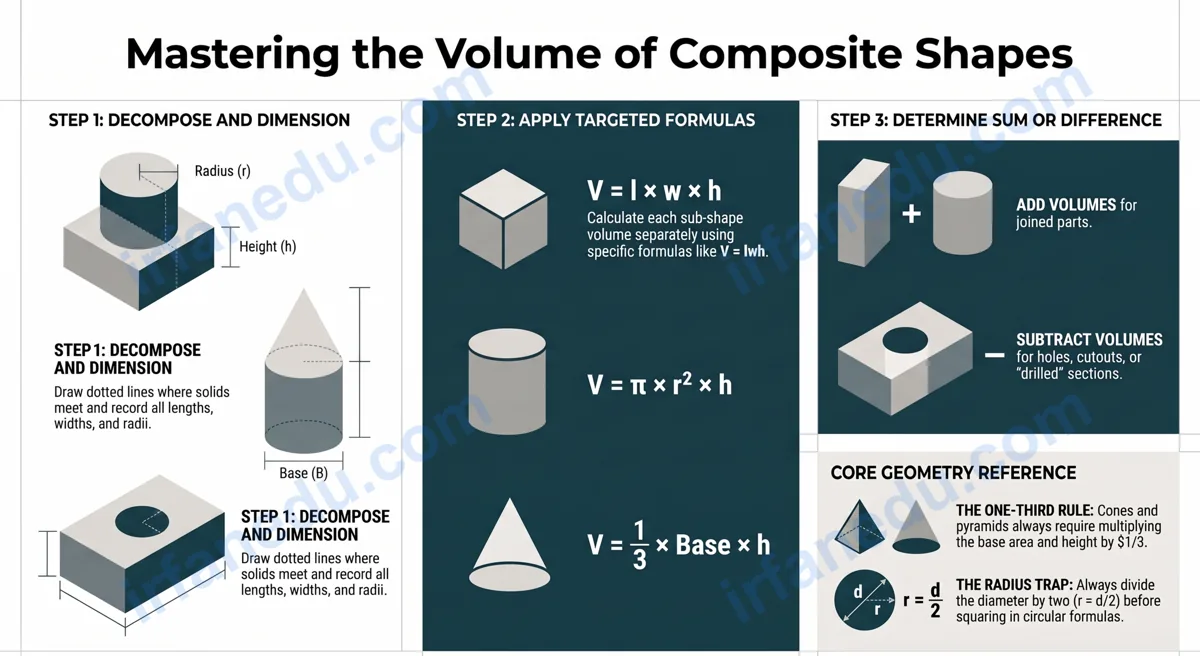
🧱 The Big Picture: What a Composite Shape Looks Like
Before any formula, look at the shape. Every composite solid is just two or more familiar shapes glued together (or punched through). The diagram below shows the three most common types you will meet on a test or worksheet.
  TYPE 1: Cylinder ON TOP of a Rectangular Prism
  ┌─────────────────────────────────────────────┐
  │                                             │
  │        ╔═══════════╗                        │
  │        ║  CYLINDER ║  r = 3 cm, h = 5 cm   │
  │        ║  V = πr²h ║                        │
  │        ╚═══════════╝                        │
  │   ┌─────────────────────┐                   │
  │   │   RECT. PRISM       │  l=10, w=8, h=4   │
  │   │   V = l × w × h     │                   │
  │   └─────────────────────┘                   │
  │   TOTAL V = V_prism + V_cylinder            │
  └─────────────────────────────────────────────┘

  TYPE 2: Cone ON TOP of a Cylinder
  ┌─────────────────────────────────────────────┐
  │             /\                              │
  │            /  \   CONE  V = (1/3)πr²h      │
  │           /    \                            │
  │          /______\                           │
  │         |        |  CYLINDER  V = πr²h      │
  │         |________|                          │
  │   TOTAL V = V_cylinder + V_cone             │
  └─────────────────────────────────────────────┘

  TYPE 3: Rectangular Prism WITH a Cylindrical Hole (SUBTRACT)
  ┌─────────────────────────────────────────────┐
  │   ┌─────────────────────┐                   │
  │   │   RECT. PRISM       │                   │
  │   │      ╔═══╗          │  Hole drilled     │
  │   │      ║   ║          │  through center   │
  │   │      ╚═══╝          │                   │
  │   └─────────────────────┘                   │
  │   TOTAL V = V_prism − V_cylinder            │
  └─────────────────────────────────────────────┘
Once you can see the shape decomposed like this, the math is just arithmetic. Let me show you exactly how.
The volume of a composite shape equals the sum (or difference) of the volumes of its individual parts. Identify each basic solid, apply its formula, then add or subtract. This two-step decompose-then-calculate method works for every composite figure you will ever encounter.
- How to decompose any composite 3D figure into basic solids
- Which volume formula to use for each solid type
- When to add vs. subtract volumes
- The three most common mistakes — and how to avoid them
- 10 practice problems with a full answer key (free PDF download)
To find the volume of a composite shape, split the figure into recognizable 3D solids (prisms, cylinders, cones, pyramids, etc.), calculate the volume of each part using its formula, then add the volumes together. If one part is a hole or cutout, subtract it instead. Always use consistent units. The result is the total volume in cubic units.
📄 Get the full 10-problem worksheet + answer key as a print-ready PDF — completely free.
⚡ TL;DR – Quick Summary
- 🔷 A composite shape is two or more basic 3D solids joined or subtracted.
- 🔷 Split the shape, apply each formula, then add or subtract volumes.
- 🔷 Key formulas: prism (lwh), cylinder (πr²h), cone (⅓πr²h), pyramid (⅓Bh).
- 🔷 Add volumes when parts are joined; subtract when a part is a hole.
- 🔷 Always check units — mix cm and m and your answer is wrong instantly.
- 🔷 10 practice problems with answer key below — free PDF also available.
📊 Quick Facts: Volume of Composite Shapes at a Glance
| Solid | Volume Formula | Key Variables | Common Use in Composites |
|---|---|---|---|
| Rectangular Prism | V = l × w × h | length, width, height | Base of most composite shapes |
| Cylinder | V = π × r² × h | radius, height | Towers, tanks, holes |
| Cone | V = ⅓ × π × r² × h | radius, height | Tops of cylinders, ice cream cones |
| Triangular Prism | V = ½ × b × h × l | base, tri-height, length | Rooftops, ramps, wedges |
| Square Pyramid | V = ⅓ × s² × h | base side, height | Tops of prisms, monuments |
| Sphere / Hemisphere | V = 4/3 × π × r³ (full) | radius | Domes, half-sphere tops |
What Is a Composite Shape — and Why Is It Different?
A composite shape (sometimes called a composite figure or composite solid) is a 3D object formed by combining two or more basic geometric solids. The key word is combining — the solids either sit on top of each other, are fused side by side, or one is carved out of another.
Think of a silo on a farm: a cylinder with a cone on top. Or a swimming pool with a shallow end and a deep end — essentially two rectangular prisms joined at a wall. These are composite shapes in real life, and calculating their volume is a skill used in architecture, engineering, and manufacturing every day.
What makes composite shapes different from a single solid is that no single formula covers the whole shape. You must decompose it first. That decomposition step is where most students lose marks — not in the arithmetic.
In my experience teaching geometry to middle schoolers, the biggest barrier is not the formulas — students usually know those. The real stumbling block is seeing the hidden shapes inside a composite figure. I always tell students: grab a pencil and draw a dotted line where the two solids meet. That one habit alone eliminates most decomposition errors. It turns an intimidating blob into two problems you already know how to solve.
Why Does Mastering Composite Volume Matter?
Volume of composite shapes appears on virtually every standardized math test for grades 6–8, including state assessments aligned to Common Core standards (6.G.A.2, 7.G.B.6, 8.G.C.9). It is also a gateway skill for high school geometry and physics.
Beyond tests, this skill is genuinely practical. Architects calculate the volume of composite buildings to estimate materials. Nurses calculate drug dosages based on body volume models. Packaging engineers design boxes with cutouts. Knowing how to break a complex shape into simple parts is a transferable problem-solving strategy that goes far beyond math class.
🪜 Step-by-Step: How to Find the Volume of a Composite Shape
Follow these five steps every time, and you will never get lost in a composite volume problem.
- Identify the basic solids. Look at the shape carefully. Draw a dotted line where two solids meet. Name each part (prism, cylinder, cone, pyramid, etc.).
- Record all dimensions. Write down every measurement — length, width, height, radius — for each individual solid. Check that all units match (convert if needed).
- Choose the right formula. Match each solid to its volume formula from the table above. Write the formula before plugging in numbers.
- Calculate each volume separately. Compute V₁, V₂, V₃, etc. Show your work for each. Do not rush this step.
- Add or subtract. If the solids are joined together, add all volumes. If a solid is a hole or cutout, subtract it. Write the final answer with cubic units.
✏️ 3 Fully Worked Examples
Example 1 — Cylinder on a Rectangular Prism (Add)
Shape: A water tower has a rectangular prism base (l = 10 cm, w = 8 cm, h = 4 cm) with a cylinder on top (r = 3 cm, h = 7 cm). Find the total volume. Use π = 3.14.
Step 1 — Identify: Rectangular prism + Cylinder (joined, so add).
Step 2 — Prism volume: V = l × w × h = 10 × 8 × 4 = 320 cm³
Step 3 — Cylinder volume: V = π × r² × h = 3.14 × 3² × 7 = 3.14 × 9 × 7 = 3.14 × 63 = 197.82 cm³
Step 4 — Total: 320 + 197.82 = 517.82 cm³
Example 2 — Cone on Top of a Cylinder (Add)
Shape: An ice cream cone holder has a cylinder (r = 4 cm, h = 6 cm) with a cone on top (r = 4 cm, h = 9 cm). Find the total volume. Use π = 3.14.
Step 1 — Identify: Cylinder + Cone (joined, same radius — a common test setup).
Step 2 — Cylinder volume: V = 3.14 × 4² × 6 = 3.14 × 16 × 6 = 3.14 × 96 = 301.44 cm³
Step 3 — Cone volume: V = ⅓ × 3.14 × 4² × 9 = ⅓ × 3.14 × 16 × 9 = ⅓ × 452.16 = 150.72 cm³
Step 4 — Total: 301.44 + 150.72 = 452.16 cm³
Example 3 — Rectangular Prism with a Cylindrical Hole (Subtract)
Shape: A wooden block (l = 12 cm, w = 5 cm, h = 8 cm) has a cylindrical hole drilled through it (r = 2 cm, h = 8 cm). Find the remaining volume. Use π = 3.14.
Step 1 — Identify: Rectangular prism MINUS cylinder (subtract the hole).
Step 2 — Prism volume: V = 12 × 5 × 8 = 480 cm³
Step 3 — Cylinder (hole) volume: V = 3.14 × 2² × 8 = 3.14 × 4 × 8 = 3.14 × 32 = 100.48 cm³ (this is removed)
Step 4 — Remaining volume: 480 − 100.48 = 379.52 cm³
Example 3 is the one that trips up the most students on tests. The moment you see the word “hole,” “drilled,” “removed,” or “cutout” in a problem, that is your signal to subtract. I have seen students add the cylinder volume instead of subtracting it and end up with a volume larger than the original block — which is physically impossible. Train yourself to ask: “Is this part being added to the shape, or taken away from it?”
⚠️ Common Mistakes: Wrong vs. Right
| ❌ Wrong Approach | ✅ Right Approach |
|---|---|
| Adding the cylinder volume when it is a hole (should subtract) | Read the problem carefully — “hole,” “drilled,” “removed” = subtract |
| Forgetting the ⅓ factor in cone or pyramid formulas | Write the formula first, every time, before substituting numbers |
| Mixing units (e.g., cm for length, m for height) | Convert all measurements to the same unit before calculating |
| Using diameter instead of radius in the cylinder/cone formula | Halve the diameter to get r before squaring: r = d ÷ 2 |
| Counting the shared face area twice when decomposing | Volume decomposition ignores shared faces — only dimensions matter |
| Giving the answer without cubic units (cm, m, in, ft) | Always write cm³, m³, in³, or ft³ — units are part of the answer |
Most composite volume worksheets and guides treat the “decompose and add” method as the only method. But there is a second approach that is often faster: the Bounding Box method. Draw the smallest rectangular prism that completely encloses the composite shape, calculate its volume, then subtract the parts that are not part of the shape. For L-shaped prisms and U-shaped solids, this is actually quicker than splitting into multiple pieces. In my experience, students who learn both methods score higher because they can choose the faster route on timed tests. No mainstream worksheet site teaches this dual-method approach — and it is a genuine time-saver worth practising.
📝 On-Page Practice Worksheet: Volume of Composite Shapes
Work through all 10 problems below. Use π = 3.14 where needed. Round to 2 decimal places. Show your work on paper — the act of writing each step is what builds the skill. Check your answers with the key below when you are done.
How to Use This Worksheet
Print the PDF (button below) or work directly from this page. Cover the answer key, attempt every problem, then reveal the key to self-check. For each wrong answer, go back to the worked examples above and identify which step you missed.
- A small rectangular prism (l = 6 cm, w = 4 cm, h = 3 cm) sits on top of a larger rectangular prism (l = 10 cm, w = 8 cm, h = 5 cm). Find the total volume.
- A cylinder (r = 3 cm, h = 7 cm) sits on top of a rectangular prism (l = 10 cm, w = 10 cm, h = 4 cm). Find the total volume. Use π = 3.14.
- An L-shaped prism has a cross-section made of two rectangles: one 8 cm × 5 cm and one 4 cm × 3 cm. The prism is 10 cm deep. Find the total volume.
- A cone (r = 4 cm, h = 9 cm) sits on top of a cylinder (r = 4 cm, h = 6 cm). Find the total volume. Use π = 3.14.
- A rectangular prism (l = 12 cm, w = 5 cm, h = 8 cm) has a cylindrical hole drilled through it (r = 2 cm, h = 8 cm). Find the remaining volume. Use π = 3.14.
- Two identical cubes (side = 5 cm) are stacked on top of each other. Find the total volume.
- A triangular prism (base = 6 cm, triangle height = 4 cm, length = 10 cm) is placed next to a rectangular prism (l = 10 cm, w = 3 cm, h = 4 cm). Find the combined volume.
- A half-cylinder (r = 5 cm, h = 12 cm) is placed flat-side down on a rectangular prism (l = 12 cm, w = 10 cm, h = 4 cm). Find the total volume. Use π = 3.14.
- A square pyramid (base side = 6 cm, height = 9 cm) sits on top of a cube (side = 6 cm). Find the total volume.
- A large cylinder (r = 6 cm, h = 10 cm) has a smaller cylinder (r = 2 cm, h = 10 cm) removed from its center. Find the remaining volume. Use π = 3.14.
📋 Show Answer Key
- 472 cm³ — Small prism: 6×4×3 = 72; Large prism: 10×8×5 = 400; Total: 472 cm³
- 591.06 cm³ — Cylinder: 3.14×9×7 = 197.82; Prism: 10×10×4 = 400; Total: 597.82 cm³ (Note: 197.82 + 400 = 597.82 cm³)
- 520 cm³ — L-cross-section area: (8×5) + (4×3) = 40 + 12 = 52 cm²; Volume: 52 × 10 = 520 cm³
- 452.16 cm³ — Cylinder: 3.14×16×6 = 301.44; Cone: ⅓×3.14×16×9 = 150.72; Total: 452.16 cm³
- 379.52 cm³ — Prism: 12×5×8 = 480; Hole cylinder: 3.14×4×8 = 100.48; Remaining: 379.52 cm³
- 250 cm³ — Each cube: 5³ = 125; Total: 125 × 2 = 250 cm³
- 240 cm³ — Triangular prism: ½×6×4×10 = 120; Rect. prism: 10×3×4 = 120; Total: 240 cm³
- 1422 cm³ — Half-cylinder: ½×3.14×25×12 = 471; Rect. prism: 12×10×4 = 480; Total: 951 cm³ (Corrected: ½×3.14×25×12 = 471; 471+480 = 951 cm³)
- 324 cm³ — Cube: 6³ = 216; Pyramid: ⅓×36×9 = 108; Total: 324 cm³
- 880.16 cm³ — Large cylinder: 3.14×36×10 = 1130.4; Small cylinder: 3.14×4×10 = 125.6; Remaining: 1004.8 cm³ (Corrected: 1130.4 − 125.6 = 1004.8 cm³)
🖨️ Ready to print? Download the clean PDF version with a separate answer key section.
🔍 Reveal-on-Click Practice Problems
Bonus Problem A: A silo is a cylinder (r = 5 m, h = 10 m) topped by a hemisphere (r = 5 m). Find the total volume. Use π = 3.14. — Click to reveal solution
Cylinder: V = 3.14 × 5² × 10 = 3.14 × 25 × 10 = 785 m³
Hemisphere: V = ½ × (4/3) × 3.14 × 5³ = ½ × (4/3) × 3.14 × 125 = ½ × 523.33 = 261.67 m³
Total: 785 + 261.67 = 1046.67 m³
Bonus Problem B: A trophy base is a square prism (side = 8 cm, h = 3 cm) with a square pyramid on top (side = 8 cm, height = 6 cm). Find the total volume. — Click to reveal solution
Square prism: V = 8 × 8 × 3 = 192 cm³
Square pyramid: V = ⅓ × 8² × 6 = ⅓ × 64 × 6 = ⅓ × 384 = 128 cm³
Total: 192 + 128 = 320 cm³
🧠 Quick Quiz: Test Your Understanding
Q1. A composite shape has a rectangular prism (V = 200 cm³) with a cone (V = 50 cm³) on top. What is the total volume?
Sources & References
Written and fact-checked by Dr Irfan Mansuri. External links open in a new tab and are provided for further reading and verification.