
Prime & Composite Numbers Worksheet 📋 Free Printable PDF + Answer Key
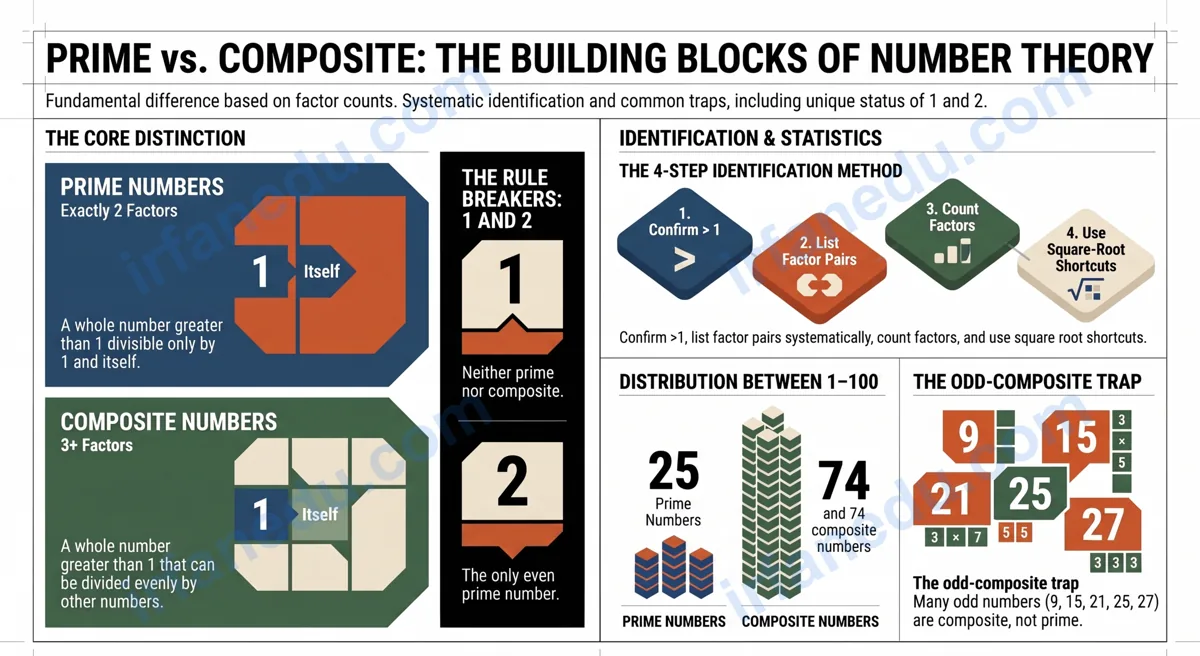
A prime number is any whole number greater than 1 that has exactly two factors — 1 and itself. A composite number is any whole number greater than 1 that has three or more factors. The number 1 is neither prime nor composite. Mastering this distinction is the gateway to fractions, GCF, LCM, and algebra.
If you’ve ever watched a student confidently write “1 is prime” on a test — and lose marks for it — you know how much a clear, practice-rich lesson on prime and composite numbers matters. This page gives you exactly that: a full lesson, three worked examples, a printable 10-problem worksheet with a complete answer key, and a free PDF download. No fluff, no filler.
By the end of this page, you will be able to:
- Define prime and composite numbers in your own words 🎯
- List all factors of any number up to 100
- Use the square-root shortcut for larger numbers
- Avoid the three most common mistakes students make
- Complete 10 graded practice problems with confidence
A prime number has exactly two factors — 1 and itself (e.g., 7 → factors: 1, 7). A composite number has three or more factors (e.g., 12 → factors: 1, 2, 3, 4, 6, 12). The number 1 is neither prime nor composite. To identify which category a number belongs to, list all its factors and count them.
📥 Free Printable PDF Worksheet (with Answer Key) — Grades 4–6
⚡ TL;DR – Quick Summary
- ✅ Prime = exactly 2 factors (1 and itself); e.g., 2, 3, 5, 7, 11, 13
- ✅ Composite = 3 or more factors; e.g., 4, 6, 8, 9, 12, 15
- ⚠️ 1 is neither prime nor composite — a very common exam trap
- ✅ 2 is the only even prime number
- 🔑 Square-root shortcut: only test divisors up to √n for large numbers
- 📋 10-problem worksheet + answer key available as a free PDF below
📊 Quick Facts: Prime vs. Composite Numbers
| Feature | Prime Number | Composite Number |
|---|---|---|
| Number of factors | Exactly 2 | 3 or more |
| Smallest example | 2 | 4 |
| Only even example | 2 (the only even prime) | All other even numbers |
| Can be divided evenly by anything other than 1 and itself? | No | Yes |
| Does 1 belong here? | No | No (1 is neither) |
| US curriculum standard | CCSS 4.OA.B.4 (Grade 4) | |
| Count between 1–100 | 25 prime numbers | 74 composite numbers |
🙋 The Most-Asked Question: What Is the Difference Between Prime and Composite?
The single question I get most often from students and parents is: “How do I tell a prime number from a composite number without memorizing a huge list?” Here is the complete answer.
The difference comes down to one thing: how many factors a number has. A factor is any whole number that divides into another number with no remainder.
| Number | All Factors | Factor Count | Prime or Composite? |
|---|---|---|---|
| 5 | 1, 5 | 2 | ✅ Prime |
| 6 | 1, 2, 3, 6 | 4 | 🔵 Composite |
| 13 | 1, 13 | 2 | ✅ Prime |
| 25 | 1, 5, 25 | 3 | 🔵 Composite |
| 1 | 1 | 1 | ⚠️ Neither |
| 2 | 1, 2 | 2 | ✅ Prime (only even prime) |
Notice that 25 is composite even though it is an odd number — a point that trips up many students who assume “all odd numbers are prime.” That assumption is wrong. Odd composites like 9, 15, 21, 25, and 27 are very common on tests.
📚 What Are Prime and Composite Numbers?
A prime number is a whole number greater than 1 whose only factors are 1 and itself. It cannot be broken into smaller equal groups. Think of it as indivisible — a mathematical atom.
A composite number is a whole number greater than 1 that can be divided evenly by at least one number other than 1 and itself. It can always be written as a product of two smaller whole numbers.
Why Does This Matter Beyond the Worksheet? 🔗
Prime and composite numbers are not just a Grade 4 topic you forget. They are the foundation for:
- Simplifying fractions: You need prime factorization to find the GCF
- Finding LCM: Essential for adding unlike fractions
- Algebra: Factoring expressions in middle and high school
- Cryptography: Modern internet security (RSA encryption) is built entirely on the difficulty of factoring large prime numbers
In my experience teaching this concept to hundreds of Grade 4–6 students, the biggest learning gap is not the definition — it is the factor-listing process. Students who struggle with prime/composite almost always struggle because they skip factors or stop too early. I teach them to always start at 1 and work in pairs (1×n, 2×?, 3×?) until the pairs start repeating. That systematic approach eliminates almost all errors.
🔢 The First 20 Prime Numbers (Memorize These)
There are 25 prime numbers between 1 and 100. Here are the first 20 — worth memorizing for any math test:
2, 3, 5, 7, 11, 13, 17, 19, 23, 29, 31, 37, 41, 43, 47, 53, 59, 61, 67, 71
🪜 Step-by-Step: How to Identify Prime and Composite Numbers
Follow these four steps to classify any whole number correctly, every time.
- Confirm the number is a whole number greater than 1. If it is 1, stop — it is neither prime nor composite. If it is 0 or negative, the prime/composite classification does not apply.
- List all factors systematically. Start with 1 × n. Then try 2 × ?, 3 × ?, and so on. Record every factor pair until the pairs start repeating (that is your signal to stop).
- Count the total number of distinct factors. Exactly 2 factors → prime. Three or more factors → composite.
- Use the square-root shortcut for numbers above 50. You only need to test divisors up to √n. If no divisor up to √n divides the number evenly, it is prime.
🖼️ Visual: Factor Pair Method
  Testing whether 36 is prime or composite:

  Start: 1 × 36  →  factors: 1, 36
         2 × 18  →  factors: 2, 18
         3 × 12  →  factors: 3, 12
         4 × 9   →  factors: 4, 9
         5 × ?   →  36 ÷ 5 = 7.2  (not a whole number, skip)
         6 × 6   →  factors: 6, 6  ← pairs repeating, STOP

  All factors of 36: 1, 2, 3, 4, 6, 9, 12, 18, 36
  Factor count: 9  →  COMPOSITE ✓

  ---

  Testing whether 17 is prime or composite:

  sqrt(17) ≈ 4.1  →  only test 2, 3, 4

         2 × ?   →  17 ÷ 2 = 8.5   (not whole, skip)
         3 × ?   →  17 ÷ 3 = 5.67  (not whole, skip)
         4 × ?   →  17 ÷ 4 = 4.25  (not whole, skip)

  No divisors found up to sqrt(17)  →  PRIME ✓
✏️ 3 Fully Worked Examples
Example 1 — Easy: Is 9 prime or composite?
Step 1: 9 > 1 ✓
Step 2: List factors: 1 × 9, 3 × 3. Factors: 1, 3, 9.
Step 3: Count = 3 factors.
Answer: 9 is COMPOSITE. (Many students guess “prime” because 9 is odd — this is the classic odd-composite trap.)
Example 2 — Medium: Is 29 prime or composite?
Step 1: 29 > 1 ✓
Step 2: √29 ≈ 5.4, so test 2, 3, 4, 5.
- 29 ÷ 2 = 14.5 (not whole)
- 29 ÷ 3 = 9.67 (not whole)
- 29 ÷ 4 = 7.25 (not whole)
- 29 ÷ 5 = 5.8 (not whole)
Step 3: No divisors found. Factors: 1, 29. Count = 2.
Answer: 29 is PRIME.
Example 3 — Hard: Is 51 prime or composite?
Step 1: 51 > 1 ✓
Step 2: √51 ≈ 7.1, so test 2, 3, 5, 7.
- 51 ÷ 2 = 25.5 (not whole)
- 51 ÷ 3 = 17 ✅ (whole number!)
Step 3: Found a factor (3). Factors: 1, 3, 17, 51. Count = 4.
Answer: 51 is COMPOSITE. This one surprises students — 51 looks prime at first glance, but 3 × 17 = 51. Always test divisibility by 3 using the digit-sum rule: 5 + 1 = 6, which is divisible by 3.
🚫 Common Mistakes: Wrong vs. Right
These are the four errors I see most often on graded worksheets and tests.
❌ Wrong: “1 is prime because it is only divisible by 1 and itself.”
✅ Right: 1 has only ONE factor (itself). A prime requires exactly TWO distinct factors. So 1 is neither prime nor composite.
❌ Wrong: “9, 15, 21, 25 are prime because they are odd.”
✅ Right: Odd composites are extremely common. Always list the factors — do not guess based on even/odd.
❌ Wrong: “2 is composite because it is even.”
✅ Right: 2 is the only even prime. Its only factors are 1 and 2. Every other even number has at least three factors (1, 2, and itself).
❌ Wrong: Testing only 2 and 3 for the number 49, concluding it is prime.
✅ Right: √49 = 7, so you must also test 5 and 7. Since 7 × 7 = 49, the number is composite.
💡 Unique Insight — What Most Worksheets Get Wrong About Teaching This Skill
Most prime/composite worksheets give students a list of numbers and ask “prime or composite?” — full stop. That trains recognition, not understanding. The deeper skill is factor fluency: the ability to quickly generate all factors of a number. In my experience, students who can list factors confidently never confuse 9, 25, or 49 for primes. The worksheet on this page is deliberately structured around factor-listing first, classification second — because that sequence builds lasting understanding, not just test-day pattern matching. If your child can list all factors of 36 in under 30 seconds, they will never miss a prime/composite question again.
📋 Prime & Composite Numbers — Practice Worksheet
Instructions: For each number below, write all its factors, then decide whether it is PRIME or COMPOSITE. Show your work in the space provided. Use the Answer Key to self-check when you are done.
How to use this worksheet: Print the PDF (button below) or work directly on this page. Complete all 10 problems, then reveal the Answer Key to check your work. If you get a problem wrong, re-read the worked example for that difficulty level above.
- Is 7 prime or composite? List all factors.
- Is 9 prime or composite? List all factors.
- Is 11 prime or composite? List all factors.
- Is 15 prime or composite? List all factors.
- Is 23 prime or composite? List all factors.
- Is 36 prime or composite? List all factors.
- Is 29 prime or composite? List all factors.
- Is 49 prime or composite? List all factors.
- Is 51 prime or composite? List all factors.
- List all prime numbers between 40 and 60.
✅ Show Answer Key
- 7 — Factors: 1, 7 → PRIME
- 9 — Factors: 1, 3, 9 → COMPOSITE
- 11 — Factors: 1, 11 → PRIME
- 15 — Factors: 1, 3, 5, 15 → COMPOSITE
- 23 — Factors: 1, 23 → PRIME
- 36 — Factors: 1, 2, 3, 4, 6, 9, 12, 18, 36 → COMPOSITE
- 29 — Factors: 1, 29 → PRIME
- 49 — Factors: 1, 7, 49 → COMPOSITE (7 × 7 = 49)
- 51 — Factors: 1, 3, 17, 51 → COMPOSITE (3 × 17 = 51)
- Primes between 40–60: 41, 43, 47, 53, 59
Problem 10 — listing all primes in a range — is the type of question that separates students who truly understand the concept from those who just memorized a list. I always include at least one range-based question in my worksheets because it forces students to apply the factor-listing method independently, without a number to anchor on. If your student nails problem 10, they have genuinely mastered this skill.
📥 Download the free printable PDF worksheet (with answer key) — print at home or in class
🧠 Quick Quiz: Test Your Understanding
Q1. Which of the following is a prime number?
See Answer
C) 23 — Its only factors are 1 and 23. Options A, B, and D are all composite: 9 = 3×3, 15 = 3×5, 27 = 3×9.
Q2. How many factors does the number 1 have?
See Answer
B) 1 — The number 1 has exactly one factor: itself. This is why it is neither prime (needs 2 factors) nor composite (needs 3+).
Q3. You are testing whether 91 is prime. What is the highest divisor you need to test?
See Answer
C) 9 — √91 ≈ 9.54, so you only need to test up to 9. (And 91 = 7 × 13, so it is composite — a famous “looks prime” trap number!)
🔍 Reveal-on-Click Practice Problems
Challenge: Is 97 prime or composite? (Show solution)
√97 ≈ 9.8. Test divisors 2, 3, 5, 7:
97 ÷ 2 = 48.5 ✗ | 97 ÷ 3 = 32.3 ✗ | 97 ÷ 5 = 19.4 ✗ | 97 ÷ 7 = 13.9 ✗
No divisors found. 97 is PRIME. It is the largest prime below 100.
Challenge: List all composite numbers between 20 and 30. (Show solution)
Primes in that range: 23, 29.
Composites: 20, 21, 22, 24, 25, 26, 27, 28
(20=4×5, 21=3×7, 22=2×11, 24=4×6, 25=5×5, 26=2×13, 27=3×9, 28=4×7)
Challenge: What is the smallest composite number? (Show solution)
The smallest composite number is 4. Its factors are 1, 2, and 4 — three factors, which meets the definition. The numbers 2 and 3 are both prime.
❓ Frequently Asked Questions
What is the difference between a prime and a composite number?
Is 1 a prime number?
Is 2 a prime number?
How do you check if a large number is prime?
Sources & References
Written and fact-checked by Dr Irfan Mansuri. External links open in a new tab and are provided for further reading and verification.