
- You should know what a function is and understand function notation: f(x) means “the output when the input is x.”
- You need basic algebra skills: solving linear equations, and (for quadratic/rational modes) factoring or cross-multiplying.
- You should be comfortable with the idea of domain and range.
If any of those feel shaky, spend 10 minutes reviewing them first — inverse functions build directly on top of all three.
Function Inverse Calculator: Find f⁻¹(x) Step by Step
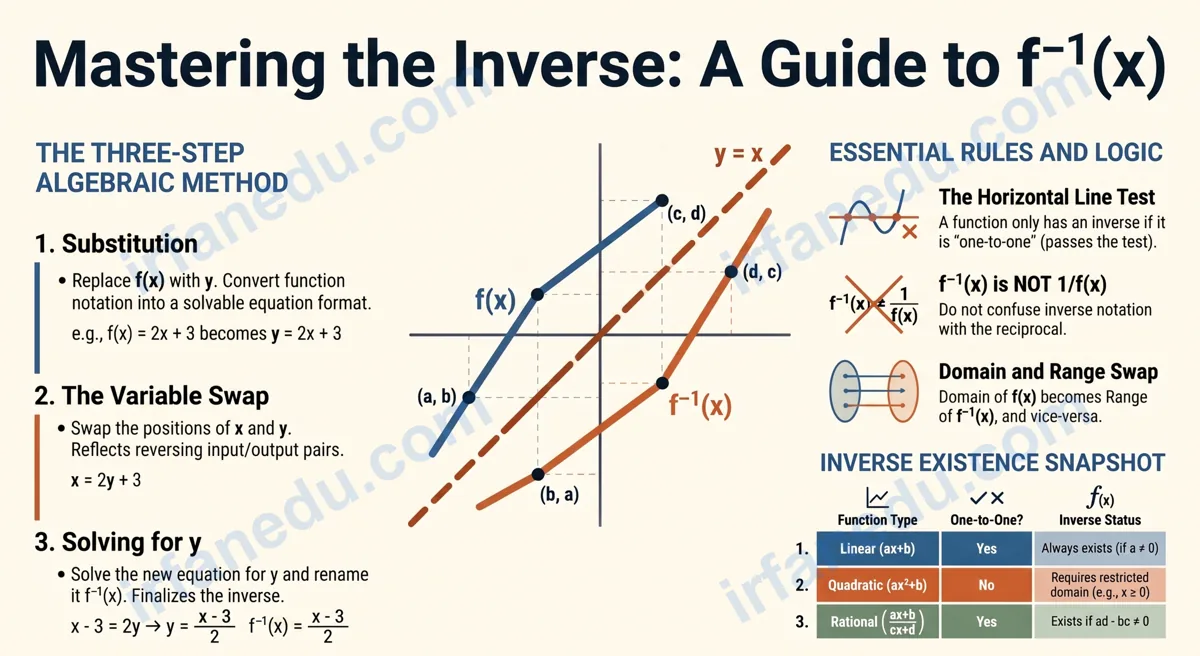
Finding the inverse of a function trips up more students than almost any other algebra topic — not because the concept is hard, but because most explanations skip the why behind the swap-and-solve method. This calculator does the algebra for you and shows every step, so you can check your work and understand the pattern.
To find the inverse of a function, replace f(x) with y, swap x and y, solve for y, then rename it f⁻¹(x). The inverse function undoes whatever the original function does — if f(3) = 7, then f⁻¹(7) = 3.
- Instantly compute f⁻¹(x) for linear, quadratic, and rational functions.
- See the numbered algebra steps that match what your teacher expects on paper.
- Learn the Horizontal Line Test to know when an inverse exists.
- Avoid the #1 mistake students make: confusing f⁻¹(x) with 1/f(x).
Key Concept
An inverse function reverses the input-output pairs of the original function. The graph of f⁻¹(x) is the reflection of f(x) across the line y = x.
A function inverse calculator finds f⁻¹(x) by reversing the input-output relationship of f(x). To find an inverse: replace f(x) with y, swap x and y, then solve for y. For example, if f(x) = 2x + 3, then f⁻¹(x) = (x − 3) / 2. Not every function has an inverse — it must pass the Horizontal Line Test (be one-to-one).
⚡ TL;DR – Quick Summary
- Replace f(x) with y, swap x and y, solve for y — that is the full method.
- Only one-to-one functions (pass the Horizontal Line Test) have inverses.
- f⁻¹(x) is NOT the same as 1/f(x) — this is the most common student error.
- The domain of f⁻¹(x) equals the range of f(x), and vice versa.
- Verify any inverse by checking f(f⁻¹(x)) = x.
- Quadratic functions need a restricted domain before an inverse exists.
Table of Contents
| Fact | Detail |
|---|---|
| Notation | f⁻¹(x) — read “f inverse of x” |
| Graphical meaning | Reflection of f(x) across y = x |
| Existence condition | Function must be one-to-one (Horizontal Line Test) |
| Domain / Range swap | Domain of f⁻¹ = Range of f; Range of f⁻¹ = Domain of f |
| Verification | f(f⁻¹(x)) = x and f⁻¹(f(x)) = x |
| Common error | Confusing f⁻¹(x) with [f(x)]⁻¹ = 1/f(x) |
Function Inverse Calculator
Select a function type, enter coefficients, and click Calculate.
f(x) = ax + b
f(x) = ax² + b (domain restricted to x ≥ 0)
f(x) = (ax + b) / (cx + d)
Step-by-Step Solution
How to Use This Calculator
- Choose a function type using the mode buttons: Linear (ax + b), Quadratic (ax² + b), or Rational ((ax+b)/(cx+d)).
- Enter the coefficients in the labeled fields. Use negative numbers where needed (e.g., enter −5 for b).
- Click “Calculate f⁻¹(x)” — or press Enter from any input field.
- Read the result: the inverse expression appears at the top of the result card.
- Follow the numbered steps below the result to see the full algebra, matching what you would write on paper.
- Click Reset to clear all fields and start a new calculation.
What Is an Inverse Function?
An inverse function f⁻¹(x) reverses the mapping of f(x): if f sends input a to output b, then f⁻¹ sends b back to a. The two functions undo each other completely.
Think of it like a lock and key. If f(x) = “lock the door,” then f⁻¹(x) = “unlock the door.” The composition of both operations returns you to exactly where you started.
Visual: f(x) and f⁻¹(x) as Reflections
  y
  |          /  f(x) = 2x+1
  |        /
  |      * (2, 5)
  |    /
  |  * (0, 1)
  |/_____________________ x
  |
  y = x (mirror line)
  |
  f⁻¹(x) = (x-1)/2
  Points swap: (5,2) and (1,0) are on f⁻¹(x)
The Horizontal Line Test
A function has an inverse if and only if it is one-to-one. The quick check: draw any horizontal line across the graph. If it crosses the graph more than once, the function is NOT one-to-one and has no inverse over its full domain.
| Function | One-to-One? | Has Inverse? | Note |
|---|---|---|---|
| f(x) = 3x + 2 | Yes | Yes | All non-zero linear functions |
| f(x) = x² | No (full domain) | Only with restriction | Restrict to x ≥ 0 |
| f(x) = (2x+1)/(x−3) | Yes | Yes | Provided ad
Sources & ReferencesWritten and fact-checked by Dr Irfan Mansuri. External links open in a new tab and are provided for further reading and verification. |