
Skin Model in Math: Complete Guide with Examples (Easy to Hard)
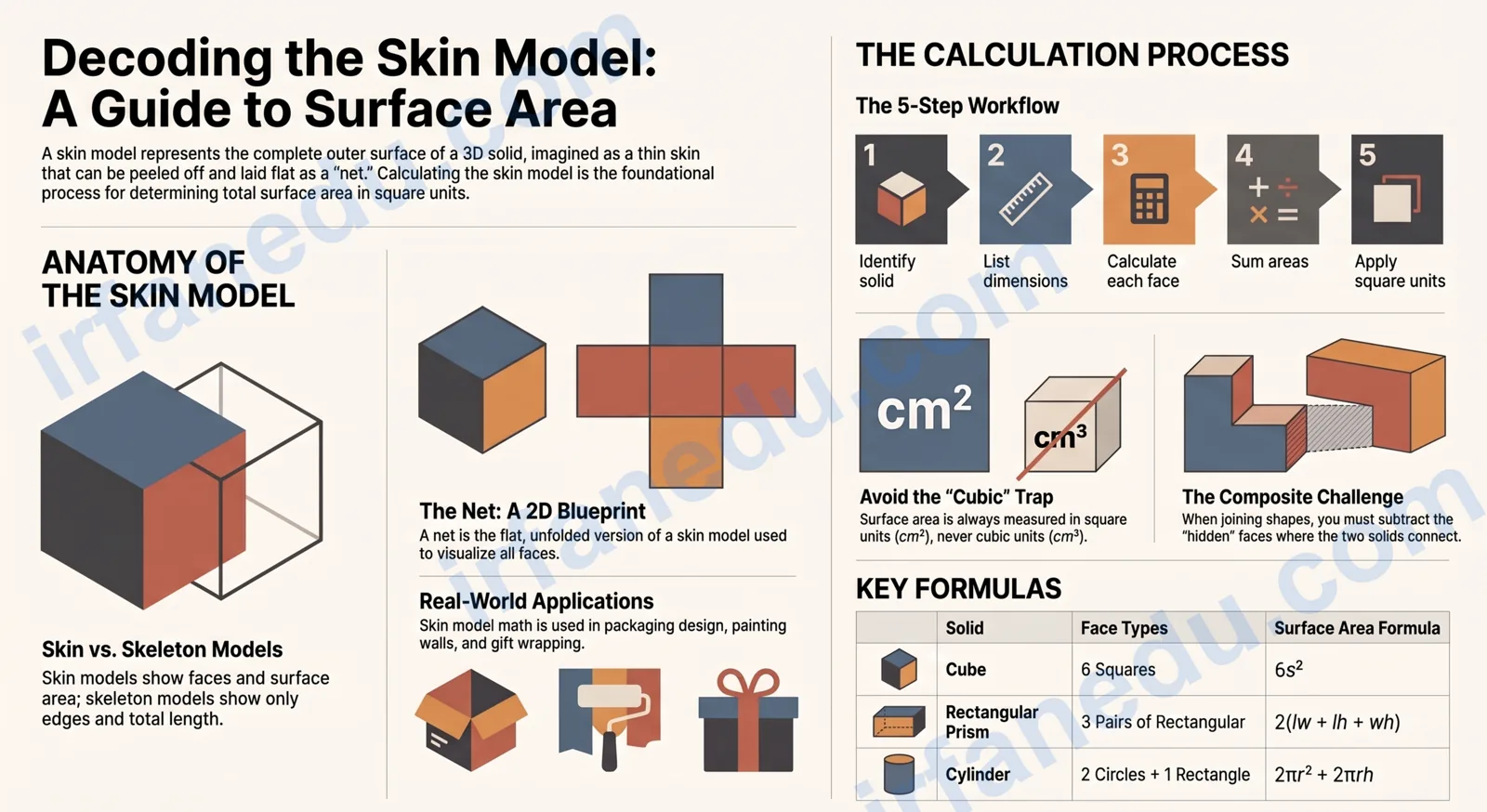
A skin model in math is the outer surface of a 3D solid, treated as a thin “skin” that can be peeled off and laid flat. This flat version is called a net. The total area of that skin is the shape’s surface area. Understanding skin models is the clearest path to mastering surface area for any 3D solid — from a simple cube to a complex composite shape.
By the end of this guide you will be able to:
- Define a skin model and explain how it relates to a net and surface area
- Distinguish a skin model from a skeleton model
- Calculate the skin model (surface area) for cubes, prisms, cylinders, and pyramids
- Avoid the three most common mistakes students make
- Apply skin model thinking to real-world problems
After reading this article you will understand what a skin model is, how to unfold any common solid into its net, and how to calculate total surface area — ranked from the simplest shape to the most challenging composite solid.
A skin model in math is the complete outer surface of a 3D solid, imagined as a thin skin that can be peeled off and laid flat as a net. Calculating the skin model means finding the total surface area — the sum of every face’s area. It applies to cubes, rectangular prisms, cylinders, triangular prisms, pyramids, and composite solids. Surface area is always measured in square units (cm², in², m²).
- A skin model = the outer surface of a 3D solid, laid flat as a net.
- Surface area = the total area of the skin model, measured in square units.
- A skeleton model shows edges only; a skin model shows faces only.
- Every face type needs its own area formula: rectangle, triangle, or circle.
- The most common mistake: using cubic units instead of square units.
- Real-world uses include wrapping paper, painting walls, and packaging design.
What Is a Skin Model in Math?
A skin model is the outer surface of a 3D solid, and nothing else. Imagine you could peel the surface off a cardboard box like a sticker sheet — that peeled sheet is the skin model. When you lay it flat without overlapping any part, you get the net of the solid.
The skin model concept appears in middle school geometry (typically grades 6-8) and is the conceptual foundation for surface area. It answers one question: how much material covers the outside of this shape?
The term “skin model” is used in some curricula to contrast with the “skeleton model” (edges and vertices only) and the “solid model” (the full filled-in 3D shape). Together, these three models help students understand the complete anatomy of a 3D figure.
Skin model — the set of all faces of a 3D solid, considered as a surface. The total area of the skin model equals the solid’s surface area. The flat version of the skin model is called a net.
In my experience teaching geometry, students who visualize the skin model first — before they memorize any formula — make far fewer errors. The formula is just a shortcut for counting up the faces you can already see in the net.
Skin Model vs. Skeleton Model: What Is the Difference?
The skin model and the skeleton model describe different parts of the same 3D solid. Understanding the difference prevents a very common confusion in geometry class.
| Feature | Skin Model | Skeleton Model |
|---|---|---|
| What it shows | Faces (surfaces) only | Edges and vertices only |
| Physical analogy | The cardboard faces of a box | The wire frame of a box |
| What you calculate | Surface area (square units) | Total edge length (linear units) |
| Flat version | Net of the solid | No standard flat version |
| Real-world example | Wrapping paper around a gift | A metal scaffolding frame |
| Units | Square units (cm², in²) | Linear units (cm, in) |
A cube has 12 edges (skeleton) and 6 square faces (skin). If a problem asks for the skin model, it wants the surface area. If it asks for the skeleton model, it wants the total length of all edges.
Quick Facts: Skin Models at a Glance
| Solid | Number of Faces | Face Types | Surface Area Formula |
|---|---|---|---|
| Cube (side s) | 6 | 6 squares | 6s² |
| Rectangular Prism (l, w, h) | 6 | 3 pairs of rectangles | 2(lw + lh + wh) |
| Triangular Prism | 5 | 2 triangles + 3 rectangles | 2(½bh) + perimeter × length |
| Cylinder (r, h) | 3 (2 circles + 1 curved) | 2 circles + 1 rectangle | 2πr² + 2πrh |
| Square Pyramid (base s, slant l) | 5 | 1 square + 4 triangles | s² + 2sl |
| Sphere (radius r) | 1 (curved) | Continuous curved surface | 4πr² |
From Easiest to Hardest: Skin Models Ranked by Difficulty
Not all skin model problems are equal. Here is a ranked progression — from the shape every student should master first to the composite solids that appear on harder assessments. Work through them in order and each level builds on the last.
- Level 1 — Cube: All 6 faces are identical squares. One formula, one measurement. The perfect starting point.
- Level 2 — Rectangular Prism: Three pairs of different rectangles. Slightly more arithmetic, same logic.
- Level 3 — Triangular Prism: Two triangular faces plus three rectangular faces. Requires the triangle area formula.
- Level 4 — Cylinder: The curved face unrolls into a rectangle whose width is the circumference. Introduces π.
- Level 5 — Square Pyramid: A square base plus four identical triangular faces. Requires the slant height (not the vertical height).
- Level 6 — Composite Solid: Two or more solids joined together. You must subtract the hidden faces where the shapes connect.
Each level introduces exactly one new idea. Students who jump straight to cylinders or pyramids without mastering the cube first almost always make unit errors or forget faces. The ranked approach is the fastest path to fluency.
How to Calculate a Skin Model (Surface Area) Step by Step
Calculating the skin model of any solid follows the same five-step process. Master this process once and it works for every shape.
- Identify the solid. Name the 3D shape and list every face it has. A rectangular prism has 6 faces. A triangular prism has 5 faces. Write them down before touching a formula.
- Write down the dimensions. Label the length, width, and height — or radius and height for cylinders — directly from the problem. Include units.
- Calculate each face’s area. Use the correct formula for each face type:
- Rectangle: Area = length × width
- Triangle: Area = ½ × base × height
- Circle: Area = π × radius²
- Add all face areas together. For shapes with identical opposite faces, multiply by 2 to save time. Sum every face.
- Write the answer in square units. Surface area is always in square units: cm², m², in², ft². Never cubic units — those are for volume.
         +-------+
         |  Top  |
         |  s×s  |
+-------++-------++-------++-------+
| Left  |  Front | Right  |  Back  |
| s×s   |  s×s   | s×s    |  s×s   |
+-------++-------++-------++-------+
         | Bottom|
         |  s×s  |
         +-------+

  Total skin model area = 6 × (s × s) = 6s²
  (Each face is a square with side length s)
Worked Examples: Level 1 to Level 4
Level 1 — Cube: The Simplest Skin Model
A cube has side length 4 cm. Find its skin model area (surface area).
- Faces: 6 squares, each with area = 4 × 4 = 16 cm²
- Total surface area = 6 × 16 = 96 cm²
Formula used: SA = 6s² = 6 × 4² = 6 × 16 = 96 cm²
Level 2 — Rectangular Prism
A rectangular box is 8 cm long, 5 cm wide, and 3 cm tall. Find its skin model area.
- Top and bottom: 2 × (8 × 5) = 2 × 40 = 80 cm²
- Front and back: 2 × (8 × 3) = 2 × 24 = 48 cm²
- Left and right: 2 × (5 × 3) = 2 × 15 = 30 cm²
- Total = 80 + 48 + 30 = 158 cm²
Formula: SA = 2(lw + lh + wh) = 2(40 + 24 + 15) = 2 × 79 = 158 cm²
Level 3 — Triangular Prism
A triangular prism has a right-triangle base with legs 3 cm and 4 cm, hypotenuse 5 cm, and a length of 10 cm. Find its skin model area.
- Two triangular faces: 2 × (½ × 3 × 4) = 2 × 6 = 12 cm²
- Rectangle 1 (base 3, length 10): 3 × 10 = 30 cm²
- Rectangle 2 (base 4, length 10): 4 × 10 = 40 cm²
- Rectangle 3 (hypotenuse 5, length 10): 5 × 10 = 50 cm²
- Total = 12 + 30 + 40 + 50 = 132 cm²
Level 4 — Cylinder
A cylinder has radius 3 cm and height 7 cm. Find its skin model area.
- Two circular faces: 2 × π × 3² = 2 × π × 9 = 18π ≈ 56.55 cm²
- Curved lateral face (unrolls to a rectangle): 2π × 3 × 7 = 42π ≈ 131.95 cm²
- Total = 18π + 42π = 60π ≈ 188.50 cm²
Formula: SA = 2πr² + 2πrh = 2π(3)² + 2π(3)(7) = 18π + 42π = 60π cm²
Imagine peeling the label off a soup can. It unrolls into a flat rectangle. The width of that rectangle equals the circumference of the circular top (2πr). The height of the rectangle equals the height of the can (h). So the lateral area = 2πr × h.
Most geometry guides teach the skin model as a memorization task: “here are the formulas, learn them.” That approach fails students on composite solid problems — and those are the problems that appear on harder tests.
The real insight is this: the skin model formula for any solid is just a shortcut for the net. If you forget the formula for a triangular prism mid-exam, you can reconstruct it in 30 seconds by drawing the net — two triangles and three rectangles — and writing the area formula for each face. No memorization required.
In my experience, students who practice drawing nets before learning formulas score significantly better on surface area problems than students who memorize formulas first. The net is the formula. The formula is just the net written in algebra.
A second non-obvious point: for composite solids, the skin model is NOT the sum of the individual skin models. When two solids are joined, the faces that touch each other are hidden and must be subtracted. This is the single most tested concept in composite solid problems, and most guides barely mention it.
Common Mistakes in Skin Model Problems (and How to Fix Them)
These are the three errors I see most often when students work on skin model problems. Each one has a simple fix.
| Mistake | What It Looks Like | The Fix |
|---|---|---|
| Using cubic units for surface area | Writing “96 cm³” instead of “96 cm²” | Surface area is 2D — always square units. Volume is 3D — always cubic units. |
| Using vertical height instead of slant height for pyramids | Plugging the pyramid’s height h into the triangle area formula instead of the slant height l | The triangular faces of a pyramid use slant height (the distance along the face), not the vertical height from base to apex. |
| Forgetting to subtract hidden faces on composite solids | Adding the surface areas of two solids without removing the joined faces | Identify the area of the face(s) where the two solids connect and subtract twice that area (once from each solid). |
| Miscounting faces on a triangular prism | Counting 4 faces instead of 5 | A triangular prism has 2 triangular ends + 3 rectangular sides = 5 faces total. Draw the net to confirm. |
In my experience, the slant height error happens because students draw a pyramid and label the dotted vertical line inside it as “h” — which is correct for volume. But the surface area formula needs the slant height, which is the length along the triangular face from base midpoint to apex. These two measurements are related by the Pythagorean theorem: slant height = √(h² + (s/2)²). I now teach students to always ask: “Is this height going through the air inside the shape, or along the face?” That one question eliminates the error almost entirely.
Real-World Applications of Skin Models
The skin model is not an abstract classroom concept. It solves real problems that engineers, designers, and everyday people face.
- Packaging design: A box manufacturer calculates the skin model of a cereal box to determine how much cardboard to cut. Minimizing surface area while maximizing volume saves material and money.
- Painting and tiling: A painter calculates the skin model of a room’s walls and ceiling to know how many cans of paint to buy. A tiler does the same for floor and wall tiles.
- Wrapping paper: Calculating the skin model of a gift box tells you the minimum area of wrapping paper needed — a direct, practical application students immediately recognize.
- Manufacturing: Sheet metal workers calculate the skin model of ducts, tanks, and enclosures to cut the correct amount of metal before bending and welding.
- Biology: The surface-area-to-volume ratio (skin model vs. solid model) determines how efficiently a cell can exchange nutrients and waste. Smaller cells have a higher ratio — a key concept in biology that starts with the math here.
A gift box is 30 cm × 20 cm × 10 cm. How much wrapping paper do you need (ignoring overlap)?
SA = 2(30×20 + 30×10 + 20×10) = 2(600 + 300 + 200) = 2 × 1100 = 2200 cm²
That is 2200 cm² of wrapping paper — about the size of an A3 sheet. Now you can shop with confidence.
Quick Quiz: Test Your Skin Model Knowledge
Q1. A cube has side length 5 cm. What is its skin model area?
Show Answer
Q2. Which units are correct for a skin model (surface area)?
Show Answer
Q3. A cylinder has radius 2 cm and height 5 cm. What is the area of just the two circular faces?
Show Answer
Practice Problems: Reveal-on-Click Solutions
Try each problem yourself before clicking to reveal the solution.
Problem 1. A rectangular prism is 6 m long, 4 m wide, and 2 m tall. Find its skin model area.
Show Solution
Problem 2. A square pyramid has a base side of 6 cm and a slant height of 5 cm. Find its skin model area.
Show Solution
4 triangular faces = 4 × (½ × 6 × 5) = 4 × 15 = 60 cm²
Total SA = 36 + 60 = 96 cm²
Problem 3. A cylinder has radius 4 cm and height 10 cm. Find its total skin model area. Use π ≈ 3.14.
Show Solution
Lateral face: 2 × 3.14 × 4 × 10 = 251.20 cm²
Total SA = 100.48 + 251.20 = 351.68 cm²
Problem 4 (Challenge). A composite solid is made by placing a cube (side 4 cm) on top of a rectangular prism (8 cm × 8 cm × 3 cm). The cube sits centered on top of the prism. Find the total skin model area. Assume the cube’s base and the prism’s top face overlap exactly where the cube sits.
Show Solution
Cube SA = 6 × 4² = 96 cm²
Hidden area (cube base = prism top face where they join): 4 × 4 = 16 cm² (subtract twice — once from each solid)
Total = 224 + 96 − 2 × 16 = 224 + 96 − 32 = 288 cm²
Frequently Asked Questions About Skin Models
What is a skin model in math?
What is the difference between a skin model and a skeleton model?
Is a skin model the same as a net?
How do you find the surface area using a skin model?
Sources & References
Written and fact-checked by Dr Irfan Mansuri. External links open in a new tab and are provided for further reading and verification.