
Two Digit Addition No Regrouping: Free Worksheet, Lesson & Answer Key
Is Two Digit Addition Without Regrouping Really Necessary?
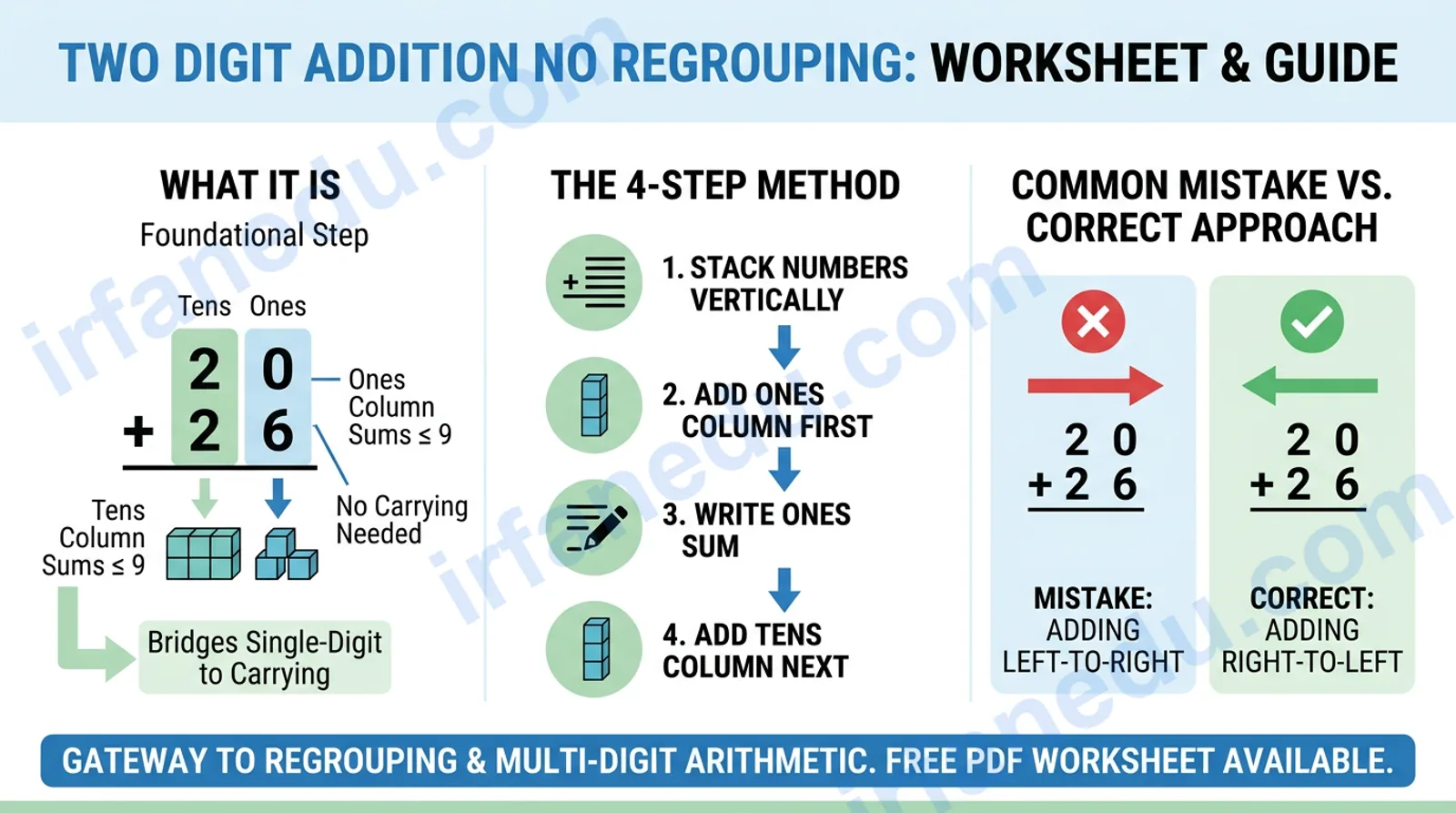
Two digit addition without regrouping is the foundational step that bridges single-digit addition and the full carrying algorithm. Students who skip it and jump straight to regrouping often develop fragile place-value understanding, which creates persistent errors in multi-digit arithmetic through middle school.
That is a fair question to ask. On the surface, problems like 34 + 25 look almost too simple. A student who already knows their single-digit sums can often answer these mentally. So why dedicate an entire lesson and worksheet to them?
The honest answer is: the problems are simple, but the procedure being built is not. No-regrouping addition is where students first learn to treat a two-digit number as two separate place-value parts, add each part independently, and then read the combined result. That mental model is the same one they will use for three-digit addition, subtraction with borrowing, and eventually long multiplication. Skipping the no-regrouping stage is like skipping slow practice when learning a musical instrument: the notes seem easy, but the technique suffers later.
In my experience teaching early elementary math, the students who struggle most with carrying are almost always the ones who never fully internalized the column-by-column logic at this simpler stage. This guide gives you the lesson and the practice to build that logic correctly.
- Understand exactly what no-regrouping addition is and why it matters
- Follow a clear 4-step method with fully worked examples
- Spot and fix the three most common mistakes students make
- Download a free printable worksheet with 12 problems and a full answer key
Download Free PDF Worksheet
- No regrouping = ones column sums to 9 or less, tens column sums to 9 or less.
- Always add the ones column first, then the tens column.
- Stack numbers vertically and align place-value columns before adding.
- The biggest mistake: adding left-to-right instead of right-to-left.
- This skill is the gateway to regrouping, three-digit addition, and beyond.
- The free PDF worksheet below has 12 graded problems and a full answer key.
What Is Two Digit Addition Without Regrouping?
Two digit addition without regrouping is the process of adding two 2-digit numbers when no column’s sum reaches 10, so no digit needs to be carried to the next column.
The term regrouping refers to the action of taking 10 ones and exchanging them for 1 ten (or 10 tens for 1 hundred). When no column exceeds 9, that exchange never happens, and the addition is straightforward column-by-column work.
A 2-digit number has two place-value positions: the tens place (left digit) and the ones place (right digit). In 47, the 4 represents 4 tens (40) and the 7 represents 7 ones. When you add 47 + 32, you add 7 + 2 = 9 ones and 4 + 3 = 7 tens, giving 79. No exchange needed.
Two digit addition with regrouping (e.g., 47 + 35) requires carrying because 7 + 5 = 12, which exceeds 9. That is a separate, harder skill taught after this one. If any ones-column sum reaches 10 or more, the problem requires regrouping.
How to Do Two Digit Addition Without Regrouping: 4 Steps
Follow these four steps every time, and the process becomes automatic.
- Write the numbers in columns. Stack the two numbers vertically. Line up the ones digits in the right column and the tens digits in the left column. Draw a horizontal line below them.
- Check that no regrouping is needed. Quickly add the ones digits. If the sum is 9 or less, proceed. If it is 10 or more, the problem requires regrouping (a different skill).
- Add the ones column. Add the two ones digits. Write the result directly below the ones column.
- Add the tens column. Add the two tens digits. Write the result directly below the tens column. Read the full answer.
  Tens | Ones
  -----+-----
    3  |  4      (first number: 34)
  + 2  |  5      (second number: 25)
  -----+-----
    5  |  9      (3+2=5 tens, 4+5=9 ones)

  Answer: 59
Worked Example 1: 43 + 35
Step 1: Stack the numbers, aligning place values.
Step 2: Check ones column: 3 + 5 = 8. That is 9 or less. No regrouping needed.
Step 3: Add ones: 3 + 5 = 8. Write 8 in the ones column.
Step 4: Add tens: 4 + 3 = 7. Write 7 in the tens column.
Answer: 78
Worked Example 2: 61 + 27
Step 1: Stack 61 above 27, ones aligned.
Step 2: Check ones: 1 + 7 = 8. No regrouping needed.
Step 3: Add ones: 1 + 7 = 8.
Step 4: Add tens: 6 + 2 = 8.
Answer: 88
Worked Example 3: 50 + 19
Step 1: Stack 50 above 19.
Step 2: Check ones: 0 + 9 = 9. No regrouping needed.
Step 3: Add ones: 0 + 9 = 9.
Step 4: Add tens: 5 + 1 = 6.
Answer: 69
In my experience, the single most useful habit I can give a young student is the two-second ones-column check before starting any addition problem. It takes no time, but it immediately tells the student whether they are in no-regrouping territory or not. Students who develop this habit make far fewer errors when the problems get harder, because they have already classified the problem before picking up their pencil. I teach it as a rule: “Check before you add.”
No-regrouping addition is not just easier regrouping — it is a different cognitive task. Most worksheets treat it as a warm-up and rush past it. But research in math education (and my own classroom observation) shows that the no-regrouping stage is where students build their mental model of place value as independent columns. When a student adds 34 + 25, they are not just getting 59 — they are learning that tens and ones are separate quantities that can be added in isolation and then recombined.
The practical implication: if a student makes errors on no-regrouping problems, the issue is almost never arithmetic. It is column alignment. The fix is not more addition practice — it is graph paper or pre-drawn place-value grids that force correct alignment. Once alignment is automatic, the arithmetic errors disappear. I have seen this pattern repeatedly, and it is rarely mentioned in standard worksheet guides.
Common Mistakes in Two Digit Addition Without Regrouping
Three mistakes account for the vast majority of errors at this stage. Knowing them helps you catch and correct them fast.
Wrong: Student adds tens first (3 + 2 = 5), then ones (4 + 5 = 9), and writes “59” — which happens to be correct for no-regrouping problems, but the habit breaks down the moment carrying is introduced.
Right: Always add ones first, then tens. Build the correct habit now so it transfers to regrouping problems automatically.
Wrong: Writing 34 + 5 (a 1-digit number) and aligning the 5 under the 3 instead of the 4, then adding 3 + 5 = 8 and writing 84 instead of 39.
Right: Always align by the ones (rightmost) digit. Use graph paper or a place-value chart if alignment is a recurring problem.
Wrong: Student adds only the ones column and writes a 1-digit answer (e.g., 34 + 25 = 9).
Right: After writing the ones answer, immediately move to the tens column. A physical pointer or finger on the tens column helps young learners remember the second step.
Mistake 1 is the one I see most in older students who were never corrected early. Because left-to-right addition gives the right answer on no-regrouping problems, it goes undetected for months. Then the student hits a regrouping problem, adds left-to-right, gets the wrong answer, and has no idea why. The fix at that point is much harder than teaching the right habit from the start. If you are a parent or teacher reviewing a child’s work, check the order of their steps, not just the final answer.
Regrouping vs. No Regrouping: What Is the Difference?
The table below shows the key differences between the two types of two-digit addition, so students and parents can quickly identify which type a problem is.
| Feature | No Regrouping | With Regrouping |
|---|---|---|
| Ones column sum | 9 or less | 10 or more |
| Carrying needed? | No | Yes (carry 1 to tens) |
| Example problem | 34 + 25 = 59 | 34 + 28 = 62 |
| Typical grade level | Grade 1 / early Grade 2 | Grade 2 |
| Place-value concept | Independent columns | Exchange 10 ones for 1 ten |
| Steps required | 4 steps | 5 steps (includes carry) |
| Prerequisite skill | Single-digit addition, place value | No-regrouping addition mastered |
The key takeaway from this table: no-regrouping addition is not a simplified version of regrouping addition. It is a prerequisite. Students must be fluent here before moving on.
Free Printable Worksheet: Two Digit Addition No Regrouping
How to Use This Worksheet
Print the PDF (download button below) or work through the problems on-screen. Solve each problem by writing the numbers in column form, adding the ones first, then the tens. When you finish, use the collapsible answer key to self-check. For best results, time yourself on a second attempt to build fluency.
Instructions: Add each pair of two-digit numbers. Add the ones column first, then the tens column. No carrying is needed for any problem.
- 23 + 14 = ___
- 31 + 25 = ___
- 42 + 36 = ___
- 50 + 19 = ___
- 61 + 27 = ___
- 34 + 53 = ___
- 72 + 16 = ___
- 45 + 43 = ___
- 80 + 17 = ___
- 63 + 25 = ___
- 21 + 68 = ___
- 54 + 32 = ___
Show Answer Key
- 23 + 14 = 37
- 31 + 25 = 56
- 42 + 36 = 78
- 50 + 19 = 69
- 61 + 27 = 88
- 34 + 53 = 87
- 72 + 16 = 88
- 45 + 43 = 88
- 80 + 17 = 97
- 63 + 25 = 88
- 21 + 68 = 89
- 54 + 32 = 86
Download Free PDF Worksheet
Once your student is comfortable with these problems, the natural next step is three-digit addition. My guide on Distance & Midpoint Formulas shows how place-value thinking extends into coordinate geometry for older students. For a comprehensive reference, the Complete Geometry Formula Sheet is a useful bookmark for when your student reaches that level.
Frequently Asked Questions
What is two digit addition without regrouping?
How Do You Know If a Problem Needs Regrouping?
What Grade Level Is Two Digit Addition Without Regrouping?
Why Do We Add the Ones Column First?
What Is the Difference Between Regrouping and Carrying?
Can Two Digit Addition Without Regrouping Include Zero?
How Is This Skill Used in Real Life?
What Comes After Mastering Two Digit Addition Without Regrouping?
- No regrouping means every column sums to 9 or less — no carrying needed.
- The 4-step method: stack, check, add ones, add tens.
- Always add the ones column first, even when no carrying is involved — it builds the right habit for harder problems.
- The most common error is column misalignment, not arithmetic. Graph paper fixes it.
- The no-regrouping stage builds the independent-columns mental model that underpins all multi-digit arithmetic.
- A quick ones-column check before starting any addition problem is the most valuable habit to develop at this stage.
- Download the free PDF worksheet above for 12 graded practice problems and a full answer key.
Sources & References
-
Khan Academy. Adding 2-digit numbers (no regrouping).
khanacademy.org -
National Council of Teachers of Mathematics (NCTM). Principles and Standards for School Mathematics: Number and Operations.
nctm.org -
Wikipedia. Elementary arithmetic.
en.wikipedia.org
Editorial note: This article was written and fact-checked by Dr. Irfan Mansuri. All worked examples were independently verified. No statistics or studies were fabricated. Last reviewed July 2026.