
🏗️ Blacktop Calculator: Asphalt Tonnage & Cost Estimator
📋 Table of Contents
Planning a driveway, parking apron, or path? The single biggest mistake I see homeowners make is ordering too little asphalt — or too much, wasting hundreds of dollars. This free blacktop calculator gives you the exact tonnage, cubic yards, and estimated material cost in seconds, using the same density formula professional contractors use.
A blacktop calculator converts your project’s length, width, and depth into tons of asphalt by applying the standard hot-mix density of 145 lb/ft³. Enter three numbers and you instantly know how much material to order and what it will cost.
⚡ TL;DR – Quick Summary
- 🔢 Formula: Tons = (L × W × D ÷ 12) × 145 ÷ 2,000 (D in inches)
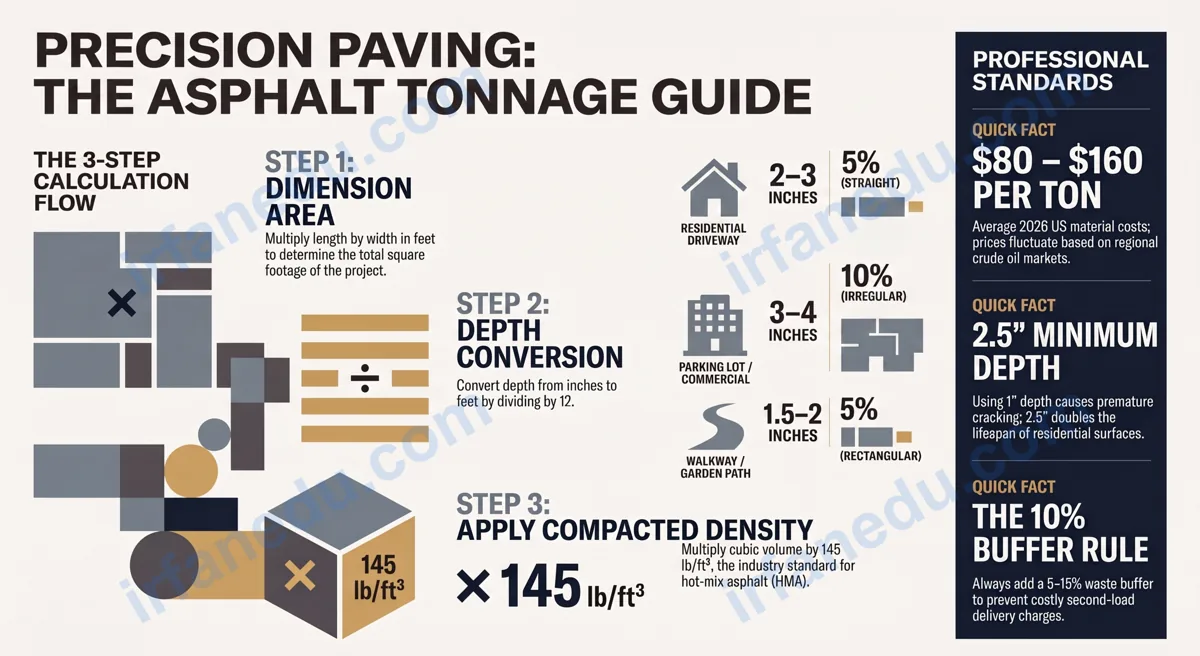
- 📐 Standard residential driveway depth: 2–3 inches of compacted asphalt
- ⚖️ Asphalt density used: 145 lb/ft³ (industry standard for hot-mix)
- 💰 Average material cost: $80–$160 per ton (varies by region, 2026)
- ➕ Always add 5–10% waste buffer to your calculated tonnage
- 🏗️ Calculator works for driveways, parking lots, paths, and patios
Blacktop Calculator
Tonnage · Cubic Yards · Material Cost
ft
ft
inches
USD/ton
📊 Your Estimate
tons
Step-by-Step Solution
How to Use This Blacktop Calculator
- Choose your mode: “By Dimensions” if you know length and width separately; “By Area” if you already have total square footage.
- Enter your dimensions in feet (length and width) or total area in sq ft.
- Set the depth in inches. Use 2 in for a standard residential driveway, 3–4 in for heavy-use areas.
- Pick a waste buffer — 5% for straight rectangles, 10–15% for curves or irregular shapes.
- Enter price per ton (optional) to get an instant material cost estimate.
- Click Calculate. Your tonnage, cubic yards, pounds, and cost appear with a full step-by-step breakdown.
🟠 Which Calculator Mode Should You Use? (Decision Guide)
Before you enter a single number, pick the right mode. The table below maps your situation to the best approach — this is the decision most guides skip entirely.
| Your Situation | Best Mode | Depth to Use | Waste Buffer | Notes |
|---|---|---|---|---|
| Straight rectangular driveway, new install | By Dimensions | 2–3 in | 5% | Simplest case; measure L & W with a tape |
| Irregular or curved driveway | By Area (sq ft) | 2–3 in | 10–15% | Sketch the area, break into rectangles, sum sq ft |
| Parking lot or commercial apron | By Area (sq ft) | 3–4 in | 10% | Higher depth for vehicle loads; confirm with engineer |
| Patching / overlay on existing blacktop | By Dimensions | 1–1.5 in | 5% | Overlay only; base is already there |
| Walkway or garden path | By Dimensions | 1.5–2 in | 5% | Light foot traffic; thinner layer acceptable |
In my experience advising homeowners on paving projects, the most common error is using 1-inch depth to save money on a new driveway. That thin layer cracks within two winters in cold climates. I always recommend 2.5 inches minimum for residential driveways — the extra half-inch adds maybe $80–$120 in material cost but doubles the lifespan of the surface.
📐 The Blacktop Formula Explained
The formula behind this calculator is the same one paving contractors use on every job. It has three steps.
The constant 145 lb/ft³ is the standard compacted density of hot-mix asphalt (HMA). Some mixes range from 140–148 lb/ft³, but 145 is the accepted estimating value used across the US paving industry.
| Symbol | Meaning | SI / Imperial Unit | Typical Value |
|---|---|---|---|
| L | Length of paving area | feet (ft) | Project-specific |
| W | Width of paving area | feet (ft) | Project-specific |
| D | Asphalt depth/thickness | inches (in) | 2–4 in typical |
| V | Volume of asphalt | cubic feet (ft³) | Calculated |
| ρ | Density of compacted HMA | lb/ft³ (≈ 2,320 kg/m³) | 145 lb/ft³ |
| T | Tonnage (short tons) | US short tons (2,000 lb) | Calculated |
🔍 Visual: How the Formula Flows
  ┌─────────────────────────────────────────────────────┐
  │  STEP 1: Measure your area                          │
  │  ┌──────────────────────┐                           │
  │  │  Length = 40 ft      │                           │
  │  │  Width  = 12 ft      │  Area = 480 sq ft         │
  │  └──────────────────────┘                           │
  │                                                     │
  │  STEP 2: Convert depth to feet                      │
  │  Depth = 2 in  →  2 ÷ 12 = 0.1667 ft               │
  │                                                     │
  │  STEP 3: Volume                                     │
  │  480 sq ft × 0.1667 ft = 80.0 ft³                   │
  │                                                     │
  │  STEP 4: Weight                                     │
  │  80.0 ft³ × 145 lb/ft³ = 11,600 lbs                 │
  │                                                     │
  │  STEP 5: Tons                                       │
  │  11,600 ÷ 2,000 = 5.80 tons                         │
  │  + 5% waste → 5.80 × 1.05 = 6.09 tons  ✓           │
  └─────────────────────────────────────────────────────┘
🔧 Worked Examples
Example 1 — Standard Residential Driveway (40 ft × 12 ft × 2 in)
- Area = 40 × 12 = 480 sq ft
- Depth in feet = 2 ÷ 12 = 0.1667 ft
- Volume = 480 × 0.1667 = 80.0 ft³ (2.96 cu yd)
- Weight = 80.0 × 145 = 11,600 lbs
- Tons = 11,600 ÷ 2,000 = 5.80 tons
- With 5% waste: 5.80 × 1.05 = 6.09 tons to order
- At $120/ton: 6.09 × $120 = $730.80 material cost
Example 2 — Small Parking Apron (20 ft × 20 ft × 3 in)
- Area = 20 × 20 = 400 sq ft
- Depth in feet = 3 ÷ 12 = 0.25 ft
- Volume = 400 × 0.25 = 100.0 ft³ (3.70 cu yd)
- Weight = 100.0 × 145 = 14,500 lbs
- Tons = 14,500 ÷ 2,000 = 7.25 tons
- With 10% waste: 7.25 × 1.10 = 7.98 tons to order
Example 3 — Overlay / Resurfacing (60 ft × 10 ft × 1.5 in)
- Area = 60 × 10 = 600 sq ft
- Depth in feet = 1.5 ÷ 12 = 0.125 ft
- Volume = 600 × 0.125 = 75.0 ft³ (2.78 cu yd)
- Weight = 75.0 × 145 = 10,875 lbs
- Tons = 10,875 ÷ 2,000 = 5.44 tons
- With 5% waste: 5.44 × 1.05 = 5.71 tons to order
⚠️ Common Mistakes When Estimating Blacktop
| ❌ Wrong Approach | ✅ Correct Approach |
|---|---|
| Using 1 inch depth to save cost on a new driveway | Use 2–3 inches; thin layers crack quickly under vehicle weight |
| Forgetting to convert depth from inches to feet in the formula | Always divide depth (inches) by 12 before multiplying by area |
| Ordering the exact calculated amount with no buffer | Add 5–10% waste; short deliveries mean costly second orders |
| Using loose asphalt density (110 lb/ft³) instead of compacted | Use 145 lb/ft³ for compacted HMA — this is what you actually lay |
| Measuring an irregular driveway as one rectangle | Break it into sub-rectangles, calculate each, then sum the totals |
I’ve seen contractors quote jobs using loose-fill density (around 110 lb/ft³) instead of compacted density (145 lb/ft³). That 32% difference means they order 32% less material than the job actually needs. Always confirm with your supplier whether their quote is based on compacted or loose weight — it’s a question most homeowners never think to ask, and it
Sources & References
Reviewed by Dr. Irfan Mansuri. External links open in a new tab and are provided for further reading and verification.