
🔧 Pipe Weight Calculator – Steel, PVC, Copper & More
📋 Table of Contents
A pipe weight calculator computes the total weight of a hollow cylindrical pipe from four inputs: outer diameter (OD), wall thickness (t), pipe length (L), and material density (ρ). The result helps engineers, plumbers, and contractors size supports, plan shipping, and verify structural loads — in seconds.
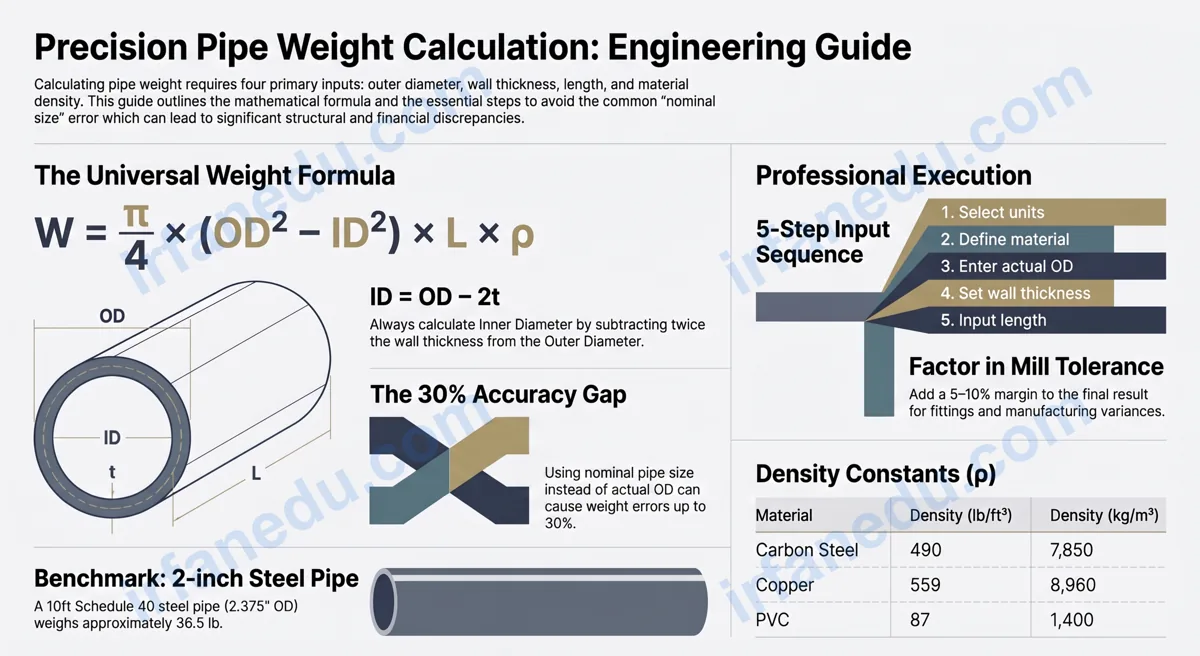
In my experience reviewing construction projects, the single most common error I see is people using the pipe’s nominal size instead of its actual outer diameter. That one mistake can throw off a weight estimate by 15–30%. The calculator below uses the correct real-world formula and shows you every step so you can trust the number.
⚡ TL;DR – Quick Summary
- 🔩 Formula: W = (π/4) × (OD² − ID²) × L × ρ — four inputs, one answer.
- 📐 ID = OD minus twice the wall thickness; never use nominal pipe size as OD.
- ⚖️ Steel density ≈ 490 lb/ft³; PVC ≈ 87 lb/ft³; copper ≈ 559 lb/ft³.
- 🖩 The calculator below outputs lb and kg with a numbered step-by-step solution.
- ⚠️ Add a 5–10% margin to account for mill tolerance and fittings.
- 🏗️ Works for any material — enter a custom density for exotic alloys.
in
in
ft
in
lb
🖩 How to Use This Pipe Weight Calculator
- Choose your unit system — click Inches / Feet / lb for US customary or mm / m / kg for metric.
- Select the material — pick Steel, Copper, PVC, Aluminum, or enter a custom density for any other alloy.
- Enter the Outer Diameter (OD) — use the actual OD from the pipe’s data sheet, not the nominal size.
- Enter the Wall Thickness (t) — find this on the pipe schedule table or the manufacturer’s spec.
- Enter the Pipe Length — in feet (imperial) or meters (metric).
- Click Calculate — the result card shows the total weight in lb and kg, the weight per foot/meter, and a numbered solution.
📐 What Is the Pipe Weight Formula?
Pipe weight equals the volume of the hollow cylinder multiplied by the material density. The pipe is a hollow cylinder, so its cross-sectional area is the area of the outer circle minus the area of the inner circle.
W = (π / 4) × (OD² − ID²) × L × ρ
where ID = OD − 2t
| Symbol | Meaning | Imperial Unit | SI Unit |
|---|---|---|---|
| W | Pipe weight | lb | kg |
| OD | Outer diameter | in (→ convert to ft) | mm (→ convert to m) |
| ID | Inner diameter | in (→ convert to ft) | mm (→ convert to m) |
| t | Wall thickness | in | mm |
| L | Pipe length | ft | m |
| ρ | Material density | lb/ft³ | kg/m³ |
| π | Pi (constant) | ≈ 3.14159 | |
Common material densities:
| Material | lb/ft³ | kg/m³ |
|---|---|---|
| Carbon Steel | 490 | 7,850 |
| Stainless Steel 304 | 499 | 8,000 |
| Copper | 559 | 8,960 |
| Aluminum | 169 | 2,700 |
| PVC | 87 | 1,400 |
| Cast Iron | 450 | 7,200 |
  Pipe Cross-Section (end view)
  ─────────────────────────────
          ┌──────────────┐
        ╱                  ╲
       │   ┌──────────┐    │
       │   │          │    │  ← Wall thickness (t)
       │   │  (hollow)│    │
       │   │          │    │
       │   └──────────┘    │
        ╲                  ╱
          └──────────────┘
       ←──── OD ────────→
           ←── ID ──→
           ID = OD − 2t

  Weight = (π/4) × (OD² − ID²) × L × ρ
✏️ Worked Examples — Matching the Calculator’s Steps
OD = 2.375 in, t = 0.154 in, L = 10 ft, ρ = 490 lb/ft³
1. ID = 2.375 − 2×0.154 = 2.067 in
2. OD in ft = 2.375/12 = 0.197917 ft; ID in ft = 2.067/12 = 0.172250 ft
3. Area = π/4 × (0.197917² − 0.172250²) = π/4 × (0.039171 − 0.029670) = π/4 × 0.009501 = 0.007461 ft²
4. Volume = 0.007461 × 10 = 0.07461 ft³
5. Weight = 0.07461 × 490 = 36.56 lb (16.58 kg)
OD = 50 mm, t = 2 mm, L = 3 m, ρ = 8,960 kg/m³
1. ID = 50 − 2×2 = 46 mm
2. OD in m = 0.050 m; ID in m = 0.046 m
3. Area = π/4 × (0.050² − 0.046²) = π/4 × (0.002500 − 0.002116) = π/4 × 0.000384 = 0.000302 m²
4. Volume = 0.000302 × 3 = 0.000905 m³
5. Weight = 0.000905 × 8,960 = 8.11 kg (17.88 lb)
OD = 4.500 in, t = 0.337 in, L = 20 ft, ρ = 490 lb/ft³
1. ID = 4.500 − 2×0.337 = 3.826 in
2. OD_ft = 0.375000 ft; ID_ft = 0.318833 ft
3. Area = π/4 × (0.375² − 0.318833²) = π/4 × (0.140625 − 0.101654) = π/4 × 0.038971 = 0.030596 ft²
4. Volume = 0.030596 × 20 = 0.61192 ft³
5. Weight = 0.61192 × 490 = 299.8 lb (136.0 kg)
In my experience reviewing pipe procurement specs, the most expensive mistake is confusing nominal pipe size (NPS) with actual outer diameter. A 2-inch NPS steel pipe has an OD of 2.375 inches — not 2.000 inches. That 19% difference compounds across hundreds of feet of pipe. I always tell engineers: pull the actual OD
Sources & References
Written and fact-checked by Dr Irfan Mansuri. External links open in a new tab and are provided for further reading and verification.