
How Much Topsoil Do I Need? 🌱 Free Calculator + Formula
📋 Table of Contents
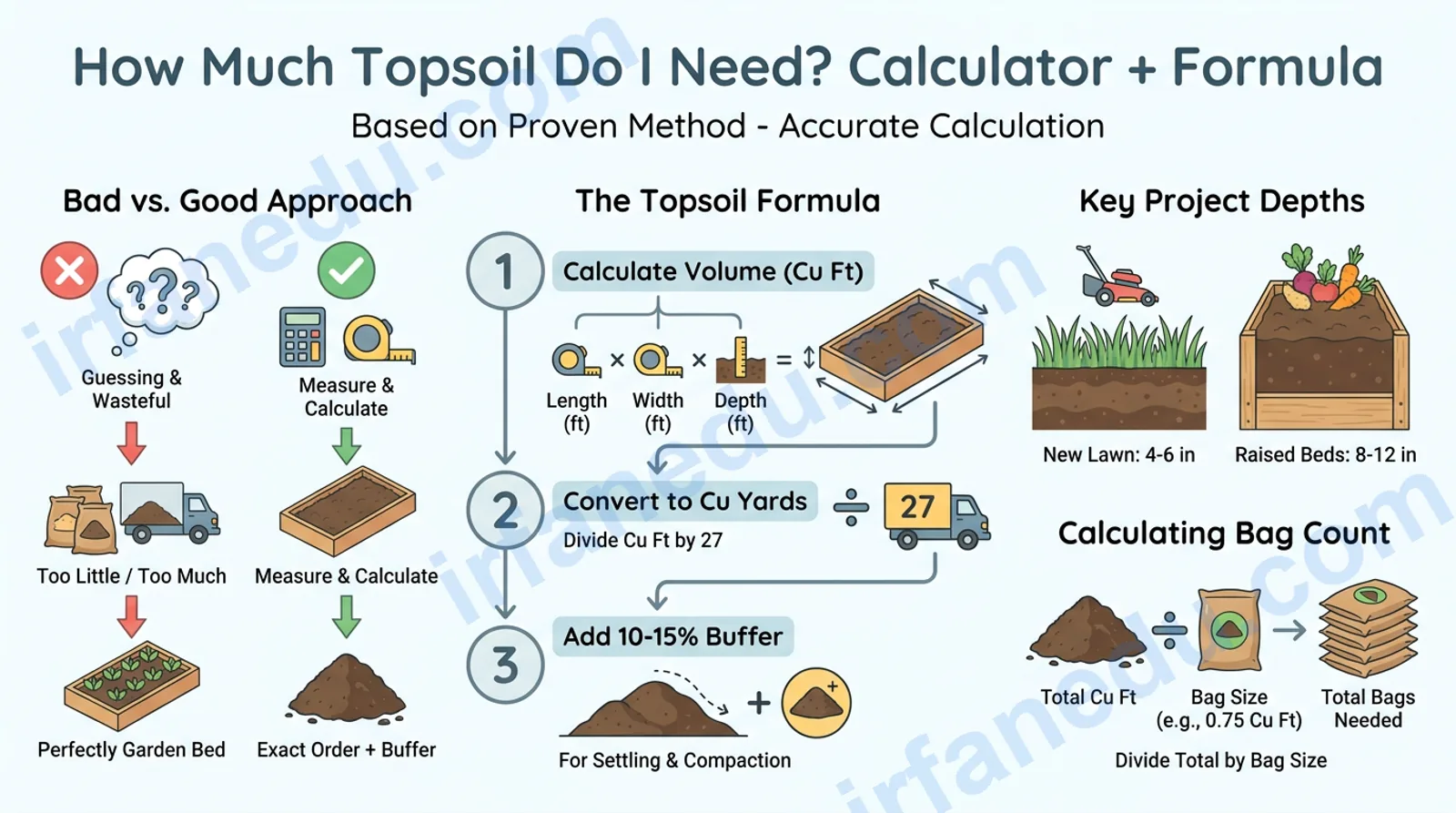
❌ Bad Approach
Guessing “a few bags should do it” — then making three trips to the store because you ran out halfway through the job. Sound familiar?
✅ Good Approach
Measure once, calculate exactly, add 10% buffer, order once. The calculator below does the math in under 10 seconds.
Every year, I see gardeners and homeowners waste money on topsoil — either buying too much (and having a pile sit in the driveway all summer) or buying too little (and running back to the store mid-project). The fix is a simple formula that takes about 30 seconds to run. This page gives you a working calculator, the exact formula, and three real-world examples so you understand every number it produces.
To find how much topsoil you need, multiply your area’s length by its width by the desired depth (all in feet), then divide by 27 to get cubic yards. For example, a 10 ft × 10 ft bed at 6 inches deep needs 1.85 cubic yards. Most bags are 0.75–1 cubic foot, so divide your cubic-foot total by the bag size to get bag count. Always add 10–15% extra for settling.
📌 Quick Summary
- 🧮 Formula: Volume (cu ft) = Length × Width × Depth (all in feet)
- 📐 Divide cubic feet by 27 to convert to cubic yards
- 🛍️ One 40-lb bag ≈ 0.75 cu ft; divide total cu ft by bag size for bag count
- 🌱 New lawn needs 4–6 in depth; raised beds need 8–12 in depth
- 📦 Always order 10–15% extra to account for settling and compaction
- ⭕ For circular areas, use π × r² × depth instead
Topsoil Calculator
Find cubic yards, cubic feet, and bag count instantly
ft
ft
in
📊 Your Topsoil Estimate
cubic yards
Step-by-Step Solution
How to Use This Topsoil Calculator
- Choose your unit system (Imperial for feet/inches, Metric for meters/centimeters).
- Select your area shape: rectangle, circle, or triangle.
Sources & References
Written and fact-checked by Dr Irfan Mansuri. External links open in a new tab and are provided for further reading and verification.