
Pavement Calculator: Asphalt & Concrete Volume, Tonnage & Cost
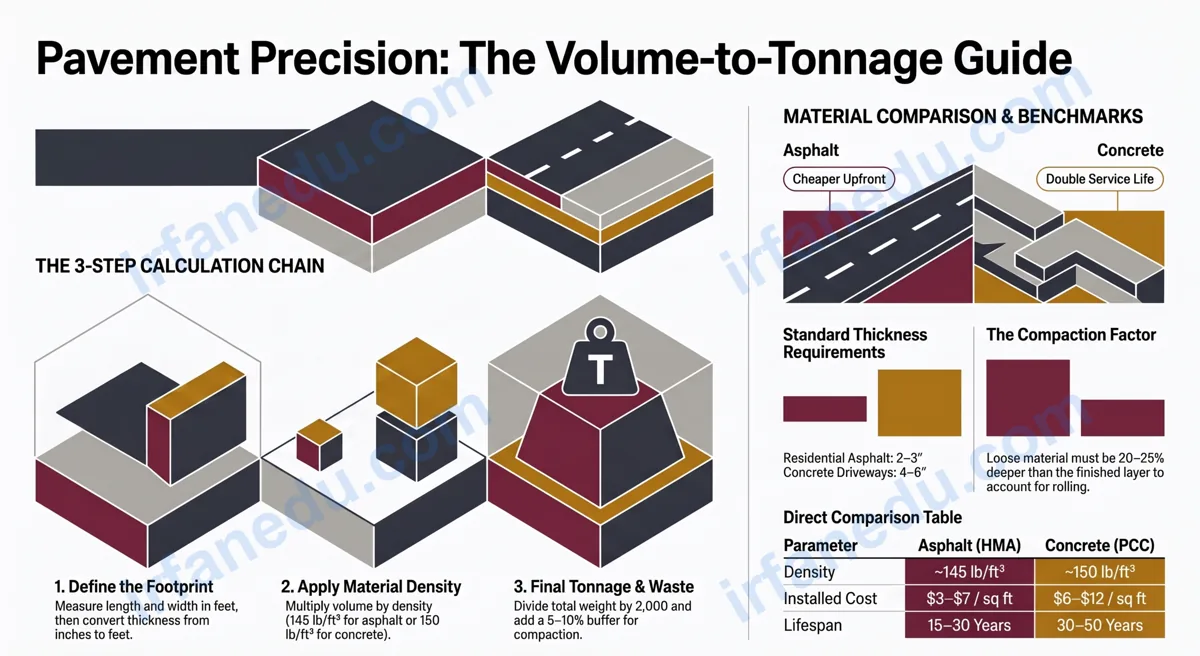
Most pavement calculators give you a cubic-yard number and leave you to figure out the rest. The part they skip is the density conversion — and that is exactly where most DIY estimates go wrong by 20% or more.
In my experience helping students and homeowners work through construction math, the single most common error is confusing volume with weight. Contractors quote asphalt by the ton, not the cubic yard. If you skip the density step, you will either over-order and waste money, or under-order and face a costly second delivery. This calculator does that conversion for you automatically — and shows every step so you can verify it yourself.
⚡ TL;DR – Quick Summary
- Volume (ft³) = Length × Width × Thickness (all in feet).
- Tons = Volume × Density (lb/ft³) ÷ 2,000.
- Asphalt density is ~145 lb/ft³; concrete is ~150 lb/ft³.
- Always add 5–10% extra material for compaction loss and waste.
- Contractors quote by the ton; this calculator handles the conversion.
- Material cost alone does not include labor, base prep, or grading.
| Parameter | Asphalt (HMA) | Concrete |
|---|---|---|
| Density | ~145 lb/ft³ (2,322 kg/m³) | ~150 lb/ft³ (2,400 kg/m³) |
| Typical driveway thickness | 2–3 in (+ 4–6 in base) | 4–6 in (+ 4 in base) |
| Sold by | US ton (2,000 lb) | Cubic yard or bag |
| Avg. installed cost (US) | $3–$7 / sq ft | $6–$12 / sq ft |
| Lifespan (maintained) | 15–30 years | 30–50 years |
Pavement Calculator
Volume • Tonnage • Material Cost
ft
ft
in
$/ton
Step-by-Step Solution
How to Use This Pavement Calculator
The calculator needs five inputs and returns volume, tonnage, and an optional cost estimate in seconds. Here is the exact sequence to follow:
- Enter Length and Width — Measure your paving area in feet. For irregular shapes, break the area into rectangles and run the calculator once for each.
- Enter Thickness in inches — Residential driveways typically use 2–3 inches of asphalt; commercial lots use 4+ inches. Concrete driveways are usually 4–6 inches.
- Choose Material — Select Asphalt (145 lb/ft³), Concrete (150 lb/ft³), or enter a custom density if your supplier specifies a different mix.
- Enter Price per Ton (optional) — Get a quote from your local supplier and type it in. Leave blank if you only need tonnage.
- Set Waste Factor — Use 5% for a standard rectangular driveway, 10% for irregular shapes, 15% for complex projects with curves or cutouts.
What Is Pavement and Why Does Density Matter?
Pavement is a durable surface layer applied to roads, driveways, parking lots, and pathways to support traffic loads and resist weathering. The two most common materials are hot-mix asphalt (HMA) and Portland cement concrete (PCC).
Density is the critical number most online calculators hide. Asphalt is sold by the US ton (2,000 lb), not by volume. A cubic foot of compacted HMA weighs approximately 145 lb. Concrete is denser at roughly 150 lb/ft³. If you skip the density conversion and order by cubic yards alone, you will get the wrong quantity every time.
The Pavement Formula: Volume, Tonnage, and Cost
The pavement calculation uses three sequential formulas. Each one feeds directly into the next.
Formula Chain
Step 1 — Volume (ft³):
  V = L × W × (D_in ÷ 12)

Step 2 — Weight (lb):
  Weight = V × ρ
  where ρ = material density in lb/ft³

Step 3 — Tonnage (US tons):
  Tons = Weight ÷ 2,000

Step 4 — With waste factor:
  Tons_final = Tons × (1 + waste%)

Step 5 — Material cost (optional):
  Cost = Tons_final × price_per_ton
| Symbol | Meaning | Unit |
|---|---|---|
| L | Length of paving area | feet (ft) |
| W | Width of paving area | feet (ft) |
| D_in | Pavement thickness | inches (in) |
| V | Volume of material | cubic feet (ft³) |
| ρ | Material density | lb/ft³ |
| Tons | Weight in US tons | short tons (2,000 lb) |
| waste% | Overage for compaction & waste | % (decimal) |
SI note: If working in metric, replace density with kg/m³ (asphalt ~2,322 kg/m³; concrete ~2,400 kg/m³) and divide by 1,000 to get metric tonnes.
Worked Examples That Match the Calculator’s Steps
Example 1: Standard Residential Asphalt Driveway
Given: 40 ft long, 12 ft wide, 3 in thick asphalt driveway. Supplier price: $85/ton. Waste: 5%.
- Convert thickness: 3 in ÷ 12 = 0.25 ft
- Area: 40 × 12 = 480 ft²
- Volume: 480 × 0.25 = 120 ft³ (= 4.44 yd³)
- Weight: 120 × 145 = 17,400 lb
- Tons: 17,400 ÷ 2,000 = 8.70 tons
- With 5% waste: 8.70 × 1.05 = 9.14 tons
- Material cost: 9.14 × $85 = $776.85
Example 2: Concrete Parking Pad
Given: 20 ft × 20 ft, 4 in thick concrete slab. Waste: 10%.
- Convert thickness: 4 ÷ 12 = 0.333 ft
- Area: 20 × 20 = 400 ft²
- Volume: 400 × 0.333 = 133.3 ft³ (= 4.94 yd³)
- Weight: 133.3 × 150 = 20,000 lb
- Tons: 20,000 ÷ 2,000 = 10.00 tons
- With 10% waste: 10.00 × 1.10 = 11.00 tons
Example 3: Small Asphalt Repair Patch
Given: 6 ft × 4 ft, 2 in thick asphalt patch. No waste factor needed for a small patch.
- Convert thickness: 2 ÷ 12 = 0.167 ft
- Area: 6 × 4 = 24 ft²
- Volume: 24 × 0.167 = 4.0 ft³
- Weight: 4.0 × 145 = 580 lb
- Tons: 580 ÷ 2,000 = 0.29 tons
Note: Most suppliers have a minimum order of 1 ton for delivery. For small patches, cold-mix asphalt bags from a hardware store are more practical.
Common Mistakes (and How to Avoid Them)
Right: Contractors price asphalt by the ton. Always convert: Tons = (ft³ × density) ÷ 2,000.
Right: Divide inches by 12 first. A 3-inch slab is 0.25 ft, not 3 ft.
Right: Asphalt compacts 10–15% during rolling. Always add at least 5% extra material.
Right: Dense-grade HMA is ~145 lb/ft³, but open-graded or porous mixes can be 120–135 lb/ft³. Confirm with your supplier.
Most pavement guides tell you to add a waste factor but never explain why. Here is the real reason: loose asphalt mix is placed at a thickness roughly 20–25% greater than the final compacted depth. A 3-inch finished layer requires about 3.6 inches of loose material. The 5–10% tonnage buffer accounts for this compaction loss plus edge trimming and any spillage during placement. If your contractor uses a vibratory roller (standard practice), the compaction ratio is predictable and 5% waste is usually sufficient for a straight rectangular driveway.
I have reviewed dozens of pavement estimating tools, and the one thing that separates a useful calculator from a useless one is the step-by-step solution. When a homeowner can see exactly how the tonnage was computed, they can walk into a supplier conversation with confidence and catch errors in a contractor’s quote. That transparency is what I built into this tool, and it is the reason I consider the step-by-step output non-negotiable.
Asphalt vs. Concrete: Which Should You Choose?
The right material depends on your budget, climate, and long-term maintenance tolerance. Here is a direct comparison to help you decide.
| Factor | Asphalt (HMA) | Concrete (PCC) |
|---|---|---|
| Upfront material cost | Lower ($3–$7/sq ft installed) | Higher ($6–$12/sq ft installed) |
| Lifespan | 15–30 years | 30–50 years |
| Maintenance |
Sources & ReferencesReviewed by Dr. Irfan Mansuri. External links open in a new tab and are provided for further reading and verification. |