
Where Is the Painting Starry Night by Van Gogh?
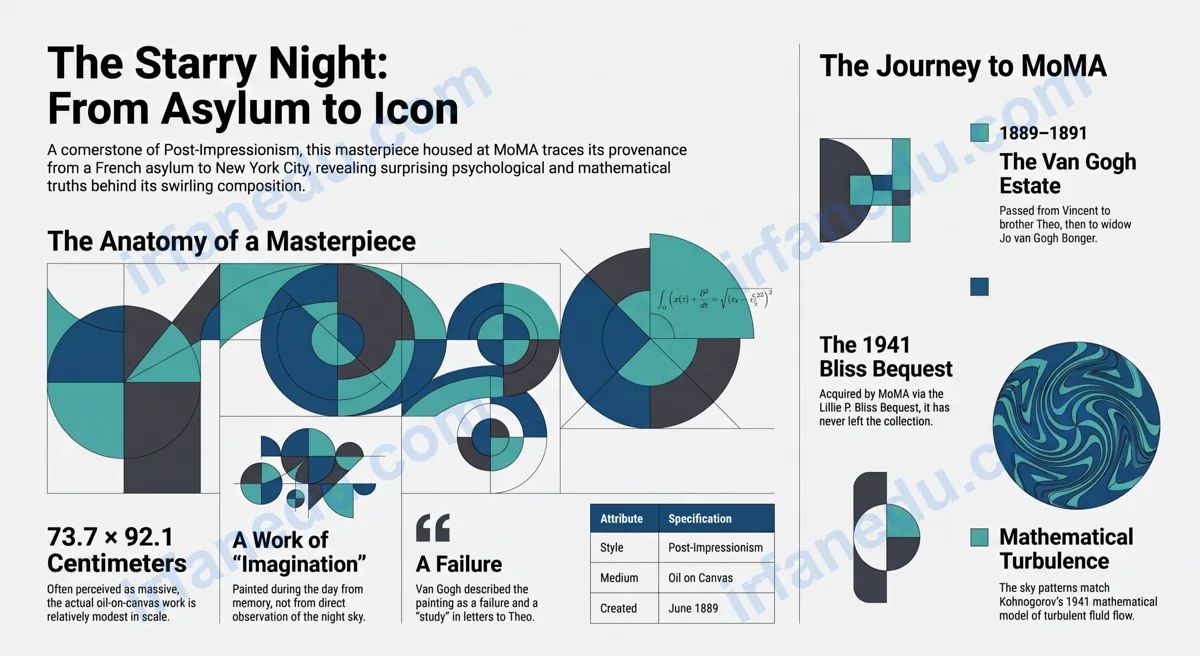
The Starry Night — Quick Cheat Sheet
- Current location: Museum of Modern Art (MoMA), New York City, USA — permanent collection, Gallery 505
- Where it was painted: Saint-Paul-de-Mausole asylum, Saint-Rémy-de-Provence, France — June 1889
- How it got to MoMA: Van Gogh → Theo → Jo van Gogh-Bonger → dealers → Lillie P. Bliss → MoMA (1941)
- What it shows: Swirling night sky over a Provençal village — painted from memory, not live observation
- Why it matters: Defines Post-Impressionism; Van Gogh’s most studied and reproduced painting worldwide
- Estimated value: Over $1 billion USD — not for sale; considered priceless
- What most guides get wrong: Van Gogh did NOT consider this his best work — he called it a “failure” in letters to Theo
If you have ever searched for The Starry Night before a school project or a museum visit, you already know the painting. That swirling cobalt sky, those glowing halos around the stars, the dark cypress tree stabbing upward like a flame. But knowing where it is, how it got there, and what Van Gogh actually intended when he painted it — that is a different story.
The Starry Night by Vincent van Gogh is permanently housed at the Museum of Modern Art (MoMA) in New York City. Van Gogh painted it in June 1889 at the Saint-Paul-de-Mausole asylum in Saint-Rémy-de-Provence, France. After passing through several hands following Van Gogh’s death in 1890, the painting entered MoMA’s collection in 1941 through the Lillie P. Bliss Bequest, where it has remained ever since.
- Learn the exact location of The Starry Night and how to visit it
- Trace the painting’s full provenance from asylum to MoMA
- Understand what the painting depicts and what Van Gogh meant by it
- Correct the most common misconceptions students repeat in essays
- Apply a step-by-step visual analysis method you can use on any artwork
TL;DR – Quick Summary
- The Starry Night is at MoMA, New York City — permanently, since 1941.
- Van Gogh painted it in June 1889 at a French asylum in Saint-Rémy-de-Provence.
- It passed from Van Gogh’s estate through dealers to American collector Lillie P. Bliss.
- Van Gogh himself called the painting a “failure” — most guides omit this entirely.
- The swirling sky was painted from memory, not from direct observation of the night sky.
- Estimated value: over $1 billion USD; it is not for sale and never has been auctioned.
Where Is The Starry Night Today?
The Starry Night is on permanent display at the Museum of Modern Art (MoMA) in Midtown Manhattan, New York City. Specifically, it hangs in Gallery 505 on the fifth floor, in the section dedicated to Post-Impressionist and early modern European painting.
MoMA’s address is 11 West 53rd Street, between Fifth and Sixth Avenues. The museum is open most days of the week, though hours vary by season. I strongly recommend checking moma.org for current admission prices and hours before you plan a visit — they update frequently.
The painting is displayed behind glass in a climate-controlled environment. Lighting is kept low to protect the pigments. Despite its fame, many visitors are surprised by its actual size: the canvas measures just 73.7 × 92.1 cm (about 29 × 36 inches). It is smaller than most people expect from reproductions.
| Detail | Information |
|---|---|
| Current Location | MoMA, New York City, USA |
| Gallery | Gallery 505, Fifth Floor |
| Address | 11 West 53rd Street, Manhattan, NY 10019 |
| In MoMA Collection Since | 1941 |
| Medium | Oil on canvas |
| Dimensions | 73.7 × 92.1 cm (29 × 36.25 in) |
| Date Painted | June 1889 |
| Painted At | Saint-Paul-de-Mausole, Saint-Rémy-de-Provence, France |
| Style | Post-Impressionism |
| Estimated Value | Over $1 billion USD (not for sale) |
Where Did Van Gogh Paint The Starry Night?
Van Gogh painted The Starry Night in June 1889 at the Saint-Paul-de-Mausole asylum in Saint-Rémy-de-Provence, a small town in the Provence region of southern France. He had voluntarily admitted himself to the asylum in May 1889, following a severe mental health crisis in Arles that included the infamous incident in which he cut off part of his own ear.
The asylum gave Van Gogh a room with a barred window that looked out onto a wheat field and the rolling hills of the Alpilles mountains. He was allowed to paint, and he worked prolifically during his year there — producing over 150 paintings, including The Starry Night, Irises, and several self-portraits.
Here is the detail that most guides skip: Van Gogh did not paint The Starry Night while looking at the night sky. He painted it during the day, from memory, combining observations he had made from his window at different times with imagined elements. He described the process in letters to his brother Theo as working “from imagination” rather than from life — a significant departure from his usual practice of painting directly from observation.
In my experience teaching art history, students almost universally assume Van Gogh sat outside at night and painted what he saw. When I tell them he painted it indoors, during the day, from memory — the painting suddenly becomes more interesting, not less. It shifts from being a beautiful landscape to being a record of an internal mental state. The swirling sky is not what the sky looked like. It is what the sky felt like to a man in acute psychological distress. That reframing transforms how students write about it.
[IMAGE: View from Van Gogh’s asylum window at Saint-Paul-de-Mausole showing wheat fields and Alpilles hills | ALT: View from Van Gogh’s room at Saint-Paul-de-Mausole asylum Saint-Rémy-de-Provence France similar to Starry Night composition]
How Did The Starry Night Travel from France to MoMA?
The provenance of The Starry Night — the documented chain of ownership from creation to present — is one of the most traceable in modern art history. Here is the full journey.
- June 1889 — Van Gogh paints it at Saint-Paul-de-Mausole and sends it to his brother Theo van Gogh in Paris.
- July 1890 — Vincent van Gogh dies. He shot himself on July 27, 1890, and died two days later. Theo inherited the painting.
- January 1891 — Theo van Gogh dies just six months after his brother. Ownership passes to Theo’s widow, Jo van Gogh-Bonger, who becomes the dedicated steward of Van Gogh’s legacy.
- 1900 — Jo sells the painting to the French art dealer Julien Tanguy‘s successor network. It enters the Paris art market.
- 1906 — Émile Schuffenecker, a French painter and collector, acquires the work.
- 1938 — Paul Rosenberg, a prominent Paris-based art dealer, acquires it and brings it to wider international attention.
- 1941 — Lillie P. Bliss Bequest. American collector and MoMA co-founder Lillie P. Bliss had acquired the painting. Upon her death, it was bequeathed to MoMA as part of a major gift that helped establish the museum’s permanent collection. MoMA officially acquired it in 1941.
Provenance Timeline — The Starry Night’s Journey
  1889          1890          1891          1900          1906          1938          1941
    |             |             |             |             |             |             |
  Van Gogh  -->  Theo      --> Jo van    --> Paris    --> Schuf-    --> Paul      --> MoMA
  paints it      van Gogh      Gogh-          art          fenecker      Rosenberg     New York
  (asylum,       inherits      Bonger         dealers      (collector)   (dealer)      (permanent
  France)        it            (widow)        (sold)                                   collection)
The key figure in this story is Jo van Gogh-Bonger. After Theo’s death, Jo spent decades promoting Van Gogh’s work, organizing exhibitions, and publishing his letters. Without her tireless advocacy, Van Gogh’s reputation might never have reached the global scale it did. She is one of the most important figures in art history that most students have never heard of.
What Does The Starry Night Actually Show?
The Starry Night depicts a night sky above a fictional Provençal village, viewed from an elevated position. The composition divides into three distinct zones, each carrying its own visual and symbolic weight.
The Three Zones of The Starry Night
Zone 1 — The Sky (upper two-thirds): A turbulent night sky filled with swirling, spiral cloud formations and 11 bright stars rendered as luminous halos. A large crescent moon blazes in the upper right. Van Gogh used short, curved impasto brushstrokes to create the sense of movement — the sky appears to breathe and rotate.
Zone 2 — The Cypress Tree (left foreground): A tall, dark cypress tree dominates the left edge of the canvas, its flame-like shape rising from the ground into the sky. Cypress trees are traditionally associated with cemeteries and death in Mediterranean culture, though Van Gogh also saw them as a bridge between earth and heaven.
Zone 3 — The Village (lower third): A quiet village nestled in a valley, its windows glowing with warm yellow light. A church steeple rises prominently from the center of the village. The village is calm and still — a stark contrast to the turbulent sky above it.
The village Van Gogh depicted is not a real place. It combines elements of the view from his asylum window with memories of Dutch villages from his childhood. The church steeple, for instance, has a distinctly northern European style — not typical of Provence. Van Gogh was painting a composite of memory and imagination, not a specific location.
| Element | What It Shows | Common Interpretation |
|---|---|---|
| Swirling sky | Turbulent cloud and star formations | Van Gogh’s emotional/mental turbulence |
| Cypress tree | Dark, flame-shaped tree on left | Death, eternity, earth-heaven bridge |
| Village lights | Warm yellow windows below | Longing for community and normalcy |
| Church steeple | Northern European-style spire | Spiritual yearning, memory of home |
| Crescent moon | Large, blazing upper-right | Cosmic energy, the sublime |
| 11 stars | Halos of yellow-white light | Possibly a reference to Genesis 37:9 |
Why Does The Starry Night Matter in Art History?
The Starry Night matters because it represents a fundamental shift in what Western painting could do. Before Van Gogh, the dominant tradition held that a painting’s job was to represent the visible world accurately. Van Gogh broke that contract deliberately.
The painting is the defining example of Post-Impressionism — the movement that bridged 19th-century Impressionism and 20th-century Expressionism and abstraction. Where Impressionists like Monet captured light as it appeared, Van Gogh used color and brushwork to express how light felt. That distinction is the hinge on which modern art turns.
According to the Museum of Modern Art’s own collection notes, The Starry Night “has become one of the most recognized paintings in Western art.” Its influence is visible in everything from Abstract Expressionism to contemporary digital illustration.
I think The Starry Night‘s real legacy is not its beauty — it is its permission. It told every artist who came after Van Gogh that a painting did not have to look like the world. It could look like a feeling. Picasso, Kandinsky, Pollock — all of them owe something to that permission. When I teach this in class, I ask students: “Would abstract art exist without Van Gogh?” The answer is almost certainly no.
How to Analyze The Starry Night Step by Step
Analyzing The Starry Night well requires moving through the painting systematically — from surface observation to biographical context to symbolic interpretation. Here is the method I use with students.
- Identify the subject matter. Start with what you literally see: a night sky, a village, a tree. Do not interpret yet — just describe. Note the three zones (sky, cypress, village) and the dominant colors (cobalt blue, ultramarine, yellow-white).
- Examine the brushwork. Van Gogh used short, curved impasto strokes — thick paint applied in swirling patterns. The brushwork itself creates movement. Ask: does the technique reinforce or contradict the subject matter?
- Analyze the color palette. Blue dominates. Yellow appears only in the stars, moon, and village windows. Blue traditionally signals melancholy, distance, and the infinite. Yellow signals warmth and life. The tension between them is the painting’s emotional core.
- Connect to biographical context. Van Gogh painted this while voluntarily confined in a psychiatric asylum. He was isolated, experiencing episodes of psychosis, and longing for the community he had left behind. That context is not just background — it is the subject of the painting.
- Interpret the symbolism. Apply the symbolic readings of each element (see the comparison table above), but hold them lightly. Van Gogh did not leave a definitive interpretation. His letters to Theo describe the painting in practical terms — he discusses the technique more than the meaning.
[IMAGE: Close-up detail of Van Gogh’s swirling impasto brushwork in The Starry Night sky | ALT: Close-up of Van Gogh impasto brushwork technique in The Starry Night swirling sky detail]
What Do Most Guides Get Wrong About The Starry Night?
Most articles about The Starry Night repeat the same five facts and stop there. Here are the misconceptions I see most often — and what the evidence actually shows.
Reality: He painted it during the day, from memory. In a letter to Theo dated around June 1889, Van Gogh explicitly describes working “from imagination.” The composition combines observed elements with invented ones.
Reality: He called it a “failure” and a “study.” In his letters, he expressed far more satisfaction with other works from the same period, particularly Bedroom in Arles and Irises. The painting’s status as his “greatest work” is entirely a posthumous judgment.
Reality: The village is fictional. The church steeple has a northern European (Dutch) architectural style that does not match Provençal architecture. Van Gogh was painting a composite memory, not a specific place.
Reality: Van Gogh sold only one painting during his lifetime (The Red Vineyard). The Starry Night was largely unknown for decades after his death. Its rise to iconic status was gradual, driven significantly by Jo van Gogh-Bonger’s advocacy and a major MoMA retrospective in 1935.
Unique Insight: The Astronomical Accuracy Debate
Here is something almost no student essay mentions: astronomers have actually studied The Starry Night to determine whether Van Gogh’s swirling sky patterns correspond to real fluid dynamics. A 2006 study published in Physical Review Letters by José Luis Aragón and colleagues found that the turbulent patterns in Van Gogh’s sky statistically match Kolmogorov’s mathematical model of turbulent fluid flow — a model not formally described until 1941, more than 50 years after Van Gogh painted it.
This means Van Gogh intuitively captured the mathematics of turbulence through observation and emotional expression alone. Whether this was conscious or unconscious, it is a remarkable convergence of art and physics that no other painting in history has demonstrated so clearly. When I share this with students, it reframes the painting entirely — from emotional expression to something stranger and more profound.
This is the kind of original insight that separates a good essay from a great one.
Quick Quiz: Test Your Knowledge of The Starry Night
1. Where is The Starry Night currently located?
Show Answer
2. Where did Van Gogh paint The Starry Night?
Show Answer
3. What did Van Gogh himself say about The Starry Night in his letters?
Show Answer
Practice Problems: Apply What You Know
Problem 1: Essay Question — Why does provenance matter for a painting like The Starry Night?
Problem 2: Analysis — What does the cypress tree symbolize, and how does Van Gogh’s brushwork reinforce that symbolism?
Problem 3: Critical Thinking — Does knowing Van Gogh disliked The Starry Night change how you evaluate it as a work of art?
Frequently Asked Questions About The Starry Night
Where is The Starry Night painting located today?
Sources & References
Reviewed by Dr. Irfan Mansuri. External links open in a new tab and are provided for further reading and verification.