
Saint Sebastian Painting: What It Means, Who Made It, and Why It Still Matters
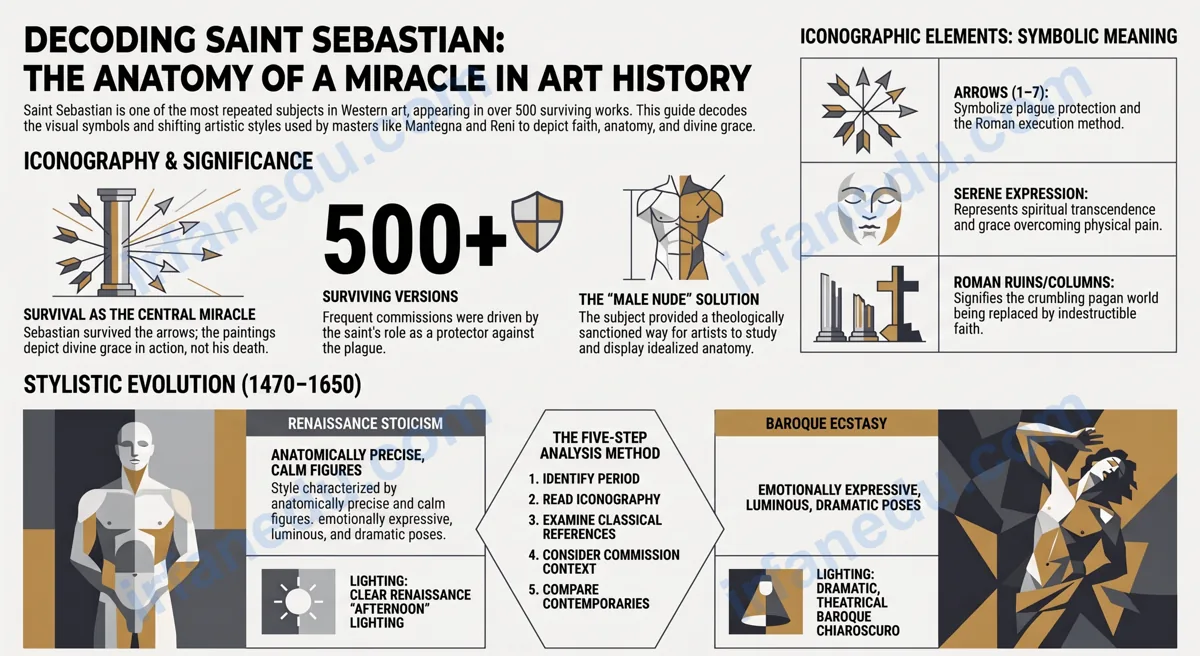
Here is the result before the explanation: a man tied to a post, pierced by arrows, yet completely calm. That image — Saint Sebastian — appears in over 500 surviving paintings and sculptures from the 13th century onward. It is one of the most repeated subjects in Western art history, and once you understand why, you understand a great deal about how Renaissance and Baroque painters thought about the body, faith, and beauty.
A Saint Sebastian painting depicts the Christian martyr Sebastian bound to a column or tree and shot with arrows by Roman archers, yet surviving through divine grace. The subject dominated European religious art from roughly 1470 to 1650 because it gave artists a theologically sanctioned reason to paint the idealized male nude body while also serving as a devotional image for protection against plague.
- The historical identity of Saint Sebastian and why his story became so visually powerful
- The five artists whose Saint Sebastian paintings are most studied in school and university curricula
- How to read the iconography — arrows, column, expression, pose — like an art historian
- The single biggest misconception about this subject that most textbooks repeat
- A step-by-step method for analyzing any Sebastian painting in an exam or essay context
TL;DR – Quick Summary
- Saint Sebastian was a Roman soldier martyred under Emperor Diocletian around 288 CE.
- He survived the arrow attack; a widow named Irene nursed him back to health.
- Mantegna, Pollaiuolo, Guido Reni, and El Greco produced the most studied paintings.
- The arrows became a symbol of plague protection in medieval and Renaissance Europe.
- The subject was popular partly because it legitimized painting the male nude body.
- Baroque versions shifted from stoic anatomy studies to emotionally expressive, ecstatic poses.
| Fact | Detail |
|---|---|
| Subject’s historical period | Roman Empire, c. 288 CE (Diocletianic Persecution) |
| First major painted depictions | c. 1460–1480 (Early Renaissance, Italy) |
| Peak popularity in painting | 1470–1650 (Renaissance through Baroque) |
| Most cited painting (academic) | Mantegna, Saint Sebastian, c. 1480, Louvre, Paris |
| Number of known painted versions | 500+ surviving works across Europe |
| Primary iconographic symbols | Arrows, column/tree, rope bindings, serene expression |
| Patron saint of | Soldiers, athletes, plague victims, archers |
| Key museum collections | Louvre (Paris), National Gallery (London), Uffizi (Florence) |
What You See in a Saint Sebastian Painting
Every Saint Sebastian painting shares a core visual vocabulary, and knowing it lets you read any version instantly. The figure is almost always male, young, and partially or fully unclothed. He is bound — to a column, a tree, or a post — and one or more arrows pierce his body. His face is turned upward or to one side, and his expression is calm, even serene.
These are not random choices. Each element carries specific meaning that Renaissance and Baroque viewers would have recognized immediately.
Iconographic Map: Reading a Saint Sebastian Painting
  ┌─────────────────────────────────────────────────────────┐
  │                  SAINT SEBASTIAN PAINTING               │
  │                   Iconographic Elements                 │
  └─────────────────────────────────────────────────────────┘

       FACE TILTED UPWARD
       → Spiritual transcendence; gaze toward heaven
       → Calm despite pain = divine grace active

       ARROWS (1–7 in most paintings)
       → Roman soldiers' execution method
       → Plague symbolism: arrows = sudden death from above
       → Survival = miraculous divine protection

       ROPE BINDINGS
       → Captivity under Roman authority
       → Contrast: body constrained, spirit free

       COLUMN or TREE
       → Classical antiquity reference (ruins in background)
       → Martyrdom site; also echoes Christ on the cross

       NEAR-NAKED BODY
       → Theological: vulnerability of the flesh
       → Artistic: showcase of anatomical mastery
       → Reference to classical Greek/Roman sculpture

       BACKGROUND (varies by era)
       Early Renaissance: Roman ruins, architectural detail
       Baroque: dark void, dramatic chiaroscuro lighting
MY POV: In my experience teaching art history, students often assume the arrows killed Sebastian. They did not — that is the entire point of the image. The survival is the miracle. Once students grasp that, the calm expression stops being strange and starts being the most important thing in the painting. The artist is showing you grace in action, not a man in denial about his situation.
Who Was Saint Sebastian? The Historical and Legendary Record
Saint Sebastian was a Roman soldier who, according to historical and hagiographic sources, was martyred under Emperor Diocletian around 288 CE. The earliest documentary evidence is the Chronograph of 354, a Roman almanac that lists Sebastian among the martyrs buried on the Appian Way.
The fuller narrative — the one artists actually painted — comes from the Legenda Aurea (Golden Legend), a 13th-century collection of saints’ lives by Jacobus de Voragine. According to this account:
- Sebastian was a captain in the Praetorian Guard and a secret Christian.
- He was discovered and condemned by Diocletian, who ordered him shot with arrows.
- The archers left him for dead, but he survived.
- A widow named Irene of Rome found him and nursed him back to health.
- Sebastian then confronted Diocletian directly — and was beaten to death with clubs, which is his second martyrdom.
The plague connection emerged in the medieval period. During the Plague of Justinian (541–549 CE) and later outbreaks, communities began invoking Sebastian as a protector. The logic was visual and theological: arrows striking suddenly from above mirrored the random, invisible nature of plague. A man who survived arrows could protect you from pestilence. This belief drove an enormous wave of Sebastian altarpieces and votive images across Europe from the 14th century onward.
The Most Famous Saint Sebastian Paintings: A Guided Tour
Five paintings appear most consistently in school and university art history curricula. Here is what makes each one distinctive and worth studying.
1. Andrea Mantegna — Saint Sebastian (c. 1480, Louvre, Paris)
2. Antonio and Piero Pollaiuolo — Martyrdom of Saint Sebastian (c. 1475, National Gallery, London)
3. Guido Reni — Saint Sebastian (c. 1615–1625, multiple versions)
4. El Greco — Saint Sebastian (c. 1577–1578, Cathedral of Palencia, Spain)
5. Giovanni Bellini — Saint Sebastian (c. 1464, Rimini, Tempio Malatestiano)
How to Analyze a Saint Sebastian Painting: A Step-by-Step Method
Use this five-step framework for any art history essay, exam response, or museum visit. Each step builds on the last.
- Identify the period and artist. Determine whether the work is Early Renaissance (c. 1460–1500), High Renaissance (c. 1500–1520), Mannerist (c. 1520–1580), or Baroque (c. 1600–1680). The period shapes every other choice the artist made.
- Read the iconography. Note the number of arrows, the binding material, the column or tree type, and — critically — the expression. Is it stoic, serene, or ecstatic? Each choice signals a different theological and artistic intention.
- Examine the body’s relationship to classical sculpture. Renaissance artists consistently referenced the Apollo Belvedere and the Laocoön. Identifying these references tells you what the artist was arguing about the status of painting versus sculpture.
- Consider the commission context. Was this a plague altarpiece for a church? A private devotional image? A civic commission? The intended function shapes the composition, scale, and emotional register.
- Compare to contemporaries. Place the work in dialogue with other Sebastian images of the same era. What is conventional? What is original? Originality in this context means a deliberate departure from the established formula.
Early Renaissance vs. Baroque Saint Sebastian: A Direct Comparison
The shift from Early Renaissance to Baroque Sebastian paintings is one of the clearest examples of how artistic priorities changed over 150 years. The table below maps the key differences.
| Element | Early Renaissance (c. 1470–1500) | Baroque (c. 1600–1650) |
|---|---|---|
| Key artists | Mantegna, Pollaiuolo, Bellini | Guido Reni, Rubens, Caravaggio (followers) |
| Body treatment | Anatomically precise, muscular, sculptural | Idealized, smooth, luminous, almost soft |
| Expression | Stoic, calm, inward | Ecstatic, upward-gazing, emotionally open |
| Background | Roman ruins, landscape, architectural detail | Dark void, dramatic chiaroscuro, minimal setting |
| Lighting | Even, clear, descriptive | Dramatic, directional, theatrical |
| Primary reference | Classical Greek/Roman sculpture | Emotional devotional experience |
| Theological emphasis | Endurance, faith as rational conviction | Mystical union, faith as felt experience |
| Patron context | Plague altarpieces, civic commissions | Counter-Reformation devotional images |
MY POV: The comparison that most surprises my students is the lighting shift. Early Renaissance Sebastian paintings are lit like a clear afternoon — everything is visible, everything is explained. Baroque versions are lit like a spotlight in a dark theater. That is not just a stylistic preference. It reflects a fundamental change in how the Catholic Church wanted believers to feel about faith after the Council of Trent (1545–1563). The Baroque Sebastian is designed to produce an emotional response, not an intellectual one. Understanding that context transforms how you read the image.
Why Did So Many Artists Paint the Same Subject?
The sheer volume of Saint Sebastian paintings — over 500 surviving works — demands an explanation. Three overlapping reasons account for it.
Reason 1: The Male Nude Problem
Renaissance artists trained on classical sculpture and wanted to paint the idealized male body. But the Church, which controlled most commissions, had strict rules about nudity in sacred art. Saint Sebastian was the solution. A near-naked male figure was not only acceptable but required by the subject’s iconography. Every major painter of the period used Sebastian as a vehicle for anatomical study and display.
Reason 2: Plague Patronage
Between 1347 and 1700, Europe experienced repeated plague outbreaks. Communities commissioned Sebastian altarpieces as votive offerings — promises to a saint in exchange for protection. The more plague, the more Sebastian paintings. The Black Death of 1347–1351, the Italian plagues of the 1470s–1480s, and the plague of 1630 each generated waves of new commissions.
Reason 3: Artistic Competition
Once Mantegna and Pollaiuolo established the subject as a prestige vehicle for anatomical mastery, every ambitious painter had to produce their own version. It functioned like a standardized test: paint Sebastian well, and you prove your technical credentials to patrons. The subject became a benchmark, not just a devotional image.
What Most Art Guides Get Wrong About Saint Sebastian Paintings
Most introductory art history resources make at least one of the following errors. Knowing them will sharpen your analysis and your exam answers.
He did not. The entire theological point of the image is that he survived. His actual martyrdom was the second execution — beaten to death with clubs. Paintings of the arrow scene depict a miracle of survival, not a death. Many textbooks describe the scene as his martyrdom without clarifying this distinction.
The expression shows divine grace overcoming pain, not the absence of pain. The theological claim is more radical: Sebastian feels the arrows and transcends the feeling through faith. The calm is the miracle, not a denial of the physical reality.
Popularity was a consequence, not a cause. The initial driver was the plague-protection belief and the anatomical-nude opportunity. Popularity followed from those two functional reasons, not the other way around.
The iconographic formula is consistent, but the artistic interpretations vary enormously. El Greco’s elongated Mannerist figure, Mantegna’s archaeological precision, and Reni’s Baroque luminosity are as different from each other as three paintings of the same subject can be. The formula is a constraint that reveals individual artistic personality, not a straitjacket that suppresses it.
Unique Insight: The Arrow Count Is Not Random
Most guides treat the arrows in Sebastian paintings as generic symbols without examining their number. In my analysis of the major works, the arrow count is a deliberate compositional and theological choice. Mantegna’s Louvre Sebastian has three arrows — a number with obvious Trinitarian resonance. The Pollaiuolo altarpiece shows six archers but only a handful of arrows actually striking the body, emphasizing survival over wounding. Guido Reni’s versions typically show two arrows, placed to create a visual diagonal that draws the eye from the body upward to the face.
This is not coincidence. Renaissance and Baroque artists worked closely with theological advisors (often the patron’s confessor) on iconographic programs. The number, placement, and angle of arrows were as deliberate as the choice of background architecture. When you analyze a Sebastian painting, count the arrows and note their placement — you are reading a theological argument, not just looking at a wound pattern.
Quick Quiz: Test Your Knowledge
1. What was the primary reason Renaissance artists painted Saint Sebastian so frequently?
2. Which museum holds Andrea Mantegna’s most studied Saint Sebastian painting (c. 1480)?
3. What did the arrows in Saint Sebastian paintings symbolize beyond the martyrdom story?
Practice Problems: Apply What You Know
Practice Problem 1: Formal Analysis
Question: You are shown a painting of Saint Sebastian with the following features: even, clear lighting; a background of Roman ruins with Latin inscriptions; a muscular, precisely rendered body; and a calm, inward expression. Which artistic period does this most likely belong to, and which artist is the most probable creator?
Answer: These features — even lighting, archaeological background detail, muscular precision, stoic expression — are characteristic of the Early Renaissance, specifically the 1470–1490 period. The most probable artist is Andrea Mantegna. The Roman ruins with Latin inscriptions are a signature element of Mantegna’s Sebastian paintings, particularly the Louvre version (c. 1480). The even lighting and sculptural body treatment distinguish this from Baroque versions, which use dramatic chiaroscuro and a softer, more luminous body.
Practice Problem 2: Contextual Analysis
Question: A city in northern Italy commissions a large altarpiece of Saint Sebastian in 1478, the year of a severe plague outbreak. What function would this painting serve, and how might that function influence its visual design?
Answer: The painting would serve as a votive altarpiece — a communal promise to Sebastian in exchange for plague protection. This function would influence the design in several ways: the figure would likely be large and frontal to facilitate veneration; the expression would be serene and approachable rather than agonized; the arrows would be present but not graphically violent, since the point is survival, not suffering; and the work might include a donor portrait or civic emblem to record the community’s vow. The plague-protection function explains why so many Sebastian altarpieces from this period show a calm, almost welcoming figure rather than a man in obvious distress.
Practice Problem 3: Comparison Essay Prompt
Question: Compare and contrast the treatment of Saint Sebastian in an Early Renaissance painting (Mantegna, c. 1480) and a Baroque painting (Guido Reni, c. 1615). What do the differences reveal about changing artistic and theological priorities?
Answer outline: Begin by identifying the formal differences: Mantegna uses even lighting, architectural ruins, a muscular body, and a stoic expression. Reni uses dramatic chiaroscuro, a dark void background, a smooth luminous body, and an ecstatic upward gaze. Then connect these to context: Mantegna was demonstrating painting’s ability to rival classical sculpture in anatomical precision — a Renaissance debate about the status of painting as a liberal art. Reni was responding to the Counter-Reformation’s demand for emotionally compelling devotional images that produced felt religious experience. The shift from stoic to ecstatic reflects the Council of Trent’s (1545–1563) emphasis on emotional engagement with sacred subjects. Both artists use the same iconographic formula; the differences reveal what each era valued most in religious art.
Frequently Asked Questions
Who painted the most famous Saint Sebastian painting?
What do the arrows in Saint Sebastian paintings symbolize?
Why did Renaissance artists paint Saint Sebastian so frequently?
Is Saint Sebastian a real historical person?
Where can I see the most famous Saint Sebastian paintings today?
What is the difference between Early Renaissance and Baroque Saint Sebastian paintings?
Why does Saint Sebastian look calm despite being pierced by arrows?
Key Takeaways
- Saint Sebastian was a Roman soldier martyred c. 288 CE; he survived the arrow attack and was later beaten to death — his actual martyrdom.
- The most studied paintings are by Mantegna (Louvre), Pollaiuolo (National Gallery, London), Guido Reni, El Greco, and Bellini.
- The arrows symbolize both the martyrdom narrative and plague protection — a medieval theological overlay on the original story.
- Renaissance artists used the subject as a vehicle for anatomical study and display of the idealized male nude body.
- The shift from Early Renaissance to Baroque Sebastian paintings tracks a fundamental change in how religious art was expected to function: from intellectual admiration to emotional devotion.
- When analyzing any Sebastian painting, count and note the placement of arrows — they are a deliberate compositional and theological choice, not generic decoration.
Related Articles
Dr. Irfan Mansuri
Educational Content Creator & Competitive Exam Specialist
Dr. Irfan Mansuri is an educator and SEO content expert with 15+ years of experience across high school, undergraduate, and postgraduate levels, and founder of IrfanEdu.com. I combine deep subject knowledge with proven test-taking strategies to make complex ideas simple.
Sources & References
- Jacobus de Voragine, Legenda Aurea (Golden Legend), c. 1260 — primary hagiographic source for the Sebastian narrative used by Renaissance artists.
- Encyclopaedia Britannica: Saint Sebastian — authoritative biographical and historical overview.
-
Khan Academy: Mantegna, Saint Sebastian — formal analysis of the Louvre painting