
Cell Organelles and Functions Chart: The Complete Visual Guide 🔬
📋 Table of Contents
- The Cell as a City: Your Master Analogy
- What Are Cell Organelles?
- Quick Facts Table
- Full Cell Organelles and Functions Chart
- Key Organelles Explained (with City Roles)
- Plant vs Animal Cell: What’s Different?
- Common Mistakes Students Make
- Visual Cell Diagram
- Real-World Applications
- How to Study the Organelles Chart (Step-by-Step)
- Quick Quiz
- Practice Problems
- Frequently Asked Questions
- Key Takeaways
- Sources & References
🏙️ The Cell as a City: Your Master Analogy
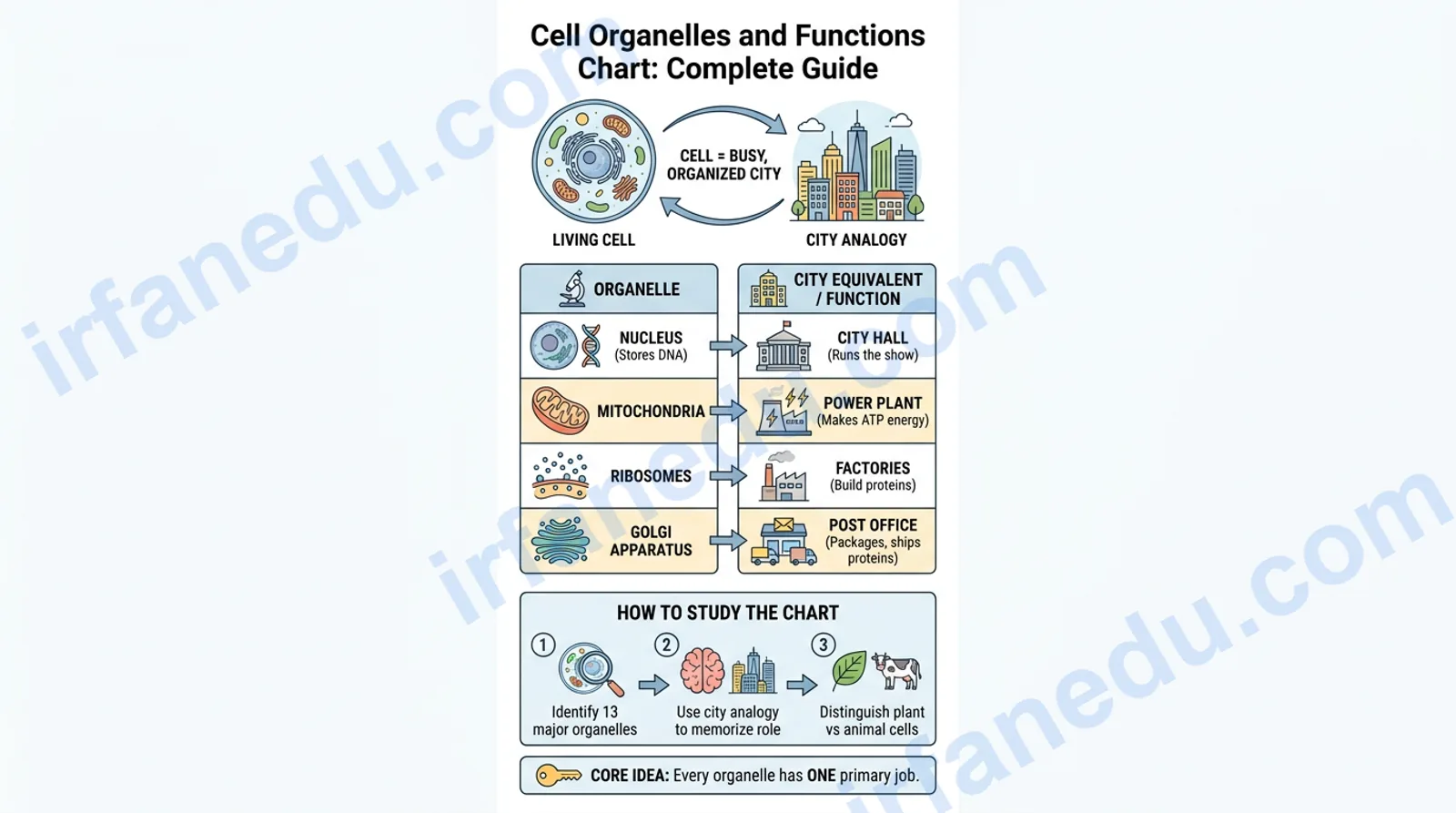
Imagine a busy, well-organized city. It has a city hall that makes all the decisions, power plants that keep the lights on, a postal service that ships packages, factories that build products, and a wall around the perimeter to keep everything safe. That city is a living cell — and every building in it is an organelle.
A cell organelle is a membrane-bound (or non-membrane-bound) structure inside a eukaryotic cell that performs a specific function. Just as a city cannot run without its buildings and services, a cell cannot survive without its organelles. This guide gives you the complete cell organelles and functions chart plus the city analogy to make every organelle stick in your memory.
I use this city analogy every time I teach cell biology, and students who adopt it consistently score higher on exams. You will see it thread through every section below — each organelle gets its city-building equivalent so you always have a mental hook to fall back on.
- 🎯 Identify all 13 major organelles and their functions
- 🏙️ Use the city analogy to memorize each organelle’s role
- 🌿 Distinguish plant cell organelles from animal cell organelles
- 📊 Read and interpret a cell organelles and functions chart
- ✅ Avoid the most common exam mistakes in cell biology
Every organelle has one primary job. Learn the job, not just the name — and the city analogy makes that job unforgettable.
⚡ TL;DR – Quick Summary
- 🏛️ The nucleus is city hall — it stores DNA and runs the show
- ⚡ Mitochondria are power plants — they make ATP energy
- 🏭 Ribosomes are factories — they build proteins from instructions
- 📦 The Golgi apparatus is the post office — it packages and ships proteins
- 🌿 Plant cells have chloroplasts and a cell wall — animal cells do not
- 🧬 13 major organelles covered — each mapped to a city building for easy recall
🔬 What Are Cell Organelles?
Cell organelles are the specialized compartments inside a eukaryotic cell. Each one carries out a distinct task that keeps the cell alive, growing, and reproducing. Think of them as the departments of your city — each with a specific mandate and staff.
Prokaryotic cells (like bacteria) do not have membrane-bound organelles. That is one of the key differences between prokaryotes and eukaryotes. When your biology exam asks about organelles, it almost always means eukaryotic cells — either animal or plant.
The word “organelle” literally means “little organ.” Just as your heart, lungs, and kidneys each do a specific job in your body, organelles each do a specific job inside the cell. There are roughly 13 major organelles you need to know for most biology courses.
📊 Quick Facts Table
| Organelle | City Equivalent 🏙️ | Found In | Membrane-Bound? |
|---|---|---|---|
| Nucleus | City Hall | Animal & Plant | Yes (double) |
| Mitochondria | Power Plant | Animal & Plant | Yes (double) |
| Ribosomes | Factories | Animal & Plant | No |
| Rough ER | Factory Road Network | Animal & Plant | Yes |
| Smooth ER | Refinery / Detox Center | Animal & Plant | Yes |
| Golgi Apparatus | Post Office | Animal & Plant | Yes |
| Lysosomes | Waste Management / Recycling | Mainly Animal | Yes |
| Vacuole | Water Tower / Storage Depot | Animal & Plant | Yes |
| Chloroplasts | Solar Power Farm | Plant Only | Yes (double) |
| Cell Wall | City Wall / Perimeter Fence | Plant Only | No |
| Cell Membrane | City Border Checkpoint | Animal & Plant | Yes |
| Cytoskeleton | Road & Bridge Network | Animal & Plant | No |
| Centrioles | Construction Cranes | Mainly Animal | No |
📋 Full Cell Organelles and Functions Chart
This is the master reference chart you can use for studying, revision, and quick lookups. Every organelle is listed with its primary function, city analogy, and a key exam fact.
| Organelle | Primary Function | City Role 🏙️ | Key Exam Fact |
|---|---|---|---|
| Nucleus | Stores DNA; controls cell activities | City Hall | Contains nucleolus (makes rRNA) |
| Mitochondria | Produces ATP via cellular respiration | Power Plant | Has its own DNA; double membrane |
| Ribosomes | Synthesizes proteins (translation) | Factories | Made of rRNA + protein; not membrane-bound |
| Rough ER | Folds and transports proteins | Factory Road Network | Studded with ribosomes (hence “rough”) |
| Smooth ER | Lipid synthesis; detoxification | Refinery | No ribosomes; abundant in liver cells |
| Golgi Apparatus | Modifies, packages, ships proteins | Post Office | Has cis (receiving) and trans (shipping) faces |
| Lysosomes | Digests waste, old organelles, pathogens | Recycling / Waste Plant | Contains hydrolytic enzymes; acidic interior (pH ~4.5) |
| Vacuole | Stores water, nutrients, waste | Water Tower | Large central vacuole in plants; small in animals |
| Chloroplasts | Photosynthesis (light → glucose) | Solar Power Farm | Contains chlorophyll; has own DNA like mitochondria |
| Cell Wall | Structural support; protection | City Wall | Made of cellulose in plants; peptidoglycan in bacteria |
| Cell Membrane | Controls what enters/exits the cell | Border Checkpoint | Phospholipid bilayer; selectively permeable |
| Cytoskeleton | Gives shape; moves organelles | Roads & Bridges | Made of microtubules, microfilaments, intermediate filaments |
| Centrioles | Organizes spindle fibers during cell division | Construction Cranes | Found in animal cells; absent in most plant cells |
In my experience, students who only memorize the chart without understanding the why behind each organelle forget everything within a week. The city analogy forces you to think about relationships — the post office only works if the factory (ribosome) produces something to ship. That relational thinking is what makes biology click and what separates a B from an A on exam day.
🏛️ Key Organelles Explained (with City Roles)
1. Nucleus — City Hall 🏛️
The nucleus is the largest organelle in most cells and the undisputed command center. It houses the cell’s entire DNA, organized into chromosomes. When the cell needs to make a protein, the nucleus sends out instructions in the form of messenger RNA (mRNA).
Inside the nucleus sits the nucleolus — a dense region that manufactures ribosomal RNA (rRNA). Think of it as the mayor’s office inside city hall. The nuclear envelope (double membrane) surrounding the nucleus has tiny pores that act like security checkpoints, controlling what molecules pass in and out.
2. Mitochondria — Power Plant ⚡
Mitochondria produce ATP through a process called cellular respiration. They consume glucose and oxygen, then release ATP plus carbon dioxide and water as byproducts. Every movement, thought, and heartbeat your body makes costs ATP — and mitochondria supply it.
Mitochondria have a double membrane. The inner membrane is folded into structures called cristae, which dramatically increase the surface area for ATP production. Fascinatingly, mitochondria have their own DNA — evidence that they were once free-living bacteria absorbed by early eukaryotic cells (endosymbiotic theory).
3. Ribosomes — Factories 🏭
Ribosomes are the protein-building machines of the cell. They read mRNA instructions (sent from the nucleus) and assemble amino acids into proteins — a process called translation. Every cell, including prokaryotes, has ribosomes.
Ribosomes are not membrane-bound. They float freely in the cytoplasm or attach to the rough endoplasmic reticulum. Free ribosomes make proteins for use inside the cell; attached ribosomes make proteins destined for export or for the cell membrane.
4. Endoplasmic Reticulum (Rough & Smooth) — Road Network 🛣️
The endoplasmic reticulum (ER) is a vast network of membranes connected to the nuclear envelope. It comes in two forms with very different jobs.
Rough ER is studded with ribosomes, giving it a bumpy appearance under a microscope. It receives newly made proteins from ribosomes, folds them correctly, and ships them to the Golgi apparatus. Smooth ER has no ribosomes. It synthesizes lipids, stores calcium ions, and detoxifies drugs and poisons — which is why liver cells (which process toxins) are packed with smooth ER.
5. Golgi Apparatus — Post Office 📦
The Golgi apparatus looks like a stack of flattened membrane sacs (called cisternae). Proteins arrive from the rough ER at the cis face (receiving dock), get modified and sorted, then leave from the trans face (shipping dock) in vesicles headed for their final destination.
Modifications the Golgi makes include adding sugar chains (glycosylation) and attaching address tags that direct each protein to the right location. Without this post office, proteins would pile up with no way to reach their destination.
6. Lysosomes — Recycling Center ♻️
Lysosomes are membrane-bound sacs filled with digestive enzymes. They break down worn-out organelles, bacteria, and cellular debris. This process — digesting your own cell’s old parts — is called autophagy. It sounds destructive, but it is essential for cell health and renewal.
7. Chloroplasts — Solar Power Farm ☀️
Chloroplasts are found only in plant cells and some algae. They capture sunlight and convert it into glucose through photosynthesis. Inside the chloroplast, stacked membrane discs called thylakoids contain chlorophyll — the green pigment that absorbs light. The fluid surrounding the thylakoids is called the stroma, where the Calvin cycle (carbon fixation) takes place.
Like mitochondria, chloroplasts have their own DNA and double membranes — more evidence for endosymbiotic theory.
If I had to pick just two organelles for a student to truly understand before anything else, I would pick the nucleus and the mitochondria. Together, they cover information flow (DNA → RNA → protein) and energy flow (glucose → ATP). Every other organelle connects back to one of these two processes. Get those two right, and the rest of the chart falls into place naturally.
8. Vacuoles — Storage Depot 🏗️
Vacuoles are fluid-filled sacs used for storage. In plant cells, a single large central vacuole can occupy up to 90% of the cell’s volume. It stores water, nutrients, and waste products, and its internal pressure (turgor pressure) keeps the plant cell rigid — which is why plants wilt when they lack water.
Animal cells have smaller, more numerous vacuoles used for temporary storage and transport. The difference in vacuole size is a reliable way to distinguish plant from animal cells under a microscope.
9. Cell Membrane — Border Checkpoint 🚧
The cell membrane surrounds every cell and controls what enters and exits. It is made of a phospholipid bilayer — two layers of phospholipid molecules with their hydrophobic (water-fearing) tails pointing inward and hydrophilic (water-loving) heads pointing outward. Proteins embedded in this bilayer act as channels, pumps, and receptors.
The membrane is described as selectively permeable — it lets some molecules pass freely (like oxygen and carbon dioxide) while blocking or regulating others (like glucose and ions).
🌿 Plant vs Animal Cell: What’s Different?
One of the most tested topics in cell biology is the comparison between plant and animal cells. Both are eukaryotic, but they have key structural differences that reflect their different lifestyles.
| Feature | Animal Cell 🐾 | Plant Cell 🌿 |
|---|---|---|
| Cell Wall | Absent | Present (cellulose) |
| Chloroplasts | Absent | Present |
| Central Vacuole | Small / absent | Large (up to 90% of cell) |
| Centrioles | Present | Absent (most species) |
| Lysosomes | Common | Rare (lytic vacuoles instead) |
| Shape | Irregular, round | Regular, box-like |
| Nucleus position | Central | Often pushed to side by vacuole |
❌ Common Mistakes Students Make
After reviewing hundreds of biology exams, I see the same errors come up again and again. Here is a wrong-vs-right breakdown to help you avoid them.
| ❌ Wrong Belief | ✅ Correct Understanding |
|---|---|
| “The cell wall and cell membrane are the same thing.” | The cell wall is a rigid outer layer (plants only). The cell membrane is a flexible inner layer present in ALL cells. |
| “Ribosomes are membrane-bound organelles.” | Ribosomes have NO membrane. They are made of RNA and protein — not enclosed by a lipid bilayer. |
| “Only animal cells have mitochondria.” | Both animal AND plant cells have mitochondria. Plants need ATP too — not just for photosynthesis but for all other cell activities. |
| “The nucleus contains the nucleolus, which stores DNA.” | The nucleolus makes rRNA. DNA is stored in the nucleus itself, not specifically in the nucleolus. |
| “The Golgi apparatus makes proteins.” | The Golgi modifies and ships proteins. Ribosomes make proteins. These are different steps in the same assembly line. |
🗺️ Visual Cell Diagram (ASCII)
Below is a simplified ASCII diagram of an animal cell showing the spatial relationship between key organelles. Use it to visualize how the city is laid out.
🏙️ Animal Cell — City Map (ASCII Diagram)
 ╔══════════════════════════════════════════════════════════╗
 ║         CELL MEMBRANE (Border Checkpoint)                ║
 ║                                                          ║
 ║   ┌──────────────┐        ○ ○ ○  Ribosomes (Factories)  ║
 ║   │   NUCLEUS    │   ≋≋≋≋≋≋≋≋≋≋  Rough ER (Road Net.)  ║
 ║   │  (City Hall) │   ─────────── Smooth ER (Refinery)   ║
 ║   │  ·Nucleolus· │                                       ║
 ║   └──────────────┘   ┌─────────┐                        ║
 ║                      │  GOLGI  │  ← Post Office         ║
 ║   ████  Mitochondria │APPARATUS│                        ║
 ║   ████  (Power Plant)└─────────┘                        ║
 ║                                                          ║
 ║   [Lysosome]  [Vacuole]   |||  Cytoskeleton (Roads)     ║
 ║   (Recycling) (Storage)                                  ║
 ║                                  ⊕ Centrioles (Cranes)  ║
 ╚══════════════════════════════════════════════════════════╝
[IMAGE: Labeled animal cell diagram showing all organelles | ALT: animal cell organelles labeled diagram for biology students]
🌍 Real-World Applications of Cell Organelle Knowledge
Understanding cell organelles is not just an exam exercise. This knowledge underpins real medical and scientific breakthroughs happening right now.
- 🧬 Cancer research: Many cancers involve mutations that disrupt normal organelle function — particularly the nucleus (uncontrolled DNA replication) and mitochondria (altered energy metabolism).
- 💊 Drug delivery: Scientists design nanoparticles that mimic vesicles to deliver drugs directly into specific organelles, improving treatment precision.
- 🌾 Genetic engineering: Modifying chloroplast DNA (plastid transformation) allows scientists to create disease-resistant or higher-yield crops.
- 🧫 Lysosomal storage diseases: Conditions like Tay-Sachs disease result from missing lysosomal enzymes, causing toxic buildup inside cells. Understanding lysosomes is critical to treating these diseases.
- 🔬 mRNA vaccines: The COVID-19 mRNA vaccines work by entering cells and using ribosomes to produce a viral protein that trains the immune system — a direct application of ribosome biology.
📚 How to Study the Organelles Chart (Step-by-Step)
Here is the exact method I recommend to any student who wants to master the cell organelles and functions chart in the shortest time possible.
- Step 1 — Anchor the analogy first. Before memorizing any name, read through the city analogy table and make sure every building makes sense to you. The analogy is your scaffold.
- Step 2 — Learn the nucleus and mitochondria deeply. These two organelles connect to the most exam questions. Understand their structure (double membrane, inner folds, DNA) not just their names.
- Step 3 — Group organelles by function. Cluster them: energy organelles (mitochondria, chloroplasts), protein-making organelles (ribosomes, rough ER, Golgi), support organelles (cytoskeleton, cell wall, cell membrane), and storage organelles (vacuole, lysosome).
- Step 4 — Study the plant vs animal comparison table. This is almost always tested. Know the three plant-only structures: cell wall, chloroplasts, large central vacuole.
- Step 5 — Draw the cell from memory. Close this guide and sketch the ASCII diagram above from memory, labeling each organelle. This is the single most effective revision technique I know.
🧠 Quick Quiz: Test Your Organelle Knowledge
🎯 3-Question Cell Organelles Quiz
Q1. Which organelle is known as the “powerhouse of the cell”?
Q2. Which organelle is found in plant cells but NOT in animal cells?
Q3. The Golgi apparatus is best described as the cell’s:
✏️ Practice Problems
Problem 1: A cell is producing large amounts of protein for export. Which organelles would be most active?
Problem 2: A student looks at a cell under a microscope and sees a large central vacuole and a rigid outer layer. Is this a plant or animal cell? How do you know?
Problem 3: Why do mitochondria and chloroplasts have their own DNA?
Problem 4: What happens to a plant cell if its vacuole loses water?
❓ Frequently Asked Questions
What are cell organelles?
What is the function of the nucleus in a cell?
What organelles are found only in plant cells?
What is the powerhouse of the cell?
Sources & References
Reviewed by Dr. Irfan Mansuri. External links open in a new tab and are provided for further reading and verification.