
DNA Replication Steps: The Complete Student Guide
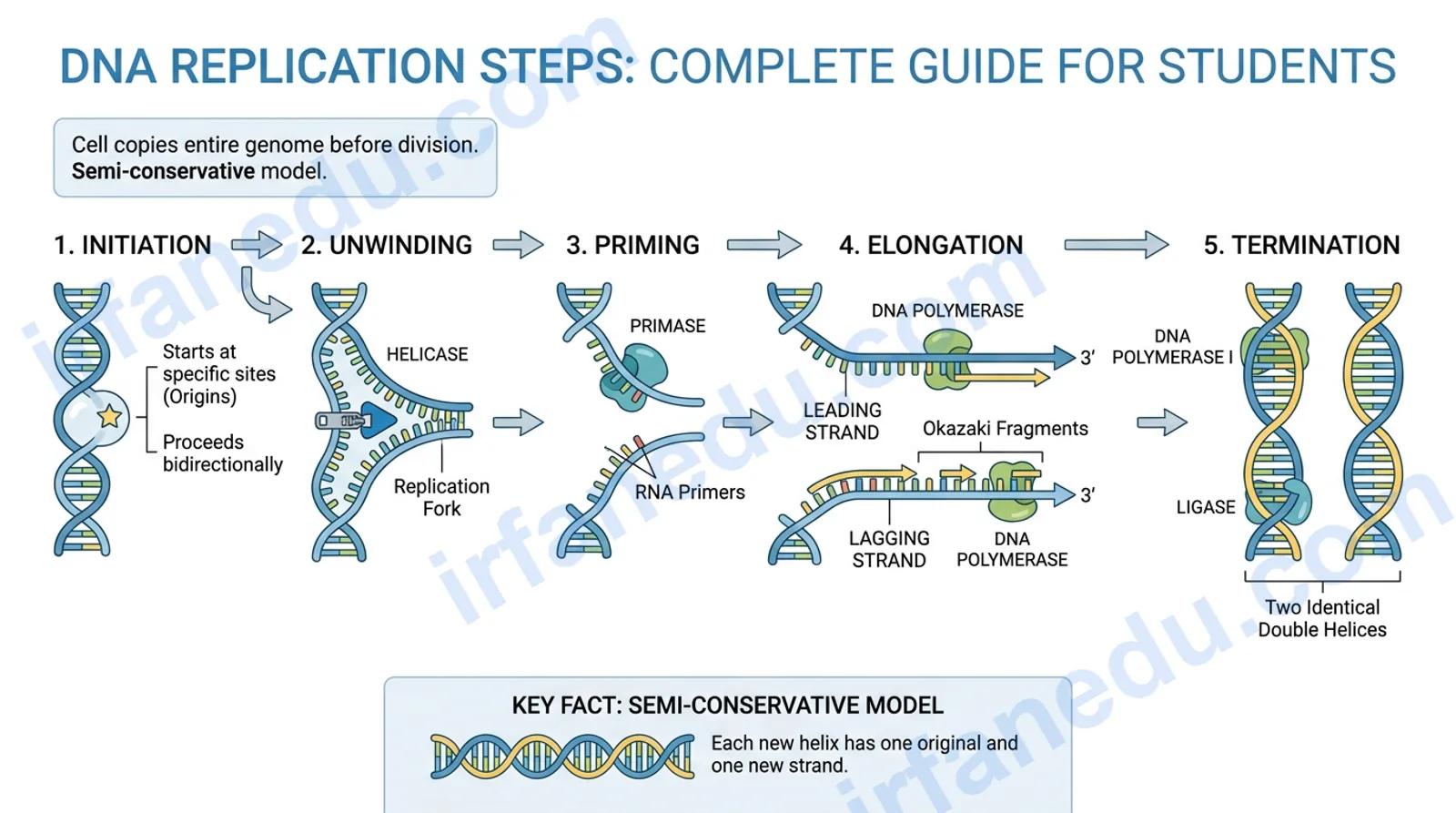
This guide breaks down each step clearly, explains why it matters, and shows you exactly which enzyme does what — so you can answer any exam question on this topic with confidence.
Every time a cell divides, it must duplicate its entire DNA before splitting. That means copying billions of base pairs with near-perfect accuracy. Understanding how that happens — step by step — is one of the most important topics in biology, and one of the most commonly tested.
DNA replication is the biological process by which a cell copies its DNA before cell division. It follows a semi-conservative model: each new double helix contains one original strand and one newly synthesized strand. The process occurs in five coordinated stages — initiation, unwinding, priming, elongation, and termination — each driven by specific enzymes including helicase, primase, DNA polymerase, and ligase.
- You will understand what triggers DNA replication and where it starts.
- You will know the role of every key enzyme involved.
- You will be able to explain the difference between the leading and lagging strands.
- You will recognize common exam traps and how to avoid them.
Table of Contents
- What Is DNA Replication?
- The Semi-Conservative Model
- Key Enzymes and Their Roles
- The 5 Steps of DNA Replication
- Leading Strand vs. Lagging Strand
- Visual Diagram of the Replication Fork
- Common Mistakes Students Make
- Prokaryotic vs. Eukaryotic Replication
- Real-World Applications
- Quick Quiz
- Practice Problems
- Frequently Asked Questions
TL;DR – Quick Summary
- DNA replication copies the genome before every cell division using a semi-conservative mechanism.
- It starts at the origin of replication and proceeds in 5 defined steps.
- Helicase unwinds the helix; primase lays RNA primers; DNA polymerase builds new strands.
- The leading strand is built continuously; the lagging strand is built in Okazaki fragments.
- DNA polymerase I removes primers; ligase seals the final gaps.
- Proofreading reduces the error rate to roughly 1 in 10 billion base pairs.
| Fact | Detail |
|---|---|
| Model | Semi-conservative |
| Direction of synthesis | 5′ to 3′ only |
| Key enzyme for elongation | DNA polymerase III (prokaryotes) |
| Primer type | RNA (synthesized by primase) |
| Lagging strand fragments | Okazaki fragments |
| Error rate (after proofreading) | ~1 per 109 nucleotides |
| Confirmed by | Meselson-Stahl experiment (1958) |
What Is DNA Replication?
DNA replication is the process by which a cell makes an identical copy of its DNA. This must happen before every cell division so that each daughter cell receives a complete set of genetic instructions.
Think of it as photocopying a book — but instead of a machine, the cell uses a team of molecular enzymes that work with extraordinary precision. The “book” is your DNA, and the copy must be accurate enough to sustain life across billions of cell divisions.
In eukaryotic cells (like human cells), replication happens in the nucleus during the S phase of the cell cycle. In prokaryotes (like bacteria), it happens in the cytoplasm since there is no nucleus. The core biochemistry is similar in both cases.
The Semi-Conservative Model Explained
The semi-conservative model states that each new DNA molecule consists of one original (parental) strand and one newly synthesized strand. This was the winning hypothesis out of three proposed models.
The other two models — conservative (both old strands stay together) and dispersive (old and new DNA mixed throughout) — were ruled out by the landmark Meselson-Stahl experiment in 1958. Matthew Meselson and Franklin Stahl grew bacteria in heavy nitrogen (15N) and then switched them to light nitrogen (14N). After one round of replication, all DNA had an intermediate density — exactly what semi-conservative predicts.
In my experience teaching this topic, students who struggle with DNA replication almost always skip the semi-conservative model and jump straight to the enzymes. That is a mistake. Understanding that each new molecule retains one parental strand is the conceptual anchor for everything else — especially for understanding why proofreading errors matter so much.
Key Enzymes and Their Roles
DNA replication is an enzyme-driven process. Each enzyme has a specific, non-negotiable job. Knowing these cold will earn you marks on any biology exam.
| Enzyme | Function | Direction |
|---|---|---|
| Helicase | Unwinds and separates the double helix at the replication fork | Moves along DNA |
| Single-strand binding proteins (SSBPs) | Stabilize separated strands, prevent re-annealing | Binds both strands |
| Topoisomerase | Relieves tension (supercoiling) ahead of the fork | Ahead of helicase |
| Primase | Synthesizes short RNA primers (~10 nt) on each template strand | 5′ to 3′ |
| DNA Polymerase III | Adds deoxyribonucleotides to build the new strand (main elongation enzyme) | 5′ to 3′ only |
| DNA Polymerase I | Removes RNA primers and replaces them with DNA | 5′ to 3′ |
| DNA Ligase | Seals nicks between DNA fragments (joins Okazaki fragments) | Seals 3′-5′ phosphodiester bonds |
The 5 Steps of DNA Replication
Here is the complete, step-by-step process. Each step builds directly on the previous one — they cannot be reordered.
Step 1: Initiation
Replication begins at specific DNA sequences called origins of replication (ori). In the bacterium E. coli, there is a single origin called oriC. In human cells, there are thousands of origins, allowing the entire 3-billion-base-pair genome to be copied in a few hours.
Initiator proteins (such as DnaA in prokaryotes) recognize and bind the origin. They recruit helicase and the rest of the replisome (the replication machinery). Two replication forks form and move in opposite directions — this is called bidirectional replication.
Step 2: Unwinding
Helicase uses ATP to break the hydrogen bonds between complementary base pairs, separating the two strands. This creates a Y-shaped structure called the replication fork. As helicase unwinds the helix, it creates torsional stress (like twisting a rope) ahead of it. Topoisomerase cuts and rejoins the DNA to relieve this tension, preventing the molecule from tangling.
Single-strand binding proteins (SSBPs) coat the separated strands, keeping them stable and preventing them from snapping back together.
Step 3: Priming
DNA polymerase III cannot start a new strand from nothing — it needs a free 3′-OH group to add nucleotides to. Primase solves this problem by synthesizing a short RNA primer (roughly 10 nucleotides long) complementary to the template strand. This primer provides the 3′-OH end that DNA polymerase needs to begin work.
One primer is placed on the leading strand template. Multiple primers are placed on the lagging strand template (one for each Okazaki fragment).
Step 4: Elongation
DNA polymerase III binds to the 3′-OH end of the RNA primer and begins adding deoxyribonucleotides (dNTPs) in the 5′ to 3′ direction. It reads the template strand in the 3′ to 5′ direction and builds the complementary new strand following base-pairing rules: A pairs with T, G pairs with C.
The two template strands run antiparallel to each other, which creates an asymmetry:
- The leading strand runs toward the fork and is synthesized continuously.
- The lagging strand runs away from the fork and is synthesized in short, discontinuous Okazaki fragments.
Step 5: Termination
Once elongation is complete, the RNA primers must be removed. DNA polymerase I (in prokaryotes) uses its 5′ to 3′ exonuclease activity to excise each primer and simultaneously fill the gap with DNA nucleotides. This leaves small nicks (breaks in the phosphodiester backbone) between adjacent DNA segments.
DNA ligase seals these nicks by forming a covalent phosphodiester bond, producing two complete, continuous daughter strands. In eukaryotes, RNase H and FEN1 remove primers, and DNA polymerase delta fills the gaps before ligase seals them.
Leading Strand vs. Lagging Strand
This is one of the most tested concepts in DNA replication. The difference comes down to one rule: DNA polymerase can only synthesize in the 5′ to 3′ direction.
Since the two template strands are antiparallel, only one strand (the leading strand) can be synthesized continuously toward the replication fork. The other strand (the lagging strand) must be built in the opposite direction — away from the fork — in short segments called Okazaki fragments.
| Feature | Leading Strand | Lagging Strand |
|---|---|---|
| Synthesis direction | Toward the fork | Away from the fork |
| Continuity | Continuous | Discontinuous (Okazaki fragments) |
| Number of primers needed | One | Many (one per fragment) |
| Template strand read direction | 3′ to 5′ | 3′ to 5′ |
| Okazaki fragment length | N/A | 100-200 nt (eukaryotes); 1000-2000 nt (prokaryotes) |
The leading/lagging strand distinction trips up students at every level. My advice: draw the replication fork yourself, mark the 5′ and 3′ ends on both template strands, then ask “which direction does polymerase need to travel?” That single exercise makes the concept click faster than any amount of reading.
Visual Diagram: The Replication Fork
  PARENTAL DNA
  5'---AAATTTGGGCCC---3'   (template for lagging strand)
  3'---TTTAAACCCGGG---5'   (template for leading strand)
             |
             v  HELICASE unwinds here
             |
  5'---AAATTT  ....  3'   (lagging strand template)
             \
              \  REPLICATION FORK
               \
  3'---TTTAAA   ....  5'  (leading strand template)
        |
        | DNA Pol III (continuous)
        v
  NEW LEADING STRAND: 5'--AAATTTGGGCCC--3'  (built continuously)

  NEW LAGGING STRAND (built in fragments):
  [Primer]-[Okazaki 1]-[Primer]-[Okazaki 2]-[Primer]-[Okazaki 3]
         <- <- <- <- <- <- <- <- <- <- <- (direction of synthesis)

  After termination:
  Primers removed by DNA Pol I
  Gaps filled with DNA
  Nicks sealed by LIGASE
  Result: two complete daughter duplexes
Common Mistakes Students Make
These are the errors I see most often in student answers. Knowing them in advance gives you a real advantage.
| Wrong Idea | Correct Understanding |
|---|---|
| ✗ "DNA polymerase starts replication." | ✓ Primase starts it by synthesizing the RNA primer. DNA polymerase III then extends from the primer. |
| ✗ "The lagging strand is built 3' to 5'." | ✓ All synthesis is 5' to 3'. The lagging strand is built in fragments that each run 5' to 3', away from the fork. |
| ✗ "Helicase builds the new strand." | ✓ Helicase only unwinds the double helix. DNA polymerase III builds the new strand. |
| ✗ "DNA replication is conservative — both old strands stay together." | ✓ It is semi-conservative. Each daughter molecule has one old strand and one new strand. |
| ✗ "Ligase removes the RNA primers." | ✓ DNA polymerase I (prokaryotes) removes primers. Ligase seals the nicks after gaps are filled. |
Prokaryotic vs. Eukaryotic DNA Replication
The core mechanism is the same in both cell types, but there are important differences you need to know for exams.
| Feature | Prokaryotes (e.g., E. coli) | Eukaryotes (e.g., Human cells) |
|---|---|---|
| Origins of replication | Single (oriC) | Thousands |
| Main elongation enzyme | DNA Pol III | DNA Pol delta / epsilon |
| Primer removal | DNA Pol I | RNase H + FEN1 |
| Chromosome type | Circular | Linear |
| Okazaki fragment size | 1000-2000 nt | 100-200 nt |
| Telomere replication | Not applicable | Telomerase extends chromosome ends |
| Location | Cytoplasm | Nucleus (S phase) |
Real-World Applications of DNA Replication
Understanding DNA replication is not just academic — it has direct applications in medicine, biotechnology, and forensics.
- PCR (Polymerase Chain Reaction): PCR mimics DNA replication in a test tube. It uses heat-stable DNA polymerase (Taq polymerase) and synthetic primers to amplify a specific DNA sequence millions of times. PCR is the foundation of COVID-19 testing, paternity testing, and forensic DNA analysis.
- Cancer treatment: Many chemotherapy drugs target DNA replication. For example, nucleoside analogs (like gemcitabine) are incorporated into DNA during replication and block polymerase, stopping cancer cells from dividing.
- Antiviral drugs: Drugs like acyclovir (for herpes) work by mimicking nucleotides and terminating viral DNA replication prematurely.
- Genetic engineering: CRISPR-Cas9 gene editing relies on the cell's own DNA repair and replication machinery to insert or correct genetic sequences.
- Aging research: Telomere shortening during replication is linked to cellular aging. Understanding this process is central to longevity research.
Quick Quiz: Test Your Knowledge
DNA Replication — 3-Question Quiz
1. Which enzyme is responsible for unwinding the DNA double helix during replication?
2. Why is the lagging strand synthesized in short fragments?
3. What does DNA polymerase I do during termination in prokaryotes?
Practice Problems
Problem 1: Identify the enzyme — "I relieve torsional stress ahead of the replication fork." Who am I?
As helicase unwinds the double helix, it creates positive supercoiling (overwinding) ahead of the fork. Topoisomerase cuts one or both strands, allows the DNA to rotate to relieve tension, and then reseals the cut. Without topoisomerase, the DNA would become so tightly coiled that replication would stall.
Problem 2: A new DNA molecule contains one strand labeled with heavy nitrogen (¹⁵N) and one with light nitrogen (¹⁴N). Which model of replication does this support?
This is exactly what the Meselson-Stahl experiment demonstrated. The conservative model would produce one all-heavy and one all-light molecule. The dispersive model would produce molecules with mixed heavy/light throughout both strands. Only the semi-conservative model produces hybrid molecules with one heavy and one light strand.
Problem 3: If a template strand reads 3'-ATCGTA-5', what is the sequence of the new complementary strand? In which direction is it synthesized?
Base-pairing rules: A pairs with T, T pairs with A, C pairs with G, G pairs with C. The template is read 3' to 5', and the new strand is built 5' to 3'. So reading the template from 3' to 5' (A-T-C-G-T-A), the new strand is T-A-G-C-A-T, written 5' to 3'.
Problem 4: How many RNA primers are needed to replicate a circular prokaryotic chromosome with 4 Okazaki fragments on the lagging strand?
One primer is needed for the leading strand (at the single origin of replication). Four primers are needed — one for each Okazaki fragment on the lagging strand. Total = 1 + 4 = 5 primers. Remember: each Okazaki fragment requires its own primer because DNA polymerase cannot start synthesis without a free 3'-OH.
Frequently Asked Questions
What are the main steps of DNA replication?
What enzyme unwinds the DNA double helix during replication?
Why does DNA replication need an RNA primer?
What is the difference between the leading strand and the lagging strand?
What are Okazaki fragments?
What is semi-conservative replication?
How accurate is DNA replication?
Key Takeaways
- DNA replication is semi-conservative: each daughter molecule has one old strand and one new strand.
- Replication starts at origins of replication and proceeds bidirectionally.
- Helicase unwinds the helix; topoisomerase relieves tension; SSBPs stabilize single strands.
- Primase lays RNA primers; DNA polymerase III extends them in the 5' to 3' direction only.
- The leading strand is continuous; the lagging strand is built in Okazaki fragments.
- DNA polymerase I removes primers (prokaryotes); ligase seals the final nicks.
- Proofreading by DNA polymerase III reduces errors to about 1 per 109 base pairs.
- Eukaryotes have multiple origins and use telomerase to replicate chromosome ends.
Related Articles
Dr. Irfan Mansuri is an educator and SEO content expert with 15+ years of experience across high school, undergraduate, and
Sources & References
Reviewed by Dr. Irfan Mansuri. External links open in a new tab and are provided for further reading and verification.