
Periodic Table Trends Explained: The Complete Student Guide
Last Updated: July 2026
This idea goes back to 1869, when Dmitri Mendeleev arranged 63 known elements by atomic mass and noticed that properties repeated at regular intervals. He called it periodicity. What he discovered was not just a sorting trick — it was a window into the architecture of matter itself.
Today, every chemistry student needs to understand periodic table trends because they explain why sodium explodes in water, why fluorine is the most reactive nonmetal, and why cesium is used in atomic clocks. Once you see the logic, the whole table becomes predictable.
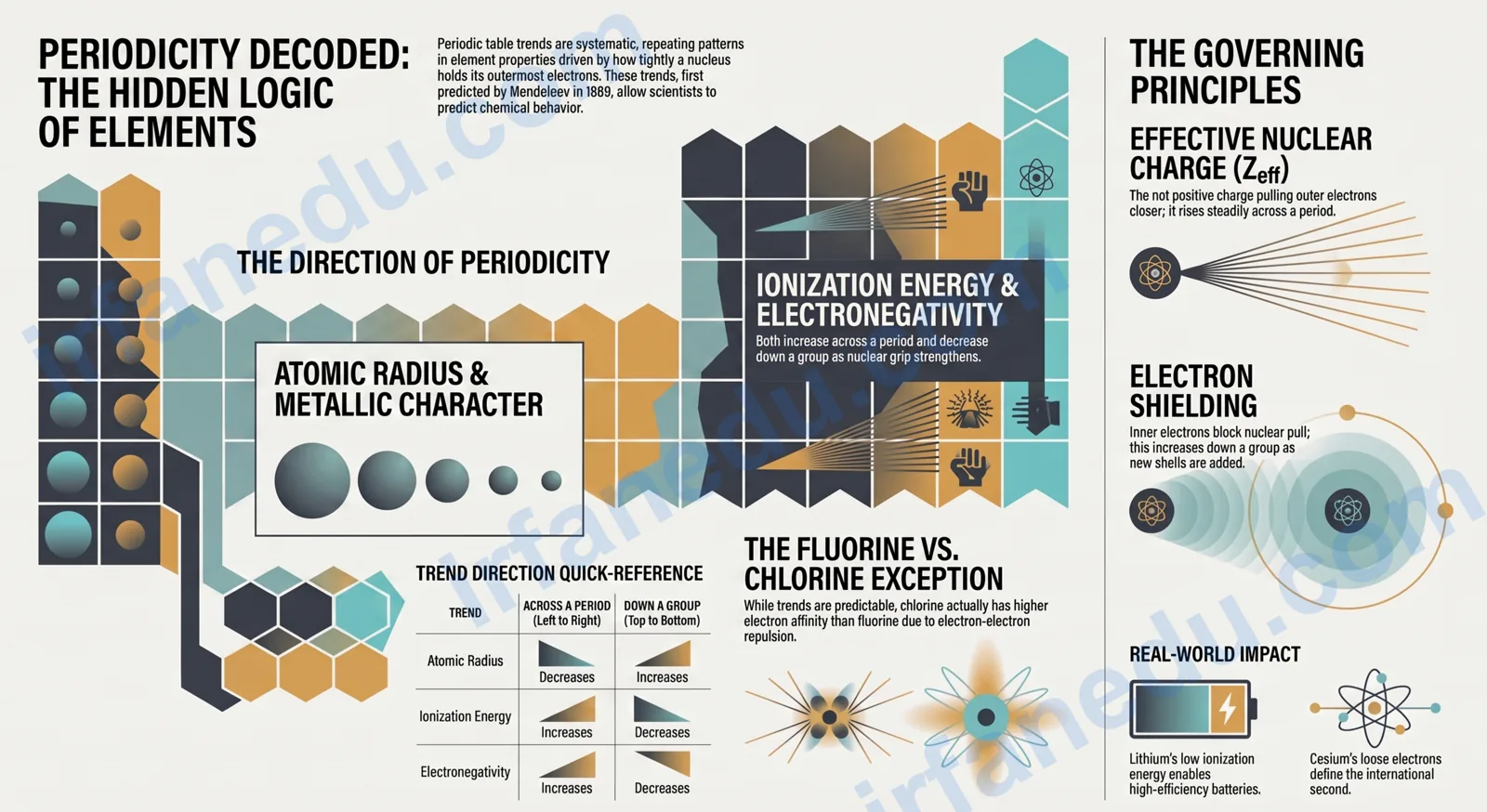
Periodic table trends are predictable patterns in element properties — including atomic radius, ionization energy, electronegativity, electron affinity, and metallic character — that repeat across periods (rows) and down groups (columns). These trends are driven by two forces: increasing nuclear charge across a period and increasing electron shielding down a group.
By the end of this guide, you will be able to:
- Name and define all five major periodic table trends
- Predict the direction of any trend across a period or down a group
- Explain the underlying cause of each trend using nuclear charge and shielding
- Avoid the most common exam mistakes on this topic
- Apply these trends to real-world chemistry problems
TL;DR – Quick Summary
- Atomic radius decreases across a period; increases down a group.
- Ionization energy increases across a period; decreases down a group.
- Electronegativity increases across a period; decreases down a group. Fluorine is highest.
- Electron affinity generally increases across a period (with exceptions at noble gases).
- Metallic character decreases left to right; increases top to bottom.
- Root cause: effective nuclear charge vs. electron shielding.
Quick Facts at a Glance
| Trend | Across a Period (left to right) | Down a Group (top to bottom) |
|---|---|---|
| Atomic Radius | Decreases | Increases |
| Ionization Energy | Increases | Decreases |
| Electronegativity | Increases | Decreases |
| Electron Affinity | Generally increases | Generally decreases |
| Metallic Character | Decreases | Increases |
Where This Idea Came From
Mendeleev’s 1869 table was a bold act of pattern recognition. He noticed that when elements were lined up by atomic mass, similar chemical behaviors appeared every eight or so elements — a pattern he called the “law of octaves,” borrowing a term from music. He was confident enough in the pattern to leave gaps for undiscovered elements and predict their properties.
When gallium (1875) and germanium (1886) were discovered with almost exactly the properties Mendeleev had predicted, the scientific world took notice. The table was not just a filing system — it was a predictive tool.
The modern explanation came later, after the discovery of the electron (1897) and the atomic nucleus (1911). Henry Moseley showed in 1913 that the correct organizing principle is atomic number (proton count), not atomic mass. With that correction, the table’s periodic trends became fully explainable through quantum mechanics and electron configuration.
What Are Periodic Table Trends?
Periodic table trends are systematic, repeating changes in element properties as you move across a row (period) or down a column (group). They are not random — each trend follows directly from how electrons are arranged around the nucleus.
Two concepts explain almost everything:
- Effective nuclear charge (Zeff): The net positive charge felt by an outer electron after accounting for shielding by inner electrons. Higher Zeff means the nucleus grips outer electrons more tightly.
- Electron shielding: Inner-shell electrons partially block the nuclear charge from reaching outer electrons. More inner shells mean more shielding, which weakens the nucleus’s grip on outer electrons.
Moving left to right across a period: proton count rises, but all new electrons go into the same shell, so shielding barely changes. Zeff rises steadily. Moving down a group: a new electron shell is added with each row, dramatically increasing shielding. Zeff on outer electrons rises only slightly, but the outer electrons are now much farther from the nucleus.
Atomic Radius Trend
Atomic radius measures the size of an atom — typically half the distance between two bonded nuclei of the same element. It is one of the most fundamental periodic trends because size affects almost every other property.
Across a period (left to right): radius decreases. Each new element has one more proton, pulling all electrons closer. Sodium (Na) has a radius of 186 pm; chlorine (Cl) in the same period has a radius of only 99 pm — nearly half the size.
Down a group (top to bottom): radius increases. Each new period adds a complete electron shell. Lithium (Li) has a radius of 152 pm; cesium (Cs), five rows below it in the same group, has a radius of 265 pm.
All three are in Period 3. Moving left to right: Na (11 protons) > Mg (12 protons) > Al (13 protons).
Answer: Na > Mg > Al
One important exception: ions. When an atom loses electrons to form a cation (positive ion), it shrinks significantly because the electron-to-proton ratio drops. When it gains electrons to form an anion (negative ion), it expands. Na+ is much smaller than Na; Cl– is much larger than Cl.
Ionization Energy Trend
Ionization energy (IE) is the minimum energy required to remove the outermost electron from a neutral gaseous atom. It is measured in kilojoules per mole (kJ/mol) and tells you how strongly an atom holds onto its electrons.
Across a period: IE increases. Higher Zeff means electrons are held more tightly, so more energy is needed to pull one away. Sodium’s first IE is 496 kJ/mol; chlorine’s is 1251 kJ/mol.
Down a group: IE decreases. Outer electrons are farther from the nucleus and more shielded. They are easier to remove. Lithium’s first IE is 520 kJ/mol; cesium’s is only 376 kJ/mol.
- IE drops slightly from Group 2 to Group 13 (e.g., Mg to Al) because the p-subshell electron in Al is easier to remove than the paired s-electron in Mg.
- IE drops slightly from Group 15 to Group 16 (e.g., N to O) because O has a paired electron in a p-orbital — electron-electron repulsion makes it easier to remove.
Successive ionization energies (IE1, IE2, IE3…) increase with each removal because you are pulling an electron from an increasingly positive ion. A dramatic jump in successive IEs reveals the element’s group number — the jump occurs when you start removing core electrons.
In my experience, ionization energy exceptions trip up more students than any other trend. My advice: memorize the two exceptions (Group 2 to 13, and Group 15 to 16) as a pair, and always draw the orbital diagram first. Once you see the half-filled and fully-filled subshell stability, the dip in IE makes complete sense. Do not just memorize the direction — understand the orbital reason behind it.
Electronegativity Trend
Electronegativity is a measure of an atom’s ability to attract shared electrons in a chemical bond. Linus Pauling developed the most widely used scale in the 1930s, assigning fluorine the highest value of 3.98 and making it the benchmark for all other elements.
Across a period: electronegativity increases. Higher nuclear charge pulls bonding electrons closer. Carbon (2.55) is less electronegative than nitrogen (3.04), which is less than oxygen (3.44), which is less than fluorine (3.98).
Down a group: electronegativity decreases. Larger atoms with more shielding attract bonding electrons less effectively. Fluorine (3.98) is far more electronegative than iodine (2.66), even though both are in Group 17.
F (3.98) is far more electronegative than C (2.55). The shared electrons are pulled strongly toward F, making F partially negative (δ-) and C partially positive (δ+). This bond polarity is why C-F bonds are among the strongest in organic chemistry.
Electronegativity differences between bonded atoms determine bond type:
- Difference < 0.4: nonpolar covalent bond
- Difference 0.4 – 1.7: polar covalent bond
- Difference > 1.7: ionic bond
Electron Affinity Trend
Electron affinity (EA) is the energy change when a neutral gaseous atom gains an electron to form a negative ion. A large negative EA value means the atom releases a lot of energy when it gains an electron — it strongly “wants” that extra electron.
Across a period: EA generally becomes more negative (stronger). Atoms with higher Zeff attract an incoming electron more strongly. Chlorine has one of the highest electron affinities (-349 kJ/mol) of any element.
Down a group: EA generally becomes less negative (weaker). Larger atoms hold an extra electron less tightly. However, the trend is less smooth than other trends.
- Noble gases (Group 18): EA is essentially zero or positive (unfavorable) because their outer shells are full.
- Group 2 elements: EA is near zero because the s-subshell is full; an extra electron would enter a higher-energy p-orbital.
- Fluorine vs. Chlorine: Chlorine (-349 kJ/mol) actually has a higher EA than fluorine (-328 kJ/mol). Fluorine’s small size creates electron-electron repulsion in its compact 2p orbital, slightly reducing its EA.
Metallic Character Trend
Metallic character describes how readily an element exhibits typical metal behaviors: conducting electricity, forming positive ions, having a lustrous surface, and being malleable. It is essentially the opposite of nonmetallic character.
Across a period: metallic character decreases. Moving right, elements hold their electrons more tightly (higher Zeff), making it harder to lose electrons and form cations. Sodium is a reactive metal; silicon is a metalloid; chlorine is a nonmetal — all in Period 3.
Down a group: metallic character increases. Larger atoms with more shielding lose electrons more easily. Lithium is a moderately reactive metal; cesium, at the bottom of Group 1, is so reactive it ignites spontaneously in air.
I find that students often confuse “metallic character” with “is a metal.” They are related but not identical. Tin (Sn) and lead (Pb) are metals, but they are less metallic in character than sodium or potassium — they do not react with water at room temperature, for example. Always think of metallic character as a spectrum, not a binary category. The staircase line on the periodic table marks the gradual transition from metals to nonmetals, not a sharp wall.
Visual Summary Diagram
The diagram below shows the direction of all five major trends on a simplified periodic table grid. Read the arrows carefully — some go in opposite directions for the same movement.
  PERIOD (left to right) ─────────────────────────────────────────────►
  GROUP                  ┌──────────────────────────────────────────────┐
  (top to bottom)        │  Li   Be   B    C    N    O    F    Ne       │
       │                 │  Na   Mg   Al   Si   P    S    Cl   Ar       │
       │                 │  K    Ca   Ga   Ge   As   Se   Br   Kr       │
       ▼                 └──────────────────────────────────────────────┘

  ─── ACROSS A PERIOD (left → right) ───────────────────────────────────
  Atomic Radius         : ████████████████████████████░░░░ DECREASES ◄
  Ionization Energy     : ░░░░░░░░░░░░░░░░░░░░████████████ INCREASES ►
  Electronegativity     : ░░░░░░░░░░░░░░░░░░░░████████████ INCREASES ►
  Electron Affinity     : ░░░░░░░░░░░░░░░░░░░░████████████ INCREASES ►
  Metallic Character    : ████████████████████████████░░░░ DECREASES ◄

  ─── DOWN A GROUP (top → bottom) ──────────────────────────────────────
  Atomic Radius         : ░░░░░░░░░░░░░░░░░░░░████████████ INCREASES ▼
  Ionization Energy     : ████████████████████████████░░░░ DECREASES ▼
  Electronegativity     : ████████████████████████████░░░░ DECREASES ▼
  Electron Affinity     : ████████████████████████████░░░░ DECREASES ▼
  Metallic Character    : ░░░░░░░░░░░░░░░░░░░░████████████ INCREASES ▼

  Legend: ░ = lower value   █ = higher value
Common Mistakes to Avoid
These are the errors I see most often in student work and on exam papers. Recognizing them now will save you points later.
| Common Mistake | Correct Understanding |
|---|---|
| “Fluorine has the highest electron affinity.” | Chlorine has a higher EA than fluorine due to electron repulsion in F’s small 2p orbital. |
| “Ionization energy always increases smoothly across a period.” | There are two dips: at Group 13 (p-electron easier to remove) and Group 16 (paired p-electron repulsion). |
| “Larger atoms always have lower ionization energy.” | Size matters, but Zeff matters too. Compare elements in the same period or group, not across both at once. |
| “Noble gases have no electron affinity.” | Noble gases have near-zero or slightly positive (unfavorable) EA — they resist gaining electrons, but it is not exactly zero for all. |
| “Metallic character and reactivity mean the same thing.” | Reactivity depends on the specific reaction. Metallic character is a broader set of physical and chemical properties. |
Real-World Applications of Periodic Trends
Periodic trends are not abstract exam content — they drive real technology and biology.
- Battery design: Lithium is used in rechargeable batteries because it has a very low ionization energy (easy to release electrons) and a small atomic radius (high charge density). Both are direct consequences of its position in the periodic table.
- Semiconductor technology: Silicon sits on the metalloid staircase, with intermediate electronegativity and ionization energy. This makes it ideal for controlled electron flow in computer chips.
- Biological systems: Sodium and potassium ions (both Group 1, different periods) have different ionic radii. Cell membranes exploit this size difference to selectively transport one over the other — the basis of nerve impulse transmission.
- Fluorine in medicine: Fluorine’s extreme electronegativity makes C-F bonds exceptionally strong and stable. Pharmaceutical chemists use this to create drugs that resist metabolic breakdown in the body.
- Cesium in atomic clocks: Cesium’s outermost electron is very loosely held (low ionization energy, large radius) and transitions between energy states at a precise frequency — 9,192,631,770 Hz — which defines the international second.
Quick Quiz: Test Your Understanding
1. Which element has the largest atomic radius?
Reveal Answer
2. Why does ionization energy drop slightly from nitrogen (N) to oxygen (O)?
Reveal Answer
3. Which element is the most electronegative?
Reveal Answer
Reveal-on-Click Practice Problems
Problem 1: Rank Be, Mg, Ca, and Ba by first ionization energy (highest to lowest).
All four elements are in Group 2. Moving down the group, atomic radius increases and shielding increases, so the outermost electron is held less tightly. Ionization energy decreases steadily down the group. Be (899 kJ/mol) > Mg (738 kJ/mol) > Ca (590 kJ/mol) > Ba (503 kJ/mol).
Problem 2: A bond between atoms A and B has an electronegativity difference of 1.2. What type of bond is it?
A difference of 1.2 falls in the 0.4–1.7 range, which defines a polar covalent bond. The electrons are shared unequally, with the more electronegative atom carrying a partial negative charge (δ-) and the less electronegative atom carrying a partial positive charge (δ+).
Problem 3: Explain why Cs is more reactive than Li, even though both are in Group 1.
Cesium is much larger than lithium and has far more electron shielding (5 inner electron shells vs. 1 for Li). Its outermost electron is very far from the nucleus and feels very little effective nuclear charge. This makes the valence electron extremely easy to remove (IE of Cs = 376 kJ/mol vs. Li = 520 kJ/mol). Because Group 1 reactivity depends on how easily the atom loses its one valence electron, Cs is significantly more reactive than Li.
Frequently Asked Questions
What are the main periodic table trends?
Why does atomic radius decrease across a period?
Which element has the highest electronegativity?
What is the difference between ionization energy and electron affinity?
Why does ionization energy increase across a period?
How does metallic character change in the periodic table?
What causes periodic trends in the first place?
Key Takeaways
- Periodic trends originate from Mendeleev’s 1869 observation of repeating patterns, later explained by atomic number and electron configuration.
- Effective nuclear charge and electron shielding are the two root causes of all periodic trends.
- Atomic radius decreases across a period and increases down a group.
- Ionization energy and electronegativity increase across a period and decrease down a group.
- Fluorine is the most electronegative element; chlorine has a higher electron affinity than fluorine.
- Metallic character is highest in the lower-left of the table and lowest in the upper-right.
- Know the two IE exceptions: Group 2 to 13, and Group 15 to 16.
Related Articles
Dr. Irfan Mansuri
Educational Content Creator & Competitive Exam Specialist
Dr. Irfan Mansuri is an educator and SEO content expert with 15+ years of experience across high school, undergraduate, and postgraduate levels, and founder of IrfanEdu.com. I combine deep subject knowledge with proven test-taking strategies to make complex ideas simple.
Sources &
Sources & References
Reviewed by Dr. Irfan Mansuri. External links open in a new tab and are provided for further reading and verification.