
⚗️ Ionic vs Covalent Bonds: The Complete Student Guide
🔬 Why does table salt dissolve in water and conduct electricity, but cooking oil does not? Why does diamond — made entirely of carbon — shatter differently from glass? And why do some molecules have high melting points while others evaporate at room temperature?
The answers all come back to one thing: the type of chemical bond holding atoms together.
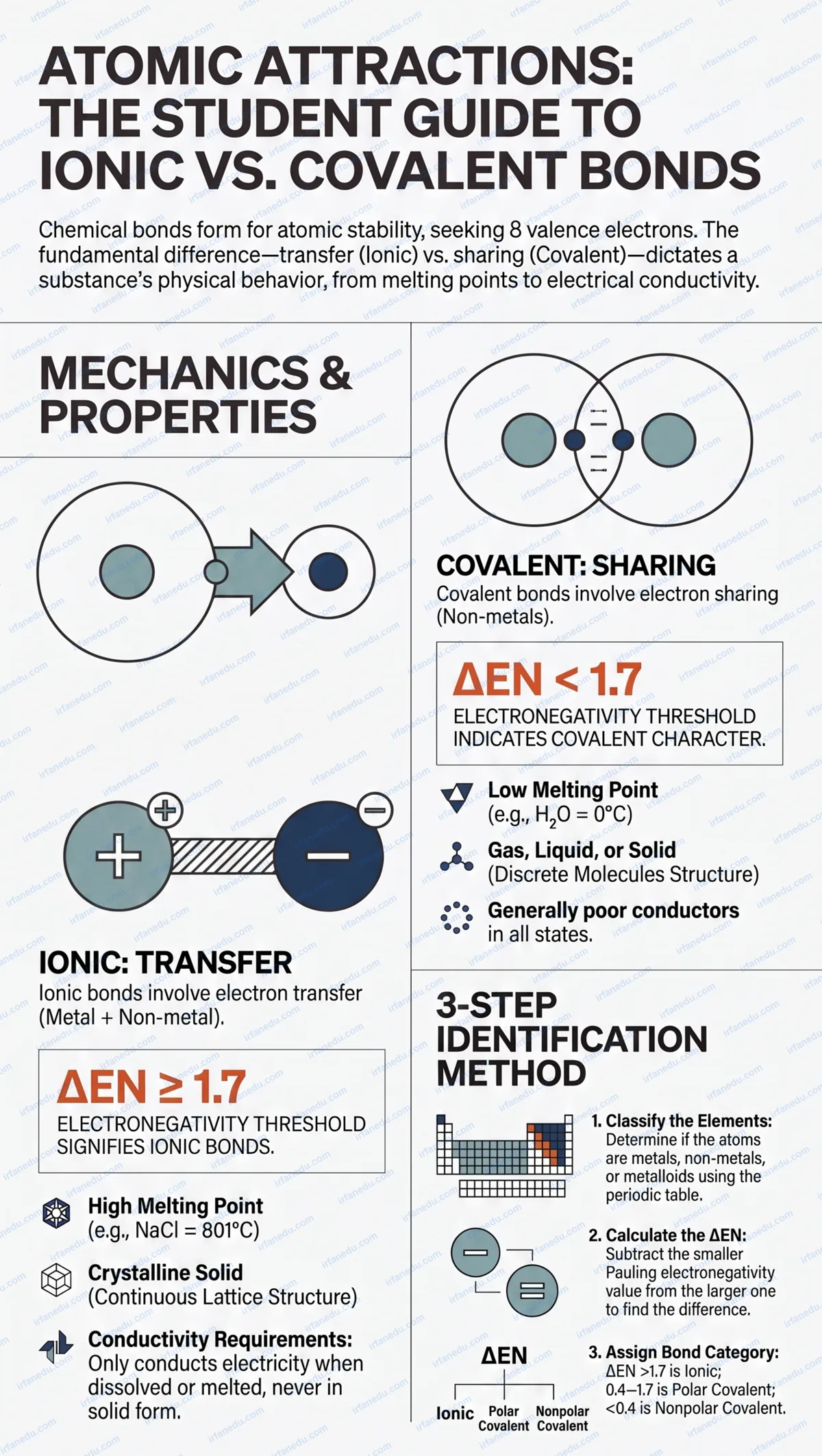
Ionic bonds form when one atom transfers electrons to another, creating oppositely charged ions that attract each other. Covalent bonds form when two atoms share electrons. The key difference: ionic bonds involve electron transfer (metal + non-metal), while covalent bonds involve electron sharing (non-metal + non-metal).
In this guide, I’ll walk you through everything you need to know — from the basic definitions to real-world examples, a step-by-step identification method, and a comparison of properties. By the end, you’ll be able to look at any compound and confidently say whether it’s ionic or covalent.
- 🎯 Understand what ionic and covalent bonds are and how they form
- 🔍 Use electronegativity to identify bond type every time
- 📊 Compare physical and chemical properties of each bond type
- 🌍 Connect bond types to real-world materials and applications
- ✅ Avoid the most common student mistakes on tests
⚡ TL;DR – Quick Summary
- 🔁 Ionic bonds transfer electrons; covalent bonds share them
- 🧂 NaCl (table salt) is ionic; H₂O (water) is covalent
- 📏 Electronegativity difference >1.7 = ionic; <1.7 = covalent
- 🌡️ Ionic compounds have higher melting points than most covalent ones
- ⚡ Ionic compounds conduct electricity when dissolved or melted
- 🔬 Many real molecules contain both ionic and covalent bonds
❓ 3 Quick Questions — Answered First
Before the deep dive, here are the three questions students ask me most often. I’ll answer each one in plain English right now.
Q1: What’s the fastest way to tell ionic from covalent?
Look at the elements involved. If you see a metal bonded to a non-metal (like sodium and chlorine in NaCl), it’s ionic. If you see two non-metals bonded together (like hydrogen and oxygen in H₂O), it’s covalent. This rule works for about 90% of the compounds you’ll see in class.
Q2: Which type of bond is stronger?
This is a trick question. Ionic compounds have very strong lattice structures with high melting points, but individual covalent bonds (like the triple bond in nitrogen gas, N₂) can be extremely strong too. The answer depends on what you’re comparing. I’ll give you the full breakdown in the properties section below.
Q3: Can a compound have both types of bonds?
Yes — and this surprises many students. Sodium nitrate (NaNO₃) is a perfect example. The nitrogen and oxygen atoms inside the nitrate ion (NO₃⁻) are held together by covalent bonds, but the nitrate ion and the sodium ion (Na⁺) are held together by an ionic bond. Both bond types exist in the same compound.
In my experience teaching chemistry, the single biggest confusion students have is thinking ionic and covalent are completely separate worlds. They’re not. Real chemistry is messier and more interesting than that. Once you understand that bonding exists on a spectrum — from pure covalent to pure ionic — everything clicks. That’s the mental model I want you to build from this guide.
🔗 What Are Chemical Bonds?
A chemical bond is a force of attraction that holds two or more atoms together. Atoms form bonds because doing so lowers their energy — bonded atoms are more stable than isolated ones.
The driving force behind bonding is the octet rule: most atoms “want” 8 electrons in their outer shell (valence shell), like the noble gases. They achieve this either by transferring electrons (ionic) or sharing them (covalent).
There are three main types of chemical bonds: ionic, covalent, and metallic. This guide focuses on the first two, which are the most commonly tested in school and university chemistry.
🔵 What Is an Ionic Bond?
An ionic bond forms when one atom transfers one or more electrons to another atom, creating two oppositely charged ions. The positive ion (cation) and negative ion (anion) then attract each other through electrostatic force — that attraction is the ionic bond.
How Ionic Bonds Form
Ionic bonds almost always form between a metal and a non-metal. Metals have low ionization energy — they give up electrons easily. Non-metals have high electron affinity — they accept electrons readily. This combination makes electron transfer energetically favorable.
🖥️ Visual Solution: Ionic Bond Formation (NaCl)
  SODIUM ATOM (Na)           CHLORINE ATOM (Cl)
  ┌─────────────────┐        ┌─────────────────┐
  │  Nucleus: +11   │        │  Nucleus: +17   │
  │  Electrons: 11  │        │  Electrons: 17  │
  │  Valence e⁻: 1  │        │  Valence e⁻: 7  │
  └────────┬────────┘        └────────┬────────┘
           │                          │
           │   ──── e⁻ transfer ────► │
           │                          │
  ┌────────▼────────┐        ┌────────▼────────┐
  │  Na⁺ (cation)   │  ◄───► │  Cl⁻ (anion)   │
  │  Charge: +1     │ ionic  │  Charge: -1     │
  │  Electrons: 10  │  bond  │  Electrons: 18  │
  └─────────────────┘        └─────────────────┘
         Electrostatic attraction holds them together
         → Forms the ionic compound NaCl (table salt)
Common Ionic Compounds
| Compound | Formula | Ions Formed | Common Use |
|---|---|---|---|
| Table salt | NaCl | Na⁺ + Cl⁻ | Food seasoning, preservation |
| Calcium carbonate | CaCO₃ | Ca²⁺ + CO₃²⁻ | Limestone, chalk, antacids |
| Magnesium oxide | MgO | Mg²⁺ + O²⁻ | Refractory materials, antacids |
| Potassium bromide | KBr | K⁺ + Br⁻ | Photography, medicine |
| Iron(III) oxide | Fe₂O₃ | Fe³⁺ + O²⁻ | Rust, pigments |
Key Properties of Ionic Compounds
- 🌡️ High melting and boiling points — strong lattice forces require lots of energy to break
- 💧 Soluble in water (most) — water molecules surround and separate the ions
- ⚡ Conduct electricity when dissolved or melted — free ions carry charge
- 🪨 Hard but brittle — the crystal lattice shatters when layers shift
- 🔬 Crystalline solid at room temperature — ions arrange in a regular lattice
🟢 What Is a Covalent Bond?
A covalent bond forms when two atoms share one or more pairs of electrons. Neither atom fully takes the electrons — they hold them together. Covalent bonds form almost exclusively between non-metal atoms.
Types of Covalent Bonds
The number of shared electron pairs determines the bond type:
- 🔹 Single bond — 1 shared pair (e.g., H–H in H₂, H–Cl in HCl)
- 🔸 Double bond — 2 shared pairs (e.g., O=O in O₂, C=O in CO₂)
- 🔺 Triple bond — 3 shared pairs (e.g., N≡N in N₂, C≡C in acetylene)
Polar vs Nonpolar Covalent Bonds
Not all covalent bonds are equal. When two atoms share electrons equally, the bond is nonpolar covalent (e.g., H₂, O₂). When one atom pulls the shared electrons more strongly toward itself, the bond is polar covalent (e.g., H₂O, HCl). The measure of an atom’s pull on electrons is called electronegativity.
Common Covalent Compounds
| Compound | Formula | Bond Type | Common Use |
|---|---|---|---|
| Water | H₂O | Polar covalent | Universal solvent, life |
| Carbon dioxide | CO₂ | Polar covalent | Photosynthesis, carbonation |
| Methane | CH₄ | Nonpolar covalent | Natural gas, fuel |
| Glucose | C₆H₁₂O₆ | Polar covalent | Energy source in cells |
| Nitrogen gas | N₂ | Nonpolar covalent | 78% of Earth’s atmosphere |
Key Properties of Covalent Compounds
- 🌡️ Lower melting and boiling points (most) — weaker intermolecular forces
- 💧 Solubility varies — polar covalent dissolves in water; nonpolar does not
- ⚡ Poor conductors of electricity — no free ions or electrons
- 🫧 Often gases or liquids at room temperature — low intermolecular forces
- 🧬 Form discrete molecules — not a continuous lattice
🔍 How to Identify Ionic vs Covalent Bonds: Step-by-Step
Here is the method I teach my students. Follow these five steps and you’ll get the right answer almost every time.
- Step 1 — Identify the elements: Look at the periodic table. Is each element a metal, non-metal, or metalloid?
- Step 2 — Apply the metal/non-metal rule: Metal + Non-metal = ionic. Non-metal + Non-metal = covalent. This alone handles most cases.
- Step 3 — Find electronegativity values: Look up the Pauling electronegativity of each element. (Fluorine = 3.98, Oxygen = 3.44, Nitrogen = 3.04, Carbon = 2.55, Hydrogen = 2.20, Sodium = 0.93, etc.)
- Step 4 — Calculate the electronegativity difference (ΔEN): Subtract the smaller value from the larger one.
-
Step 5 — Apply the ΔEN rule:
- ΔEN > 1.7 → Ionic bond
- ΔEN 0.4 – 1.7 → Polar covalent bond
- ΔEN < 0.4 → Nonpolar covalent bond
Na electronegativity = 0.93 | Cl electronegativity = 3.16
ΔEN = 3.16 − 0.93 = 2.23
2.23 > 1.7 → Ionic bond ✅
H electronegativity = 2.20 | Cl electronegativity = 3.16
ΔEN = 3.16 − 2.20 = 0.96
0.4 < 0.96 < 1.7 → Polar covalent bond ✅
Both Cl atoms: electronegativity = 3.16
ΔEN = 3.16 − 3.16 = 0.00
0.00 < 0.4 → Nonpolar covalent bond ✅
📊 Ionic vs Covalent Bonds: Full Properties Comparison
This table gives you a side-by-side comparison of every major property. Bookmark it for exam revision.
| Property | ⚡ Ionic Bonds | 🔗 Covalent Bonds |
|---|---|---|
| How they form | Electron transfer | Electron sharing |
| Elements involved | Metal + Non-metal | Non-metal + Non-metal |
| ΔEN threshold | > 1.7 | < 1.7 |
| Melting point | High (e.g., NaCl = 801°C) | Low to moderate (e.g., H₂O = 0°C) |
| Boiling point | Very high | Generally lower |
| State at room temp | Solid (crystalline) | Gas, liquid, or solid |
| Electrical conductivity | Yes (dissolved/melted) | No (most cases) |
| Solubility in water | Usually high | Varies (polar = yes, nonpolar = no) |
| Solubility in organic solvents | Usually low | Often high (especially nonpolar) |
| Hardness | Hard but brittle | Soft to very hard (e.g., diamond) |
| Structure | Crystal lattice | Discrete molecules |
| Examples | NaCl, MgO, CaCl₂ | H₂O, CO₂, CH₄, C₆H₁₂O₆ |
When I look at this comparison table, the property that surprises students most is electrical conductivity. They expect ionic compounds — which sound “charged” — to always conduct electricity. But a solid block of NaCl is actually a poor conductor. The ions are locked in place. You need to dissolve it or melt it first to free those ions. That’s a concept that shows up on tests constantly, and it’s one of the most misunderstood facts in introductory chemistry.
🚫 Common Mistakes Students Make (Wrong vs Right)
These are the errors I see most often. Knowing them before your exam could save you several marks.
| ❌ Wrong Thinking | ✅ Correct Understanding |
|---|---|
| “Ionic bonds are always stronger than covalent bonds.” | Bond strength depends on context. The N≡N triple bond (covalent) has a bond energy of 945 kJ/mol — stronger than many ionic bonds. |
| “Ionic compounds always dissolve in water.” | Most do, but not all. Silver chloride (AgCl) and barium sulfate (BaSO₄) are ionic but nearly insoluble in water. |
| “Solid NaCl conducts electricity.” | Solid NaCl does NOT conduct electricity. Ions are fixed in the lattice. It only conducts when dissolved or melted. |
| “All covalent compounds are gases.” | Many covalent compounds are solids (e.g., glucose, diamond, plastic polymers). State depends on intermolecular forces, not bond type alone. |
| “A compound can only have one type of bond.” | Many compounds (e.g., NaNO₃, Ca(OH)₂) contain both ionic and covalent bonds within the same formula unit. |
| “Polar covalent bonds are the same as ionic bonds.” | They are related but different. Polar covalent bonds have unequal sharing; ionic bonds involve complete electron transfer. It’s a spectrum, not a binary. |
🌍 Real-World Applications of Ionic and Covalent Bonds
Understanding bond types isn’t just for passing exams. These bonds govern the materials and processes that shape everyday life.
🔵 Ionic Bonds in the Real World
- 🧂 Table salt (NaCl) — food preservation and flavoring for thousands of years
- 🦷 Fluoride in toothpaste (NaF, CaF₂) — ionic compounds that strengthen tooth enamel
- 💊 Pharmaceutical salts — many medications are formulated as ionic salts (e.g., lithium carbonate for bipolar disorder) to improve solubility and stability
- 🏗️ Cement and concrete (CaO, Ca(OH)₂) — ionic compounds that form the backbone of construction materials
- 🔋 Batteries — lithium-ion batteries use ionic movement between electrodes to store and release energy
🟢 Covalent Bonds in the Real World
- 💧 Water (H₂O) — polar covalent bonds make water the “universal solvent” and enable all biochemistry
- 🧬 DNA and proteins — the backbone of life is built on covalent bonds between carbon, nitrogen, oxygen, and hydrogen
- ⛽ Fuels (CH₄, C₈H₁₈) — covalent bonds in hydrocarbons store chemical energy released during combustion
- 💎 Diamond and graphite — both are pure carbon with covalent bonds, but different structures give them wildly different properties
- 🧴 Plastics and polymers — long chains of covalently bonded carbon atoms form the synthetic materials used in packaging, clothing, and electronics
[IMAGE: Diagram comparing diamond lattice (covalent) and NaCl crystal lattice (ionic) side by side | ALT: diamond covalent lattice vs NaCl ionic crystal lattice comparison diagram]
🧠 Quick Quiz: Ionic vs Covalent Bonds
Select your answer, then click “Show Answer” to check.
Q1: Which of the following is an ionic compound? 🧂
Show Answer
Q2: The electronegativity difference between two atoms is 0.8. What type of bond do they form? ⚡
Show Answer
Q3: Which property is TRUE for ionic compounds in solid form? 🪨
Show Answer
✏️ Practice Problems (Click to Reveal Solutions)
Try each problem yourself first, then click to see the full worked solution.
Problem 1: Is MgCl₂ ionic or covalent? Explain your reasoning.
Magnesium (Mg) is a metal (Group 2). Chlorine (Cl) is a non-metal (Group 17).
Metal + Non-metal = ionic bond.
Electronegativity check: Mg = 1.31, Cl = 3.16. ΔEN = 1.85 > 1.7 → confirms ionic.
MgCl₂ forms when Mg transfers 2 electrons (one to each Cl), creating Mg²⁺ and 2 Cl⁻ ions.
Problem 2: Is NH₃ (ammonia) ionic or covalent? What type of covalent bond is it?
Nitrogen (N) and Hydrogen (H) are both non-metals → covalent bond.
Electronegativity: N = 3.04, H = 2.20. ΔEN = 0.84. Since 0.4 < 0.84 < 1.7 → polar covalent.
Nitrogen pulls the shared electrons more strongly, giving the N end a partial negative charge (δ⁻). This polarity makes ammonia soluble in water.
Problem 3: Why does NaCl conduct electricity when dissolved in water but not in solid form?
In solid NaCl, Na⁺ and Cl⁻ ions are locked in a rigid crystal lattice. They cannot move, so they cannot carry an electric current.
When NaCl dissolves in water, the water molecules surround and separate the ions (hydration). The Na⁺ and Cl⁻ ions are now free to move through the solution and carry electric charge → conducts electricity.
The same happens when NaCl is melted: heat breaks the lattice and frees the ions.
Problem 4: Identify all bond types in calcium hydroxide, Ca(OH)₂.
Ca(OH)₂ contains two types of bonds:
1. Covalent bond — between O and H inside the hydroxide ion (OH⁻). Both are non-metals. ΔEN (O–H) = 3.44 − 2.20 = 1.24 → polar covalent.
2. Ionic bond — between Ca²⁺ (metal cation) and OH⁻ (polyatomic anion). Calcium transfers 2 electrons to form Ca²⁺, and the hydroxide ions carry the negative charge.
This is a classic example of a compound with both bond types.
❓ Frequently Asked Questions: Ionic vs Covalent Bonds
What is the main difference between ionic and covalent bonds?
Sources & References
Reviewed by Dr. Irfan Mansuri. External links open in a new tab and are provided for further reading and verification.