
✓ Expert Reviewed by Dr. Irfan Mansuri | Last Updated: July 2026
How to Convert Moles to Grams: A Clear, Step-by-Step Guide
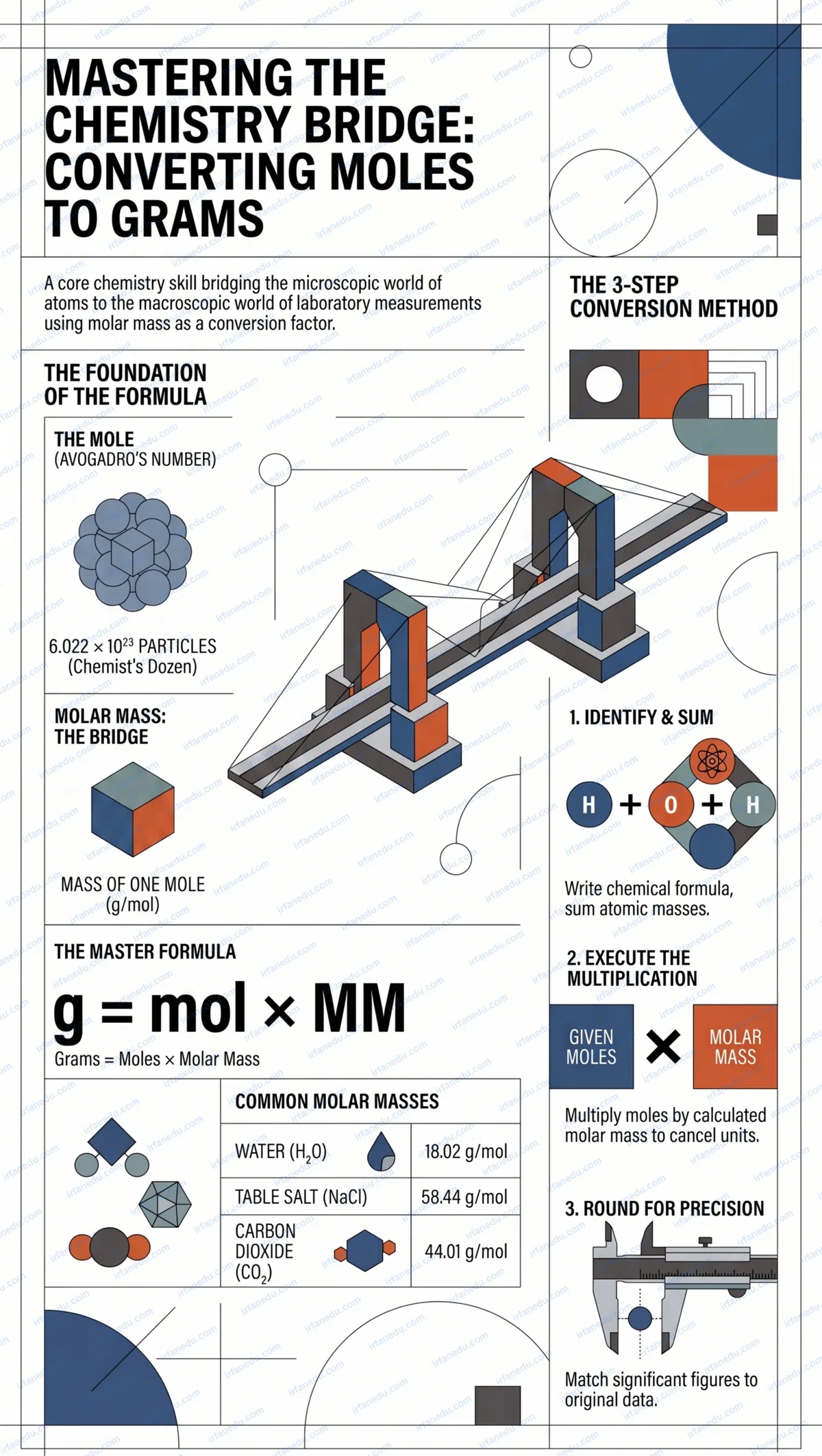
If converting moles to grams has ever confused you, you are absolutely not alone. 🙌 This is one of the most searched chemistry questions by students at every level, and the confusion is completely understandable — the word “mole” sounds strange, the formula feels abstract, and one small slip in arithmetic can throw off your whole answer.
Here is the good news: once you see the logic behind it, this conversion becomes one of the easiest things in chemistry. I have taught this concept to hundreds of students, and I promise you — by the end of this guide, you will feel genuinely confident doing it yourself.
To convert moles to grams, multiply the number of moles by the molar mass of the substance: grams = moles × molar mass (g/mol). The molar mass is found by adding the atomic masses of all atoms in the chemical formula using a periodic table. For example, 2 moles of water (H&sub2;O, molar mass = 18.02 g/mol) equals 36.04 grams.
By the end of this guide, you will be able to:
- ✅ Explain what a mole is and why chemists use it
- ✅ Calculate the molar mass of any compound
- ✅ Apply the moles-to-grams formula confidently
- ✅ Avoid the three most common conversion mistakes
- ✅ Reverse the process and convert grams back to moles
⚡ TL;DR – Quick Summary
- 🔢 Formula: grams = moles × molar mass
- 📊 Molar mass = sum of all atomic masses in the formula (g/mol)
- 🧪 Example: 3 mol of CO&sub2; (44.01 g/mol) = 132.03 g
- 🔄 Reverse: moles = grams ÷ molar mass
- ⚠️ Biggest mistake: dividing instead of multiplying (moles → grams)
- 📅 Molar mass values come from the periodic table — always use it
| Substance | Formula | Molar Mass (g/mol) | 1 Mole = ? Grams |
|---|---|---|---|
| Water | H&sub2;O | 18.02 | 18.02 g |
| Table Salt | NaCl | 58.44 | 58.44 g |
| Carbon Dioxide | CO&sub2; | 44.01 | 44.01 g |
| Glucose | C&sub6;H&sub1;&sub2;O&sub6; | 180.16 | 180.16 g |
| Oxygen Gas | O&sub2; | 32.00 | 32.00 g |
| Sodium Hydroxide | NaOH | 40.00 | 40.00 g |
🧬 What Is a Mole in Chemistry?
A mole is a unit of measurement that represents exactly 6.022 × 10²³ particles — atoms, molecules, or ions. This number is called Avogadro’s number, named after the Italian scientist Amedeo Avogadro.
Think of it this way: just as “a dozen” always means 12 of something, “a mole” always means 6.022 × 10²³ of something. The difference is scale — atoms are so unimaginably tiny that you need an astronomically large number to have a measurable amount of them.
Chemists use moles because it bridges the gap between the microscopic world of atoms and the macroscopic world of grams and liters that you can actually measure in a lab. You cannot weigh out “5 trillion trillion atoms” on a scale — but you can weigh out “2 moles” of a substance.
The mole is the foundation of stoichiometry — the branch of chemistry that deals with the quantities of reactants and products in chemical reactions. Mastering this unit opens the door to understanding all of quantitative chemistry.
⚖️ Understanding Molar Mass
Molar mass is the mass of one mole of a substance, expressed in grams per mole (g/mol). It is the essential bridge between moles and grams.
You calculate molar mass by adding up the atomic masses of every atom in the chemical formula. Atomic masses are listed on the periodic table — usually shown as a decimal number below each element’s symbol.
How to Calculate Molar Mass: Three Examples
Hydrogen (H): 1.008 g/mol × 2 atoms = 2.016 g/mol
Oxygen (O): 16.00 g/mol × 1 atom = 16.00 g/mol
Molar mass of H&sub2;O = 18.02 g/mol
Carbon (C): 12.01 g/mol × 1 atom = 12.01 g/mol
Oxygen (O): 16.00 g/mol × 2 atoms = 32.00 g/mol
Molar mass of CO&sub2; = 44.01 g/mol
Hydrogen (H): 1.008 × 2 = 2.016 g/mol
Sulfur (S): 32.07 × 1 = 32.07 g/mol
Oxygen (O): 16.00 × 4 = 64.00 g/mol
Molar mass of H&sub2;SO&sub4; = 98.09 g/mol
📐 The Moles-to-Grams Formula
The conversion formula is beautifully simple. Once you know the molar mass, you only need one multiplication step.
You can also write this using dimensional analysis (unit cancellation), which is the method most chemistry teachers prefer because it shows your units clearly:
Notice how the units work out: mol × g/mol = g. The “mol” units cancel, leaving you with grams. This is a great way to check that you set up the problem correctly.
The Reverse Formula (Grams to Moles)
If you need to go the other direction — from grams to moles — simply rearrange the formula:
Both formulas come from the same relationship. Think of molar mass as the conversion factor that sits between moles and grams in every calculation.
I always tell my students to memorize the triangle: put “grams” at the top, “moles” and “molar mass” at the bottom. Cover what you want to find — if you cover grams, you see moles × molar mass. If you cover moles, you see grams ÷ molar mass. This simple visual trick eliminates formula confusion instantly, and I have seen it help even the most anxious students feel calm during exams.
🪜 Step-by-Step Method: How to Convert Moles to Grams
Follow these four steps every single time and you will never go wrong. This method works for any substance — elements, simple compounds, or complex molecules.
-
Step 1 — Write down the chemical formula.
Identify the substance. Make sure you have the correct formula (e.g., NaCl for table salt, not NaCl&sub2;). -
Step 2 — Find the molar mass.
Use a periodic table. List each element, its atomic mass, and how many atoms appear in the formula. Add them all together to get the molar mass in g/mol. -
Step 3 — Apply the formula.
Multiply: grams = moles × molar mass. Plug in your values and calculate. -
Step 4 — Write your answer with units.
Always include “g” (grams) in your final answer. Round to the same number of significant figures as the data given in the problem.
🔬 Worked Examples: Moles to Grams
Let me walk you through five complete examples, from simple to more complex. Each one follows the four-step method above.
Example 1 — Oxygen Gas (O&sub2;)
Step 1: Formula = O&sub2;
Step 2: Molar mass = 16.00 × 2 = 32.00 g/mol
Step 3: grams = 4.0 mol × 32.00 g/mol = 128.0 g
Step 4: Answer = 128 g (3 sig figs)
Example 2 — Sodium Chloride (NaCl)
Step 1: Formula = NaCl
Step 2: Na = 22.99 g/mol; Cl = 35.45 g/mol; Total = 58.44 g/mol
Step 3: grams = 0.50 × 58.44 = 29.22 g
Step 4: Answer = 29 g (2 sig figs)
Example 3 — Glucose (C&sub6;H&sub1;&sub2;O&sub6;)
Step 1: Formula = C&sub6;H&sub1;&sub2;O&sub6;
Step 2:
C: 12.01 × 6 = 72.06
H: 1.008 × 12 = 12.10
O: 16.00 × 6 = 96.00
Total = 180.16 g/mol
Step 3: grams = 2.5 × 180.16 = 450.4 g
Step 4: Answer = 450 g (2 sig figs)
Example 4 — Calcium Hydroxide (Ca(OH)&sub2;)
Step 1: Formula = Ca(OH)&sub2; — note the parentheses mean (OH) appears twice
Step 2:
Ca: 40.08 × 1 = 40.08
O: 16.00 × 2 = 32.00
H: 1.008 × 2 = 2.016
Total = 74.10 g/mol
Step 3: grams = 1.75 × 74.10 = 129.68 g
Step 4: Answer = 130 g (3 sig figs)
Example 5 — Iron (Fe)
Step 1: Formula = Fe (a pure element)
Step 2: Molar mass of Fe = 55.85 g/mol
Step 3: grams = 0.25 × 55.85 = 13.96 g
Step 4: Answer = 14 g (2 sig figs)
[IMAGE: Periodic table highlighting atomic masses of H, C, N, O, Na, Cl, Ca, Fe | ALT: periodic table showing atomic masses used in moles to grams conversion]
🗺️ Visual Solution: The Moles-Grams Conversion Roadmap
This ASCII diagram shows the complete conversion pathway. Use it as a mental map every time you set up a problem.
  ┌─────────────────────────────────────────────────────────────┐
  │                                                             │
  │   GIVEN: Number of Moles (mol)                              │
  │                    │                                        │
  │                    ▼                                        │
  │   ┌────────────────────────────────┐                        │
  │   │  STEP 1: Write chemical formula│                        │
  │   │  e.g.  H₂O,  NaCl,  CO₂       │                        │
  │   └────────────────┬───────────────┘                        │
  │                    │                                        │
  │                    ▼                                        │
  │   ┌────────────────────────────────┐                        │
  │   │  STEP 2: Find Molar Mass       │                        │
  │   │  Sum of (atomic mass × count)  │                        │
  │   │  from the Periodic Table       │                        │
  │   └────────────────┬───────────────┘                        │
  │                    │                                        │
  │                    ▼                                        │
  │   ┌────────────────────────────────┐                        │
  │   │  STEP 3: Apply Formula         │                        │
  │   │                                │                        │
  │   │  grams = moles × molar mass    │                        │
  │   │                                │                        │
  │   │  (mol × g/mol → units cancel   │                        │
  │   │   leaving just grams ✓)        │                        │
  │   └────────────────┬───────────────┘                        │
  │                    │                                        │
  │                    ▼                                        │
  │   ANSWER: Mass in Grams (g) ✅                              │
  │                                                             │
  │   ─────────────────────────────────────────────────         │
  │   REVERSE (grams → moles):                                  │
  │   moles = grams ÷ molar mass                                │
  │   ─────────────────────────────────────────────────         │
  │                                                             │
  │   QUICK REFERENCE:                                          │
  │   H₂O  = 18.02 g/mol  │  NaCl = 58.44 g/mol               │
  │   CO₂  = 44.01 g/mol  │  O₂   = 32.00 g/mol               │
  │   NaOH = 40.00 g/mol  │  Fe   = 55.85 g/mol               │
  └─────────────────────────────────────────────────────────────┘
🚫 Common Mistakes and How to Fix Them
These are the errors I see most often — and every single one of them is avoidable once you know what to watch for.
| Mistake | ❌ Wrong Approach | ✅ Correct Approach |
|---|---|---|
| Dividing instead of multiplying | grams = moles ÷ molar mass | grams = moles × molar mass |
| Ignoring subscripts in formula | H&sub2;O: only count O once (16 g/mol) | H&sub2;O: 2(1.008) + 16.00 = 18.02 g/mol |
| Misreading parentheses | Ca(OH)&sub2;: count only 1 O and 1 H | Ca(OH)&sub2;: the 2 outside multiplies both O and H |
| Using mass number instead of atomic mass | Using 23 for Na (mass number) | Use 22.99 g/mol (atomic mass from periodic table) |
| Forgetting units in the answer | Answer: 36.04 | Answer: 36.04 g |
| Rounding molar mass too early | Using 18 g/mol for water throughout | Use 18.02 g/mol; round only the final answer |
In my experience, the single most damaging mistake students make is dividing when they should multiply. It happens because the grams-to-moles direction (which uses division) gets mixed up with the moles-to-grams direction. My fix: write the formula out every single time before touching your calculator. Do not do it in your head. That one habit alone has saved countless exam marks for my students.
🌍 Real-World Applications of Moles-to-Grams Conversion
This is not just an abstract classroom exercise. Moles-to-grams conversions happen in real laboratories, factories, and hospitals every single day.
- 🏥 Pharmacy and Medicine: Pharmacists calculate drug dosages in moles to ensure the correct number of active molecules reaches a patient. Converting to grams tells them how much powder or liquid to measure.
- 🏭 Industrial Chemistry: Chemical plants use stoichiometry to scale up reactions. If a reaction requires 5 moles of a reagent, engineers convert that to grams (or kilograms) to order the right amount of raw material.
- 🍞 Food Science: Nutritionists and food scientists work with molar quantities when studying metabolic reactions. Glucose metabolism, for example, is described in moles — then converted to grams for practical measurements.
- 🔋 Battery Technology: Engineers designing lithium-ion batteries calculate how many moles of lithium ions move during charging, then convert to grams to determine electrode mass requirements.
- 🌱 Agriculture: Fertilizer application rates are often calculated using molar concentrations of nitrogen, phosphorus, and potassium, then converted to grams or kilograms per hectare.
Understanding this conversion is not just about passing a chemistry test. It is a fundamental skill that connects abstract atomic theory to the physical, measurable world.
📚 Want to go deeper into chemistry and science concepts?
Explore my full science guide on photosynthesis — another core topic where understanding molecules and mass really matters.
🧠 Quick Quiz: Test Your Knowledge
Select an answer for each question. Instant feedback appears after you choose. 👇
Q1. How many grams are in 3.0 moles of water (H&sub2;O)? (Molar mass = 18.02 g/mol)
Q2. What is the molar mass of CO&sub2;? (C = 12.01, O = 16.00)
Q3. You have 90.1 g of water. How many moles is that? (Molar mass of H&sub2;O = 18.02 g/mol)
✏️ Practice Problems (Click to Reveal Solutions)
Try each problem on your own first, then click to check your work. 💪
Problem 1: How many grams are in 2.0 moles of NaCl? (Na = 22.99, Cl = 35.45)
Molar mass of NaCl = 22.99 + 35.45 = 58.44 g/mol
grams = 2.0 mol × 58.44 g/mol = 116.88 g
Rounded to 2 sig figs: 117 g