
📚 Literary Devices List with Examples: 30 Things Nobody Tells You About How Writers Work Their Magic
📋 Table of Contents
- Why Literary Devices Matter More Than You Think
- ⚡ TL;DR – Quick Summary
- Quick Facts Table
- Sound Devices (1–6)
- Figurative Language Devices (7–14)
- Narrative & Structural Devices (15–21)
- Rhetorical Devices (22–27)
- Advanced Devices Worth Knowing (28–30)
- How to Identify Literary Devices in Any Text
- Common Mistakes Students Make
- 🧠 Quick Quiz
- Practice Problems
- FAQ
- Key Takeaways
- Related Articles
- About the Author
- Sources & References
A literary device is a technique or tool that writers use to convey meaning, create emotion, and shape a reader’s experience. From metaphor and simile to foreshadowing and irony, these devices are the building blocks of every great poem, novel, and essay ever written.
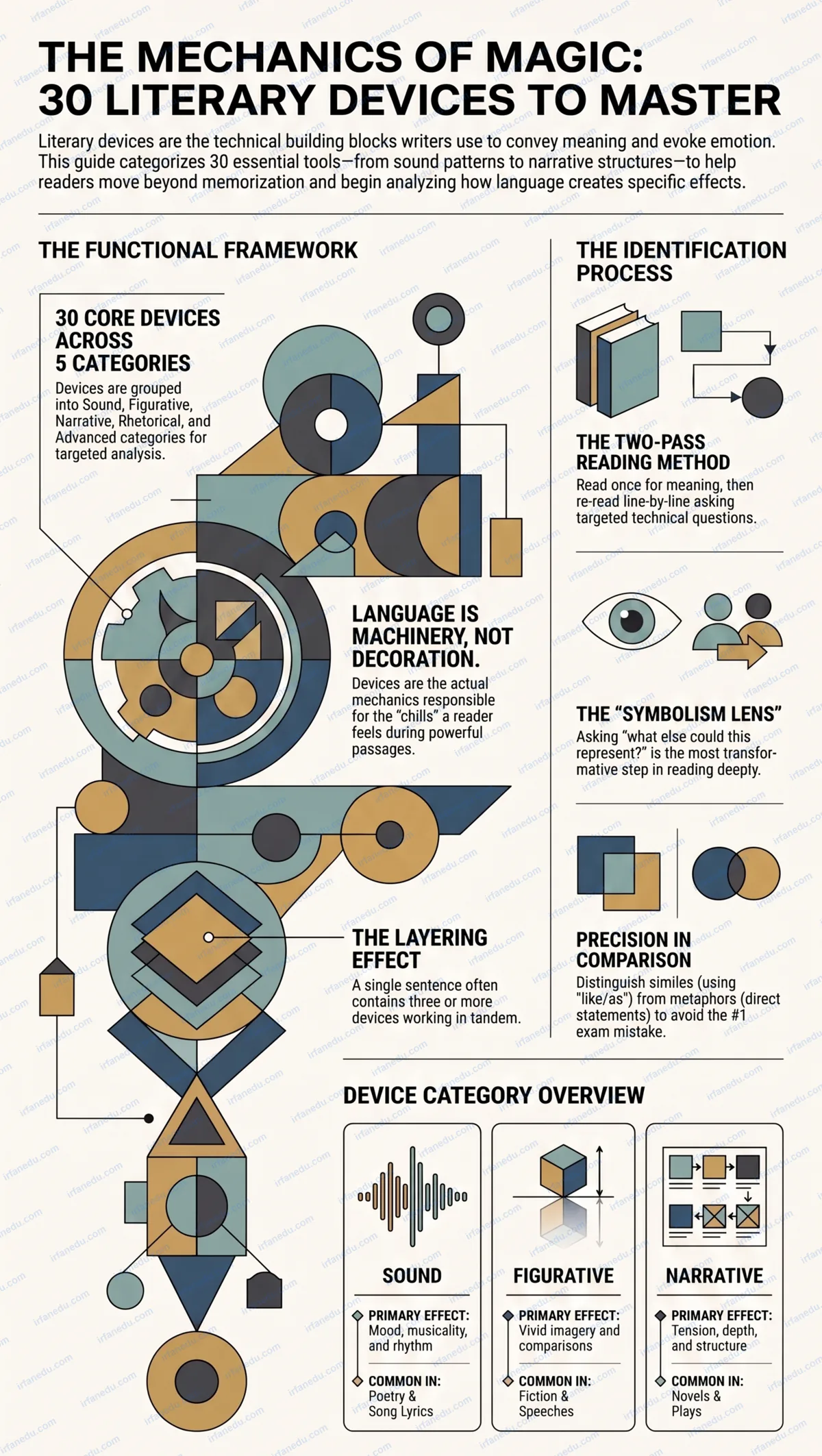
Here is something most teachers skip: literary devices are not just labels you memorize for exams. They are the actual mechanics of how language creates feeling. When you read a line that gives you chills, a literary device is almost always responsible.
In my experience teaching literature at multiple levels, students who learn to recognize and name these devices start reading more deeply — and writing more powerfully — almost immediately. This guide gives you 30 of the most important ones, with real examples you can use right away.
Here are 7 things nobody tells you about literary devices before you start:
- One sentence can contain three or more devices at once — and the best writers do this on purpose.
- Most “difficult” poems become simple once you can name what the poet is doing technically.
- Simile and metaphor are not the same thing — and mixing them up is the #1 exam mistake.
- Irony has three distinct types, and only one of them is what most people mean when they say “ironic.”
- Foreshadowing is almost invisible when it works — you only notice it on a second reading.
- Sound devices like alliteration and assonance affect readers emotionally even when they are not consciously noticed.
- Symbolism is everywhere in everyday language — you use it without realizing it constantly.
By the end of this article, you will be able to:
- ✅ Define and recognize 30 core literary devices
- ✅ Identify them in poems, stories, and essays
- ✅ Explain their effect on the reader in exam answers
- ✅ Avoid the most common identification mistakes
⚡ TL;DR – Quick Summary
- 🔊 Sound devices (alliteration, assonance, onomatopoeia) create rhythm and mood through repeated sounds.
- 🖼 Figurative language (metaphor, simile, personification) creates vivid comparisons and images.
- 📖 Narrative devices (foreshadowing, flashback, irony) shape how a story is told and received.
- 🗣 Rhetorical devices (anaphora, hyperbole, rhetorical question) persuade and emphasize powerfully.
- 🎯 Simile uses “like/as”; metaphor states the comparison directly — never confuse them in an exam.
- 🔍 To identify devices: read once for meaning, then re-read line by line asking targeted questions.
📊 Quick Facts: Literary Devices at a Glance
| Category | Devices Covered | Primary Effect | Common In |
|---|---|---|---|
| 🔊 Sound Devices | Alliteration, Assonance, Consonance, Onomatopoeia, Rhyme, Rhythm | Mood, musicality, emphasis | Poetry, song lyrics |
| 🖼 Figurative Language | Metaphor, Simile, Personification, Hyperbole, Synecdoche, Metonymy, Oxymoron, Paradox | Vivid imagery, comparison | Poetry, fiction, speeches |
| 📖 Narrative Devices | Foreshadowing, Flashback, Symbolism, Irony, Motif, Allegory, Imagery | Story structure, depth, tension | Novels, short stories, plays |
| 🗣 Rhetorical Devices | Anaphora, Rhetorical Question, Antithesis, Chiasmus, Euphemism, Understatement | Persuasion, emphasis, tone | Speeches, essays, non-fiction |
| 🌀 Advanced Devices | Juxtaposition, Epistrophe, Zeugma | Contrast, layered meaning | Literary fiction, poetry |
🔊 Sound Devices (Devices #1–6)
Sound devices use the physical sound of words to create emotional and musical effects. They work even when a reader is reading silently — the brain still processes the rhythm.
1 Alliteration
The repetition of the same consonant sound at the beginning of nearby words.
“Peter Piper picked a peck of pickled peppers.”
Alliteration creates rhythm, makes phrases memorable, and can reinforce tone — harsh consonants like “k” and “g” feel aggressive, while soft sounds like “s” and “l” feel gentle.
2 Assonance
The repetition of vowel sounds within nearby words (not necessarily at the start).
“The rain in Spain stays mainly in the plain.”
Assonance creates internal rhyme and a flowing, melodic quality. It is subtler than alliteration but just as powerful in poetry.
3 Consonance
The repetition of consonant sounds anywhere within words — not just at the start.
“The lumpy, bumpy road.”
Consonance differs from alliteration because the repeated sound can appear anywhere in the word. It adds texture and cohesion to a line.
4 Onomatopoeia
A word that phonetically imitates the sound it describes.
“The bees buzzed. The fire crackled. The door slammed.”
Onomatopoeia makes writing visceral and immediate. It pulls the reader into the sensory world of the text rather than just describing it from a distance.
5 Rhyme
The repetition of similar sounds, usually at the end of lines in poetry.
“Shall I compare thee to a summer’s day? / Thou art more lovely and more temperate.”
End rhyme is the most common form, but internal rhyme (within a single line) is equally powerful. Rhyme creates unity, memorability, and a sense of completion.
6 Rhythm
The pattern of stressed and unstressed syllables that gives writing a beat.
“Shall I com-PARE thee TO a SUM-mer’s DAY?” — Shakespeare
Rhythm is the heartbeat of a poem. Iambic pentameter (da-DUM x5) is the most famous English rhythm pattern. Breaking the expected rhythm at a key moment creates powerful emphasis.
In my experience, students treat sound devices as the “easy” category and rush past them. That is a mistake. When a poet chooses harsh consonants in a love poem, or soft vowels in a war poem, that contrast is intentional and deeply meaningful. Always ask: what does this sound do to the feeling of the line?
🖼 Figurative Language Devices (Devices #7–14)
Figurative language says one thing to mean another. These devices create comparisons, images, and emotional resonance that literal language simply cannot achieve.
7 Simile
A direct comparison between two unlike things using “like” or “as.”
“Life is like a box of chocolates.” — Forrest Gump
“Her eyes were as cold as ice.”
The key marker is always “like” or “as.” Remove those words and you have a metaphor. Similes feel slightly more tentative than metaphors — they suggest a comparison rather than declaring one.
8 Metaphor
A direct comparison between two unlike things, stated as if it were literally true — no “like” or “as.”
“Life is a journey.” | “The world is a stage.” — Shakespeare
“Time is money.”
Metaphors are bolder and more assertive than similes. They collapse the distance between two things entirely, forcing the reader to see one through the lens of the other.
9 Personification
Giving human qualities, emotions, or actions to non-human things.
“The wind whispered through the trees.”
“The sun smiled down on us.”
Personification makes abstract or natural things feel relatable and emotionally charged. It is one of the most commonly tested devices in school exams.
10 Hyperbole
Deliberate, dramatic exaggeration for emphasis or comic effect — not meant to be taken literally.
“I’ve told you a million times.”
“I’m so hungry I could eat a horse.”
Hyperbole signals intensity of feeling. When a character uses extreme exaggeration, it reveals how strongly they feel about something — even if the literal statement is impossible.
11 Synecdoche
Using a part of something to represent the whole, or the whole to represent a part.
“All hands on deck.” (hands = sailors)
“The White House announced today.” (White House = the US government)
Synecdoche is everywhere in everyday speech. It creates efficiency and emphasis by letting one specific detail stand in for a larger concept.
12 Metonymy
Replacing the name of something with a closely associated word or concept.
“The pen is mightier than the sword.” (pen = writing; sword = military force)
“The crown will decide.” (crown = the monarchy)
Metonymy differs from synecdoche in that the substitute is associated with — but not literally part of — the original. Both create concise, resonant language.
13 Oxymoron
Two contradictory words placed side by side to create a new, paradoxical meaning.
“Deafening silence.” | “Bittersweet.” | “Living death.”
“Parting is such sweet sorrow.” — Shakespeare
Oxymorons capture the complexity of human experience — the way two opposite feelings can exist simultaneously. They are especially powerful in describing grief, love, and conflict.
14 Paradox
A statement that seems self-contradictory but reveals a deeper truth on reflection.
“The more you know, the more you realize you know nothing.” — Socrates
“I must be cruel only to be kind.” — Shakespeare, Hamlet
Unlike an oxymoron (which is a phrase), a paradox is usually a full statement. It invites the reader to think more deeply rather than accept the surface meaning.
[IMAGE: Figurative language comparison chart showing simile vs metaphor vs personification with color-coded examples | ALT: literary devices figurative language chart simile metaphor personification examples for students]
📖 Narrative & Structural Devices (Devices #15–21)
These devices shape how a story is constructed and experienced. They control time, perspective, and the layers of meaning beneath the surface plot.
15 Foreshadowing
Hints or clues early in a text about events that will happen later.
In Romeo and Juliet, Romeo says: “My life were better ended by their hate, than death prorogued, wanting of thy love.” — hinting at his eventual death.
Foreshadowing creates suspense and makes a narrative feel inevitable rather than random. It rewards re-readers who spot the clues they missed the first time.
16 Flashback (Analepsis)
A scene that interrupts the present narrative to show events from the past.
In F. Scott Fitzgerald’s The Great Gatsby, Nick’s narration frequently flashes back to reveal Gatsby’s origins and his history with Daisy.
Flashbacks provide context, reveal character motivation, and create emotional depth. They show that the past is never truly past — it shapes every present moment.
17 Symbolism
An object, person, place, or event that represents something beyond its literal meaning.
The green light in The Great Gatsby = Gatsby’s dreams and the American Dream.
A dove = peace. A storm = conflict or change.
Symbolism operates on two levels simultaneously — the literal and the thematic. Identifying symbols is key to understanding what a text is really about beneath its surface story.
18 Irony
A contrast between what is said/expected and what is actually meant/happens. Comes in three types.
| Type | Definition | Example |
|---|---|---|
| Verbal Irony | Saying the opposite of what you mean (sarcasm is a harsh form) | “Oh great, another Monday.” (meaning the opposite) |
| Dramatic Irony | The audience knows something a character does not | In Romeo and Juliet, we know Juliet is alive; Romeo does not |
| Situational Irony | What happens is the opposite of what was expected | A fire station burns down |
19 Motif
A recurring element — image, symbol, phrase, or idea — that develops the central theme.
In Macbeth, blood appears repeatedly — first as a symbol of honor, then guilt, then tyranny. The motif tracks the moral decay of the protagonist.
A motif differs from a symbol in that it recurs throughout the text. Each repetition adds a new layer of meaning, building toward the work’s central theme.
20 Allegory
A narrative where characters and events represent abstract ideas or moral qualities — the whole story is an extended metaphor.
George Orwell’s Animal Farm = an allegory for the Russian Revolution and the dangers of totalitarianism.
Plato’s Allegory of the Cave = ignorance vs. enlightenment.
Allegory allows writers to explore dangerous political or philosophical ideas through the safety of fiction. The surface story is always readable on its own, but the deeper meaning is the real point.
21 Imagery
Descriptive language that appeals to one or more of the five senses to create a mental picture.
“Season of mists and mellow fruitfulness, / Close bosom-friend of the maturing sun.”
Imagery is not just visual — it includes sound (auditory), touch (tactile), smell (olfactory), and taste (gustatory). The richest literary passages layer multiple senses at once.
If I had to pick one device that transforms a student’s reading ability overnight, it is symbolism. Once you start asking “what else could this represent?” about every object and setting in a text, literature opens up entirely. A closed door is never just a closed door. A broken mirror is never just an accident. Train yourself to ask that question constantly.
🗣 Rhetorical Devices (Devices #22–27)
Rhetorical devices are tools of persuasion and emphasis. They appear in speeches, essays, and political writing — but also in poetry and fiction whenever a writer wants to create a strong emotional effect.
22 Anaphora
The repetition of a word or phrase at the beginning of successive clauses or sentences.
“I have a dream that one day… I have a dream that my four little children… I have a dream today.”
Anaphora builds rhythm, creates emphasis, and makes a message feel urgent and inevitable. It is one of the most powerful tools in any speaker’s or writer’s arsenal.
23 Rhetorical Question
A question asked for effect, not because an answer is expected.
“If you prick us, do we not bleed?” — Shakespeare, The Merchant of Venice
“Can we afford to ignore climate change any longer?”
Rhetorical questions engage the reader directly, forcing them to consider a point without the writer having to state it bluntly. They create the feeling of dialogue in a one-sided text.
24 Antithesis
Placing two contrasting ideas side by side in a parallel grammatical structure.
“It was the best of times, it was the worst of times.” — Charles Dickens, A Tale of Two Cities
“To err is human; to forgive, divine.” — Alexander Pope
Antithesis highlights contrast and creates balance. The parallel structure makes the contrast feel precise and deliberate rather than accidental.
25 Chiasmus
A rhetorical device where the second part of a sentence reverses the grammatical structure of the first.
“Ask not what your country can do for you — ask what you can do for your country.” — John F. Kennedy
“Never let a fool kiss you or a kiss fool you.”
Chiasmus creates a satisfying sense of symmetry and surprise. The reversal makes the second half feel like an unexpected but logical conclusion to the first.
26 Euphemism
Replacing a harsh, blunt, or taboo word with a milder, more acceptable expression.
“Passed away” instead of “died.”
“Collateral damage” instead of “civilian casualties.”
Euphemisms reveal social attitudes and power dynamics. When a writer uses them deliberately, they often signal something worth examining — who benefits from softening this language?
27 Understatement (Litotes)
Deliberately describing something as less significant than it actually is, for ironic or humorous effect.
“It’s just a scratch.” (said of a serious wound)
“The Titanic had a bit of a problem.” (understatement of a catastrophe)
Understatement creates dry humor and can make a serious point feel more powerful by contrast. It is the opposite of hyperbole — and often funnier.
🌀 Advanced Devices Worth Knowing (Devices #28–30)
These three devices appear in more advanced literary analysis. Knowing them will set your exam answers apart from the majority of students.
28 Juxtaposition
Placing two contrasting elements side by side to highlight their differences.
In Charles Dickens’ A Tale of Two Cities, the luxury of the French aristocracy is juxtaposed with the starvation of the poor — making both conditions feel more extreme by comparison.
Juxtaposition is broader than antithesis — it can involve characters, settings, or entire scenes, not just phrases. It forces the reader to compare and contrast without the writer having to state the comparison explicitly.
29 Epistrophe
The repetition of a word or phrase at the end of successive clauses — the reverse of anaphora.
“…government of the people, by the people, for the people, shall not perish from the earth.”
Epistrophe creates a hammering, conclusive effect. The repeated ending word lands like a gavel — it closes each clause with the same emphasis, making the final word feel like the most important one.
30 Zeugma
Using one word (usually a verb) to govern two or more other words in a way that creates a surprising or humorous effect.
“She broke his car and his heart.”
“He lost his keys and his temper.” — the verb “lost” applies literally to keys and figuratively to temper.
Zeugma creates a sudden tonal shift — from literal to figurative — that produces wit or pathos. It is a favorite device of satirists and comic writers because the surprise is built into the grammar itself.
Sources & References
Reviewed by Dr. Irfan Mansuri. External links open in a new tab and are provided for further reading and verification.